WORLD
WORLD
Gekka-o
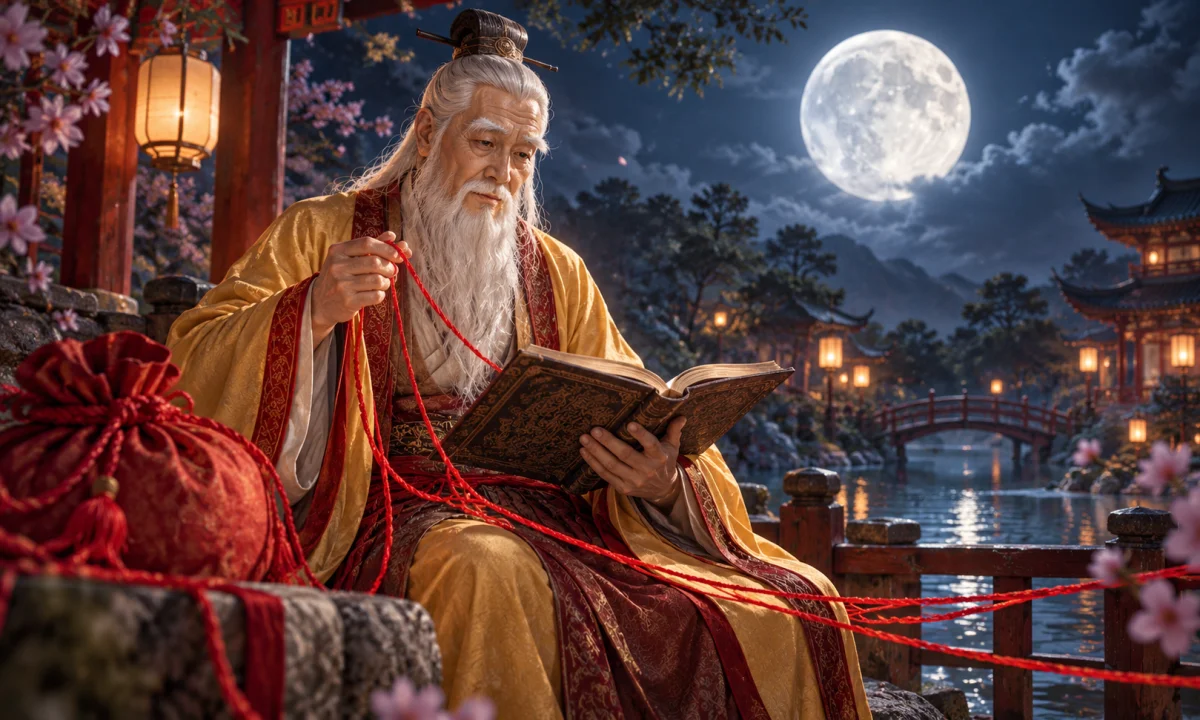
Gekka-o is a name sometimes used for the elderly matchmaker spirit known in Japanese as Gekka Rōjin (月下老人), literally “the old person beneath the moon.” The figure is associated with marriage, destined relationships and the invisible bond said to connect future spouses. Despite being placed in Japanese mythology, Gekka-o is not generally regarded as an ancient native Japanese god. The character is primarily a Japanese form of the Chinese deity Yuèxià Lǎorén (月下老人), commonly called Yue Lao, whose legends entered Japanese cultural and religious life through broader East Asian traditions.
Name and identity
The name Gekka-o is not the most usual Japanese form of the figure’s name. Japanese references more commonly use Gekka Rōjin, “Old Person Under the Moon,” or Gekka no Rōjin, “the old person beneath the moon.” The element gekka means “beneath the moon,” while rōjin means an old person or elderly man. Some English-language lists and modern mythological databases use “Gekka-o,” apparently treating the figure as a moon-associated elder or translating the final element in a different way.
Because the spelling and romanisation vary, Gekka-o should not automatically be treated as a separate deity from Gekka Rōjin or Yue Lao. The available tradition points instead to a single East Asian matchmaker figure known under related names. The Japanese name also does not mean “king of the moon.” It refers to an old man encountered under moonlight, whose authority concerns human unions rather than the moon itself.
Origins in Chinese legend
The best-known story of this figure comes from medieval Chinese literature, especially a tale associated with the Tang-period collection Youyang zazu. The story concerns a man named Wei Gu, who encounters an old stranger at night. The elderly figure is sitting beneath the moon and consulting a book. He also carries or controls a red cord used to bind people who are destined to marry.
Wei Gu asks about the book and the cord. The old man explains that the book records future marriages and that the red cord links the feet of people who will eventually become husband and wife. No matter how far apart they live, how different their circumstances may be, or how long it takes, those joined by the cord will ultimately meet and marry.
In versions of the story, Wei Gu is shown the young woman who will become his wife. He reacts with disbelief or hostility because she is a child of humble background. The tale then moves forward through the passing years. Wei eventually marries a woman of suitable social standing, but a distinctive mark reveals that she is the same person indicated by the old man years earlier. The details differ between retellings, but the central point remains: human attempts to avoid a foretold union cannot easily defeat the bond represented by the red cord.
This narrative establishes the figure’s most important characteristics. He is an old man who possesses knowledge of future relationships, keeps a register of marriages and carries the means by which destined partners are connected. His power is not usually portrayed as sexual seduction or romantic inspiration. Instead, it is the power to recognise and enforce a relationship believed to have been arranged by fate.
Cultural and religious setting
Yue Lao developed within a religious environment in which popular devotion, local custom, literary storytelling, Daoist ideas and Buddhist traditions could overlap. He is often described as a deity, immortal or supernatural matchmaker, but his status is not identical to that of a major god in a single unified pantheon. Different communities have treated him as a divine elder, a celestial official, a spirit of marriage or a folk religious figure.
When the tradition reached Japan, it existed alongside native beliefs about en-musubi, the binding or formation of significant relationships. Japanese shrines and legends frequently connect particular deities with marriage, fertility, household harmony and the meeting of people whose lives are meant to intersect. Such traditions do not make every marriage deity a form of Gekka Rōjin. They show instead that the imported matchmaker could be understood within an existing Japanese concern with bonds, social continuity and relationships sanctioned by the sacred world.
Gekka Rōjin is therefore best understood as a figure of cultural transmission. His story belongs to a wider East Asian religious and literary network rather than to an isolated Japanese myth preserved in one canonical Japanese scripture. He may appear in discussions of Japanese mythology because Japanese culture adopted, translated and reinterpreted many Chinese religious figures, especially through Buddhist institutions, learned literature and popular custom.
Appearance and attributes
Gekka-o is generally imagined as an elderly man encountered at night, often beneath a bright moon. His age is important: the white-haired matchmaker represents experience, patience and knowledge of events that remain hidden from ordinary people. He is not usually described as a warrior, ruler or creator. His authority comes from knowing the pattern of human destiny.
The most significant object associated with him is the red thread or red cord. In the older Chinese story, the cord binds the feet of people who are destined to marry. Later retellings often describe it more generally as tying two people together, regardless of distance or obstacles. The cord can be invisible to ordinary people, which makes it a fitting symbol for an unseen relationship that becomes visible only when the destined partners meet.
A register, book or marriage record is another recurring attribute. The old man’s book suggests that marriages are not entirely accidental. It also presents destiny as something recorded by a supernatural bureaucracy, an idea found in several East Asian traditions. The details of the record vary, but it commonly functions as evidence that the old man knows relationships before the people involved know one another.
The moon contributes atmosphere and symbolism rather than making Gekka-o a lunar god. Night allows the matchmaker to appear in a liminal setting between the ordinary world and the supernatural one. The moon’s regular cycles can also suggest the passage of time: people may wait years before discovering the relationship that has already been arranged in the unseen order of things.
Role in love and marriage
Gekka-o’s principal role is to unite people in marriage. His influence is traditionally concerned with a socially recognised union rather than with every form of affection. The old tales focus on spouses, family alliances and the force of a bond that eventually becomes part of ordinary social life.
This distinction matters because the figure is sometimes described in modern summaries as a general god of love. That description is convenient but incomplete. Gekka Rōjin does not function exactly like a Western god of romantic desire, nor is he simply a spirit who makes people fall in love. His traditional image is closer to that of a supernatural registrar and matchmaker who knows which people are destined to become partners.
The stories also contain an element of inevitability. A person may resist, reject or attempt to escape the relationship identified by the matchmaker, yet the destined outcome returns in an unexpected form. This theme reflects an enduring tension between personal choice and forces beyond individual control. In some interpretations, the red cord expresses hope that a difficult search for a partner has meaning. In others, it warns that social and cosmic expectations can limit personal freedom.
The red thread and its changing meaning
The red thread has become the most recognisable symbol connected with Yue Lao and his Japanese counterpart. In contemporary retellings, it is often described as an invisible red string tied around the little fingers of two people. This version is widespread in modern East Asian popular culture, but it should not be confused with every older form of the legend.
The early Chinese tale is commonly associated with a red cord tied to the feet, not necessarily the little finger. As the story travelled through different languages, literary traditions and media, the location and appearance of the cord changed. The underlying idea remained the same: an unseen connection links people whose relationship is destined to occur.
In Japan, the image of a red thread is often discussed alongside the expression akai ito, “red thread.” The phrase has become especially familiar in stories about romantic destiny, matchmaking and relationships that survive separation. However, not every Japanese use of the red thread is a direct reference to Gekka Rōjin. Some uses belong to broader East Asian symbolism or to modern romantic storytelling rather than to a specific act of worship.
Relationship to Japanese deities
Gekka-o should not be confused with Tsukuyomi, the Japanese moon deity. Tsukuyomi is a member of the heavenly generation in the Kojiki and Nihon Shoki, whereas Gekka Rōjin is an elderly matchmaker associated with the moonlit setting of a Chinese-derived legend. The two figures share a lunar association only in a broad symbolic sense.
Nor is Gekka-o identical to Ōkuninushi, who is connected in Japanese religious tradition with the land, relationships and the binding of human connections. Ōkuninushi is a major figure in Japanese mythology with a substantial role in shrine traditions and creation narratives. Gekka Rōjin has a narrower and different identity, centred on the red cord of marriage and the knowledge of destined unions.
Japanese people seeking blessings for relationships may visit shrines associated with en-musubi, but this practice should not be presented as universal worship of Gekka Rōjin. The imported matchmaker may be known in literary or popular contexts without having a major independent cult in Japan. His presence in a list of Japanese mythological beings therefore requires qualification: he belongs to Japanese cultural reception, but his principal legendary origin is Chinese.
Interpretations of the figure
Gekka-o can be interpreted as a personification of fated connection. The red cord gives a visible form to a relationship that cannot yet be seen, while the old man represents a power capable of perceiving the future. The story may reassure people that distance, class, timing and unfamiliarity do not necessarily prevent a destined meeting.
At the same time, the legend is not simply a celebration of free romantic choice. In the traditional tale, the person who learns about the destined marriage does not control the outcome. The old man’s knowledge can even create fear or resistance. This ambiguity has allowed the figure to serve different purposes: he may represent hope for lovers, authority for family expectations, or the unsettling idea that private decisions are already written elsewhere.
The elderly appearance also carries cultural meaning. An old matchmaker is not merely a comic marriage broker. He resembles a custodian of accumulated knowledge, someone who has seen generations of people enter relationships and families. His age gives the supernatural claim a tone of solemnity. He is a witness to the long course of human life rather than a youthful embodiment of passion.
Later reception
In modern fiction, Gekka-o or Yue Lao may appear as a symbolic matchmaker, a guardian of romantic destiny or an unseen official who manages relationships. The red thread is especially common in novels, television dramas, comics, games and films across East Asia. These adaptations may turn the figure into a humorous old man, a mysterious supernatural administrator or a benevolent guide for separated lovers.
Such portrayals often simplify or expand the traditional material. A modern story may use the red thread to connect soulmates who never marry, or may treat the thread as a metaphor for friendship and emotional attachment. These developments are creative adaptations rather than evidence that the older figure traditionally governed every kind of relationship.
For Gekka-o, the most accurate description is therefore a cautious one: he is the Japanese-named form, or a variant name, of the Chinese-derived moonlit matchmaker better known in Japan as Gekka Rōjin and in Chinese tradition as Yue Lao. His enduring image is an old man beneath the moon, holding a record of future marriages and binding destined partners with a red cord that ordinary eyes cannot see.