WORLD
WORLD
Gama-sennin
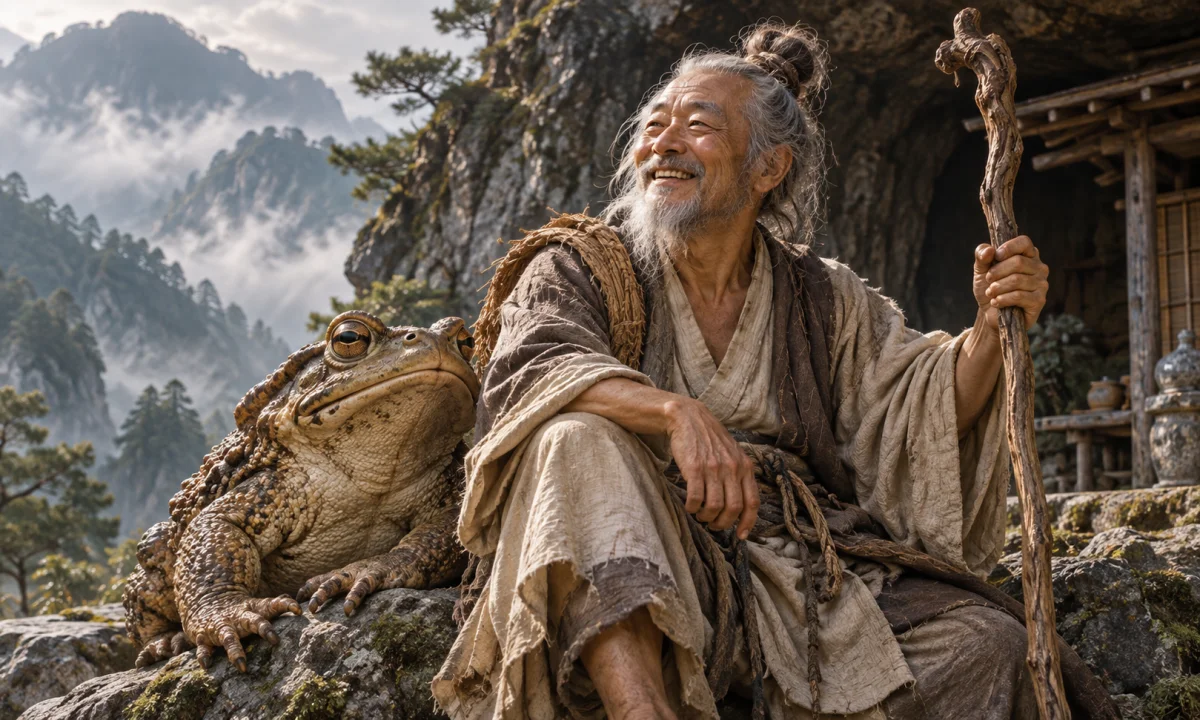
Gama-sennin (Japanese: 蝦蟇仙人, “Toad Immortal” or “Toad Hermit”) is a legendary Daoist-style sage associated with toads, supernatural longevity and arcane powers. Although the figure belongs to Japanese mythology and Japanese artistic tradition, the underlying idea is strongly connected with Chinese stories of transcendent hermits and immortals. Gama-sennin is not a single god with one universally accepted biography. The name can describe a recurring legendary type, an image in painting and woodblock prints, or a Japanese interpretation of the Chinese immortal Liu Haichan.
Name and meaning
The name combines gama, meaning “toad,” with sennin, a Japanese term for an immortal hermit or mountain sage. The word sennin is the Japanese reading of the Chinese concept usually written as xian: a human being who has acquired extraordinary longevity, magical knowledge or spiritual transcendence through discipline, meditation, alchemy and life in the wilderness.
Gama is written with characters associated with a large toad or frog-like amphibian. Japanese usage does not always make the same strict distinction between frogs and toads that modern zoology does, but the traditional image of Gama-sennin is generally that of a toad. He may appear with one enormous toad, surrounded by several smaller ones, or carrying a toad on his shoulder or head.
The name should not be understood as the name of a species of monster. Gama-sennin is usually a human or human-like sage whose identity is expressed through his relationship with toads. In some representations he appears almost indistinguishable from a wild ascetic; in others, his body and companions suggest that he possesses the ability to transform himself or command supernatural amphibians.
Origins in Chinese immortal lore
The most important background to Gama-sennin is the Chinese tradition of Daoist immortals. Japanese culture adopted many stories, images and religious ideas from China, especially through Buddhism, Confucian learning, Daoist practices and the visual arts. Japanese artists and storytellers frequently adapted Chinese sages rather than reproducing them exactly.
Gama-sennin is often identified with, or treated as a Japanese form of, Liu Haichan, a legendary Chinese Daoist figure. His name can be rendered in Japanese in more than one way, and the connection is not presented identically in every Japanese source. Consequently, it is safer to describe Liu Haichan as the principal Chinese prototype or parallel rather than assume that every Japanese image labelled Gama-sennin represents precisely the same character.
In Chinese legend, Liu Haichan is associated with a three-legged toad, commonly called the Jin Chan or “golden toad.” Stories about him vary, but one widely circulated version tells how he abandoned worldly office or ambition after encountering a supernatural teacher. He then pursued Daoist wisdom and became linked to the mysterious three-legged toad. Another story describes him drawing the creature from a well with a string of coins. The image of coins and a toad later acquired associations with wealth and prosperity in Chinese popular religion, although this financial symbolism is not the whole meaning of Gama-sennin in Japan.
These stories belong to a broad body of legend rather than to a single authoritative scripture. Daoist religious history, local folklore, hagiography and later artistic convention all contributed to the figure. Japanese versions could emphasize the hermit’s magical nature, his strange appearance or his connection with Japanese tales about animal transformation.
The sennin tradition in Japan
Japanese sennin are usually mountain-dwelling sages who have escaped ordinary human limitations. They may live for centuries, fly through the air, command animals, travel between distant places or possess medicines that prolong life. Their knowledge can be religious, alchemical, medical or magical. Some are benevolent teachers, while others are eccentric and difficult to approach.
This tradition should be distinguished from the formal pantheon of Shinto kami and from the buddhas and bodhisattvas of Buddhism. A sennin is generally a transformed or perfected human being, not a creator deity. The category also overlaps with stories of ascetics, mountain practitioners and hermits who acquire power through severe training. In Japan, such figures could be interpreted through several religious frameworks at once, and their stories do not always fit neatly into a single doctrine.
Gama-sennin therefore represents the meeting of Chinese Daoist immortality lore with Japanese interest in enchanted animals, mountain solitude and bodily transformation. The toad gives the sage a distinctive identity, but the broader theme is the crossing of the boundary between ordinary humanity and an older, wilder form of existence.
Appearance and attributes
There is no fixed official appearance for Gama-sennin. Artists commonly portray him as an old, thin or heavily bearded hermit with a rough, partially exposed body. He may wear simple robes, a loincloth or ragged mountain clothing. His unkempt appearance emphasizes his distance from civilized life and worldly status.
The most recognizable attribute is the toad. It may sit on his shoulder, cling to his back, rest on his head or loom beside him at an unnatural size. In some images the sage holds a small toad in his hand, as though displaying a familiar or a magical assistant. Other compositions surround him with a whole group of amphibians. The animals are not merely decorative: they identify the hermit’s supernatural specialization.
Gama-sennin is sometimes shown with a staff, a gourd, a scroll or other objects associated with wandering sages and occult knowledge. These details vary by artist and should not be treated as universal symbols. His expression can range from benevolent amusement to grotesque intensity. The unusual contrast between an elderly human body and large, lively toads is often central to the image.
Some traditions attribute the following powers to the Toad Immortal:
- exceptionally long life or complete immortality;
- knowledge of medicines, elixirs and secret forms of healing;
- the ability to summon, control or communicate with toads;
- magical transformation into a toad or another animal;
- command of hidden forces associated with mountains, water and the wilderness;
- instruction in techniques that allow a human practitioner to acquire supernatural abilities.
These powers are traditional motifs rather than consistently defined abilities. A particular painting, story or theatrical performance may give Gama-sennin only one of them, especially the power to command toads.
Toads, transformation and hidden knowledge
Toads have an ambiguous place in Japanese folklore. They can be associated with damp places, night activity, the earth and the margins between cultivated land and wilderness. Their sudden appearance after rain and their capacity to remain hidden make them effective animals in stories about transformation and secret power.
In the case of Gama-sennin, the toad is also a sign of the sage’s rejection of ordinary respectability. He is not a courtly immortal surrounded by refined symbols. His companion is a lowly, strange and sometimes repellent creature. This contrast can make the hermit appear comic, grotesque or spiritually independent. The image suggests that valuable knowledge may be found outside official institutions and conventional beauty.
The toad can also imply a connection with water, the moon and regeneration, but these interpretations are not fixed features of every Gama-sennin tradition. The strongest and most reliable meaning is the bond between the hermit and the animal, together with the idea that the sage possesses knowledge inaccessible to ordinary people.
Gama-sennin in Japanese art and storytelling
The figure became especially recognizable through Japanese visual culture. Paintings, illustrated books, woodblock prints and small carved objects could present Gama-sennin as a subject in his own right. His unusual silhouette and easily recognized animal companion made him attractive to artists interested in eccentric sages and supernatural beings.
Japanese artists did not always treat him as a character in a long narrative. A single image could communicate his identity through a few attributes: a wild hermit, an oversized toad and a pose suggesting secret knowledge. This helps explain why different depictions may disagree about his clothing, age, companions and powers without necessarily contradicting one another.
His appearance also suited the taste for the bizarre and humorous found in some early modern Japanese art. A huge toad perched on an old man’s body could be amusing as well as mysterious. The subject allowed artists to combine religious or legendary material with visual grotesquerie, theatrical exaggeration and playful transformations.
Gama-sennin should not be confused with a single Japanese folktale hero whose adventures are preserved in one standard cycle. References may instead arise from a mixture of Chinese source material, Japanese illustrated traditions, local stories about magical toads and the broader repertory of sennin imagery.
Relationship to Jiraiya and toad magic
Confusion often arises between Gama-sennin and Jiraiya. Jiraiya is the hero of a famous Japanese tradition of a warrior or outlaw who learns toad magic. The best-known form of the story developed in the nineteenth-century popular novel Jiraiya Gōketsu Monogatari, or “The Tale of the Gallant Jiraiya.” In that narrative, Jiraiya’s powers are connected with a toad sage or toad-based magical teaching.
Jiraiya and Gama-sennin are therefore related through the motif of toad sorcery, but they are not the same figure. Jiraiya is an adventuring human protagonist, while Gama-sennin is an immortal or supernatural hermit. The exact identity of the teacher in retellings can vary, and illustrations may emphasize their resemblance, but the two names should not be used interchangeably.
The wider Jiraiya tradition also includes a conflict involving a snake-associated antagonist and a heroine linked with slug magic. This three-way animal symbolism belongs to the Jiraiya narrative tradition, not automatically to Gama-sennin’s own identity. A picture of a toad sage does not by itself indicate that the Jiraiya story is being depicted.
Distinction from the three-legged money toad
Another possible source of confusion is the Chinese three-legged toad, often known by names such as Jin Chan. This creature is commonly associated with prosperity, wealth and the attraction of money. It may be displayed as a household or business talisman, frequently with coins.
Gama-sennin can be connected with this tradition through the legends of Liu Haichan, but a Japanese image of the Toad Immortal is not simply a money charm. The hermit’s ragged body, mountain setting and human identity point toward the sennin tradition. Conversely, a three-legged toad statue surrounded by coins may represent the prosperity creature rather than Gama-sennin.
Not every large toad in Japanese art is Gama-sennin, and not every image of Liu Haichan uses the Japanese name. Identification depends on accompanying inscriptions, attributes, the number and form of the toads, and the artistic context.
Gama oil and other toad-related traditions
Japanese culture also contains the tradition of gama no abura, or “toad oil.” This was a popular patent medicine and a subject of street performance. Sellers used theatrical demonstrations and elaborate claims to promote an ointment said to have healing or protective qualities. The product was connected in popular imagination with a legendary toad, particularly the toads associated with Mount Tsukuba.
Gama no abura and Gama-sennin share the imagery of the toad, but they are not identical traditions. The medicine-selling performance belongs to the history of popular commerce, folk medicine and street entertainment. Gama-sennin belongs primarily to the lore of supernatural hermits and the artistic adaptation of Chinese immortal figures. Some later representations may allow the associations to overlap, but one should not assume that the sage invented or personally sold the ointment.
Modern use of the “toad sage” idea
The expression “toad sage” remains recognizable in modern Japanese popular culture, especially in fantasy stories, manga, animation and games that draw on the visual language of sennin and animal transformation. The most famous modern example is the use of toad sages and toad training in Naruto. Characters such as Jiraiya and Naruto receive abilities associated with toads, mountains and sage training.
These modern characters are adaptations of several older motifs rather than direct portrayals of a single historical Gama-sennin tradition. Their powers, personalities and narratives belong to modern fiction. They should be separated from the older Chinese and Japanese legends, in which the Toad Immortal is usually a mysterious hermit represented through symbolic imagery rather than a fully developed serial hero.
Gama-sennin is best understood as a border-crossing figure: Chinese in major points of origin, Japanese in name and artistic reception, and connected to a wider Asian tradition of hermits who achieve powers beyond ordinary human life. His enduring image is the eccentric sage accompanied by a toad, a combination that makes hidden wisdom, wild nature and transformation visible in a single memorable form.