WORLD
WORLD
Elegua
Elegua is a widely known name for a complex orisha associated with roads, thresholds, communication, chance and the opening of possibilities. The name is especially familiar in Cuba and other communities shaped by the Yoruba religious tradition in the Atlantic world. In Yoruba contexts, related forms include Èṣù, Èlégbára and Ẹlẹ́gbára, although the precise relationship between these names and figures varies by region, language and religious tradition. Elegua is not simply a mischievous “god of luck”: he is a powerful divine intermediary whose actions can enable, obstruct, reveal or transform human affairs.
Yoruba religious setting
The Yoruba-speaking peoples have historically lived mainly in present-day southwestern Nigeria and parts of the Republic of Benin and Togo. Yoruba religious traditions recognise a supreme creative power, often called Olódùmarè or Olórun, together with numerous òrìṣà. The orishas are divine powers connected with natural forces, human institutions, moral relationships and particular forms of knowledge. Their worship is maintained through ritual, prayer, sacrifice, praise poetry, divination, possession traditions and lineages of religious specialists.
Within this religious system, Èṣù occupies an unusual and essential position. He is associated with roads and crossroads, but also with language, interpretation, exchange, uncertainty and the consequences of human choices. He carries messages and offerings between humans and the orishas, yet he is not merely a neutral messenger. His presence makes communication possible while also exposing ambiguity, hypocrisy and disorder. A person may ask for a road to be opened, but the opening of that road does not necessarily guarantee a desired result.
Yoruba religion was transmitted for centuries through oral forms rather than through a single canonical scripture. Important knowledge appears in ìjálá praise poetry, chants, ritual speech, family traditions and the verses of the Ifá divination system. Stories about Èṣù therefore exist in multiple versions. Their details may differ between towns, priests, lineages and historical periods, and no single account should be treated as the universally accepted biography of Elegua.
The name and the question of identity
“Elegua” is an English and Spanish-influenced spelling commonly used in accounts of Afro-Cuban religion. It is related to Yoruba names such as Èlégbára, often interpreted in connection with one who possesses or controls power. Other spellings include Elegguá, Elegba, Eshu-Elegba and Legba. These forms should not automatically be treated as interchangeable in every context.
In many Yoruba traditions, Èṣù is the principal name of the orisha. In Cuban Lucumí, the name Eleguá commonly identifies the orisha who stands at the entrance of religious and worldly activity, while Eshu may refer to a related manifestation or a distinct ritual aspect. Some practitioners understand Eleguá and Eshu as two aspects of one divine power; others maintain clearer distinctions between them. These differences arise from the development of religious practice in different places, not simply from confusion or incorrect translation.
Elegua should also be distinguished from Mawu-Lisa, Legba in Fon traditions and other West African threshold figures. These beings may share themes of crossroads, mediation and communication, and historical contact between neighbouring peoples has influenced some religious practices. Nevertheless, they belong to different traditions and should not be collapsed into a single character. Likewise, Elegua is not the same being as the Christian devil, although colonial writers sometimes equated Èṣù with Satan because they misunderstood or condemned his role.
Roads, crossroads and thresholds
Elegua’s most familiar symbolism concerns places where paths meet. A crossroads is a practical location of choice, movement and exchange, but it is also a religious image of uncertainty. It marks the point at which a person must decide which direction to take and accept that every choice has consequences. Doors, gates, boundaries and entrances carry related meanings.
Because he governs or oversees passage, Elegua is often approached before other orishas. In many Yoruba and African-diaspora ceremonies, prayers or offerings begin with him so that communication will be clear and ritual work will not be obstructed. This does not mean that he is always the highest-ranking orisha. Rather, his position as intermediary makes his acknowledgement necessary. A message cannot travel, and an offering cannot reach its destination, without the power that manages the connection.
His role has a social dimension as well. Roads connect villages, markets, households and strangers. Elegua therefore belongs not only to isolated wilderness or supernatural space but also to commerce, travel, conversation and public life. He is present wherever people negotiate, exchange information or encounter the unexpected.
Messenger, interpreter and guardian of communication
Èṣù is closely connected with àṣẹ, the vital power through which divine speech, ritual action and authority become effective. Words do not have identical consequences in every setting. Tone, timing, intention and interpretation matter. Elegua’s involvement reflects this complexity: he can carry a message faithfully, expose a hidden meaning or create a situation in which an apparently simple statement produces unexpected results.
His association with communication also appears in his relationship with Orunmila, the orisha of wisdom and Ifá divination. In many traditions, Èṣù is involved in the transmission and testing of knowledge. Ifá verses often present him as a figure whose actions reveal the need for sacrifice, correct conduct or careful interpretation. He may challenge a diviner, test a person’s character or ensure that an ignored obligation becomes impossible to overlook.
Calling him merely a “trickster” can therefore be misleading. Trickery is one part of his mythic activity, but his deeper function concerns the instability of human certainty. He demonstrates that appearances can deceive, that rigid judgments can fail and that moral consequences may emerge from actions people thought were harmless.
Character and powers
Elegua can be generous, protective and helpful, but he is not a harmless mascot. He may open a road for a traveller, protect a household entrance or assist communication with other orishas. He may also block a path, disrupt plans or bring a hidden conflict into the open. In many stories, the problem is not that he acts without reason; rather, people have neglected an obligation, behaved arrogantly or assumed that success was guaranteed.
His character combines opposing qualities. He belongs to the boundary between order and disorder, wisdom and confusion, cooperation and conflict. He can bring people together through trade and conversation, yet he can also reveal how quickly relationships break down when individuals trust appearances more than truth. This ambiguity is a religious principle, not merely a personality trait. A world with no uncertainty would leave no room for choice, responsibility or transformation.
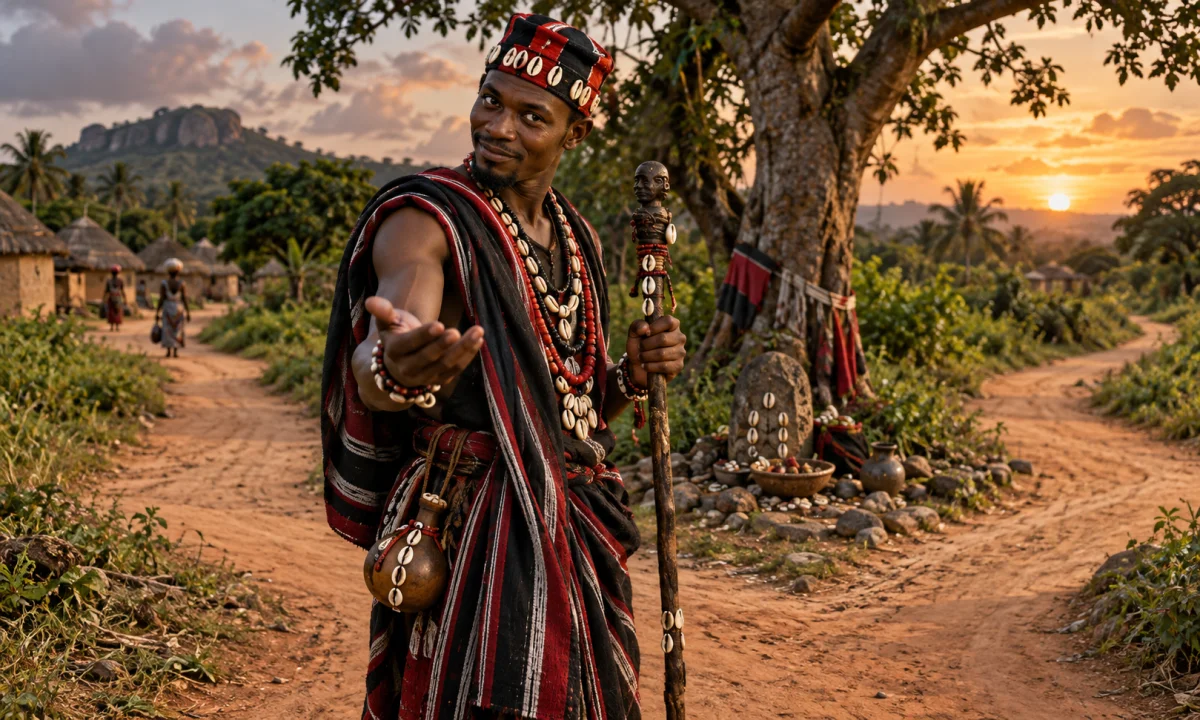
In Yoruba settings, representations of Èṣù vary considerably. He may be represented through a consecrated stone, a shrine object, a carved figure or other sacred materials determined by local practice. Some shrines are placed near entrances or outside a compound, reflecting his guardianship of boundaries. Physical form is not identical across all communities, and no single statue can define the orisha’s appearance.
In Lucumí and related Caribbean traditions, Eleguá may be represented by a small cement or stone head, sometimes with a distinctive opening or facial features. Some depictions present him as a child, an old man or a figure with a playful expression. These images belong to particular ritual histories and should not be projected unchanged onto every Yoruba tradition.
Colours, offerings and ritual practice
Red and black are strongly associated with Èṣù in many Yoruba and Afro-Atlantic contexts. The colours may symbolise paired forces, the visible and hidden, vitality and danger, or the contrast between opposing possibilities. Their meaning is not fixed everywhere, and practitioners may use different colours according to lineage and ritual circumstance.
Offerings vary widely. They may include food, palm oil, drinks, roasted items, sweets, tobacco or other materials considered appropriate in a particular community. It is inaccurate to list one universal offering or assume that a popular representation captures all ritual practice. Offerings are made within a relationship of obligation and exchange, often in response to divination or established religious custom. They are not simply gifts intended to “bribe” a capricious spirit.
In Afro-Cuban religious practice, Eleguá is often honoured at the beginning of ceremonies and is associated with the protection of the home and the opening of ritual communication. Some devotees maintain a consecrated representation of Eleguá near the entrance. Practices differ between houses of worship, and religious authority rests with initiated practitioners and ritual lineages rather than with generalised descriptions.
Stories and recurring motifs
The two-coloured hat
One widely circulated story tells of Èṣù walking between two friends while wearing a hat that appeared one colour on one side and another colour on the other. After he passed, each friend insisted that the hat had been a different colour. Their disagreement became a quarrel until Èṣù revealed the hat and showed that both had seen only part of the truth.
The tale appears in several forms and is not a complete or universally fixed Yoruba myth. Its central lesson is nevertheless consistent with many representations of Èṣù: limited viewpoints can produce confident but incompatible judgments. The story is often used to explain his connection with ambiguity, perspective and the danger of treating partial knowledge as certainty.
Testing conduct and sacrifice
In many Ifá narratives, Èṣù’s actions expose the consequences of neglecting sacrifice or proper conduct. A person may consult divination, receive instructions and then decide that the prescribed action is unnecessary. When misfortune follows, Èṣù may be portrayed as the force that makes the neglected obligation visible. In other versions, he tests whether a person is honest, generous or capable of keeping a promise.
These stories should not be reduced to the idea that Èṣù randomly punishes people. They commonly present a moral universe in which words, promises and ritual responsibilities have practical effects. Èṣù makes those effects active and unavoidable.
Conflict, balance and mediation
Some narratives place Èṣù between powerful beings or competing interests. He may carry a message, alter the timing of an encounter or expose a contradiction that others would prefer to conceal. His intervention can create conflict, but it can also prevent one side from claiming absolute authority. By disturbing an unstable arrangement, he may make a new balance possible.
This pattern helps explain why Èṣù can be invoked as both an opener of roads and a source of obstacles. The obstacle may be a punishment, a warning or an opportunity to recognise that the chosen path was poorly understood.
Elegua in the African diaspora
The Atlantic slave trade forcibly displaced many Yoruba people and brought Yoruba religious knowledge into Cuba, Brazil, Trinidad, the United States and other parts of the Americas. Religious traditions survived through memory, kinship, initiation, ritual adaptation and contact with other African peoples and European Christianity. Eleguá became especially prominent in Cuba, where Yoruba-derived religion developed into Regla de Ocha, also widely known as Santería or Lucumí religion.
In Cuba, Eleguá’s role as the first orisha addressed in many ceremonies became particularly prominent. He is associated with doors, streets, choices and the protection of the household. Catholic images were sometimes used under colonial conditions, producing forms of religious concealment and later devotional association. Eleguá is often linked with the Holy Child of Atocha or, in some communities, with Saint Anthony of Padua, but these identifications are historical and devotional correspondences rather than evidence that the figures are identical.
Caribbean traditions also developed names, objects, stories and ritual distinctions that should be understood on their own terms. They preserve substantial Yoruba religious themes while reflecting life in the Americas, colonial pressure, Catholic surroundings and interaction with other African traditions. “Elegua” therefore refers both to a Yoruba-derived religious power and to distinct regional expressions of that power.
Common misconceptions
- Elegua is not simply the devil. The equation with Satan arose largely from Christian and colonial interpretation. Èṣù’s association with disruption and temptation does not make him a Christian demon.
- Elegua is not always a child. Childlike images are important in some Lucumí representations, but Yoruba traditions portray or conceptualise Èṣù in varied ways.
- Elegua is not merely a god of luck. He is connected with opportunity, but also with responsibility, communication, sacrifice, uncertainty and the consequences of choice.
- There is no single universal appearance or ritual. Names, colours, offerings, shrine forms and relationships differ among communities and lineages.
- Èṣù and Eleguá should not be separated or merged without explanation. Some traditions treat them as closely related aspects of one power, while others preserve a stronger distinction between the names and ritual roles.
Modern representation
Elegua appears in contemporary novels, visual art, music, documentaries and popular discussions of African and Afro-Caribbean religion. Such representations may draw attention to his imagery of crossroads and transformation, but they often simplify him into a generic trickster, a symbol of rebellion or a supernatural figure who grants wishes. Those uses can be creative, yet they do not replace the religious meanings maintained by Yoruba and Lucumí practitioners.
The most important feature of Elegua’s tradition is the insistence that no road, message or decision exists in isolation. Every passage involves relationships, obligations and interpretation. At the entrance, the crossroads figure asks whether the traveller understands where they are going, what they have promised and what other paths their choice may close.