WORLD

Ekeko
Ekeko is an Andean figure associated with prosperity, abundance and the fulfilment of everyday wishes. He is especially important in the Aymara cultural world of the Bolivian Altiplano, where he is celebrated during the Alasitas festival. Although Ekeko is often described as an Inca deity, that classification requires care: the figure’s strongest continuing traditions are Aymara, and there is no secure evidence that a clearly identifiable Ekeko existed as a major god in the pre-conquest Inca religious system.
Origins and cultural setting
Ekeko belongs to the religious and folkloric traditions of the central Andes, particularly the high plateau around present-day La Paz and Lake Titicaca. This region has long been home to Aymara-speaking communities, as well as Quechua-speaking populations and peoples whose cultures existed before the Inca expansion. Religious life in the Andes was not organized around a single, uniform pantheon. Local sacred places, ancestral beings, household powers, agricultural spirits and larger regional deities could overlap and acquire new meanings over time.
The figure now called Ekeko may preserve elements of older Andean ideas about a being who brings food, wealth and material plenty. However, the surviving evidence does not allow scholars to reconstruct a single, uncontested pre-Hispanic biography for him. Early Spanish accounts describe many Andean religious practices, but they do not provide a universally accepted portrait of an Ekeko equivalent to the figure known today. The modern tradition appears to have developed through a mixture of indigenous beliefs, colonial social conditions, market customs and Catholic forms of public celebration.
Some interpretations connect Ekeko with an older Aymara being called Iqiqu or with related names recorded in different spellings. The exact relationship between Iqiqu and the modern Ekeko is debated. In some accounts, Iqiqu is an indigenous protective or generous figure whose identity was altered by colonial influence. In others, the names refer to traditions that were gradually combined. Spanish spellings such as Ekeko, Equeco and Iqiqu reflect differences in language, transcription and regional usage rather than a completely settled ancient name.
Name and classification
Ekeko is commonly treated as a deity, household spirit, folk saint-like figure or culture hero, depending on the community and the context. These categories do not always correspond neatly to Andean religious concepts. A figure may be honoured through offerings, represented in the home and invoked for practical assistance without belonging to a formal pantheon comparable to those of classical Mediterranean mythology.
The name is also associated with the Aymara verb alasiña, meaning “to buy” or “to purchase,” through the name of the Alasitas festival. This connection reflects the festival’s emphasis on acquiring miniature versions of desired goods. It should not be assumed, however, that the festival’s name proves that Ekeko himself originated as a market god. The relationship between the figure, the festival and older ritual practices developed over time and has been interpreted in more than one way.
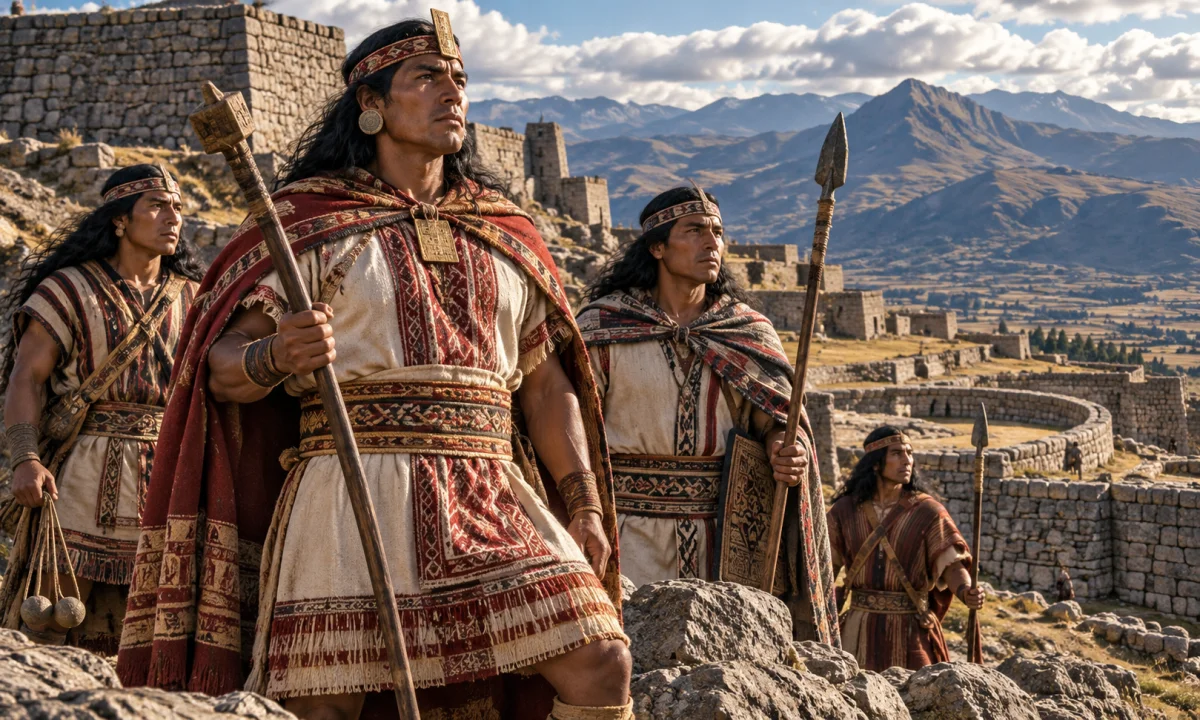
Calling Ekeko an “Inca god” is therefore an oversimplification. The Inca Empire ruled much of the central Andes before the Spanish conquest and incorporated many local traditions, but not every Andean sacred figure was Inca in origin. Ekeko is more accurately described as an Aymara-associated Andean figure with a major Bolivian tradition. His classification as Inca often results from the broad use of “Inca mythology” for the mythology of the Andes as a whole.
Appearance and attributes
Modern Ekeko figures are usually small, stocky male statuettes wearing Andean clothing. Common features include a round face, a moustache, a woollen cap or chullo, a poncho and short trousers. The figure often stands with his arms extended or held away from his body so that miniature objects can be attached to him. Some representations show him carrying bags, bundles and packages, while others place tiny goods around his feet or across his clothing.
The appearance is not uniform. Figurines vary according to period, locality, maker and purpose. Some are carefully dressed and brightly painted; others are simple clay objects. The familiar moustached figure may reflect a combination of indigenous clothing and colonial or republican-era visual conventions. It should not automatically be treated as a direct portrait of an ancient god.
Ekeko’s characteristic objects represent the material conditions of a good life. Miniature houses may signify the hope of obtaining a home, while tiny vehicles can express a wish for transport or travel. Food, sacks of grain, tools, money, office supplies, diplomas and household goods may represent security, employment, education or professional success. Contemporary versions can include objects associated with mobile phones, computers and other modern necessities.
These objects are not merely decorative accessories. Their small size is central to the ritual logic of the Alasitas tradition. A desired possession is represented in miniature as an expression of a future reality. The miniature may be bought, offered, blessed or displayed with the expectation that the full-sized equivalent will eventually be obtained.
Ekeko and abundance
Ekeko’s central power is the increase and protection of material well-being. He is associated with food, successful commerce, income, domestic prosperity and the fulfilment of practical wishes. His role is therefore different from that of a god concerned primarily with war, the weather or the dead.
His abundance is often imagined as something that must be welcomed, cared for and ritually activated. A figurine placed in a home may be treated as a continuing presence rather than as a disposable charm. In some traditions, people offer him food, drink or cigarettes. The object is given a place among the household’s hopes for the future, particularly during the yearly cycle of the Alasitas festival.
The relationship is not necessarily understood as a simple bargain. Andean religious practice commonly emphasizes reciprocity: humans honour powerful beings, and those beings are expected to support life, fertility, health or prosperity. The exchange may involve offerings, respect and participation in communal rituals rather than a single request followed by a guaranteed reward.
The Alasitas festival
The most important public setting for Ekeko is the Alasitas festival in La Paz, Bolivia. The principal celebration is traditionally held around 24 January, although related events and miniature markets can take place at other times and in other regions. The festival brings together commerce, ritual, craft production and wishes for the coming year.
People purchase miniature representations of what they hope to obtain. These may include money, food, property documents, houses, cars, animals, academic certificates or business equipment. The objects are often taken to be blessed by a Catholic priest, an indigenous ritual specialist known in many contexts as a yatiri, or both. The combination reflects the religious history of the Andes, where Catholic practices and indigenous ritual forms have frequently existed together rather than remaining completely separate.
During some observances, the miniatures are placed near an Ekeko figure or carried in a ritual procession. People may ask for the desired circumstances to become real during the coming year. The belief is not simply that an image magically transforms on its own. The ritual expresses a relationship among personal effort, divine or spiritual assistance, social hope and the circulation of goods.
La Paz’s Alasitas has become one of the best-known expressions of Bolivian cultural identity. Its significance extends beyond private luck. The festival supports artisans, traders and families, and it creates a public space in which aspirations about work, housing, education and economic stability can be expressed. It also preserves Aymara cultural elements within a major urban setting.
In 2017, UNESCO inscribed the cultural practices associated with the journey of the Ekeko and the Alasita festival of La Paz on its Representative List of the Intangible Cultural Heritage of Humanity. Such recognition concerns a living cultural practice rather than confirming a single ancient origin story. It also does not make every modern depiction or commercial product an unchanged survival from the pre-Hispanic past.
Stories and historical traditions
Ekeko does not have one universally accepted cycle of myths comparable to the extensive narrative traditions surrounding figures such as the Inca creator Viracocha. Stories about his origin differ by region and by period. Some portray him as an ancient Aymara being who brings abundance. Others connect him with a humble indigenous man whose generosity or resourcefulness helped people during a time of hardship.
A widely circulated historical legend links the development of the La Paz Ekeko tradition with the indigenous uprising and siege of La Paz in 1781. In versions of the story, a small figure or image associated with an indigenous servant, worker or local man was kept in a colonial household and later credited with providing protection or food during the siege. The details vary substantially, and the story should be treated as a later explanatory tradition rather than as securely documented evidence for the figure’s ancient origin.
These narratives are important even where their historical details cannot be verified. They connect Ekeko with survival, social inequality and the hope that ordinary people can endure crisis. The figure’s later association with money and consumer goods should not obscure these older themes of food security, generosity and protection within a precarious world.
Offerings and ritual practice
Cigarettes are among the most recognizable offerings associated with Ekeko. In some traditions, a cigarette is placed in the figure’s mouth, and devotees may light it during a ritual. The practice is part of modern popular observance and is especially visible in representations sold at markets. It should not be projected uncritically into the remote pre-Hispanic past, since tobacco practices and the symbolic meaning of cigarettes changed substantially after European colonization.
Other offerings can include food, drink, coca leaves, flowers and miniature goods. The exact practice depends on the community, the ritual specialist and the religious setting. A Catholic blessing does not necessarily replace indigenous belief, and an indigenous ceremony does not necessarily exclude Catholic devotion. Andean religious life has often been shaped by this kind of layered practice.
The miniature itself can be understood as a promise, a prayer, a symbolic possession or a material representation of a desired future. Its meaning may be personal, communal or both. A miniature house, for example, can express the hope of a family for stable housing, while a miniature diploma can represent a student’s ambition and the support of relatives.
Relationship to other Andean beings
Ekeko is sometimes confused with other important Andean sacred figures, but they are not identical.
- Pachamama is a major earth-related presence associated with land, fertility, nourishment and the conditions that sustain life. Ekeko may appear in ceremonies that also honour Pachamama, but he is not simply another name for her.
- Illapa is a name used in Andean traditions for a thunder, lightning or storm-associated power, often connected with rain and agricultural productivity. His sphere differs from Ekeko’s focus on household prosperity and desired goods.
- Supay has a complex history. The term was associated with an Andean underworld or spirit figure and was later used by Christian missionaries in ways that encouraged identification with the Devil. Supay is not an alternative name for Ekeko.
- El Tío, honoured by some miners in Bolivia, is a distinct subterranean mine spirit whose imagery has been influenced by Catholic ideas about the Devil. He belongs to mining ritual contexts, not to the Alasitas tradition.
Ekeko may also be mistaken for a generic “good-luck dwarf” because of his small statue and association with wealth. That comparison can be misleading. His meaning comes from specific Aymara and Andean histories of reciprocity, miniature offerings, markets, household religion and colonial change.
Interpretation and cultural significance
Ekeko represents more than personal riches. His loaded body makes visible the relationship between prosperity and the objects required for ordinary life: food, shelter, transport, employment, education and family security. The figure’s abundance is concrete rather than abstract. It is measured in the things that allow people to live with dignity.
The tradition also illustrates how religious symbols change in response to social conditions. An older indigenous figure may acquire new clothing, new stories and new ritual associations as communities encounter colonial rule, Catholic institutions, urban markets and modern economies. Such changes do not necessarily make the tradition inauthentic. Living traditions are often maintained through adaptation as well as continuity.
For many devotees, Ekeko remains a sacred or spiritually effective presence. For others, the figure may also express cultural identity, family custom or participation in a national festival. These meanings can exist together. A person may buy a miniature as a ritual wish, a cultural practice, a work of local craftsmanship or a symbol of hope without drawing a strict boundary between those purposes.
Modern representations
Ekeko is widely represented in Bolivian craft markets, festival stalls, museums, tourism materials and popular art. Commercial production has made his image recognizable far beyond the communities in which the tradition developed. Reproductions may be sold as souvenirs or decorative objects, while others are purchased for ritual use during Alasitas.
Modern depictions sometimes exaggerate his moustache, belly, clothing or burden of goods to make the figure immediately identifiable. They may also add contemporary objects that did not exist in earlier versions. Such changes belong to the continuing life of the tradition, but they should not be confused with evidence about an ancient Inca pantheon.
Ekeko is best understood as a living Andean figure whose strongest religious and cultural associations are Aymara and Bolivian. His history contains older indigenous elements, colonial transformations, Catholic and indigenous ritual interactions, local legends and modern expressions of economic hope. Treating him simply as an Inca god removes the regional complexity that gives the figure his meaning.