WORLD

Dongo
Dongo is a name associated chiefly with a thunder and storm deity in traditions connected with the Songhay- and Zarma-speaking peoples of West Africa, particularly around the Niger River region. The name is also recorded in other African cultural contexts, so it does not always identify one universally defined being. Accounts of Dongo vary because the traditions were transmitted mainly through oral teaching, ritual practice and local religious specialists rather than through a single canonical scripture.
Origins and cultural setting
The strongest and most consistent identification of Dongo is with the religious traditions of the western Sahel. Songhay and Zarma communities historically lived across areas that are now parts of Mali, Niger, Burkina Faso and neighbouring regions. Their religious worlds included a high creator or sky power, ancestral forces, spirits associated with places and natural phenomena, and beings connected with illness, protection, fertility and political authority.
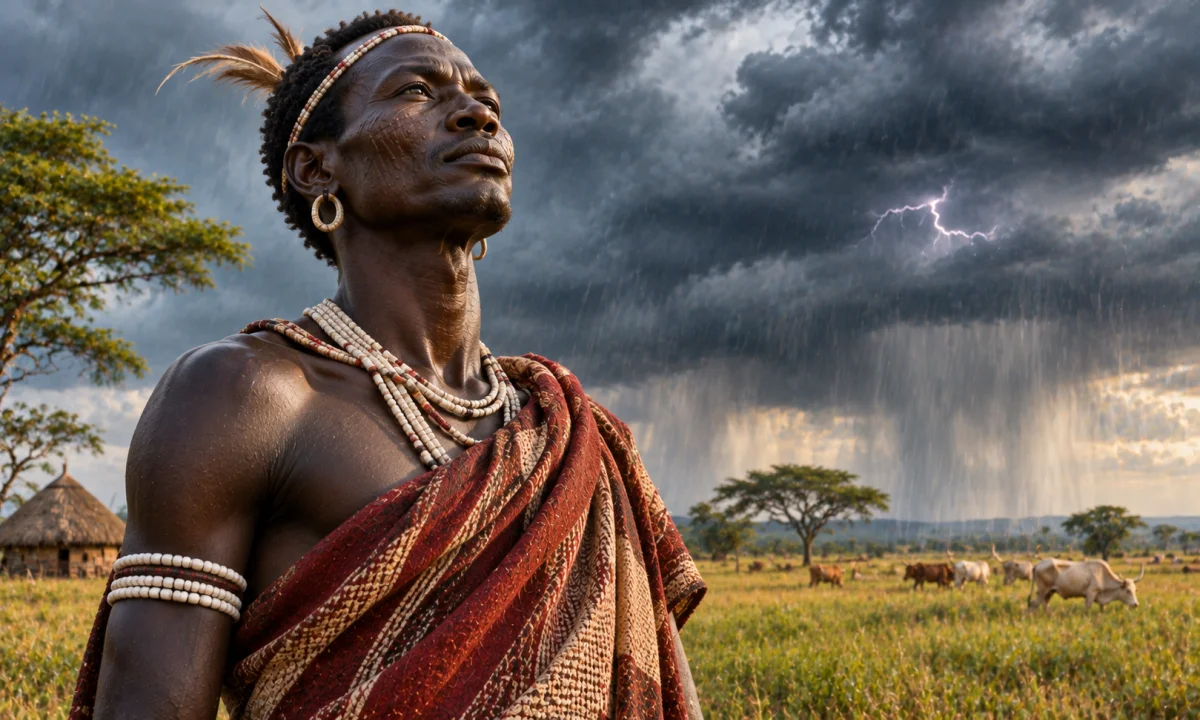
Within this setting, thunder was not merely a meteorological event. It could be understood as a sign of supernatural power, a warning, or an intervention in the human world. Lightning, violent storms and the arrival of rain were especially significant in a region where farming and pastoral life depended heavily on seasonal water. A thunder deity therefore belonged to a religious system concerned with both danger and renewal.
Descriptions of Dongo come from accounts of local belief and ritual rather than from one ancient epic that defines the figure in detail. Oral traditions may differ from one town, community or religious lineage to another. Some accounts treat Dongo as a deity; others place him among powerful spirits or supernatural beings. The word god is often used in English for convenience, but it should not be assumed that traditional categories correspond exactly to European ideas about a god.
Name and identity
The spelling Dongo reflects the way the name has been recorded in English and other European languages. Oral names can be represented differently when they are written down, and related traditions may use forms that are not identical. The name should therefore not be treated as evidence of a single, fixed mythology shared by every community in the region.
In the best-known interpretation, Dongo is a personification or divine master of thunder. He is associated with lightning, storms and rain, and in some descriptions with the moral force of the sky. The thunderclap may be understood as the audible expression of his presence. This does not mean that every Songhay or Zarma community explains storms in precisely the same way, or that Dongo occupies the same rank in every local religious system.
The available descriptions are also too limited to support a detailed family tree or a uniform biography. Claims that Dongo has a universally agreed spouse, parentage, physical form or sequence of adventures should be treated cautiously unless they can be tied to a clearly identified local tradition. Much online material combines information from different West African religions and presents it as one mythology, producing details that are not securely established for Dongo himself.
Thunder, rain and agricultural life
Dongo’s importance is closely related to the environmental power of storms. Rain can sustain crops, replenish rivers and support animals, while lightning and thunder can destroy homes, injure people and kill livestock. A storm deity consequently embodies a double power: the ability to nourish life and the ability to punish or devastate.
This combination appears widely in African religious traditions, but shared themes do not prove that all thunder beings are the same figure. In the case of Dongo, the association with rain may connect the deity to agricultural fertility and the continuation of community life. The storm is not simply a frightening spectacle; it is part of the seasonal rhythm on which human prosperity depends.
Thunder could also be interpreted morally. In many traditional religious systems, extraordinary natural events are connected with the conduct of human beings, breaches of taboo or disturbances in the relationship between the living, the dead and the spiritual world. Where such interpretations occur, Dongo’s thunder may function as a warning or judgement. The exact offences involved, however, are not uniform in the surviving descriptions and should not be presented as a single universal code.
Ritual specialists and religious practice
Religious specialists have an important place in accounts of Songhay and related West African traditions. Such specialists may serve as intermediaries, diviners, healers or custodians of ritual knowledge. Where Dongo is honoured, the relationship with the deity is likely to be managed through local institutions and inherited practices rather than through private belief alone.
Ritual responses to thunder or lightning could include offerings, prayers, taboos or ceremonies conducted by people with recognised spiritual authority. A person struck by lightning, or a place affected by a storm, might acquire special religious significance. In some African traditions, lightning-struck objects are treated as powerful and dangerous because they are understood to have been marked by a supernatural force. It is possible to find similar ideas in accounts associated with Dongo, but practices differ by community and should not be assumed to belong to all Songhay or Zarma people.
Accounts of thunder cults in the western Sahel sometimes describe ritual groups whose members serve a storm power or protect the community from its destructive aspects. The existence and organization of such groups vary in the ethnographic record. It is safer to speak of local thunder-related ritual specialists than to impose a single institution on every tradition in which the name Dongo appears.
Attributes and representation
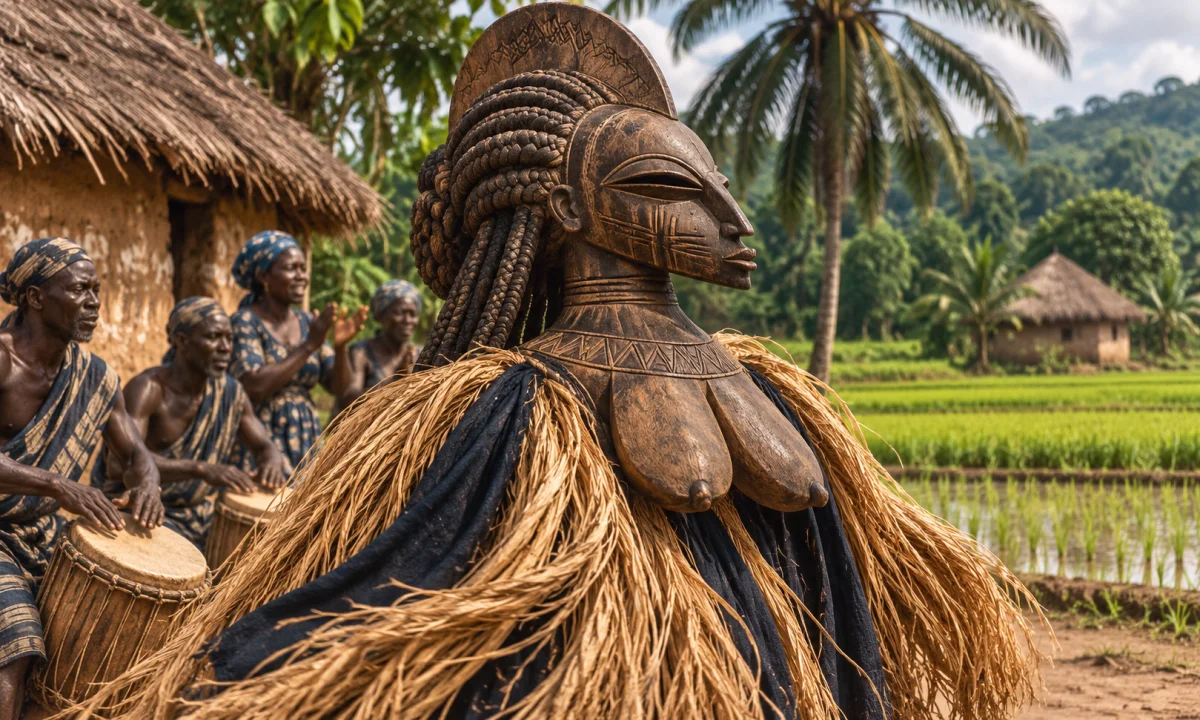
Dongo does not possess one standard appearance comparable to the fixed images of a figure from a classical art tradition. Oral religious beings may be known through their powers, sounds, effects and ritual signs rather than through a consistently described human body. Thunder itself can be the principal manifestation of the deity.
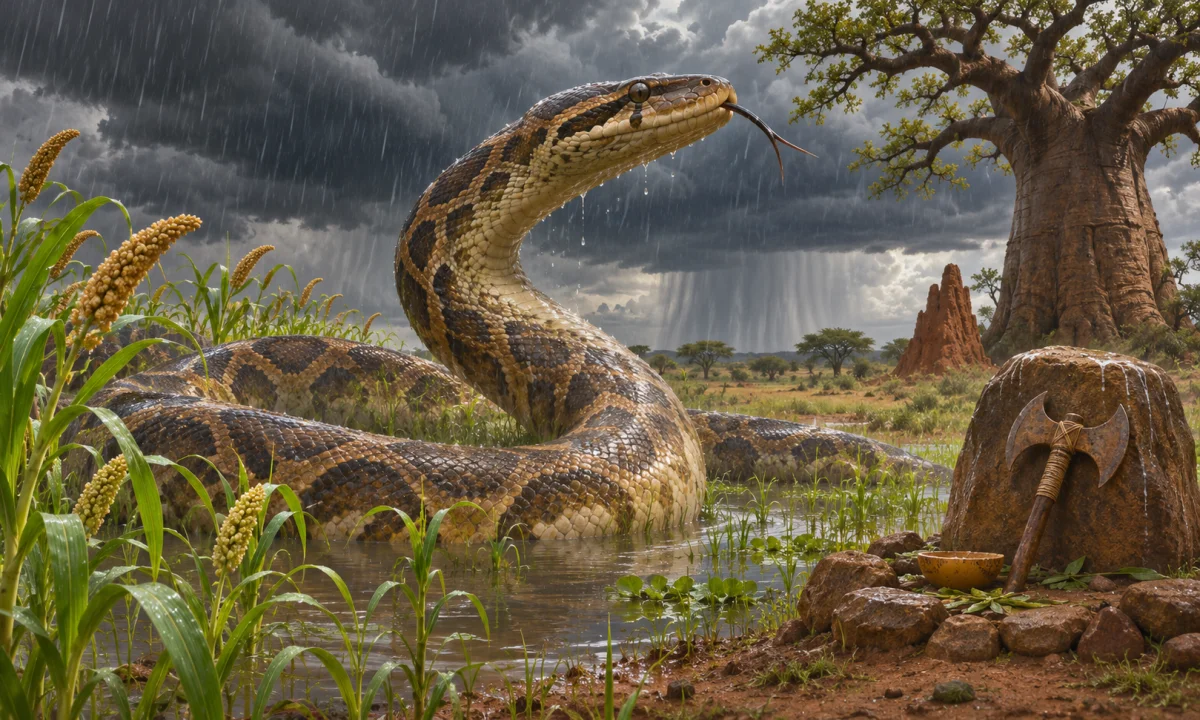
Modern summaries sometimes portray Dongo as a man carrying weapons associated with storms, such as an axe, hammer or club. These images may be influenced by better-documented depictions of other African thunder deities, especially the Yoruba Shango, whose ritual symbolism includes the double-headed axe. There is no secure basis for treating such objects as universal attributes of Dongo. A careful account should distinguish between a traditional description tied to a particular community and an illustration created for a modern mythology book, website or game.
Lightning, dark clouds, rain and the sound of thunder are more reliable symbolic associations. They express the deity’s connection with the sky and with the power to alter earthly conditions. The storm can represent authority because it is beyond ordinary human control, but it can also represent generosity when it brings needed rain.
Stories and variants
Dongo is not known from a single widely transmitted cycle of myths with a stable plot, cast of characters and ending. This is an important difference between Dongo and figures whose stories were preserved in major written epics or extensive bodies of recorded oral literature. Information about Dongo is often presented in brief descriptions of religious function rather than in long narratives.
Some secondary accounts call Dongo a son or subordinate of a supreme sky power. Such descriptions may reflect a particular interpretation of the relationship between a high creator and a more immediately active natural force. They should not be generalised without identifying the local tradition behind them. A thunder deity may be understood as an independent power, a servant of the creator, an ancestral being or a spirit with authority over a specific aspect of nature.
Likewise, the relationship between Dongo and other storm beings is not always clear. A name used in one community may refer to a particular deity, while a similar name elsewhere may belong to a spirit, ancestor, ritual title or entirely different figure. The absence of a complete written mythology makes it especially important to avoid turning scattered descriptions into a fictional biography.
Religious significance
Dongo’s significance lies in the way thunder connects the sky, the land and the community. The deity represents a force that cannot be controlled by ordinary human means but that is essential to survival. This gives the figure a distinctly ambivalent character: Dongo may be feared for lightning and destructive storms, yet welcomed because rain makes cultivation possible.
The figure also illustrates how African religious traditions often treat the natural world as spiritually meaningful. Weather is not necessarily separated from questions of morality, social order and ritual responsibility. A storm may be experienced simultaneously as a physical event and as communication from a power that requires respect.
For communities living along the Niger and across the Sahel, water has social and political importance as well as ecological value. Rivers, floodplains and seasonal rains influence settlement, trade, farming and pastoral movement. A thunder deity therefore belongs to a broader landscape of spiritual relationships involving rivers, ancestors, local spirits and the powers associated with the sky.
Distinguishing Dongo from similar figures
Dongo should not automatically be equated with every African god of thunder. West and Central Africa contain many distinct storm deities, and similarities in function often arise because thunder and rain are important everywhere.
- Shango or Sango is the well-known Yoruba orisha of thunder, lightning and royal power. He has a large body of Yoruba religious tradition and a distinctive ritual history. He is not simply another name for Dongo.
- Hevioso, also written Heviosso or associated with related forms such as Xevioso, belongs to the religious traditions of the Fon and neighbouring peoples of the ancient Dahomey region. He should be kept distinct from a Songhay or Zarma Dongo.
- Nzazi is a Kongo-associated thunder power whose name and religious setting belong to Central Africa. Similar storm symbolism does not make Nzazi and Dongo the same being.
- Oya is a major Yoruba orisha connected with winds, storms, transformation and the boundary between life and death. Her role is broader and different from that of a thunder deity identified as Dongo.
Names can also be confused through transcription. A similar-looking word may refer to a local spirit or to a figure from another language, while an English-language source may use “African mythology” as though the continent had one shared pantheon. Africa contains thousands of cultural and linguistic traditions. The regional setting and the community associated with a name are therefore essential to understanding it.
Historical evidence and modern presentation
Knowledge of Dongo depends on oral traditions, local religious practice and records made by outsiders or by later researchers. Such records are valuable but incomplete. An observer may translate a local religious category as “god,” “spirit” or “demon,” each of which carries different assumptions in English. Written descriptions may also omit ritual knowledge that could only be learned through participation in a community.
Modern websites, encyclopedias and mythology lists often reduce Dongo to a short definition such as “African god of thunder.” That description identifies the central association but leaves out the uncertainty surrounding regional variation. Illustrations may add horns, weapons, armour or a dramatic humanoid form without evidence that these features belong to traditional representations.
Dongo has not become a major, universally recognisable figure in global popular culture in the way that Shango or Anansi has. When the name appears in fantasy fiction, role-playing games or online character lists, those uses are modern inventions or adaptations unless they explicitly preserve a documented local tradition. Such portrayals may borrow the general idea of a powerful African storm deity, but they should not be mistaken for evidence about the historical religious figure.
The most responsible description of Dongo is therefore a regional one: a thunder-associated supernatural power known especially in Songhay- and Zarma-related contexts, with traditions and interpretations that vary by community. His symbolism joins danger and fertility, punishment and protection, and the unpredictable force of the sky with the life-giving necessity of rain.