WORLD
WORLD
Civatateo
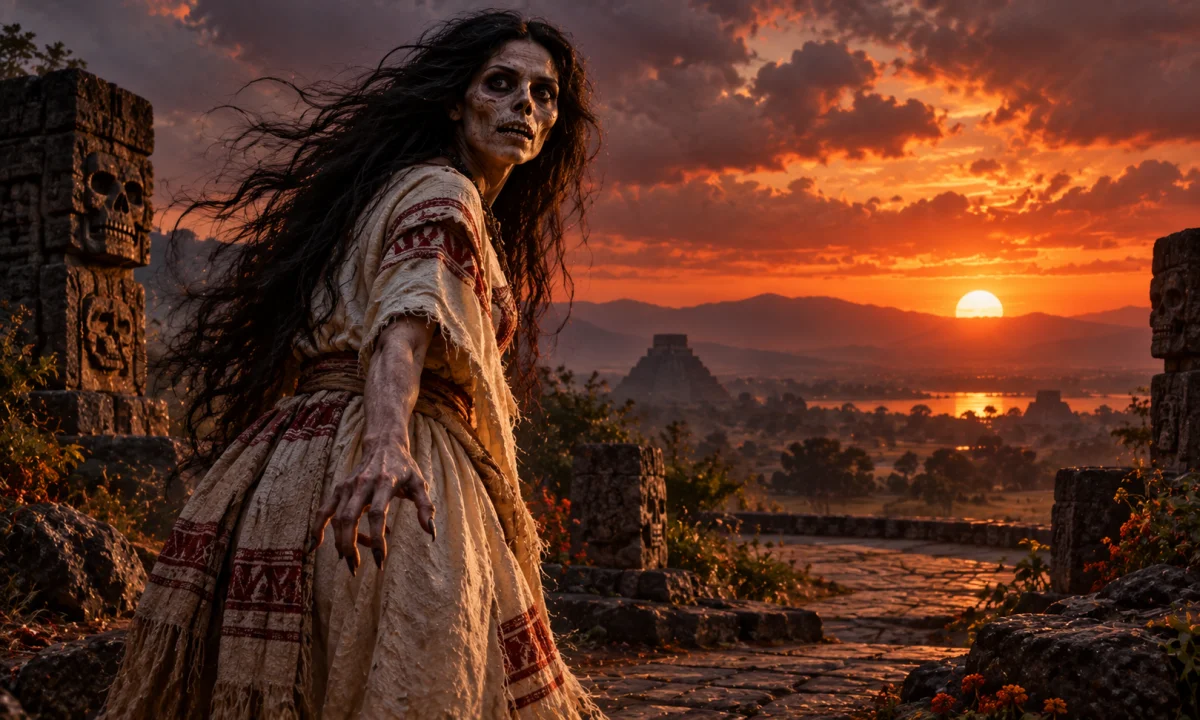
Civatateo is a variant spelling of cihuateteo, the Nahuatl name commonly used for the spirits or deified dead of women who died in childbirth in central Mexican religious tradition. The name is often translated as “divine women” or “goddess-women.” In Aztec or Mexica belief, these women were not treated simply as ordinary ghosts. Death in childbirth could give a woman a special, dangerous sacred status comparable in some respects to that of a warrior who died in battle.
The spelling Civatateo appears in some modern English-language treatments, but it is not the form most commonly used by scholars. The usual forms are cihuateteo in a simplified spelling or cihuātēteoh in a more precise representation of Classical Nahuatl. The singular and plural forms are not always handled consistently in modern writing. For that reason, “Civatateo” may refer either to one such being or to the group as a whole, depending on the source.
Origins and cultural setting
The Civatateo belong to the religious world of central Mexico before and during the Spanish conquest. Their traditions were recorded mainly in early colonial sources written or compiled after the fall of Tenochtitlan. The most important evidence comes from Nahuatl-language materials associated with Bernardino de Sahagún, including the Florentine Codex, as well as pictorial and alphabetic manuscripts describing the calendar, rituals and beliefs of Nahua communities.
These records must be read with care. They preserve valuable Indigenous information, but they were produced in a colonial Christian environment and often reflect the questions, categories and priorities of European missionaries. They do not provide a single complete account of Aztec religion. Different communities may also have used related terms differently, and the surviving accounts do not always agree about the precise nature of the beings they describe.
Childbirth held profound religious and social importance in Nahua society. Giving birth was understood through the language of struggle and warfare. A woman in labor fought a battle, and a successful birth could be described as a victory. If she died, her death was not necessarily interpreted as an ordinary defeat. She had died while engaged in a dangerous task that had cosmic significance, and her fate could therefore resemble that of a warrior killed in combat.
This connection between childbirth and warfare helps explain why the dead women were granted an exceptional afterlife. Aztec ideas about the destinations of the dead were not based only on moral judgment. The manner of death, the social role of the deceased and the forces connected with that death could all influence what happened afterward. Women who died in childbirth were consequently associated with the sun and with the movement of sacred forces through the sky.
The name and classification of the Civatateo
The Nahuatl term is generally analysed as a form related to cihuatl, “woman,” and teotl, a word that can mean a god, sacred power, divine being or numinous force. Translating cihuateteo simply as “goddesses” can therefore be misleading. The term does not necessarily indicate a pantheon of individual female deities in the later European sense. It can refer to dead women who have acquired sacred power, to a collective class of supernatural beings, or to divine women associated with specific calendar and ritual dangers.
Some sources use related names, including cihuapipiltin, often translated as “noble women” or “little noble women,” when discussing supernatural women connected with illness and the calendar. The relationship between the terms is not entirely uniform across the evidence. Some modern accounts treat them as closely related or overlapping categories, while others distinguish them. It is safer not to assume that every reference to one name describes exactly the same group as every reference to the other.
The Civatateo are also sometimes described as female counterparts to deceased warriors. This comparison is useful, but it should not be taken to mean that the two groups were identical. Warriors and women who died in childbirth occupied different social and ritual positions, and the records describe their movements and associations in distinct ways.
Their place in the journey of the sun
One of the best-known traditions states that women who died in childbirth accompanied the sun during part of its daily journey. Male warriors who died in battle or in sacrifice were associated with the sun’s rising and its movement from the eastern horizon toward the zenith. The women who died in childbirth were connected with the later portion of the journey, carrying the sun from the zenith toward the western horizon.
This division reflected a wider symbolic geography. The east, called tlapcopa in Nahuatl sources, was associated with the warriors and the rising sun. The west, called cihuatlampa, “the place of women,” was associated with the women who died in childbirth and the sun’s descent. The western direction was not simply a place of weakness or darkness. It was a powerful sacred region with its own dangers and responsibilities.
Some accounts describe these women as returning to earth after their service to the sun. At particular times they could descend into the human world, especially during ominous calendar days. Their appearance was therefore linked both with an honoured cosmic role and with fear. They were beings who had passed through a violent transformation and possessed power that ordinary living people could not safely control.
Dangerous appearances and supernatural powers
The Civatateo were feared for their ability to bring illness and misfortune. Colonial descriptions associate them especially with afflictions affecting children. These could include convulsions, paralysis, distorted mouths, weakness or other conditions interpreted through the religious language of supernatural attack. The accounts do not provide a modern medical diagnosis, and their descriptions should not be treated as clinical observations. They show instead how illness could be understood within Nahua ritual thought.
Children were particularly vulnerable to the Civatateo. Some traditions warn that the beings might seize or harm children who encountered them, especially at night or at dangerous places. The danger was not necessarily limited to a direct attack. Their presence could pollute a location, bring sickness into a household or expose a person to an unlucky calendrical influence.
Crossroads were among the places associated with them. In many religious traditions, a crossroads is a boundary between routes and worlds, and in central Mexican ritual thought it could be a place of uncertainty and supernatural contact. A person who travelled at the wrong time, ignored ritual precautions or came across an offering might be exposed to the Civatateo.
Some sources connect the beings with the night, owls and other ominous signs. These associations fit the wider symbolism of death, transition and the dangerous hours between ordinary activities. They do not mean that every owl was considered a Civatateo or that the beings always appeared in one fixed animal form. Such details vary according to the source and later interpretation.
Accounts sometimes describe offerings or protective practices intended to placate them. Food, paper objects and other ritual items could be placed at locations associated with their movements. The surviving descriptions do not establish one universal ceremony performed everywhere. Ritual responses probably differed by community, period and circumstance.
Appearance in art and written descriptions
There is no single securely documented canonical appearance for the Civatateo. Modern illustrations often show them as skeletal women, corpses or frightening female spirits with claws. These images reflect genuine associations with death and danger, but many specific visual details come from later artistic reconstruction, popular retelling or the merging of several different Aztec figures.
Some sculptures and painted manuscripts have been interpreted as representations of cihuateotl or related female supernatural beings. Such figures may have skull-like faces, exposed teeth, elaborate headdresses, skirts or raised hands. However, identifying an object with the Civatateo is often a matter of iconographic interpretation rather than an unquestionable label supplied by the original maker. Art historians compare the image with its archaeological context, costume, symbols and associated inscriptions, and different interpretations remain possible.
Their frightening appearance should also be understood alongside their honoured status. A woman who died in childbirth was not merely imagined as a wandering corpse. She had become connected with cosmic movement and the sun. The combination of reverence and fear is characteristic of many religious beings who cross boundaries between life and death.
Calendar associations
The Civatateo were connected with certain unlucky or dangerous days in the ritual calendar. Early colonial descriptions state that they descended or became active on specified calendar occasions. The exact presentation of these days differs between sources and translations, and modern summaries sometimes simplify or rearrange the information.
The 260-day ritual calendar, known as the tonalpohualli, assigned religious qualities to individual days and longer periods. A day’s significance depended on its number, its named sign and the wider cycle in which it occurred. The appearance of the Civatateo on particular dates therefore formed part of a larger system of divination rather than a random list of haunted nights.
Calendar specialists and ritual practitioners could use such associations to assess danger, illness or the suitability of an activity. The Civatateo were not necessarily believed to be present in the same manner on every night. Their power was shaped by sacred time, and the calendar helped determine when their influence was strongest.
Relationship to childbirth and women’s religious roles
The Civatateo tradition reveals that Nahua ideas about women’s religious importance were not limited to domestic life. Childbirth was a physically dangerous event with cosmic and political meaning. Midwives performed rituals, gave speeches and guided the mother through labor. The language surrounding childbirth could invoke warfare, capture and victory because the mother and the child were understood to be engaged in a serious struggle.
A woman who died giving birth could consequently become a powerful ancestor-like or supernatural figure. Her death marked the completion of an exceptional act, and her transformed status could be both honoured and feared. The tradition does not imply that women were generally expected to die in childbirth or that their deaths were considered desirable. Instead, it shows how a tragic and dangerous event was incorporated into a religious system that recognized the courage and sacred force associated with it.
The Civatateo also complicate any simple division between benevolent and malevolent beings. They could be honoured because of their service to the sun, yet feared because they could inflict disease. In Mesoamerican religious traditions, sacred power was often morally and physically dangerous rather than consistently kind or evil. Protection, respect and ritual caution could coexist.
Distinction from similar figures
The Civatateo should not be confused with Mictecacihuatl, the female ruler associated with the realm of the dead. Mictecacihuatl is an underworld figure connected with Mictlan and with the governance of the dead, whereas the Civatateo are a class of transformed women whose deaths occurred in childbirth. A source may discuss both female supernatural beings without treating them as the same figure.
They are also distinct from Coatlicue, the earth and mother goddess known from Mexica religious tradition, and from Coyolxauhqui, the moon-associated figure in the myth of Huitzilopochtli. Both goddesses are sometimes drawn into modern discussions of frightening female imagery, but neither name is simply another name for the Civatateo.
The Civatateo are likewise not identical to La Llorona, the colonial and modern legend of a woman who mourns or seeks her children. La Llorona developed through later historical and folkloric processes, with roots that are debated and varied across regions. Similar themes—female death, children, night travel and danger near water or roads—can encourage comparisons, but the two traditions belong to different historical contexts.
Later reception
In modern writing, the Civatateo are often presented as ghostly women, undead warriors or skeletal monsters. These descriptions can make the subject accessible, but they may flatten the older religious distinctions between honoured dead, divine powers, calendar beings and dangerous spirits. The popular image of a single standardized monster is not supported by all surviving evidence.
Contemporary books, games, art and online mythology databases may also use the spelling “Civatateo” because it is easy for English readers to pronounce or because it was inherited from an earlier secondary source. Such usage does not necessarily indicate a separate being. At the same time, not every fictional character called a Civatateo accurately represents Nahua tradition. Modern adaptations should therefore be treated as reinterpretations rather than direct descriptions of pre-Hispanic belief.
The surviving tradition presents these beings most clearly as women transformed by the dangerous sacred power of childbirth: honoured companions of the sun, inhabitants of the western sphere and terrifying visitors whose presence could bring illness, especially to children. Their significance lies in the way they unite warfare, motherhood, death, sacred time and the movement of the sun within the religious imagination of central Mexico.