WORLD
WORLD
Bishamon
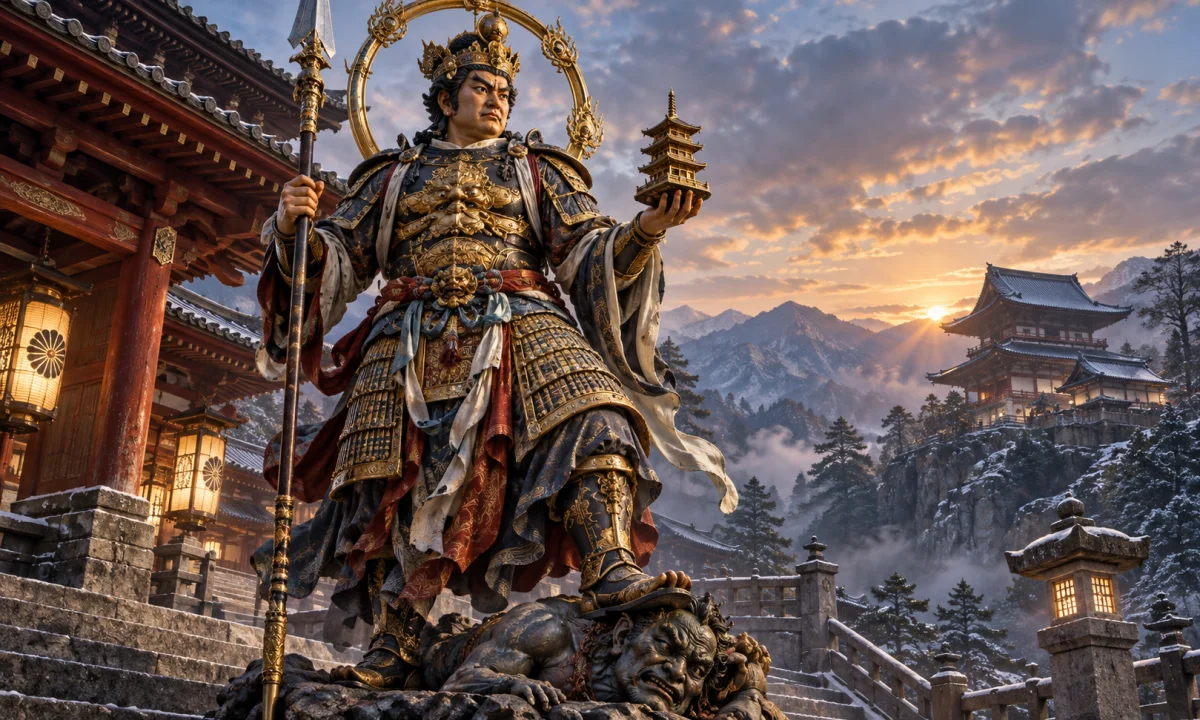
Bishamon, more fully known in Japanese as Bishamonten, is a major Buddhist guardian deity in Japan. He protects the northern direction, defends the Buddhist teachings, and is associated with military strength, righteous authority and material prosperity. Although often discussed under the broad label of Japanese mythology, Bishamon originates in Indian Buddhist tradition and reached Japan through the religious and artistic cultures of China and Korea. His Japanese identity combines several related roles: one of the Four Heavenly Kings, a powerful protector of temples and rulers, a warrior deity, and one of the Seven Lucky Gods.
Origins in Buddhist tradition
Bishamonten is the Japanese form of Vaiśravaṇa, a deity known in Sanskrit Buddhist sources. In ancient Indian religious tradition, Vaiśravaṇa is connected with Kubera, a lord of wealth and a ruler of supernatural beings known as yakshas. Buddhist traditions adapted him as a guardian of the Buddha’s teaching and as one of the great protective kings who defend the world.
The Sanskrit name Vaiśravaṇa is related to the idea of hearing or becoming widely known. In East Asian Buddhism, this meaning helped support the Chinese name Duōwén Tiān, usually translated as “Heavenly King of Much Hearing.” The title refers to a guardian who listens to the Buddha’s teachings and protects the places where those teachings are preserved. Japanese names such as Bishamonten derive from the Chinese pronunciation and transmission of Vaiśravaṇa.
The figure entered Japan with Buddhism, probably in the broader movement through which Buddhist scriptures, images and institutions arrived from the Korean peninsula and China. The precise history of individual early images and practices varies, but Bishamonten was established in Japanese Buddhist culture by the early historic period. He was represented in temple sculpture, ritual texts and protective traditions rather than belonging originally to the indigenous kami system.
Bishamonten among the Four Heavenly Kings
Bishamonten is best known in his role as one of the Shitennō, the Four Heavenly Kings. These guardians stand at the four quarters of the Buddhist cosmos and protect the world, Buddhist communities and the Dharma, or Buddhist teaching. Bishamonten rules the north. The other three kings are usually identified as Jikokuten in the east, Zōchōten in the south and Kōmokuten in the west.
In this group, Bishamonten is often called Tamonten, the Japanese reading of the same guardian’s title as Heavenly King of Much Hearing. The names Bishamonten and Tamonten do not normally indicate two unrelated gods. They emphasize different aspects of the same Buddhist deity. “Bishamonten” highlights the name derived from Vaiśravaṇa, while “Tamonten” identifies his position and religious function among the Four Heavenly Kings.
The Four Heavenly Kings are traditionally described as protectors of Mount Sumeru, the cosmic mountain at the centre of Buddhist cosmology. They guard the four directions and watch over various classes of spirits and beings. Their role is not simply to wage war. They preserve moral and cosmic order, repel harmful forces and support the survival of Buddhist practice.
In temple images, the Four Heavenly Kings are commonly shown as armoured warriors. They may stand at the entrances to temple halls or surround a central image of the Buddha or another important Buddhist figure. Bishamonten can therefore be recognized not only as an independent deity but also as the northern member of a protective quartet.
Name, identity and classification
The spelling Bishamon is a shortened form of Bishamonten and is especially common when the deity is discussed as a lucky god or warrior protector. In formal religious and art-historical contexts, Bishamonten or Tamonten may be preferred. The variations are matters of Japanese usage and transliteration rather than evidence for separate beings.
Bishamon is sometimes called a god in English, but that description requires care. In Buddhist cosmology he is generally a deva, a powerful celestial being who remains within the cycle of existence rather than an ultimate creator. He is also a guardian king and, in Japanese practice, a sacred protector who may be worshipped through prayers, offerings, ritual observance and temple devotion.
His classification can change according to context. As one of the Four Heavenly Kings, he is a protector of the Buddhist order. In legends and popular religious practice, he appears as a victorious warrior and a giver of good fortune. Within the Seven Lucky Gods, he represents prosperity and success. These roles overlap, but they developed in different religious and cultural settings and should not be treated as a single original doctrine.
Appearance and attributes
Bishamonten is usually depicted as a fierce, imposing man in armour. His armour reflects his role as a guardian and military protector, although the exact style varies according to period, region and artistic tradition. He commonly wears a helmet or crown and holds weapons such as a spear, a trident-like implement or a military staff. In some images, the weapon is raised aggressively; in others, it is held in a more formal and controlled manner.
One of his most distinctive attributes is the pagoda or treasure tower held in one hand. The pagoda can symbolize the Buddhist teaching, a sacred reliquary, or a storehouse of spiritual and material treasure. In images where Bishamonten holds a weapon in one hand and a pagoda in the other, the combination expresses both protective force and the preservation of the Dharma.
Another common feature is the small defeated figure beneath his feet. This being is often called a jaki, a harmful or unruly spirit. The figure is not necessarily a single named demon with an independent mythology. Instead, it represents the forces of disorder, arrogance or evil that the guardian subdues. The image makes Bishamonten’s protective power visible: he stands above the dangers threatening the Buddhist community.
Some images show Bishamonten standing alone, while others place him among the Four Heavenly Kings. His expression may be stern, angry or watchful. The fierce appearance does not mean that he is an evil or demonic figure. In Buddhist protective imagery, controlled anger can represent a compassionate response to forces that obstruct wisdom and moral conduct.
Functions as protector and warrior
Bishamonten’s primary religious function is protection. He guards Buddhist temples, scriptures, teachers and practitioners. He is also understood to protect communities and rulers who support righteous government and the Buddhist law. As a result, Japanese rulers and military leaders could find in him an image of legitimate defence and victorious authority.
His warrior character became particularly prominent in Japanese history. Devotion to Bishamonten was found in different Buddhist institutions and among members of the warrior class, although the intensity and form of that devotion varied. He could be invoked for victory, protection in battle and the defeat of enemies. Such uses connected him with worldly concerns, but traditional Buddhist interpretations generally placed those concerns within a wider moral framework: victory was most legitimate when directed against disorder or threats to the Dharma.
Bishamonten is also associated with wealth. This connection reflects his relationship to Vaiśravaṇa and Kubera, whose older Indian identity includes the rulership of treasures. In Japan, Bishamonten’s wealth is often represented as a reward for devotion, discipline and protection of the Buddhist order rather than as unlimited personal enrichment. His treasures may be spiritual, material or both.
Bishamon and the Seven Lucky Gods
In Japan, Bishamonten is one of the Shichifukujin, or Seven Lucky Gods. The group includes deities and sacred figures drawn from Buddhist, Shinto, Daoist and other East Asian traditions. It became especially popular in the early modern period, when the Seven Lucky Gods were associated with good fortune, prosperity, longevity, happiness and success.
As a member of this group, Bishamonten is usually presented as a dignified armoured warrior carrying a spear and sometimes a small pagoda. His inclusion emphasizes courage, authority, protection and financial good fortune. He is often distinguished from the gentler or more openly festive appearance of some of the other lucky gods, though the group as a whole allows many different combinations of religious symbolism.
The lucky-god role should not be confused with Bishamonten’s older position as one of the Four Heavenly Kings. The two identities belong to different layers of Japanese religious history. The Four Heavenly Kings are part of Buddhist cosmological and temple traditions, while the Seven Lucky Gods form a later popular religious grouping shaped by pilgrimage, commerce, household devotion and auspicious imagery.
Stories and associated traditions
Bishamonten does not have one single Japanese myth comparable to a fixed epic cycle. His stories are distributed across Buddhist scriptures, temple legends, miracle tales, devotional records and local traditions. These sources often emphasize his ability to appear at moments of danger, punish impiety, protect a temple or grant success to a devoted worshipper.
In Buddhist narratives more broadly, Vaiśravaṇa appears as a guardian who attends the Buddha, hears his teachings and commands supernatural forces. He is connected with yakshas and other nonhuman beings who may be dangerous when uncontrolled but can serve as protectors when brought within the Buddhist order. Japanese traditions inherited and adapted these themes, often presenting Bishamonten as a commanding protector of sacred places.
He is also associated with the Buddhist teacher and warrior-saint Prince Shōtoku in Japanese tradition. One famous legend states that Shōtoku received aid from Bishamonten during a conflict with the Mononobe clan, a story connected with the early establishment of Buddhism in Japan. The details belong to later religious and historical tradition rather than securely documented contemporary evidence. They show how Bishamonten could be portrayed as a defender of the Buddhist faith and as a source of victory for a ruler who supported it.
Mount Shigi in Nara Prefecture is one of the most important Japanese centres associated with Bishamonten. The temple Chōgosonshi-ji, commonly known as Shigisan, preserves a strong tradition of Bishamonten devotion and is linked with the monk Myōren in the famous illustrated narrative known as the Shigisan Engi. The stories and paintings connected with the temple concern miraculous events, religious discipline and the power of faith. They are valuable evidence for the cultural life of Bishamonten devotion, though they should be read as religious and literary traditions rather than straightforward historical reports.
Other temples and local communities have developed their own forms of Bishamonten worship. Some traditions associate him with the first day of the tiger in the traditional calendar because of the symbolic relationship between the tiger, the north and military protection. These associations are not uniform across Japan, and individual temples may emphasize different legends, rituals or festival practices.
Symbolism of the north and the tiger
The northern direction has a special place in Bishamonten’s identity. As the northern Heavenly King, he belongs to a cosmological system in which directions are guarded by powerful divine or semi-divine beings. In Japanese visual culture, his northern association may be expressed through the arrangement of temple images, ritual observances and auspicious calendar days.
The tiger is frequently connected with Bishamonten in Japanese popular and religious symbolism. A common expression links the tiger with the cycle of time through the phrase “the day of the tiger, the hour of the tiger, the year of the tiger.” In some traditions, a manifestation or appearance of Bishamonten is said to have occurred under such circumstances. The details and importance of this motif vary by temple, and it should not be assumed to be a universal feature of all Buddhist accounts of Vaiśravaṇa.
Tigers also reinforce Bishamonten’s image as a powerful guardian. Their association with strength, vigilance and the northern quarter makes them suitable companions in devotional art. Yet not every image of Bishamonten includes a tiger, and the pagoda, armour and weapon remain more reliable identifying features.
Distinguishing Bishamon from related figures
Bishamon and Vaiśravaṇa: These are different cultural names and forms of the same broad Buddhist guardian tradition. Vaiśravaṇa is the Sanskrit name, while Bishamonten is the Japanese form used in Japan. Local practices may add attributes that are especially Japanese, but this does not create a wholly separate deity.
Bishamon and Kubera: Kubera is an ancient Indian deity of wealth and a lord of yakshas. Vaiśravaṇa is closely related to him and was historically shaped by this connection, but Buddhist traditions give Vaiśravaṇa a distinctive role as a guardian of the Dharma. It is therefore misleading to treat Bishamon as merely a Japanese god of money.
Bishamon and Tamonten: In most Japanese Buddhist contexts, Bishamonten and Tamonten are names for the same figure. Tamonten stresses the title “Heavenly King of Much Hearing,” especially in the Four Heavenly Kings. Bishamonten is more common when discussing his independent worship, warrior identity or membership in the Seven Lucky Gods.
Bishamon and Hachiman: Hachiman is a Japanese deity associated with warfare, royal legitimacy and the protection of the state, and was later interpreted through Buddhist categories. Bishamon is not simply another name for Hachiman. Their histories, religious institutions and iconographies are distinct, even though both can be represented as protectors and warriors.
Bishamon and Fudō Myōō: Fudō Myōō is a Wisdom King, or Myōō, associated with fierce protection and the destruction of spiritual obstacles. Bishamon is a Heavenly King and guardian of the Buddhist cosmos. Both may appear formidable and armed, but they belong to different categories within Japanese Buddhist iconography.
Cultural significance
Bishamon’s importance lies in the way he joins apparently different concerns: the defence of religious teaching, the protection of political and social order, military victory, spiritual discipline and material prosperity. His armour and weapons communicate force, while the pagoda communicates the value of what that force protects. The defeated spirit beneath his feet expresses the defeat of disorder rather than a simple triumph of violence.
His development also illustrates how religious figures change as they move across cultures. A deity connected with wealth and yaksha spirits in India became a Buddhist guardian in East Asia, a temple protector and warrior figure in Japan, and eventually a member of a popular group of lucky gods. None of these identities completely erases the others, but each belongs to a particular historical and devotional context.
Later reception and modern representations
Modern Japanese art, fiction, games and popular media sometimes use Bishamon as a warrior character or as a name suggesting strength, fortune and supernatural authority. Such representations may borrow his armour, spear, pagoda or association with the Seven Lucky Gods while changing his personality and story for dramatic purposes. These creative versions should be distinguished from the temple deity and from the wider Buddhist traditions of Vaiśravaṇa.
In contemporary religious life, Bishamonten remains visible in temple sculpture, festivals, pilgrimage sites, household observance and images sold as auspicious objects. His meaning can differ between practitioners: some approach him as a protector of Buddhism, some as a guardian of family and community, and others as a source of courage and good fortune. The enduring image is that of an armoured guardian whose power is directed toward preserving sacred teaching and overcoming forces that threaten moral and social order.