WORLD
WORLD
Barquiel
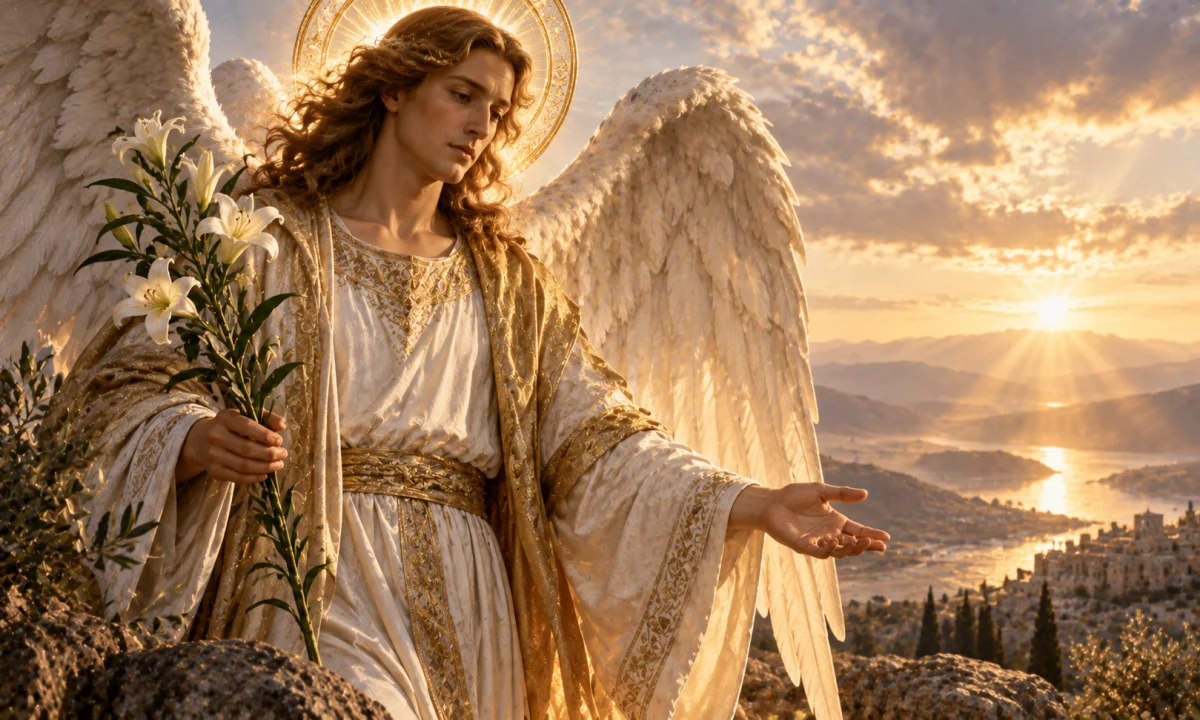
Barquiel is an uncommon name associated with angelological and occult traditions. It is often treated as a variant spelling of Barachiel, Barakiel, or related forms derived from a Hebrew expression meaning “lightning of God” or “God is lightning.” However, the exact identity of Barquiel is uncertain. The name does not belong to the universally recognised group of angels named in the Hebrew Bible, the New Testament, or the Qur’an, and surviving sources do not present a single consistent account of the figure.
Information about Barquiel is therefore best understood as part of later angelic catalogues, esoteric writings, and devotional or magical systems rather than as a clearly defined biblical character. Some lists describe a being called Barachiel or Barakiel as an archangel connected with blessing, lightning, or the month of February. Other sources use similar names for different offices or place the angel within varying celestial hierarchies. The spelling Barquiel may reflect a transliteration, a regional form, or a modern adaptation of these names.
Origins and cultural setting
Angel names developed across several overlapping religious and literary environments. Ancient Jewish writings, early Christian traditions, medieval theological works, liturgical calendars, magical manuals, and later occult publications all contributed to the large body of angelic names known today. These traditions did not always agree about which angels were authoritative, how many archangels existed, or what duties each one performed.
In the Hebrew Bible, angels are usually described by their actions rather than by extensive personal biographies. A small number are named, most notably Michael and Gabriel, while other figures appear without names. Later Jewish writings expanded the angelic world considerably, naming numerous heavenly beings and assigning them responsibilities over nations, natural forces, heavenly bodies, human affairs, or divine judgement.
Christian writers inherited many of these ideas but developed them in different ways. Some theologians accepted a limited number of named archangels, while others discussed larger angelic hierarchies based on scripture, apocalyptic literature, and theological speculation. Medieval and Renaissance writers also encountered angel names through non-canonical religious texts and magical traditions. In this setting, names resembling Barquiel could be preserved, altered, or reassigned as texts were copied and translated.
No single ancient scripture establishes Barquiel as a universally recognised angel. The name belongs more securely to the history of later angelology than to the central scriptural traditions of Judaism or Christianity. Claims that present Barquiel as a major biblical archangel should therefore be treated cautiously.
The name and its spellings
The most important difficulty surrounding Barquiel is linguistic variation. Angel names were commonly written in Hebrew, Aramaic, Greek, Latin, Arabic, and various European languages. A single name could acquire several spellings when represented in different alphabets. Small changes in vowels and consonants were especially common because ancient writing systems did not always record vowels, and because translators had to choose approximate equivalents.
Forms connected with Barquiel include Barachiel, Barakiel, Baraquiel, Barchiel, and Barak’el. These names are often explained through a Hebrew element associated with lightning or blessing and the divine element -el, meaning “God.” The interpretation “lightning of God” is particularly relevant to descriptions of Barakiel or Barachiel, while the name Barachiel is also frequently connected with blessing. The relationship between these meanings is not always clear, since similar spellings may have been interpreted differently by different writers.
Barquiel should not automatically be treated as a separate, fully documented angel. In some contexts it may simply be a variant of Barachiel or Barakiel. In others, it may be an independent spelling used by a particular author or catalogue. Without a specific source, it is not possible to determine which interpretation is intended.
Classification in angelic traditions
Where Barquiel is identified with Barachiel or Barakiel, the figure is sometimes classified as an archangel. This classification is not consistent across all sources, however. The term “archangel” itself has been used in several ways: sometimes for a small group of exalted heavenly messengers, sometimes for a rank within a celestial hierarchy, and sometimes simply as a title for a particularly important angel.
Some later lists connect Barachiel with one of the seven archangels. The number seven has strong symbolic importance in Jewish, Christian, and esoteric traditions, and lists of seven archangels became widespread. Yet the names included in those lists vary. Michael, Gabriel, Raphael, and Uriel appear frequently, while other names—including Raguel, Remiel, Saraqael, Jophiel, and Barachiel—appear in different combinations depending on the tradition.
There is no universally accepted seven-archangel system that places Barquiel in a fixed position. A source that describes the figure as one of seven archangels is expressing a particular theological or esoteric arrangement rather than an uncontested religious standard.
Lightning, blessing and natural forces
The most persistent symbolic association connected with the Barquiel or Barakiel name is lightning. This association follows naturally from the proposed meaning “lightning of God.” In religious symbolism, lightning can represent divine power, revelation, judgement, sudden transformation, or the visible energy of the heavens.
Lightning has an important place in biblical and wider Near Eastern religious imagery. It may accompany divine appearances, express the majesty of the creator, or signify the overwhelming force of the sacred. An angel whose name refers to lightning would therefore be understood symbolically as a bearer or manifestation of heavenly power, even when no specific story describes the angel controlling storms.
Some later descriptions instead emphasise blessing. In these accounts, Barachiel is associated with divine favour, good fortune, abundance, or the protection of households. This theme is especially prominent in certain Christian devotional traditions concerning Barachiel, where the angel may be invoked as a giver of blessings. The connection is not necessarily identical to the lightning symbolism: it may reflect a different interpretation of the name or the development of a separate devotional tradition.
It is important not to turn these symbolic associations into claims about a fixed ancient office. There is no broadly established scriptural passage declaring Barquiel to be the angel responsible for all lightning, weather, or prosperity. Such roles belong to later systems of interpretation and should be identified as such.
Associations with February and the planets
Some occult and angelological lists associate Barachiel or a related form with the month of February. The basis for this association is not uniform. It may come from systems that assign an angel to each month, from later compilations that connect angels with astrological signs, or from attempts to organise the large number of angelic names found in esoteric literature.
Other catalogues link similar names with planetary or astrological powers. These systems commonly assign angels to planets, zodiacal signs, hours, days, months, or natural elements. Such correspondences were developed within Renaissance and later ceremonial magic, drawing on Jewish, Christian, Hermetic, astrological, and folkloric materials. They should not be confused with a single ancient angelology shared by all Jewish or Christian communities.
Because the lists differ, the same name may be assigned different dates, planets, offices, or ranks. A statement that Barquiel is specifically the angel of February, Jupiter, lightning, or a particular zodiacal sign may be accurate within one catalogue while unsupported or contradicted by another. The identity of the source tradition is essential.
Stories and relationships
Unlike Michael, Gabriel, Raphael, or the fallen angel figures described in later literature, Barquiel has no widely known narrative cycle. There is no generally accepted account of a birth, celestial battle, descent to earth, conversation with a prophet, or relationship with a named human hero. Most references are classificatory rather than narrative: they place the name in a list and assign it a rank, function, or symbolic correspondence.
This absence of stories is significant. Later popular summaries sometimes present Barquiel as if the angel had a detailed mythology, but such accounts often combine material from different sources or expand brief catalogue entries into narrative descriptions. Statements that Barquiel commanded a specific host, served under a particular archangel, or appeared in a named biblical episode require direct support from a clearly identified tradition. They cannot be assumed from the name alone.
Similarly, Barquiel should not be given family relationships with other angels simply because the names appear together in a list. Angelic catalogues normally describe ranks or offices, not genealogies. When two names occur in the same group, that does not mean that one is the parent, sibling, servant, or rival of the other.
Religious and symbolic significance
Barquiel’s significance lies less in a stable mythology than in the way later traditions used angelic names to express divine qualities. Lightning suggests immediacy, splendour, danger, and revelation. Blessing suggests protection, fertility, generosity, and the presence of divine favour. These ideas can coexist in an angelic symbol: heavenly power is not merely destructive but may also be understood as a source of renewal and abundance.
The name also illustrates the fluid boundary between recognised religious tradition and esoteric classification. Angelology has never been produced by one institution alone. Scriptural interpretation, liturgy, apocalyptic speculation, private devotion, magical practice, and modern reference works have all shaped the names and functions attributed to angels. A figure such as Barquiel reflects that layered history.
For religious communities that venerate Barachiel, the angel may represent blessing and benevolent protection. For readers of occult catalogues, the name may instead function as part of a system of correspondences involving dates, celestial forces, or ritual symbolism. These uses should be distinguished rather than treated as interchangeable expressions of one universally defined belief.
Distinction from similar figures
Barquiel is easily confused with several other names. The closest is Barachiel, often regarded as the most familiar form of the same or a closely related name. Barakiel is another common variant, particularly when the name is interpreted through the Hebrew word for lightning. Because spelling practices vary, some authors use these forms interchangeably, while others assign them separate entries.
Barquiel should also be distinguished from Baraq or Barak, names associated with human figures in biblical or later religious contexts. The Hebrew name Barak, meaning “lightning,” belongs to a human judge and military leader in the Book of Judges; it is not itself the name of Barquiel. A shared linguistic element does not establish that the human and angelic figures are the same.
Nor should Barquiel be confused with Barbiel, a name appearing in some angelic and astrological lists. Barbiel is sometimes connected with the month of October or with other seasonal and zodiacal correspondences, depending on the source. Despite the similar sound, Barbiel and Barquiel are not automatically identical.
The name may also be confused with Barakel, a figure mentioned in some accounts of the Watchers in the Book of Enoch. The spellings are close, and the names may have undergone transmission changes, but an identification should not be made without examining the particular text and language involved. Enochic angel lists themselves vary between manuscripts and translations.
Later reception
Barquiel has had little presence in mainstream literature, film, or popular fantasy compared with better-known angels such as Michael, Gabriel, Lucifer, or Azrael. When the name appears in modern occult writing, online angel directories, games, or fantasy fiction, its portrayal is usually based on a mixture of variant spellings and later correspondences. A modern work may present Barquiel as a storm angel, a guardian, a warrior, or a celestial administrator without claiming to reproduce an established historical tradition.
Modern references should therefore be read as adaptations unless they clearly identify an older religious or esoteric source. A fictional portrayal can use the name creatively, but it should not be treated as evidence that ancient communities assigned Barquiel a particular appearance, weapon, rank, or biography. The historically cautious description is that Barquiel is an uncertain and uncommon angelic name, probably related in many contexts to Barachiel or Barakiel, with associations involving lightning and blessing in later traditions.