WORLD

Duma
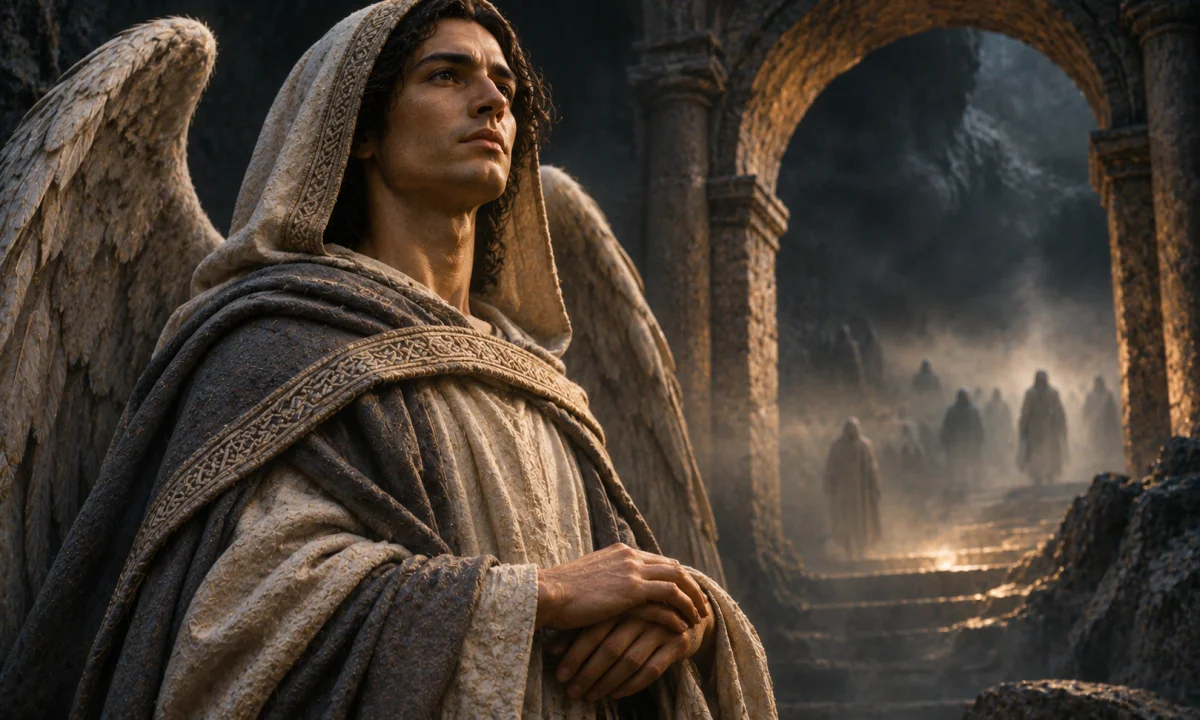
Duma, also written Dumah or Dūmā, is an angelic figure found primarily in Jewish religious and mystical traditions. His name is associated with silence, the dead, judgment, and the regions beyond ordinary human life. Duma is not described consistently across every source: in some traditions he is an angel appointed over the spirits of the dead, while in others he is connected with Gehenna, the realm of punishment, or with the silence surrounding death.
The figure belongs to the complex development of Jewish angelology, in which angels may act as messengers, guardians, heavenly officials, accusers, recorders, or administrators of divine judgment. Unlike Michael or Gabriel, Duma is not a major biblical character with a developed narrative. Most information about him comes from later Jewish literature, rabbinic discussions, and mystical texts. These sources do not always agree on his exact office, rank, or relationship to other beings associated with death.
The name Duma and its meanings
The name is usually connected with the Hebrew root d-m-m, which carries meanings related to silence, stillness, muteness, or cessation. The association is especially appropriate for an angel linked with the dead, since death is understood as a state of silence and separation from the activity of the living world. Transliteration varies because Hebrew names can be represented in English in several ways. Duma and Dumah are the most common forms in English-language discussions.
The name should not automatically be treated as a personal name in the modern sense. In some passages, it may function as the designation of an office or supernatural authority rather than as the name of a character with a single, fixed biography. Jewish angelic names often express a being’s function, relationship to God, or sphere of authority. Duma’s association with silence may therefore describe both his identity and the domain over which he presides.
Several other appearances of the word or similar names occur in Jewish and Near Eastern materials. They must be distinguished from the angel. In the Hebrew Bible, Dumah can refer to a descendant of Ishmael and to a geographical region. Isaiah 21 contains an oracle concerning Dumah, although the passage does not identify Dumah as an angel. The Arabian settlement later known as Dumat al-Jandal is sometimes connected with the biblical place-name, but that geographical tradition is separate from the later angelic figure.
Origins and religious setting
Duma emerges from a religious environment in which the fate of the dead was increasingly described through images of heavenly courts, guarded gates, appointed angels, and differentiated regions in the afterlife. Early biblical texts often speak about death and the underworld in broad or poetic terms, especially through the concept of Sheol. Later Jewish writings developed more elaborate ideas about judgment after death, the condition of souls, punishment, reward, and the angelic beings who administer these processes.
Rabbinic Judaism did not possess one universally authoritative catalogue of angels. Biblical passages, oral interpretation, apocalyptic writings, liturgical traditions, rabbinic stories, and mystical works all contributed to Jewish ideas about the heavenly world. As a result, an angel may appear under different descriptions in different sources. A being who is associated with the dead in one text may be connected with judgment or punishment in another.
Duma is particularly important within this broader pattern because he represents an administrative aspect of death. He is not usually portrayed as a heroic or compassionate guardian. Instead, he belongs to the impersonal and formidable side of the divine order: the heavenly authority that receives, supervises, or judges the dead.
Duma in rabbinic tradition
One important rabbinic association appears in discussions concerning the dead and the boundary between the living and the deceased. Duma is described as an angel appointed over the spirits of the dead. In such traditions, the dead are not simply absent; they inhabit a spiritual domain governed by powers that ordinary human beings cannot see. Duma’s office reflects the belief that even death remains subject to divine organization and judgment.
Some rabbinic material depicts Duma as commanding a large host of angels. The numbers used in these descriptions are generally expressions of immense scale rather than information that can be verified as a literal census. They emphasize the magnitude of the supernatural administration surrounding death. Duma’s authority is therefore not merely personal. He is presented as a superior official with attendants or subordinate beings.
His name also links him with silence. The dead no longer participate in the speech and activity of the living, and Duma’s realm is imagined as one in which human voices have been stilled. This symbolism can be solemn rather than purely frightening. Silence suggests the finality of death, but it may also suggest secrecy, hidden judgment, and the limits of human knowledge concerning what follows life.
Rabbinic references do not provide a continuous story about Duma’s origin, appearance, or personal character. There is no stable account of his birth, a rebellion, a set of adventures, or a clearly defined family. Claims that give him a detailed biography should therefore be treated cautiously unless they are tied to a particular later source or adaptation.
Duma and Gehenna
In Jewish traditions concerning the afterlife, Duma is sometimes connected with Gehenna. Gehenna is a term that developed from the Valley of Hinnom near Jerusalem and came to signify a place or condition of punishment after death. Jewish interpretations of Gehenna have varied considerably. It has been understood in different periods as a realm of judgment, a temporary purgation, a place of punishment for the wicked, or a symbol of spiritual consequences.
Some mystical and post-biblical texts describe Duma as a prince or governing angel of Gehenna. In this role, he may oversee punishments, guard the entrance to a region of the dead, or exercise authority over souls undergoing judgment. The details differ among texts, and the title should not be treated as a universally accepted doctrine of Judaism.
The connection between Duma and Gehenna creates an apparent overlap with other figures associated with death, punishment, or the underworld. This overlap reflects the way Jewish literature developed through layers of interpretation rather than through a single standardized mythology. A text may assign a particular duty to Duma that another text assigns to a different angel or to the angel of death. Such variations are evidence of changing religious imagination, not necessarily contradictions that can be resolved into one official profile.
Appearance and powers
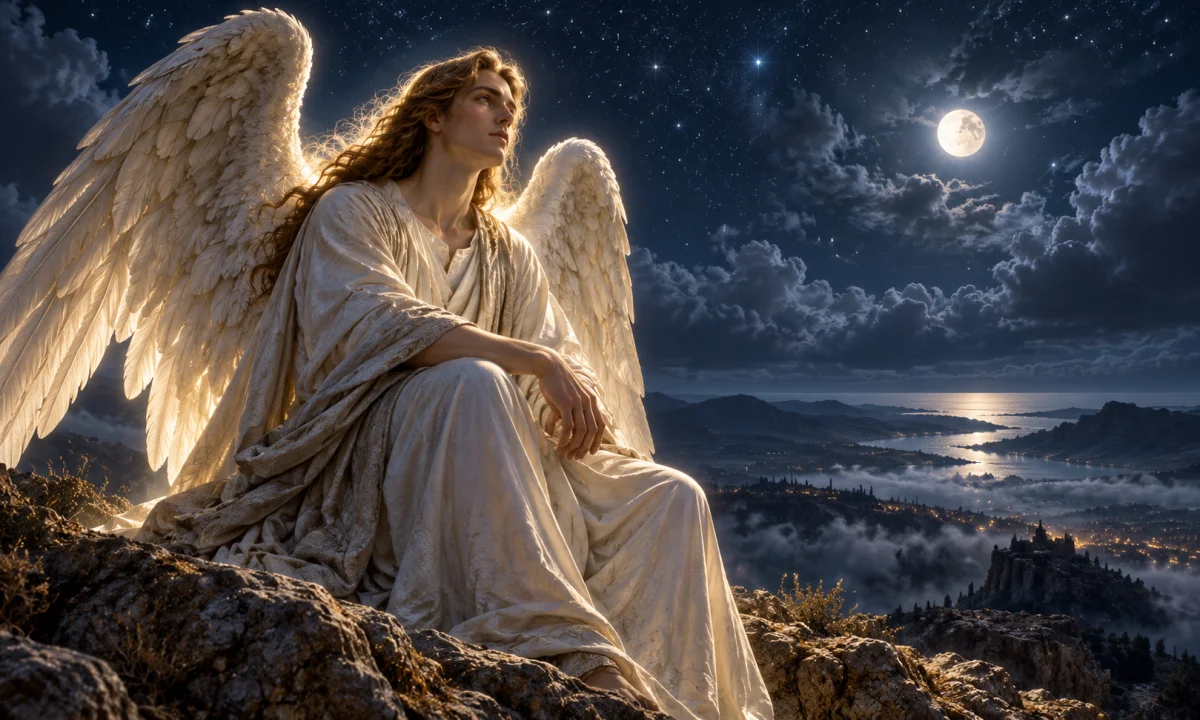
Traditional sources do not preserve a single canonical appearance for Duma. He is not consistently described with a particular number of wings, a fixed color, a distinctive weapon, or a recognizable animal form. Artistic portrayals that give him a skeletal body, black wings, a hood, or a weapon usually belong to later imagination, modern occultism, or visual symbolism rather than to a well-established Jewish description.
Duma’s defining qualities are functional rather than physical. They include:
- Authority over the dead: He may supervise or govern the spirits of deceased people.
- Connection with silence: His name and role evoke the stillness of death and the hidden realm beyond ordinary speech.
- Association with judgment: In some sources, he is involved in the evaluation or punishment of souls.
- Guardianship of the underworld: Mystical traditions may place him at the gates or within the administrative structure of Gehenna.
- Command over other angels: Certain descriptions portray him as a high-ranking official with a large angelic retinue.
These attributes should be understood as recurring themes rather than as a universally fixed list of powers. Duma is not a deity of death, and Jewish tradition does not generally treat him as an independent ruler with power equal to God. Like other angels, he acts within a divinely ordered cosmos. His authority is delegated and limited, even when the sources portray it as terrifying to human beings.
Duma and the angel of death
Duma is often described in modern summaries as “the angel of death,” but this wording can be misleading. Jewish sources contain several ways of discussing the angel or agency of death, and names are not always used consistently. In some traditions, Duma has duties close to those of a death angel because he receives or supervises the dead. In others, he is an official of the afterlife rather than the being who directly causes a person’s death.
The expression “angel of death” can itself refer to a role rather than a single universally named individual. Jewish literature may use different names or descriptions for supernatural agents involved in taking life, recording death, escorting souls, or judging the deceased. Duma should therefore not automatically be equated with every figure called the Angel of Death.
He is also distinct from Samael, another complex figure in Jewish literature who may be associated with accusation, death, severity, or destructive power. Some later accounts bring the two figures into related systems of judgment, but they are not identical in all sources. Similarly, Duma should not be casually identified with Azrael, the angel of death in later Islamic and popular traditions. Their functions may appear comparable, but they arise from different textual and religious histories.
Duma in Jewish mysticism
Jewish mystical literature expanded descriptions of the heavenly worlds, angelic hierarchies, judgment, and the soul’s passage after death. In these writings, Duma may appear as a powerful official connected with Gehenna and with the administration of punishment. The language is often symbolic and dramatic, presenting the afterlife as a structured court or kingdom populated by rulers, guardians, accusers, and messengers.
Mystical descriptions should not be read as straightforward maps accepted equally by all Jewish communities. Kabbalistic texts use symbolic language to explore sin, repentance, divine justice, and the soul’s relationship to holiness. Duma’s silence can represent the secrecy of judgment, the muting of worldly claims before divine truth, or the terrifying absence of ordinary human defenses.
At the same time, these writings preserve an important religious idea: death is not outside the reach of moral order. The dead may be beyond human institutions, but they are not beyond divine awareness. An angel such as Duma gives that belief a personal and administrative form.
Distinguishing Duma from similar names
Confusion surrounding Duma often results from similar spellings and from the movement of names between languages. Several distinctions are especially important:
- Duma or Dumah the angel: A figure of Jewish rabbinic and mystical tradition associated with silence, the dead, judgment, and sometimes Gehenna.
- Dumah in the Hebrew Bible: A name associated with a descendant of Ishmael and with a place or region. These references do not clearly describe an angel.
- Dumat al-Jandal: An Arabian settlement associated by some historical and biblical discussions with the place-name Dumah. It is not an angelic being.
- Azrael: A later Islamic and popular name for the Angel of Death, belonging to a different religious tradition and not simply another name for Duma.
- Samael: A major and varied figure in Jewish angelic and demonological literature whose attributes overlap with death and accusation but who is not identical with Duma in every source.
Similarities between these figures can be useful for comparative study, but they should not erase their different origins. The fact that several traditions imagine an angelic administrator of death does not prove that all such figures derive from one character or possess the same theology.
Symbolism and cultural significance
Duma embodies the idea that silence can be an active spiritual force. Silence is not merely the absence of speech; it is the condition in which human claims, excuses, and social status lose their power. Before death and judgment, the ordinary noise of life is stilled. Duma’s name captures this transition with unusual economy.
His figure also expresses the bureaucratic or judicial side of the unseen world. Many religious traditions imagine death through a psychopomp, a being who transports souls. Duma is different in emphasis. He is more often an official of the destination or process surrounding the dead: a guardian, supervisor, or judge within a larger heavenly system. This makes him an example of how Jewish angelology can transform abstract ideas about death into a network of named offices.
Because Duma is not a central biblical character, his importance depends heavily on interpretation. For some readers he is a frightening guardian of Gehenna; for others he is a symbolic embodiment of death’s silence and the limits of human knowledge. Neither interpretation should be presented as the single meaning of the figure across all Jewish sources.
Later reception
Duma has appeared occasionally in modern occult writing, fantasy fiction, games, and other popular treatments of angels and demons. These adaptations may present him as a grim angel of death, a ruler of hell, a fallen angel, or a supernatural warrior. Such portrayals often combine elements drawn from several unrelated traditions and may give Duma a visual appearance or personality absent from Jewish sources.
Modern uses of the name can be imaginative and culturally significant, but they should be distinguished from traditional material. In the Jewish traditions where Duma is most clearly attested, he is primarily a figure of silence, the dead, judgment, and the administration of the afterlife—not a standardized horned demon, a rival deity, or a universally defined personification of death.