WORLD

Dubbiel
Dubbiel is a named angelic figure in Jewish religious and interpretive tradition, generally understood as the heavenly prince or patron of Persia. He is associated especially with the angelic “princes” of nations described in the Book of Daniel and with later rabbinic discussions of the spiritual powers connected to earthly kingdoms. Dubbiel is not one of the principal angels of the Hebrew Bible, and much of the information about him comes from later Jewish interpretation rather than from a single, continuous narrative.
Origins in Jewish Angelology
The background to Dubbiel is found in the idea that nations may possess supernatural representatives in the heavenly realm. This concept appears most clearly in the Book of Daniel, particularly in Daniel 10. In that chapter, an angel explains that the “prince of the kingdom of Persia” resisted him for twenty-one days until Michael, described as one of the chief princes, came to help. The passage does not name the Persian prince.
Later Jewish interpreters treated these national princes as angelic or spiritual beings associated with particular kingdoms. They were not necessarily equivalent to guardian angels in the modern popular sense. Some could oppose God’s messengers, resist divine purposes, or embody the political and spiritual interests of the nations they represented. The passage in Daniel therefore became an important foundation for Jewish speculation about heavenly powers behind earthly empires.
Dubbiel is identified in rabbinic tradition with the prince of Persia. His name appears in connection with the interpretation of Daniel’s vision, especially in the Babylonian Talmud, where Dubbiel is presented as a powerful celestial representative of Persia. The traditions do not provide a full biography for him. Instead, they place him within a larger structure of angelic administration, national conflict and divine judgment.
The Name Dubbiel
The name is commonly written in English as Dubbiel, although forms such as Dubiel and Dobiel also occur in discussions of Jewish angelology. Transliteration varies because Hebrew names can be represented in more than one way using the Latin alphabet. These spellings should not automatically be treated as the names of separate beings.
The name is often connected with the Hebrew word dub, meaning “bear,” together with the divine element -el, meaning “God.” On that basis, Dubbiel is sometimes explained as “bear of God” or “God is my bear.” Such interpretations are plausible as wordplay or etymological analysis, but the exact intention behind the name is not certain. Ancient angel names do not always preserve transparent explanations of their original meaning, and later writers may have interpreted names differently from the communities that first used them.
The possible reference to a bear has encouraged symbolic interpretations, including strength, fierceness and endurance. There is no clear early account, however, that describes Dubbiel as physically resembling a bear. The animal connection belongs primarily to the interpretation of the name and should not be confused with a traditional description of his appearance.
Dubbiel as the Prince of Persia
Dubbiel’s principal identity is that of the angelic prince of Persia. In this context, “Persia” refers to the great Iranian empire known to the biblical and rabbinic worlds, not to a small local territory. Persia was a major political power in Jewish history. The Persian Empire ruled over the Jewish community after the Babylonian exile and played a significant role in the historical setting of biblical books such as Ezra, Nehemiah and Esther.
The title “prince” has a special meaning in these traditions. It does not necessarily indicate a human ruler or a conventional military commander. A national prince is a heavenly being whose activity is linked symbolically or mystically with a kingdom and its people. The prince may function as a representative, advocate or opponent, depending on the passage and the theological perspective being used.
In Daniel 10, the unnamed prince of Persia opposes the angel bringing a message to Daniel. This scene presents international history as part of a conflict in the invisible world. Political events are not described as being controlled by angels in a simple mechanical way, but earthly empires are portrayed as having corresponding spiritual powers. Later readers who identified the Persian prince as Dubbiel therefore understood him as the celestial counterpart of the Persian empire.
Dubbiel should not be assumed to be evil in the same sense as Satan or a demon. His opposition to a divine messenger places him on the hostile side of a particular conflict, but the available traditions do not consistently classify him as a rebellious angel or an independently wicked spirit. His role is more closely connected with the ambiguous and competitive status of national angelic princes.
The Twenty-One-Day Conflict
The most important narrative associated with Dubbiel derives from the conflict in Daniel 10. Daniel fasts and mourns, and a heavenly messenger eventually arrives to explain that his journey was delayed by the prince of Persia. Michael, the prince associated with Israel, intervenes, allowing the messenger to continue.
Rabbinic discussions expand this episode. In the Babylonian Talmud, Dubbiel is named as the minister or prince of Persia in a passage connected with the twenty-one-day delay. The tradition is concerned not only with a struggle between two individual angels but also with the relationship between heavenly powers, national destiny and divine permission.
Some versions of the interpretation connect Dubbiel with a temporary change in the heavenly order involving Gabriel. The details are difficult to reconstruct with certainty, and different summaries of the rabbinic material can make the episode appear more straightforward than the original discussion actually is. The central point is that Dubbiel represents Persia during a period when the heavenly affairs associated with that empire affect the delivery of a message to Daniel.
The story does not present a simple battle in which one angel defeats another through superior physical strength. Jewish interpretations of Daniel often treat such scenes as revelations of competing jurisdictions, accusations and permissions within the divine court. The delay lasts for a defined period, but the outcome remains subject to God’s ultimate authority.
Relationship to Michael and Gabriel
Dubbiel is most often discussed alongside Michael, the heavenly prince of Israel, and Gabriel, the messenger who appears in the Book of Daniel. Michael and Dubbiel represent opposing national interests within the symbolic geography of Daniel’s vision: Michael is connected with Israel, while Dubbiel is connected with Persia.
This relationship should not be understood as a permanent rivalry between two equal gods. Jewish monotheism places all angels beneath the authority of the one God. Even powerful national princes are created beings whose actions take place within a divine order. Their conflicts dramatize the struggle surrounding empires and nations without making them independent deities.
Gabriel’s relationship with Dubbiel is more episodic. Gabriel is the messenger whose progress is hindered by the Persian prince in the Daniel tradition. Later rabbinic interpretation explores the circumstances of that delay and the role of other angels. Because these discussions are compact and sometimes depend on specialized interpretation, claims that Dubbiel “defeated” Gabriel or permanently replaced him go beyond what can be stated with confidence.
Sources and Limits of the Tradition
Dubbiel is not named in the standard biblical text. His identity depends on the later association of the unnamed Persian prince in Daniel with a specific angelic name. The earliest substantial evidence for that identification belongs to rabbinic literature, especially material associated with the Babylonian Talmud.
Later Jewish mystical and angelological writings also include lists of angels connected with nations, heavenly regions or cosmic offices. In these contexts, Dubbiel may appear as one member of a wider hierarchy of national princes. Such texts were produced over different periods and within different intellectual settings. They should not be treated as a single, uniform account of Jewish belief.
The surviving evidence does not establish a complete myth about Dubbiel. There is no widely preserved creation story, family history, physical description or collection of independent legends comparable to the traditions surrounding Michael, Gabriel or Samael. Information about him is concentrated around his title as Persia’s prince and his place in the interpretation of Daniel 10.
It is therefore useful to distinguish between three levels of tradition. The biblical text speaks of an unnamed prince of Persia. Rabbinic interpretation supplies the name Dubbiel and develops the implications of national angelic powers. Later mystical catalogues may place him within increasingly elaborate heavenly systems. These stages are related, but they are not identical.
Appearance and Powers
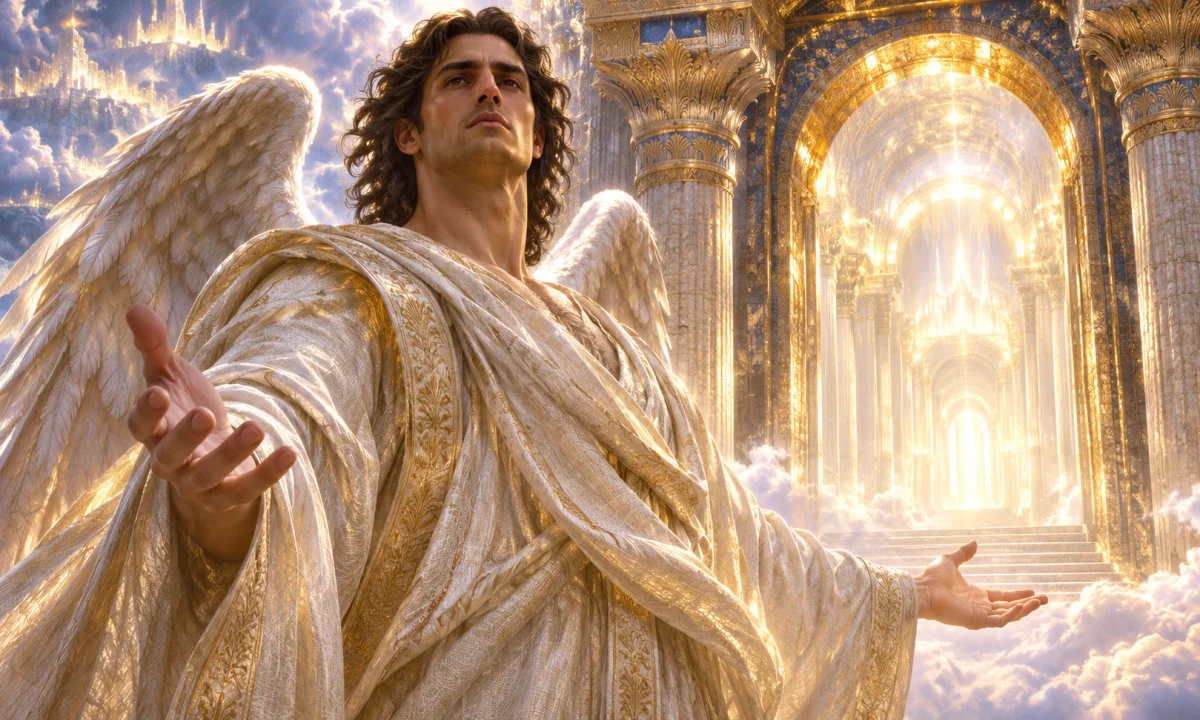
No authoritative traditional description gives Dubbiel a definite human, animal or composite form. Artistic depictions of him as a bear-like angel are modern imaginative choices based on the possible meaning of his name rather than established descriptions from Jewish scripture or rabbinic literature.
His most consistently attributed power is the ability to resist or delay another heavenly messenger. This suggests considerable authority within the symbolic sphere of Persia. He is also treated as a representative of a major empire, which gives him a significance beyond that of an ordinary unnamed spirit.
Some modern accounts assign Dubbiel additional powers, such as control over warfare, influence over particular days or planets, command of other spirits, or a fixed place in systems of ceremonial magic. These associations are not securely grounded in the main Jewish sources about him. They often result from the tendency of later occult writers and online angel lists to combine names from different traditions into standardized catalogues.
The evidence supports a narrower description: Dubbiel is a powerful national angelic prince associated with Persia and involved, directly or interpretively, in the heavenly conflict surrounding Daniel’s revelation.
Symbolism and Religious Significance
Dubbiel illustrates how Jewish interpreters understood the relationship between political history and divine providence. Persia was not merely an empire on a map. In the interpretive world shaped by Daniel, its power had a corresponding presence in the heavenly realm. Dubbiel gives that presence a name.
The figure also reflects a complex view of angels. Angels in Jewish tradition are not always gentle messengers or purely benevolent protectors. They may act as advocates, accusers, guardians, executors of judgment or representatives of nations. Their loyalty and function depend on the particular story. Dubbiel’s opposition to the messenger in Daniel shows that the supernatural world can contain conflict without challenging the sovereignty of God.
His association with Persia also carries historical and theological complexity. Persian rule could be remembered positively in Jewish tradition because the Persian king Cyrus permitted exiled Jews to return and rebuild the Temple. At the same time, Persia remained a powerful foreign empire whose interests did not always coincide with those of Israel. Dubbiel’s ambiguous status reflects this tension better than a simple classification as either a benevolent or malevolent being.
The bear symbolism sometimes attributed to his name can suggest force, political power and stubborn resistance. These meanings are interpretive rather than directly stated in the ancient sources. They may help explain why later writers found the name memorable, but they should not replace the more firmly attested identification of Dubbiel as Persia’s heavenly prince.
Distinguishing Dubbiel from Similar Names
Dubbiel should not be confused with Dubiel or Dobiel merely because those spellings occur in English-language references. They are usually variant transliterations of the same name. A source using one spelling may still be discussing the rabbinic prince of Persia.
He should also be distinguished from Dabriel, a name that appears in some later angelic or occult lists. The similar sound does not prove that Dabriel and Dubbiel are the same figure. Their identities depend on the specific text in which they occur.
Dubbiel is not the Persian god Mithra, Ahura Mazda or Angra Mainyu. He belongs to Jewish angelology, not to the pantheon or dualistic theology of Zoroastrianism. The fact that he is associated with Persia does not make him a Persian religious deity. Likewise, there is no sound basis for identifying him with a particular figure from ancient Iranian mythology.
Nor should Dubbiel automatically be called a demon. In some popular treatments, any angel who opposes another angel is labelled demonic. The older Jewish material is more nuanced. Dubbiel is a national celestial power whose role is adversarial in the Danielic episode, but the surviving evidence does not give him the standard profile of a demon or fallen angel.
Later Reception
Dubbiel has had a limited presence in modern popular culture compared with Michael, Gabriel, Lucifer or other widely known supernatural figures. He occasionally appears in fantasy fiction, role-playing games, occult reference works and online lists of angels. Modern authors may portray him as a bear-headed warrior, a guardian of Persia, a commander of celestial armies or a morally ambiguous rival of Michael.
These portrayals can draw inspiration from genuine elements of the tradition—his name, his association with Persia and his connection with the conflict in Daniel—but they are creative expansions rather than established ancient lore. Fixed rankings, detailed weapons, prescribed colours, planetary correspondences and elaborate biographies should be treated as modern additions unless tied to a specific historical text.
Within the older religious tradition, Dubbiel’s importance lies less in a developed personality than in his function. He gives a name to the spiritual power associated with Persia and helps later Jewish readers explore how earthly empires, angelic agencies and divine purpose might interact. His sparse tradition is therefore significant precisely because it reveals a larger theological pattern: the history of nations can be imagined as having a corresponding drama in the heavenly world.