WORLD
WORLD
Baku
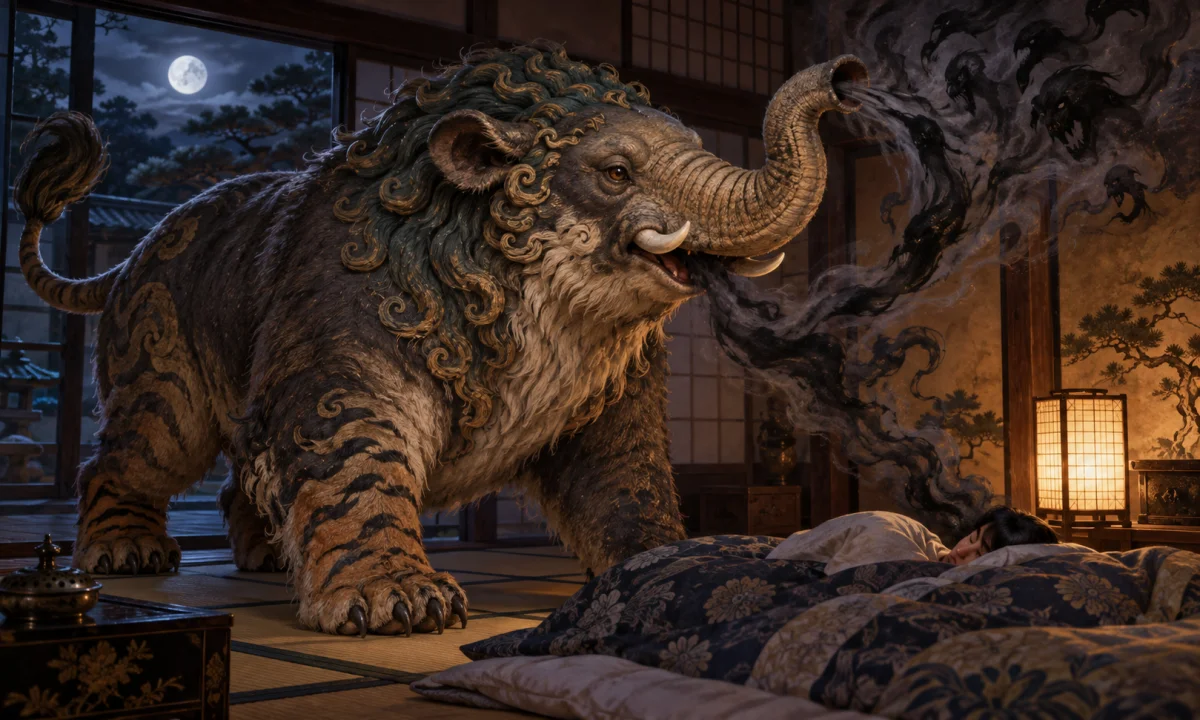
Baku is a supernatural dream-eating creature in Japanese tradition. It is commonly described as a being that devours nightmares and protects sleepers from harmful dreams. In modern illustrations, the baku often resembles a tapir, with a long snout, rounded body and heavy limbs. This appearance is traditional in Japan, but the creature is not simply the real South American or Asian tapir. The Japanese baku developed from older East Asian ideas about an imaginary animal and acquired its connection with dreams through a long process of cultural change.
Origins in East Asian tradition
The Japanese name baku, usually written 獏 or sometimes 貘, is related to the Chinese term mo or mo-like names for a legendary creature. Accounts of this animal varied considerably. Classical Chinese descriptions did not always give it a single stable form, and later writers and artists represented it in different ways. It could be imagined as a composite animal with features borrowed from several familiar creatures rather than as a species with a fixed natural appearance.
Descriptions associated with the Chinese tradition sometimes gave the animal an elephant-like trunk, rhinoceros-like eyes, a cow's tail and tiger-like feet. Other representations made it look more like a bear, a large feline or a tapir. Some accounts connected the creature with iron or copper, while others focused on its unusual body and rarity. These differences matter because the Japanese baku was not copied from one universally accepted original. It was adapted from a changing body of Chinese lore, imagery and written explanation.
The creature entered Japanese cultural life through the broader movement of texts, religious ideas, art and material culture from the Asian mainland. It was encountered in learned settings as an exotic or legendary animal and gradually became part of Japanese beliefs about protection, sleep and dreams. The exact point at which the Chinese animal became the specifically Japanese dream-eater is difficult to establish. Surviving descriptions and images do not form a single continuous account, and the meaning of the name changed according to period and context.
The name and identity of the baku
The word baku can cause confusion because it is used for several related but distinct things. In traditional contexts, it may refer to the legendary animal, an image of that animal, or a protective presence connected with dreams. In modern Japanese, baku can also refer to the real tapir, whose name is commonly written バク in the katakana script. The real animal and the supernatural baku are not the same entity.
The visual resemblance between the legendary creature and the tapir became increasingly influential. Japanese artists and popular culture often portray the baku with a tapir's rounded head, flexible snout, small ears and sturdy body. This makes the creature easy to recognize, but it can give the misleading impression that traditional Japanese people had always identified the baku with a zoologically known tapir. Japan has no native tapir species, and older descriptions were shaped by literary and artistic convention rather than by direct observation of a local animal.
The kanji used for the name also reflect the complicated history of the figure. Chinese and Japanese characters were applied to an animal whose identity was already uncertain, and the same or related characters could be interpreted differently in different periods. Spelling alone therefore does not prove that every reference describes the dream-eating creature. Context is needed to determine whether a passage concerns a legendary animal, a protective emblem, an imported literary motif or the real tapir in modern usage.
Appearance and supernatural abilities
There is no single canonical appearance for the baku. Traditional images often show a composite beast rather than a naturalistic animal. It may have a trunk or elongated muzzle, prominent claws, a compact body and features taken from elephants, bears, tigers, rhinoceroses or other animals. Japanese depictions from the early modern period increasingly settled on a tapir-like form, although artists continued to exaggerate its size and strangeness.
The baku's defining ability is the consumption of dreams. In the most familiar interpretation, it eats nightmares and prevents them from causing harm. A person troubled by a frightening dream might call upon the baku, either before sleep or after waking. The creature then consumes the disturbing dream, leaving the sleeper safe from its effects.
Dreams were not necessarily treated as meaningless private experiences. In many religious and cultural settings, dreams could be regarded as warnings, omens, encounters or signs of spiritual influence. A frightening dream might therefore be more than an unpleasant story in the mind: it could be understood as a threat to health, fortune or peace of mind. The baku provided a vivid protective image for controlling this uncertain realm.
Some traditions extend the baku's appetite beyond nightmares. If it consumes dreams indiscriminately, it might also devour pleasant or auspicious dreams. This creates an important ambiguity. Calling for the baku can protect a sleeper from a bad dream, but invoking it carelessly after a fortunate dream could risk losing something valuable. Such caution is typical of folklore, where a protective power may have conditions or unintended consequences rather than functioning like a simple supernatural machine.
The baku and sleeping protection
Images of the baku could be used as protective objects associated with beds, pillows and sleep. A picture, carving or written name might be kept near a sleeper as a form of apotropaic protection—that is, a means of warding off danger. The image did not merely illustrate a story. It could serve as a symbolic guardian, especially when nightmares, illness or spiritual vulnerability were associated with the hours of sleep.
One traditional response to a nightmare is the expression “Baku, eat it!” or a similar appeal to the dream-eater. The exact wording and practice vary, and not every Japanese tradition treats the phrase in the same way. The underlying idea is consistent: the dream is offered to a supernatural consumer before it can continue to trouble the dreamer.
Dream protection also appears in the wider culture of Japanese sleep customs. The makura, or pillow, was not only a practical object but could carry symbolic meaning. Pillow decorations, embroidered designs and associated charms could help create a protected sleeping space. The baku was especially suitable for this role because its supernatural function directly addressed dangers believed to arise during sleep.
Its protective character sometimes overlaps with other Japanese traditions concerning auspicious objects, household guardians and beings that repel misfortune. This does not make the baku identical with an omamori charm, a Buddhist guardian or a Shinto kami. Rather, it could be represented alongside many other protective practices. The nature of the baku depended on the setting: a learned text might discuss it as an exotic creature, an artist might depict it as a curious monster, and a household might treat its image as a safeguard against nightmares.
Appearance in Japanese literature and art
The baku became especially visible in the culture of the Edo period, when illustrated books, encyclopedias, commercial prints and collections of strange beings circulated widely. Early modern Japanese readers encountered many supernatural creatures through popular reference works and yokai picture books. These publications did not always preserve a strict distinction between ancient belief, foreign lore, literary invention and artistic entertainment.
Artists such as Toriyama Sekien included the baku among their catalogues of unusual beings. Such works helped establish visual conventions that remain influential, including the creature's large body, long snout and mixture of animal traits. They should not be read as photographic records of a uniform popular belief. Edo-period artists often selected, rearranged and stylized older material, and their books could be simultaneously encyclopedic, humorous and imaginative.
Written references likewise preserve several layers of meaning. Some present the baku as an animal from Chinese tradition. Others emphasize its ability to eat dreams. Still others treat its image as an auspicious emblem. The dream-eating interpretation eventually became the dominant association for many Japanese audiences, but it did not erase the figure's older identity as a foreign and composite legendary animal.
Religious and cultural context
The baku is often called a creature of Japanese mythology, but it does not belong exclusively to an indigenous Japanese religious system. Its history reflects cultural exchange across East Asia. Chinese literary traditions, Buddhist networks, imported artistic motifs and Japanese folklore all contributed to the form recognized today.
It is also misleading to describe the baku simply as a demon. In English, “demon” can mean any frightening supernatural being, but the baku is generally protective rather than malicious. Nor is it a god with a large institutional cult, a fixed temple mythology or a clearly defined divine genealogy. It is better understood as a legendary beast and dream guardian whose significance was expressed through images, stories, sayings and protective customs.
The baku does not have one universally accepted sacred scripture or a single authoritative myth comparable to the major narrative cycles associated with figures such as Susanoo or Amaterasu. Its tradition is dispersed across descriptions, illustrations, customs and later retellings. This makes variation a central part of its history. Claims that give the baku one exact body, one fixed origin or one unchanging religious role usually simplify a more complicated tradition.
Symbolism and interpretation
The baku can be interpreted as a symbol of the desire to control the dangers of the unconscious or the uncertain world of sleep. Nightmares feel powerful because they combine vivid emotion with a temporary loss of control. Imagining a creature that consumes them turns an intangible threat into something that can be confronted, named and removed.
Its enormous appetite has a double meaning. On one level, the baku is a reassuring protector: whatever frightens the sleeper can be swallowed. On another, its hunger suggests that supernatural protection must be approached carefully. A creature capable of consuming bad dreams might also consume dreams that should be preserved. This tension gives the baku more complexity than a simple mascot of pleasant sleep.
The creature's composite body also carries symbolic force. By combining traits from powerful, dangerous or unfamiliar animals, the baku becomes a being that does not fit ordinary categories. Its strangeness is precisely what allows it to operate at the boundary between waking and dreaming, nature and imagination, foreign lore and local tradition.
Distinguishing the baku from similar figures
- The real tapir: A tapir is a living mammal with a flexible nose and several species found in parts of Asia and the Americas. The legendary baku may look like a tapir, but the two are not historically identical.
- The Chinese mo: The Japanese baku is historically connected with Chinese legendary-animal traditions, but the Chinese creature had varying descriptions and was not always defined as a dream-eater.
- Japanese yokai: “Yokai” is a broad modern category for strange or supernatural beings. The baku is often included within it, but this classification does not describe a single traditional religious status.
- Nightmare spirits: The baku is sometimes compared with beings that cause nightmares, such as the European incubus or other sleep-related spirits. The comparison is useful only at a broad thematic level. The baku generally removes or consumes nightmares rather than causing them.
- Dream deities: The baku is not necessarily a god of dreams. Its role is more specific and practical: it protects sleepers by eating harmful dreams.
The baku in modern culture
The dream-eating baku remains recognizable in Japan and has become popular internationally through fantasy fiction, animation, manga, video games, illustrations and children's media. Modern creators often use the creature as a friendly guardian, a mysterious monster or a character with powers over dreams. Some designs emphasize the tapir-like appearance, while others return to the older composite-animal form.
Modern adaptations frequently give the baku abilities that go beyond traditional folklore, such as entering dreams, manipulating memories or fighting nightmare creatures. These are creative expansions rather than established features of the older tradition. Likewise, a cute or heroic baku used as a mascot should not be mistaken for evidence that every historical account portrayed it as gentle or child-friendly.
Contemporary uses often preserve the central idea that dreams can be consumed, protected or transformed. The baku therefore continues to work as a flexible image: it can represent comfort after a nightmare, anxiety about losing one's dreams, or the mysterious border between imagination and waking life. Its enduring appeal lies in the combination of an unusual animal form and a simple but powerful promise—that even the most frightening dream may be given to something capable of eating it.