WORLD
WORLD
Bakemono
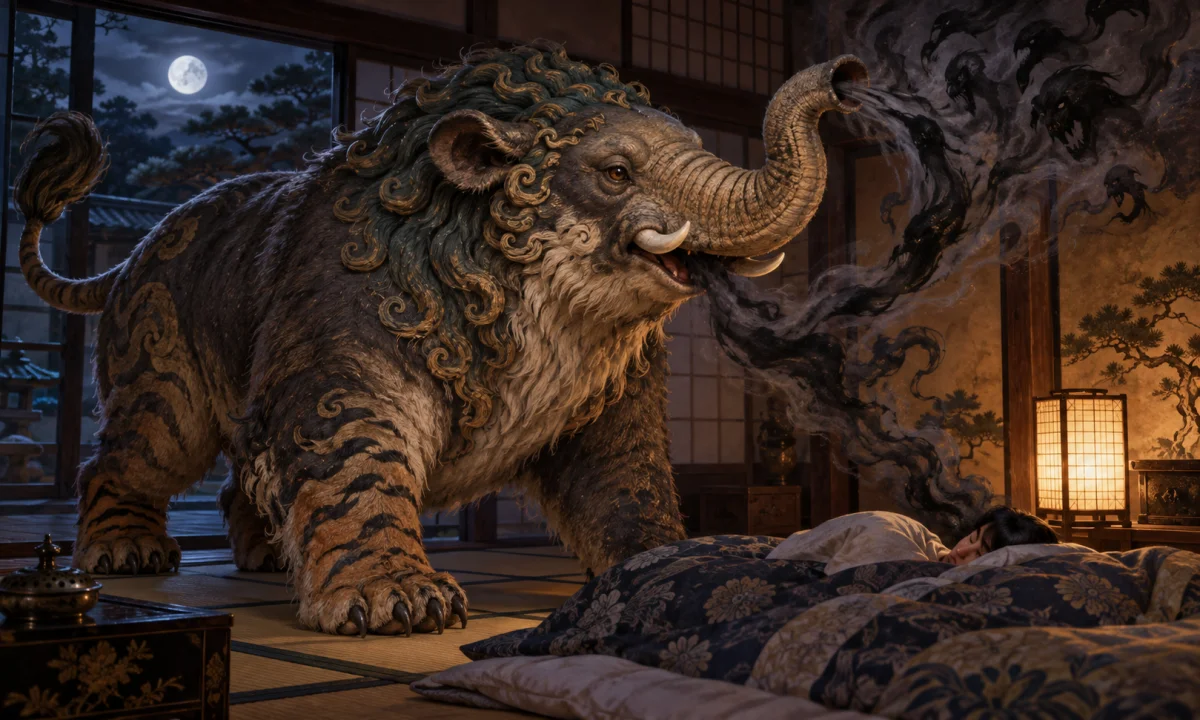
Bakemono (化け物), often translated as “monster,” “apparition,” or “thing that changes,” is a broad Japanese term for a supernatural or uncanny being. It does not usually identify one particular creature with a fixed appearance, genealogy, or mythology. Instead, it describes beings and phenomena understood as strange, transformed, deceptive, or outside the ordinary human world. Depending on context, a bakemono may be a shape-shifting animal, a haunted object, a ghostlike apparition, a frightening monster, or an unnamed supernatural presence.
Bakemono belongs to the vocabulary of Japanese folklore rather than to a single, standardised religious system. The word is closely related to obake, another common term for a supernatural being or “something that changes.” Both words come from the verb bakeru, meaning “to transform,” “to change form,” or “to disguise oneself.” Because bakemono is a general category, its meaning changes according to period, region, genre, and speaker. A story may use it for a dangerous monster, while another may apply it to a harmless trickster or a ghostly manifestation.
The meaning of the name
The word bakemono combines bake, from bakeru, with mono, meaning “thing” or “being.” Its literal sense is therefore close to “a transformed thing.” This meaning is important because transformation is one of the central ideas associated with Japanese supernatural folklore. A familiar animal, household object, natural feature, or dead person may appear in an unfamiliar form and become a source of fear or wonder.
The term is not equivalent to the name of a species. In English-language writing, “Bakemono” is sometimes presented as though it were one specific Japanese monster. That usage is misleading. There is no single traditional Bakemono with a universally recognised body, origin story, or set of powers. The plural can refer generally to many supernatural beings, although Japanese does not require a separate plural ending in the way English does.
Obake is often used in much the same way. In ordinary modern Japanese, both words can refer to a ghost, monster, or frightening supernatural creature. In folklore discussions, however, obake may emphasise the fact that something has changed or is appearing in disguise, while bakemono can sound more like “monster” or “supernatural creature.” These distinctions are tendencies rather than strict rules.
Origins and cultural setting
Beliefs associated with bakemono developed within a religious and cultural environment in which the boundaries between the natural, human, and supernatural worlds were not always sharply fixed. Japanese traditions included reverence for kami, Buddhist ideas about spirits and rebirth, local legends concerning dangerous places, and stories about the dead returning through unresolved attachment. These traditions did not create one unified doctrine of bakemono, but they provided concepts through which unusual events could be understood.
Animals, mountains, forests, rivers, abandoned buildings, and old household objects could all become the focus of supernatural stories. Their significance varied by locality. A fox in one tale might be a mischievous deceiver, in another a powerful spirit, and in another simply an animal blamed for an unsettling event. The supernatural status of such a figure was often conveyed through behaviour—speaking, changing shape, creating illusions, or entering human society—rather than through a fixed visual design.
The idea of transformation also reflects the older Japanese concept of mononoke, a term historically associated with uncanny spiritual forces or harmful supernatural influences. In some contexts, mononoke were connected with illness, possession, resentment, or the disruptive power of a spirit. The word should not be treated as an exact synonym for bakemono, but the two overlap in the wider history of Japanese supernatural thought.
Japanese folklore was transmitted through oral tradition, local custom, religious storytelling, illustrated scrolls, literary collections, theatrical performance, and popular entertainment. Stories that resemble bakemono narratives appear in setsuwa, or short didactic tales, medieval accounts of strange events, Buddhist collections, regional legends, and early modern books of ghost stories. These sources do not present a single official classification. Instead, they preserve changing attempts to describe experiences that were regarded as uncanny, dangerous, entertaining, or morally significant.
Bakemono and the classification of supernatural beings
Modern discussions often place bakemono within the broad category of yōkai. This is useful but not exact. Yōkai is itself a flexible term that can cover monsters, strange phenomena, spirits, demons, and other uncanny beings. The modern use of “yōkai” as an umbrella category was shaped partly by later scholarship, publishing, museums, and popular culture. Historical Japanese sources did not always organise supernatural beings according to the modern yōkai category.
Bakemono is therefore best understood as a descriptive word rather than a formal taxonomic rank. It can overlap with several more specific categories:
- Shape-shifting animals: Foxes, known as kitsune, and raccoon dogs, known as tanuki, are frequently described as changing form or deceiving humans. Their stories are often associated with bakemono, although each has its own traditions and symbolism.
- Haunted objects: Some tales describe old tools or household objects becoming animate and developing supernatural personalities. These beings are commonly associated with the later category of tsukumogami.
- Ghosts: A dead person who returns may be called a yūrei, especially when the story focuses on death, attachment, or unresolved emotion. A ghost can also be called an obake or bakemono in ordinary speech, but the categories are not identical.
- Monsters and demons: An oni is a more specific type of supernatural being, traditionally associated with punishment, violence, wilderness, and the Buddhist imagination of demons. It may be described as a bakemono in a general sense, but “bakemono” does not mean oni.
- Transformed humans or strange people: Folklore includes stories of people who are revealed to be supernatural beings, or who encounter beings disguised as travellers, neighbours, spouses, or strangers.
These categories can overlap because Japanese folklore is not a zoological system. A single tale may call attention to the creature’s animal identity, its ghostly nature, its connection with a place, or its ability to transform. The chosen name depends on what aspect the storyteller wishes to emphasise.
Forms, powers and behaviour
Since bakemono is a general label, it has no standard physical appearance. A bakemono may look almost human, resemble an animal, appear as a distorted body, or emerge from an ordinary object. Some stories describe a being that appears normal until a small detail reveals its true nature: an unusual shadow, an animal’s feet, a strange voice, or a face that changes unexpectedly.
Shape-shifting is the most characteristic ability associated with the term. A supernatural being may imitate a person, take the form of a beautiful woman, disguise itself as a monk or traveller, or become an object in order to deceive someone. Transformation can be temporary or permanent within the story, and it may be performed through magic, spiritual power, age, or accumulated vitality.
Illusion is another common power. A bakemono may make a road appear longer, create a false house, cause travellers to become lost, or make food and money appear where none exists. Such episodes often occur at night or in isolated places, when ordinary explanations are difficult to establish. The being may not physically transform at all; it may instead confuse human perception.
Some bakemono are threatening, especially when they prey on travellers, attack people, cause illness, or lure victims into dangerous places. Others are comic and disruptive rather than murderous. They may play tricks, steal clothing, imitate human manners badly, or expose human greed and gullibility. A story’s tone can therefore range from horror to satire.
Many tales connect supernatural behaviour with boundaries: day and night, village and wilderness, life and death, human and animal, or familiar and unfamiliar. A bakemono often appears when those boundaries become uncertain. The creature’s purpose may be to punish disrespect, test a person’s character, frighten an audience, or explain an event that seemed impossible.
Animals, objects and transformation tales
Stories about kitsune and tanuki are among the best-known traditions associated with the wider idea of the bakemono. Foxes may disguise themselves as humans, produce illusions, possess people, or enter into complicated relationships with them. These stories vary considerably: some portray foxes as dangerous and deceitful, while others show them as loyal, grateful, or capable of forming enduring attachments. Fox folklore also intersects with traditions concerning Inari, a major kami associated with rice, prosperity, and other aspects of Japanese religious life. The foxes connected with Inari should not automatically be treated as identical to every mischievous fox in folklore.
Tanuki stories often present the animal as a trickster and shape-shifter. In popular imagery, tanuki have exaggerated features and a comic personality, but older tales can be more unsettling. Like foxes, tanuki may adopt human forms, imitate voices, or deceive people through illusions. Their role differs from story to story, and the familiar cheerful image of the tanuki is only one part of a much broader tradition.
Another important group involves objects that acquire life or supernatural agency. The later term tsukumogami is commonly associated with old objects becoming animate after long use or after reaching a particular age. Such beings can be benevolent, resentful, mischievous, or frightening. Their stories may express anxiety about neglect, waste, household labour, and the treatment of possessions. They are often discussed alongside bakemono because an object that suddenly moves, speaks, or changes form is literally a “transformed thing.”
Not every tale of a strange object should be assigned to tsukumogami, however. The categories developed through different sources and later interpretations, and historical writers did not always use them consistently. The broad word bakemono can describe the event without establishing a precise folklore classification.
Stories, literature and visual culture
Medieval and early modern Japanese literature preserved many accounts of strange transformations, hauntings, and encounters with supernatural beings. Buddhist tales sometimes used apparitions and monstrous figures to illustrate the consequences of attachment, wrongdoing, or neglected religious duties. Other narratives treated supernatural events as local wonders or entertaining mysteries rather than as formal religious instruction.
During the Edo period, roughly from the seventeenth to the nineteenth century, popular publishing helped circulate stories and images of ghosts, monsters, and strange creatures. Collections of kaidan, or supernatural tales, became widely read. Illustrated books and prints gave visual form to beings that had previously existed mainly in oral accounts or literary descriptions. Artists and authors could exaggerate features, combine motifs, or invent comic scenes, making it difficult to separate older local traditions from deliberate artistic creation.
Toriyama Sekien’s illustrated catalogues of strange beings are particularly influential in the history of yōkai imagery. His works helped establish visual conventions for many supernatural creatures, but they should not be read as a complete ancient encyclopedia. Some figures drew on earlier stories, while others were developed or reshaped through literary and artistic interpretation. The continuing popularity of these images has led many later audiences to treat flexible folklore characters as though they had always possessed fixed designs.
Religious and symbolic significance
Bakemono stories do not belong exclusively to Shinto, Buddhism, or any other single religious tradition. They exist in a cultural environment shaped by all of these influences, as well as by local custom and secular entertainment. A story may involve a shrine, a Buddhist temple, a protective ritual, or a spirit of the dead without making the creature an official figure of that religion.
The symbolic meaning of a bakemono depends on the narrative. Transformation can express distrust of appearances, fear of strangers, unease about social change, or the danger of entering a forbidden place. A human who fails to recognise a disguised supernatural being may be punished for arrogance or greed. Conversely, a person who shows compassion may receive protection or a reward.
Bakemono can also represent the instability of identity. The being may imitate a family member so convincingly that recognition becomes uncertain. An animal may display more loyalty than a human companion, while an apparently ordinary object may reveal a hidden history. These reversals allow folklore to question assumptions about what is truly human, trustworthy, alive, or familiar.
Distinguishing bakemono from related terms
The most important distinction is between bakemono as a general description and named beings such as kitsune, tanuki, yūrei, or oni. Calling a kitsune a bakemono may be acceptable when using the word broadly, but it does not replace the specific name or erase the fox’s particular traditions. Similarly, an oni may be monstrous, yet the term bakemono does not describe the oni’s distinctive religious and folkloric history.
“Ghost” is also an imperfect translation. Some bakemono are ghosts, but many are living animals, animated objects, spirits of uncertain status, or illusions. “Monster” can be equally misleading when it suggests an inherently evil creature. Traditional stories include frightening beings, comic tricksters, guardians, victims, and morally ambiguous figures.
The safest translation depends on context. “Supernatural creature” works in a general folkloric discussion; “monster” may suit a frightening narrative; “apparition” may fit a ghostly manifestation; and “shape-shifter” may be appropriate when transformation is central. Retaining the Japanese term is useful when the broadness of the original word matters.
Modern usage and popular culture
In contemporary Japanese, obake and bakemono remain ordinary words for ghosts, monsters, and frightening supernatural figures. They appear in children’s entertainment, horror fiction, seasonal events, advertising, games, manga, anime, and films. Modern works often use the terms as creative labels rather than as claims about a single traditional being.
Popular culture has also made “yōkai” internationally familiar and has encouraged the impression that Japanese folklore consists of a fixed bestiary. In reality, many designs now treated as standard were shaped by artists, publishers, museums, television, and digital media. Modern adaptations may combine several traditions, give a creature a consistent personality, or turn a frightening being into a mascot. Such versions are part of the continuing reception of folklore, but they should be distinguished from the varied historical meanings of bakemono.
Bakemono is therefore most accurately understood as a flexible Japanese word for the uncanny and transformed. It names a field of possibilities rather than one monster: a world in which an animal may wear a human face, an old object may acquire a will of its own, and an apparently ordinary encounter may conceal a supernatural change.