WORLD
WORLD
Asariel
Asariel is a name associated in some later angelological and esoteric writings with water, the sea, and the zodiacal sign Pisces. Unlike Michael, Gabriel, Raphael, or other angels with substantial scriptural and liturgical traditions, Asariel does not have a firmly established identity in the Bible, the Qur’an, or the principal early Jewish and Christian angelic texts. The name appears mainly in modern compilations of angel names and occult traditions, where its spelling, rank, and attributes vary considerably.
Origins and religious setting
Angels have been named and classified in many different ways across Jewish, Christian, Islamic, mystical, and later esoteric traditions. Some names are rooted in biblical passages, ancient apocalypses, liturgical prayers, or established theological commentary. Others emerge from mystical speculation, magical manuals, Renaissance occultism, nineteenth-century esotericism, or modern attempts to organize large catalogues of supernatural beings.
Asariel belongs to the less securely documented group. The name is not a standard figure in the Hebrew Bible, the New Testament, or the Qur’an. Nor is Asariel one of the principal named angels in widely known early Jewish apocalyptic works such as the Book of Daniel or the Book of Enoch. This absence does not disprove the existence of the name in every historical manuscript or local tradition, but it means that claims about Asariel should not be presented as though they represented a universally recognized ancient doctrine.
Many references to Asariel come through modern angel dictionaries, occult lists, astrological angelologies, and popular spiritual writings. These sources often preserve names without explaining where they first appeared, or they repeat information from earlier compilations without independent evidence. As a result, the historical origin of the name and its supposed attributes remain uncertain.
The name Asariel
The form Asariel resembles the many angelic names ending in -el, a Hebrew element commonly understood as referring to God. Names such as Michael, Gabriel, Raphael, and Uriel follow this pattern. However, the resemblance alone does not establish a reliable Hebrew etymology for Asariel.
Different sources may use related or alternative forms, including Asaryel, Asariel, or names that are easily confused with Sariel, Ariel, and Azrael. These variations are not necessarily different spellings of one historical angel. They may reflect transliteration, copying errors, independent occult systems, or the tendency of later writers to adapt unfamiliar names to a familiar angelic pattern.
The meaning sometimes assigned to Asariel is connected with water or the sea, but this association does not provide a secure translation of the name. It is better understood as a traditional attribution found in certain later lists than as a proven meaning derived from an ancient language.
Classification in later angelology
In modern esoteric angelology, Asariel is most often described as an angel of water. Some lists connect the figure with the ocean, rainfall, springs, tides, emotional depth, intuition, and the hidden movements of the unconscious mind. Other systems assign Asariel to Pisces, the final sign of the zodiac, or place the angel among spiritual beings associated with the element of water.
These classifications are not consistent across all sources. One writer may describe Asariel as a ruling spirit of Pisces, while another may present the name as belonging to a guardian of the sea or to an angel invoked in rituals involving water. There is no single authoritative hierarchy that establishes Asariel's rank, duties, or relationship with other angels.
The name is therefore best treated as part of a later symbolic angelology, rather than as the name of a universally recognized archangel. In some popular lists, Asariel is called an archangel, but that title is not supported by a widely accepted scriptural or historical tradition. The term “archangel” itself has different meanings in different religions, and applying it to Asariel usually reflects the classification system of a particular modern source.
Water symbolism
The association between Asariel and water draws on a symbolism that is widespread in religious and mythological traditions. Water can represent life, cleansing, fertility, transformation, danger, chaos, memory, and the boundary between the visible and invisible worlds. Seas and rivers may nourish human communities, but they can also conceal monsters, swallow ships, and separate the known world from distant realms.
Within Jewish and Christian symbolism, water has several meanings. Creation narratives present the ordering of waters as part of the formation of the cosmos. The Flood represents judgment and destruction, while ritual washing and baptism use water as a sign of purification, renewal, or entry into a religious community. These traditions do not, however, identify Asariel as the angel responsible for water.
In later esoteric interpretations, Asariel's supposed connection with water is often extended into the emotional and psychological realm. The angel may be invoked symbolically in relation to compassion, dreams, imagination, healing, adaptability, and the release of grief. Such interpretations belong to modern spiritual practice and should be distinguished from established Jewish, Christian, or Islamic teaching.
Association with Pisces
Some contemporary angel lists connect Asariel with Pisces, the twelfth sign of the Western zodiac. Pisces is traditionally represented by two fish and is associated in astrology with fluidity, sensitivity, imagination, sympathy, and spiritual longing. Because water is also the element assigned to Pisces in modern Western astrology, the connection between Asariel and the sign is symbolically convenient.
There is no evidence that this assignment formed part of an ancient, universally accepted angelic system. Jewish angelology, Christian angelology, and Western astrology developed through overlapping but distinct historical processes. Later occult writers often combined material from these traditions, creating correspondences between angels, planets, zodiac signs, elements, metals, colours, and days of the week.
Consequently, descriptions of Asariel as the “angel of Pisces” should be identified as an astrological or esoteric attribution, not as a central teaching of biblical religion. It may be meaningful within a particular modern practice, but it does not have the same historical status as the biblical association of Michael with certain scriptural episodes or the recurring New Testament role of Gabriel as a messenger.
Attributes and appearance
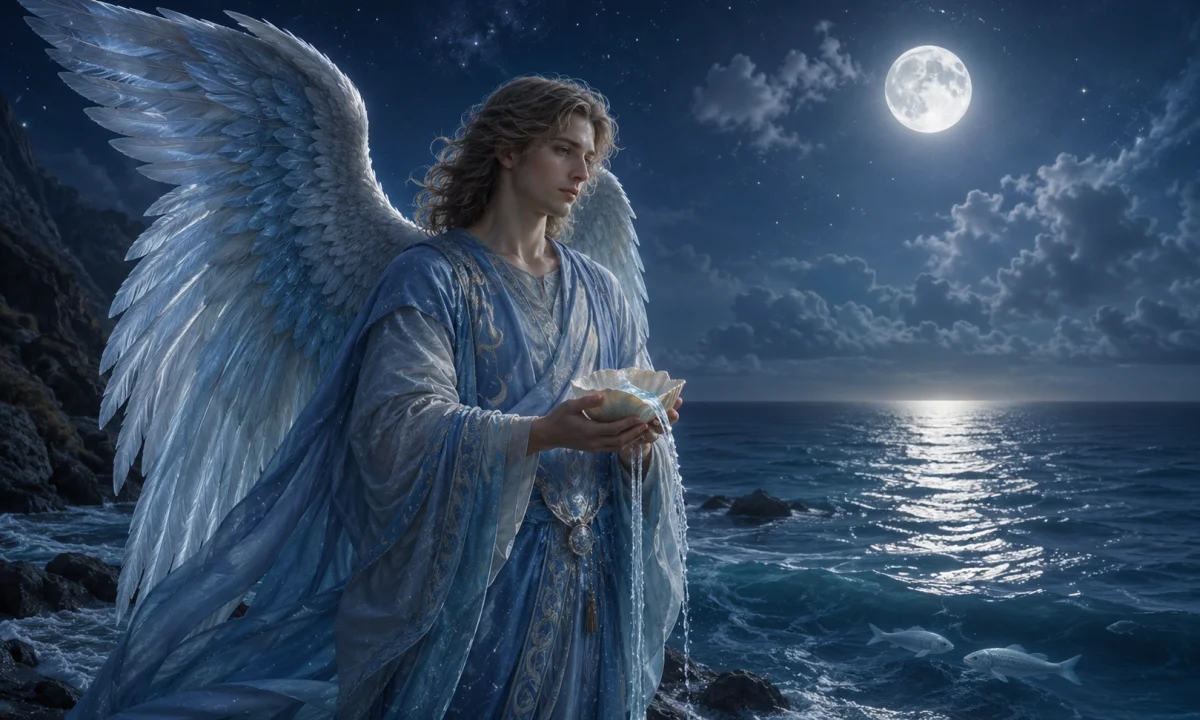
There is no stable ancient description of Asariel's appearance. In modern artwork and spiritual writing, the figure may be shown with blue or silver clothing, wings resembling waves, a shell, a vessel of water, or a background of stars and ocean. These images express the angel's supposed watery and celestial associations, but they are creative representations rather than inherited iconography.
Descriptions of Asariel's powers likewise vary. Commonly attributed functions include:
- guiding or protecting people who travel by sea;
- symbolically governing rivers, rain, springs, or the ocean;
- supporting emotional healing and compassion;
- encouraging intuition, dreams, and imaginative insight;
- helping people adapt to change; and
- representing spiritual purification through water.
These roles should not be treated as a fixed catalogue. They are interpretations built from the symbolic meaning of water and from the astrological qualities associated with Pisces. Different authors may omit some of them or add unrelated functions.
Stories and relationships
No widely recognized myth or scriptural narrative centres on Asariel. There is no well-established account of the angel's creation, a rebellion in heaven, a meeting with a prophet, or a conflict with a demon that belongs to a major religious canon. Stories sometimes found in online descriptions are generally brief devotional inventions, modern retellings, or unsourced expansions of the angel's supposed attributes.
Asariel is also not securely related to a particular angelic family or hierarchy. Some popular sources place the figure among archangels, elemental angels, zodiacal guardians, or angels of the months. These categories often come from separate systems that have been combined in modern reference works. A list that places Asariel beside the four archangels, for example, should not automatically be read as evidence that historical Jewish or Christian tradition did the same.
Likewise, there is no reliable traditional basis for describing Asariel as a spouse, sibling, servant, rival, or superior of another named angel. Relationships of this kind may appear in imaginative fiction or contemporary spiritual material, but they should not be confused with inherited religious narratives.
Distinction from similar names
Sariel
Sariel is a different figure from Asariel. Sariel appears in some ancient Jewish apocalyptic and mystical traditions, although the spelling and role vary. In the Book of Enoch, Sariel is listed among prominent angels, and other sources associate the name with the moon, divine judgment, or instruction. Because the two names sound similar, they are sometimes conflated in later lists, but they should not be merged without evidence.
Ariel
Ariel, whose name is often interpreted as “lion of God” or “altar of God” depending on context, has a much broader history in Jewish, Christian, and occult writings. Ariel may refer to a name connected with Jerusalem in biblical usage, an angelic or spiritual being in later traditions, or a spirit of nature in Renaissance and modern occultism. The similarity between Ariel and Asariel does not prove that they are alternate names for the same being.
Azrael
Azrael is commonly known in Islamic and later Jewish and Christian folklore as an angel associated with death. The precise status of the name differs between Islamic sources and later popular representations, but Azrael's death-related identity is distinct from the watery and astrological attributes usually assigned to Asariel.
Other water-associated beings
Asariel should also be distinguished from deities, spirits, and legendary beings whose traditional roles are genuinely connected with water. These include figures such as Poseidon, Neptune, Tiamat, the biblical Leviathan, mermaids, river spirits, and various local water guardians. An association with the sea does not make Asariel part of these mythologies, nor does it place the figure within a pre-Christian pantheon.
Religious significance and historical assessment
From a historical perspective, Asariel illustrates how angelic names can circulate beyond the boundaries of formal scripture and established liturgy. Religious traditions have often generated new angelic names through interpretation, visionary writing, mystical speculation, translation, and ritual practice. Later occult authors then arranged these names into elaborate systems, sometimes assigning them precise functions that are not present in earlier material.
The lack of a secure ancient source does not prevent Asariel from having personal significance for people who use the name in prayer, meditation, art, or contemporary spiritual practice. It does mean that such use should be described accurately. A modern practitioner may regard Asariel as a protector of the sea or a guide through emotional change, while a historian would classify those beliefs as part of recent or esoteric reception rather than as settled ancient doctrine.
Asariel is therefore most responsibly presented as a minor and uncertain angelic figure in later esoteric tradition. The water and Pisces associations are recognizable in modern angel reference works, but the evidence for a continuous ancient cult, a canonical story, or a universally accepted angelic office is lacking. Treating those limits as part of the subject's identity prevents an obscure name from being transformed into a falsely documented archangel.
Later reception
In contemporary spiritual culture, Asariel may appear in writings about angel meditation, zodiacal correspondences, elemental symbolism, crystal practices, dream work, and ocean-themed spirituality. Artists and authors often portray the figure as serene, blue-robed, winged, and surrounded by waves or moonlit water. These images belong to modern devotional and imaginative culture rather than to a continuous traditional iconography.
Asariel does not have a major, widely recognized role in mainstream film, television, literature, or games. When the name appears in modern fiction, its meaning may be reinvented according to the needs of a particular story. A fictional Asariel may therefore be a guardian, warrior, antagonist, or entirely different kind of supernatural being. Such portrayals should be kept separate from the limited and variable angelological tradition associated with the name.