WORLD

Dagiel
Dagiel is a little-known angelic name found chiefly in later occult and esoteric angelologies. It is most often associated with Pisces, the final sign of the Western zodiac, and with symbolic themes such as water, fish, intuition and the boundary between the visible and invisible worlds. Unlike Michael, Gabriel or Raphael, Dagiel does not have a widely established role in the Bible, the Qur’an or other major canonical scriptures. The surviving information is brief, inconsistent and largely dependent on later lists of zodiacal or planetary spirits.
Origins and religious setting
The name Dagiel belongs to the broad tradition of cataloguing angels according to cosmic structures. In Jewish, Christian and later Western esoteric thought, angels were sometimes arranged in relation to the stars, planets, zodiacal signs, hours, directions, elements or parts of the natural world. These systems did not all share the same theology. Some were connected with mystical speculation, while others belonged to ceremonial magic, Renaissance occult philosophy or modern occult correspondence tables.
Dagiel is not a prominent figure in the Hebrew Bible. Nor is Dagiel one of the named angels whose stories and offices are developed in early Christian scripture. The name is also not a standard member of the principal angelic figures recognized in Islamic tradition. Its presence is instead associated with later angel lists that circulated in esoteric literature and in reference works dealing with magical names.
The exact origin of the name is uncertain. Some compilations place Dagiel within a Jewish or Kabbalistic framework, but that classification should be treated carefully. A name appearing in a list described as “Kabbalistic” does not necessarily mean that it can be traced to a classical Kabbalistic text. Many occult writers borrowed Hebrew-looking names, rearranged older material or attributed collections to prestigious ancient authorities. The textual history of individual names can therefore be difficult to establish.
The name Dagiel
Dagiel is commonly understood as a name formed from elements resembling Hebrew. The Hebrew word dag means “fish,” while -el is a common divine element meaning “God” or referring to God. On that basis, the name may be interpreted loosely as “fish of God” or “God is [connected with] fish.” This is a possible linguistic reading, not a securely documented ancient translation.
The spelling is not completely stable. Dagiel is the most familiar form in modern English-language occult references, while forms such as Daghiel may appear in related lists or secondary compilations. Variant spellings do not necessarily represent separate angels. At the same time, similarity of spelling alone is not enough to prove that all such forms have the same origin or meaning.
The apparent reference to fish fits the association with Pisces, whose conventional symbol consists of two fish. It remains uncertain, however, whether the name was originally created to match the zodiacal sign or whether an older name was later assigned to Pisces because its sound and apparent meaning seemed appropriate.
Association with Pisces
Dagiel is most often described as an angel of Pisces. Pisces occupies the twelfth position in the Western zodiac and is traditionally a mutable water sign. In astrological symbolism, it has been associated with sensitivity, imagination, dreams, compassion, spiritual receptivity and the dissolution of rigid boundaries.
These qualities provide the main context for Dagiel’s modern interpretation. As the angel connected with Pisces, Dagiel may be presented as a guardian or spiritual emblem of people born under that sign. In symbolic readings, the figure can represent the movement between ordinary awareness and dream experience, the depths of the unconscious, and the tension between empathy and lack of boundaries.
Such descriptions should not be confused with a detailed ancient mythology. There is no widely preserved narrative in which Dagiel appears as a character with a family, genealogy, celestial rank or sequence of adventures. Most statements about the angel’s qualities are extrapolations from the symbolism of Pisces rather than accounts of independent stories about Dagiel.
Different zodiacal angel lists may assign different names to Pisces. Some traditions and modern systems associate the sign with other angels, archangels or spiritual beings. Consequently, describing Dagiel as “the angel of Pisces” identifies a particular occult convention, not a universal doctrine shared by Judaism, Christianity, Islam or all forms of Western astrology.
Attributes and symbolism
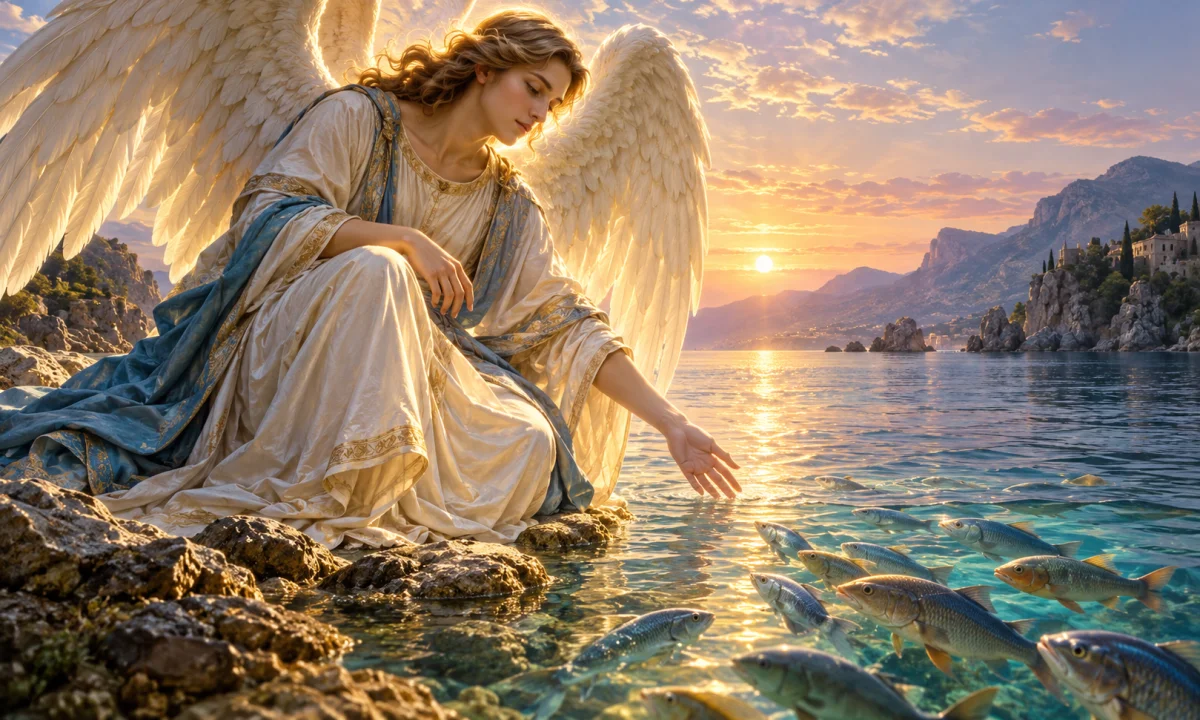
Dagiel has no consistently established physical appearance. Images of a winged human figure standing over water, a luminous being surrounded by fish or an androgynous spirit of the deep are modern artistic interpretations rather than features preserved in a canonical description.
The symbolic attributes most often connected with Dagiel arise from four related ideas:
- Water: Water suggests emotion, purification, intuition and the hidden depths of the mind.
- Fish: The fish connects the name with Pisces and may also evoke movement through an unseen or spiritual realm.
- Dreams and vision: Pisces is commonly associated with dreams, imagination and altered states of awareness, so Dagiel is sometimes treated as a guide through symbolic or visionary experience.
- Compassion: The figure may be interpreted as representing mercy, emotional sensitivity and concern for suffering beings.
In ceremonial or contemporary esoteric practice, these themes can be turned into correspondences involving colors, incense, metals, stones or ritual times. Such assignments vary widely and should not be presented as ancient facts about Dagiel. There is no single authoritative system of symbols that governs every appearance of the name.
Role in angelic classifications
Dagiel’s classification is usually functional rather than hierarchical. In the major scriptural traditions, angels may be described as messengers, guardians, worshippers of God or agents carrying out divine commands. Later theologians also developed hierarchies of celestial beings, especially through discussions of orders such as seraphim, cherubim and thrones.
Dagiel is not normally assigned a secure place within those classical hierarchies. The title “angel of Pisces” describes an astrological correspondence, not a rank such as archangel, principality or power. Some modern lists may call Dagiel a guardian angel, but this language is often used broadly and does not establish a recognized doctrine of personal guardianship.
This distinction matters because occult catalogues frequently place together beings from very different traditions. A list may include biblical angels, names drawn from mystical speculation, figures from medieval magical manuals and names created or transmitted by modern occult authors. Their appearance in the same table does not mean that they share a common origin or equal religious status.
Sources and transmission
Information about Dagiel is sparse because the name does not belong to a large narrative tradition. It is encountered mainly through angelic and occult name lists, zodiacal correspondences and later reference works. In many cases, modern entries repeat information from earlier compilations without explaining where the name first appeared. This makes it difficult to determine whether a particular attribute is ancient, medieval, Renaissance or comparatively recent.
The label “Jewish angel” is therefore potentially misleading. Dagiel may be presented in material influenced by Hebrew language and Jewish mystical vocabulary, but that does not demonstrate that Dagiel was a figure of ordinary Jewish religious practice or a universally accepted part of Jewish angelology. Classical Jewish sources contain extensive discussions of angels, divine names and celestial realms, yet Dagiel is not among the best-attested named angels of that literature.
Nor should the absence of a major surviving story be treated as evidence that Dagiel once had a large mythology that has simply been lost. The more cautious interpretation is that the name functioned primarily as a brief entry in a correspondence system. Such entries often provided a name and an association, while leaving later readers to supply personality, imagery and ritual significance.
Meaning in contemporary spiritual interpretation
Today, Dagiel may be used as a symbolic figure in astrology, angel meditation or personal spiritual practice. A person working with the name may regard it as an image of emotional understanding, imaginative insight or acceptance of uncertainty. The Pisces connection also allows Dagiel to symbolize the meeting of opposites: individuality and unity, waking life and dreams, boundaries and surrender.
These interpretations belong to modern or revivalist spirituality rather than to a single continuous historical cult of Dagiel. They can be meaningful within a personal devotional or esoteric framework, but they should be distinguished from documented religious tradition. There is no broadly recognized liturgy, feast day, scriptural prayer or universally accepted sacred image devoted to Dagiel.
The angel’s obscurity also illustrates how names can acquire significance through classification. Once a name is placed beside Pisces, later readers naturally connect it with fish, water and the emotional symbolism of that sign. Over time, these associations can make a short catalogue entry appear to possess a richer mythology than the historical evidence supports.
Distinguishing Dagiel from similar names
Dagiel should not automatically be identified with every figure whose name contains a similar sound. The name may be confused with Dagon, an ancient Near Eastern deity whose name and interpretation have a separate history. Dagon is not an angel and should not be treated as an older form of Dagiel merely because both names can be associated with fish in later popular imagination.
Dagiel is also distinct from Dagda, the important supernatural figure of Irish mythology. Dagda belongs to the mythological traditions of Gaelic Ireland and has no established connection with the zodiacal angel Dagiel. Likewise, resemblance to names such as Daniel or other angelic names ending in -el does not establish a relationship.
Even the spelling Daghiel requires caution. It may be a variant transcription of Dagiel in some sources, but a similar-looking name in another catalogue could represent a different figure. Identifying names across angelic lists requires attention to the source, language, chronology and surrounding associations, not just to orthography.
Dagiel in modern culture
Dagiel has little presence in mainstream popular culture compared with angels such as Michael, Gabriel or Azrael. The name may appear in modern occult websites, self-published angel directories, fantasy role-playing material or fictional settings that draw on lists of obscure supernatural beings. In these contexts, Dagiel may be given elaborate powers, a personal history or a distinctive appearance.
Those additions are creative adaptations rather than evidence for a previously unknown traditional mythology. A fictional Dagiel might be portrayed as a guardian of oceans, a messenger of dreams or a celestial fish-like being, but such portrayals should be kept separate from the limited historical association with Pisces.
Historically, Dagiel is best understood as an uncertain and lightly documented name in later angelic and astrological classification. Its significance comes less from surviving stories than from the symbolic framework attached to Pisces: water, fish, imagination, compassion and the mysterious regions between ordinary perception and spiritual experience.