WORLD

Damabiath
Damabiath is an uncertain angelic name found in some modern and esoteric lists of angels. It is not a clearly identified angel in the Hebrew Bible, the New Testament, or the principal bodies of early Jewish and Christian angelology. In many cases, Damabiath appears to be a variant spelling, transcription, or corruption of Damabiah, the name traditionally assigned to the sixty-fifth angel of the 72-fold angelic system known as the Shem ha-Mephorash. Because the evidence is inconsistent, Damabiath should not automatically be treated as a separate and independently documented angel.
The uncertainty surrounding the name
The spelling Damabiath does not have a stable, widely accepted identity across religious and historical sources. Angel names were often copied through several languages, alphabets, and systems of pronunciation. A name written in Hebrew characters could be transliterated into Latin letters in more than one way, and later occult authors sometimes altered spellings while adapting older lists to their own systems.
The most likely comparison is with Damabiah, commonly written in forms such as Damabiah, Damabia, or related transliterations. The final -th in Damabiath may reflect a copying error, an attempt to represent a different pronunciation, or confusion with other angelic names ending in -iah or -aath. There is not enough reliable evidence to establish that Damabiath and Damabiah were originally conceived as two distinct beings.
This uncertainty is important because many popular angel directories present names, meanings, colours, planets, stones, hours, and personality traits as though every entry came from a single ancient tradition. In reality, such systems often combine biblical material, Jewish mystical concepts, medieval magical texts, Renaissance occult philosophy, and modern spiritual interpretation. Damabiath belongs to this uncertain area of transmission rather than to a clearly defined scriptural tradition.
Relationship to Damabiah
Damabiah is generally listed as the sixty-fifth name in versions of the Shem ha-Mephorash, a 72-name system associated with three verses in Exodus 14:19–21. Each of those verses contains seventy-two Hebrew letters in the traditional arrangement used by later Kabbalistic interpreters. By taking one letter from each verse according to a prescribed order, interpreters formed seventy-two three-letter combinations. These combinations later became the foundations for angelic names, usually expanded with the divine ending -iah.
The biblical verses themselves do not present a numbered list of seventy-two angels. The angelic names belong to later Jewish mystical and magical developments built around the verses. Consequently, Damabiah is not a biblical character with a narrative role in Exodus. It is a name within a symbolic and occult arrangement that was elaborated over time.
Where Damabiath is connected with Damabiah, the attributes assigned to the former usually derive from this Damabiah tradition rather than from an independent myth. Some systems associate Damabiah with the sea, water, hidden knowledge, wisdom, protection, and the successful completion of undertakings. These associations are not uniform, and they should be described as later angelological correspondences rather than universally accepted religious teachings.
Religious and cultural setting
Jewish angelology developed in several different settings. The Hebrew Bible refers to angels and other heavenly beings in varied ways, including messengers, divine attendants, guardians, and agents of judgment. Later Jewish writings expanded the names and functions of such beings, especially in apocalyptic literature, rabbinic discussion, mystical speculation, and magical texts. No single Jewish doctrine contains a complete and universally authoritative catalogue of angels.
The 72-name system associated with Damabiah belongs especially to the history of Jewish mysticism and later Western esotericism. Medieval Kabbalistic writers treated divine names as powerful expressions of sacred language. In magical and devotional practice, these names could be connected with prayer, meditation, protection, healing, astrology, or the ordering of spiritual forces.
Christian occult writers later adopted many of these names. During the Renaissance and early modern period, Christian Kabbalah, ceremonial magic, angelic magic, and astrological symbolism developed overlapping lists. The names were then linked with planets, zodiacal signs, hours of the day, bodily qualities, virtues, and ritual formulas. Modern books and websites frequently preserve these associations, but they often differ from one another and should not be assumed to represent ancient consensus.
Name and possible meaning
The meaning assigned to Damabiah depends largely on whether the name is treated as a form of Damabiah. Popular occult sources commonly give Damabiah meanings related to divine wisdom, the source of wisdom, or knowledge of divine works. Such translations are interpretive rather than secure dictionary definitions. The Hebrew forms behind angelic names in the 72-name tradition are terse letter combinations, and their expanded meanings were developed through later linguistic and theological interpretation.
The ending -iah is associated with the divine name Yah or a shortened form of the Tetragrammaton in many Hebrew names. It does not, by itself, prove that a particular name appeared in the Bible or in early Jewish writings. In the form Damabiath, the final -th makes the etymology even less certain. It may be a transliteration feature rather than a meaningful part of the original name.
It is therefore safest to describe Damabiath as an uncertain or variant angelic name, and to discuss its possible relationship to Damabiah without claiming a definitive translation.
Attributes associated with the Damabiah tradition
When Damabiath is identified with Damabiah, several recurring themes appear in later angelic correspondences:
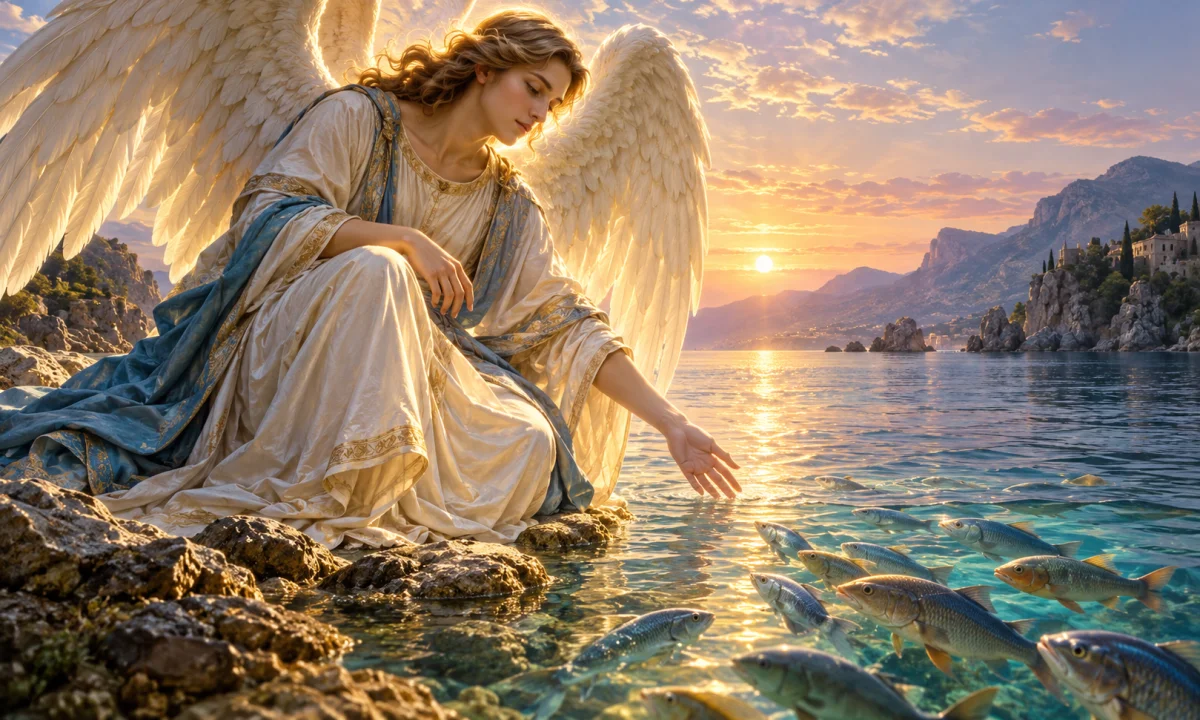
- Water and the sea: Damabiah is frequently connected with the sea, oceans, rivers, or the broader symbolism of water. Water may represent life, purification, change, depth, and the concealed movements of the spiritual world.
- Wisdom and hidden knowledge: The name is sometimes linked with the understanding of divine order, secret knowledge, and insight into causes that are not immediately visible.
- Protection: Later occult lists may describe Damabiah as protecting against harmful influences, deception, enchantment, or dangers associated with travel and uncertain circumstances.
- Completion and fruitful work: Some systems connect the angel with the successful outcome of projects, especially work requiring patience, careful planning, or the ability to adapt to changing conditions.
- Emotional depth: Because of the water symbolism, modern interpreters sometimes associate the name with sensitivity, intuition, imagination, and the capacity to move through emotional change.
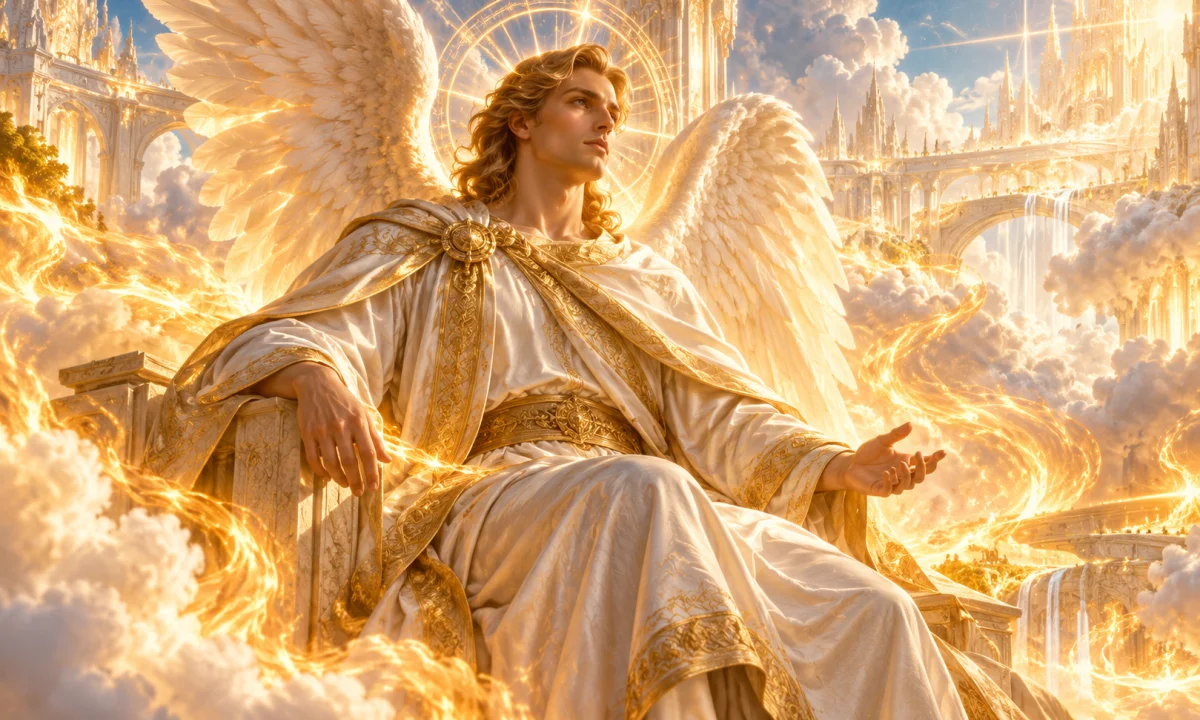
These qualities belong to an interpretive tradition, not to a surviving narrative about a being named Damabiath. There is no ancient story in which Damabiath commands the sea, teaches a particular hero, or performs a recorded miracle. Descriptions of appearance are equally unstable. Unlike archangels such as Michael or Gabriel, the figure has no widely established iconography in Jewish or Christian art.
Astrological and magical correspondences
Later occult systems often assign each of the seventy-two names a particular five-day period, degree of the zodiac, planetary influence, angelic choir, or hour of the day. Damabiah is commonly placed within such schedules, but the exact details vary according to the system being used. One list may associate the name with Aquarius or with water symbolism, while another may emphasise a planetary or calendrical correspondence.
These arrangements should not be confused with ancient astronomy or with official Jewish or Christian doctrine. They are products of ceremonial magic, astrological angelology, and modern esoteric publishing. A person using one of these systems may regard the associated angel as a guardian or spiritual influence, but that devotional or magical use reflects the system's own assumptions.
The same caution applies to claims that a person born on a particular day has Damabiath or Damabiah as a personal guardian angel. Birth-date angel systems are comparatively late frameworks and are not part of a universally accepted scriptural teaching. They may be meaningful within contemporary spiritual practice, but they should be identified as modern or esoteric interpretations.
Stories, relationships and traditional roles
No well-established mythology gives Damabiath a family, rank, teacher, adversary, or group of companions. The name is not associated with a major episode in Genesis, Exodus, Daniel, Tobit, Revelation, or another widely known sacred narrative. Nor is there a stable tradition identifying Damabiath as one of the archangels, the seven chief angels, a throne angel, or a member of a named heavenly court.
If the name is treated as Damabiah, its role is primarily functional and symbolic. It represents one position in an ordered list of divine names, with powers and virtues assigned through later interpretation. This is different from the narrative roles of angels such as Gabriel, who appears as a messenger in biblical and Christian tradition, or Raphael, whose role as a healer is strongly associated with the Book of Tobit.
Some modern descriptions portray Damabiah as a guardian of sailors, a ruler of oceans, or a powerful spirit of water. Such portrayals should not be presented as ancient stories unless a specific historical tradition supports them. They are expansions of symbolic associations found in later angelic lists.
Distinguishing Damabiath from similar names
Several kinds of confusion can arise around the name:
- Damabiah: This is the closest and most probable comparison. It is the better-known spelling in lists of the 72 names and is often the source of attributes later attached to Damabiath.
- Gabriel: Gabriel is a distinct angel with strong biblical, Jewish, Christian, and Islamic traditions. Any association between Gabriel and water, messages, or particular planets should not be transferred to Damabiath.
- Uriel and other named angels: Uriel, Raphael, Michael, and other major angelic figures have separate textual histories. Similar endings or shared inclusion in modern angel lists do not indicate kinship.
- Water deities and spirits: Damabiath should not be equated with Poseidon, Neptune, sea nymphs, merfolk, or local water spirits. Water symbolism in an angelic system is not the same as membership in a mythology of aquatic gods.
- Demons and planetary spirits: Some occult books arrange angels, demons, intelligences, and planetary spirits in paired or neighbouring lists. Such editorial arrangements do not prove that Damabiath has a traditional demonic counterpart or that the figure belongs to a particular hierarchy.
Interpretation and cultural significance
The interest of Damabiath lies less in a preserved myth than in the history of how sacred names were transmitted and reinterpreted. The name illustrates the movement of angelic ideas between scripture, mystical interpretation, magical practice, occult classification, and popular spirituality. A name that began as part of a highly structured system of Hebrew letter combinations could later acquire a personality, a visual identity, a zodiacal position, and a set of psychological qualities.
Water symbolism helps explain the name's continuing appeal. Across many religious traditions, water can signify birth, cleansing, danger, fertility, transformation, and the boundary between the known and unknown. When later interpreters connected Damabiah with water, they were drawing on a broad symbolic language rather than preserving a single ancient legend about an aquatic angel.
The figure can also be read as an example of the difference between textual authority and devotional imagination. A name may have genuine importance within a mystical or magical practice even when its history is obscure and its attributes are not consistent. Respectful description therefore requires both recognition of contemporary spiritual use and clarity about what can actually be established from historical tradition.
Later reception
Damabiath has no major, stable presence in classical literature, mainstream religious art, or widely known modern fiction. The name is more likely to appear in occult manuals, angel directories, esoteric websites, spiritual calendars, and systems of contemporary angel meditation. In these contexts, it may be presented as an individual guardian angel with a colour, crystal, prayer, symbol, or personality profile.
Such presentations are modern adaptations unless they can be traced to a specific older tradition. They may use Damabiath as a distinct spelling for personal or aesthetic reasons, even when the underlying material derives from Damabiah. A fictional work or spiritual system may therefore give Damabiath an elaborate character, but that character should not be mistaken for an established figure of Jewish, Christian, or Islamic tradition.
The most accurate identification is consequently cautious: Damabiath is an obscure angelic name whose exact origin and identity are uncertain, and which is probably related to the better-attested esoteric name Damabiah. Its reported associations with water, wisdom, protection, and hidden knowledge belong chiefly to later angelological interpretation rather than to a documented ancient narrative.