WORLD

Dardariel
Dardariel is an obscure angelic name found chiefly in later angelological and occult name-lists associated with Jewish and Christian esoteric traditions. Unlike Michael, Gabriel, Raphael or other widely attested angels, Dardariel does not have a clearly established role in the Hebrew Bible, the New Testament, the Qur’an or the principal early Jewish and Christian writings about angels. Surviving references are brief, inconsistent and often detached from a narrative.
The name therefore belongs to the history of learned angelology rather than to a widely shared religious tradition. It is best understood as the name of a minor or specialised angel in later mystical and magical classifications. The exact origin of the name, its original meaning and its earliest appearance remain uncertain.
Origins and textual setting
Ancient Jewish and Christian traditions contain many named angels, but they do not all have the same status. Some appear in canonical scripture; others are known from apocalyptic writings, rabbinic discussions, mystical texts, liturgical traditions, magical manuals or medieval compilations. Dardariel belongs to the less securely documented end of this spectrum.
No well-known biblical passage presents Dardariel as a major messenger, warrior, guardian or divine attendant. Nor is there a universally recognised story about the angel in the major books of Jewish or Christian scripture. The name is instead associated with later systems that attempted to catalogue the invisible world by assigning angels to times, planets, stars, elements, directions, sacred names or stages of spiritual ascent.
Such systems were especially common in medieval and early modern esoteric literature. Jewish mystical speculation, Christian occultism, astrological magic and ceremonial traditions sometimes preserved large collections of angelic names. These names could be copied from earlier manuscripts, adapted from Hebrew or Aramaic forms, transliterated in several ways or combined with newly developed classifications. As a result, a name might survive without a stable biography or a consistent description.
The documentary status of Dardariel is consequently limited. References to the angel should not be treated as evidence for a universally accepted figure of ancient Judaism or Christianity. They show that the name circulated in particular streams of angelic speculation, not that every Jewish or Christian community recognised Dardariel as part of its religious teaching.
The name Dardariel
The meaning of Dardariel is not securely established. The ending -el is common in angelic names and is generally associated with the Hebrew word for God, El. This ending indicates the linguistic and religious environment in which many angelic names were formed, but it does not by itself reveal the angel’s function.
The first part of the name has no universally accepted interpretation. It may reflect a transliteration from a Hebrew, Aramaic or other Semitic form, but the relevant original spelling is not sufficiently secure to support a confident translation. Attempts to derive a precise meaning from the name alone are therefore speculative.
Spelling is also an important issue. Angelic names were copied by hand and transmitted across languages that used different alphabets. A single name could acquire variant forms through transliteration, scribal alteration or editorial normalisation. Similar-looking names may consequently be related, but resemblance is not proof of identity. Dardariel should not automatically be equated with every figure called Dardiel, Dardar or another name with a similar sound.
Classification in angelic lists
Later occult and angelological compilations sometimes place Dardariel among angels connected with the divisions of sacred or astronomical time. In this type of literature, angels may be assigned to hours of the day or night, planetary influences, lunar cycles or other calendrical structures. These assignments are not uniform, and different lists may give the same name different positions or functions.
Because the surviving references are not consistent, it is unsafe to describe Dardariel as definitively the angel of one particular hour, planet, day or celestial sphere. Popular reference works and modern occult websites sometimes repeat a single assignment as though it were universal, but such statements often depend on a late compilation rather than on a stable ancient tradition.
The most responsible description is that Dardariel appears in some later systems of specialised angelic classification. In those systems, the name may have served as part of a larger symbolic order in which every period or region of the cosmos was given a spiritual guardian. The classification itself reflects an attempt to make the unseen world intelligible and structured; it does not provide a consistent individual mythology for Dardariel.
Attributes and appearance
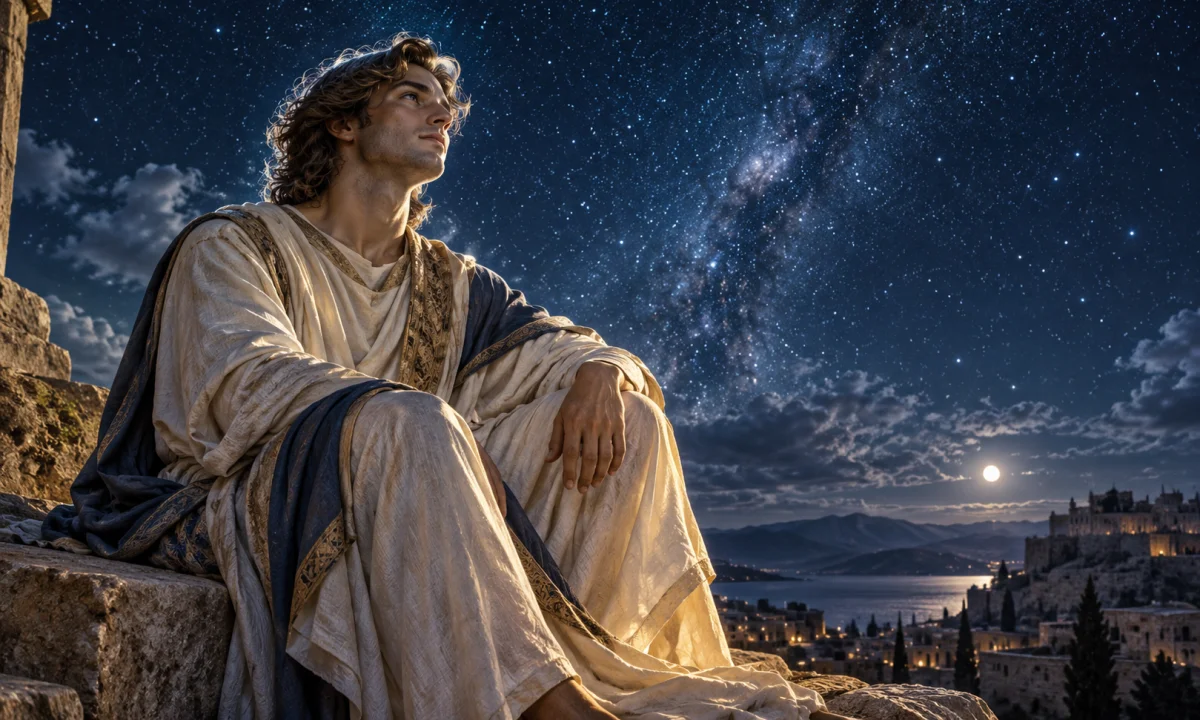
No standard physical appearance is attached to Dardariel. There is no widely recognised iconography showing the angel with a particular number of wings, a distinctive garment, a weapon, an animal companion or a fixed colour. Depictions found in modern occult art are therefore interpretive rather than traditional representations.
Likewise, Dardariel has no securely established list of powers. Depending on the classification in which the name appears, the angel may be treated as a guardian or ruler within a temporal or celestial order. This is different from having a clearly defined power over a human activity or natural force. The surviving material does not support confident claims that Dardariel governs healing, warfare, dreams, weather, death, love or any other specific sphere.
The absence of a fixed appearance is significant. In many religious traditions, angels are described less as independent gods or personalities than as servants, messengers or manifestations of divine authority. A minor angelic name in a catalogue may therefore function symbolically, marking a position in the heavenly hierarchy rather than identifying a character with an extensive narrative life.
Stories and relationships
Dardariel is not associated with a major surviving myth or scriptural episode. There is no broadly accepted account of a battle, revelation, fall, pilgrimage or encounter in which the angel plays a central part. Nor is there a well-established relationship with a particular archangel, prophet, patriarch or saint.
This lack of narrative distinguishes Dardariel from figures such as Michael, who appears in biblical and later apocalyptic traditions as a heavenly defender, or Gabriel, whose role as a messenger is developed in Jewish, Christian and Islamic sources. It also separates Dardariel from angels whose identities are shaped by substantial bodies of mystical commentary or liturgical devotion.
When Dardariel is mentioned in a list, the surrounding structure is usually more important than any individual story. The angel’s significance lies in occupying a designated place within a hierarchy, timetable or magical correspondence. Such lists were often used for contemplation, prayer, ritual practice or the organisation of esoteric knowledge, although the precise purpose varied from one work to another.
Religious and cultural significance
Dardariel illustrates how traditions about angels developed beyond the boundaries of canonical scripture. Jewish and Christian thinkers repeatedly explored the organisation of heaven, asking how divine messengers might be ranked and how the material world might correspond to the spiritual one. The resulting traditions included both theological reflection and forms of practical magic.
In some settings, naming an angel was understood as a way of recognising the order of creation. Time, the stars and the movements of the heavens could be interpreted as signs of divine governance. A name such as Dardariel might therefore have functioned as a marker of cosmic order even when no independent narrative about the angel was preserved.
At the same time, caution is necessary when discussing “angelic mythology.” The word mythology can suggest a single coherent story cycle, while the sources for Dardariel are better described as scattered traditions of classification. The name may have been meaningful within a particular manuscript or occult system without ever becoming part of common worship or official doctrine.
It is also important to distinguish historical evidence from later reconstruction. A name appearing in a modern catalogue does not automatically prove that it was known in antiquity. Some compilations preserve old material, but they may also rearrange, reinterpret or expand it. Without a secure early text, the age and original context of Dardariel remain uncertain.
Distinction from similar names
Dardariel can be confused with other angelic or religious names because many are built from similar sounds and the element -el. Names recorded in different traditions may resemble one another without referring to the same being. In particular, forms such as Dardiel or Dardar should be treated separately unless a specific source explicitly identifies them as variants.
The name should also not be merged with similarly transliterated beings from Islamic angelology. Arabic religious literature includes angelic names and groups whose spellings may look comparable when transferred into Latin characters, but a resemblance between Dardariel and another name is not enough to establish a shared origin. Jewish, Christian and Islamic angelologies sometimes influenced one another, yet they retain distinct textual histories and theological contexts.
Nor should Dardariel be confused with a demon simply because the name occurs in magical literature. Medieval and early modern occult texts often included divine names, angels, spirits and demons within the same practical or classificatory framework. A text’s use of a name in ritual instructions does not by itself determine the figure’s moral status in every religious tradition.
Modern reception
Dardariel has limited visibility in modern popular culture. The name occasionally appears in encyclopaedic lists of angels, contemporary occult writing, fantasy reference material and online catalogues of supernatural beings. These treatments may assign the angel a definite appearance, personality or power in order to make the figure more useful in fiction or ritual practice.
Such portrayals belong to modern adaptation, not to a firmly established ancient biography. A fantasy novel, role-playing game or digital catalogue may develop Dardariel into a guardian, warrior or celestial ruler, but those characteristics should not be presented as traditional unless they can be traced to a specific earlier source. The same caution applies to claims that the angel has a fixed colour, sigil, weapon or planetary correspondence.
Dardariel is most accurately understood as a minor and uncertain figure of later angelic classification. Its importance lies less in a developed myth than in what the name reveals about the human effort to map the heavenly world: to assign spiritual identities to times, celestial movements and hidden orders. The surviving evidence supports recognising Dardariel as a name within that tradition while leaving its exact origin, meaning and function open to scholarly caution.