WORLD
WORLD
Aristaeus
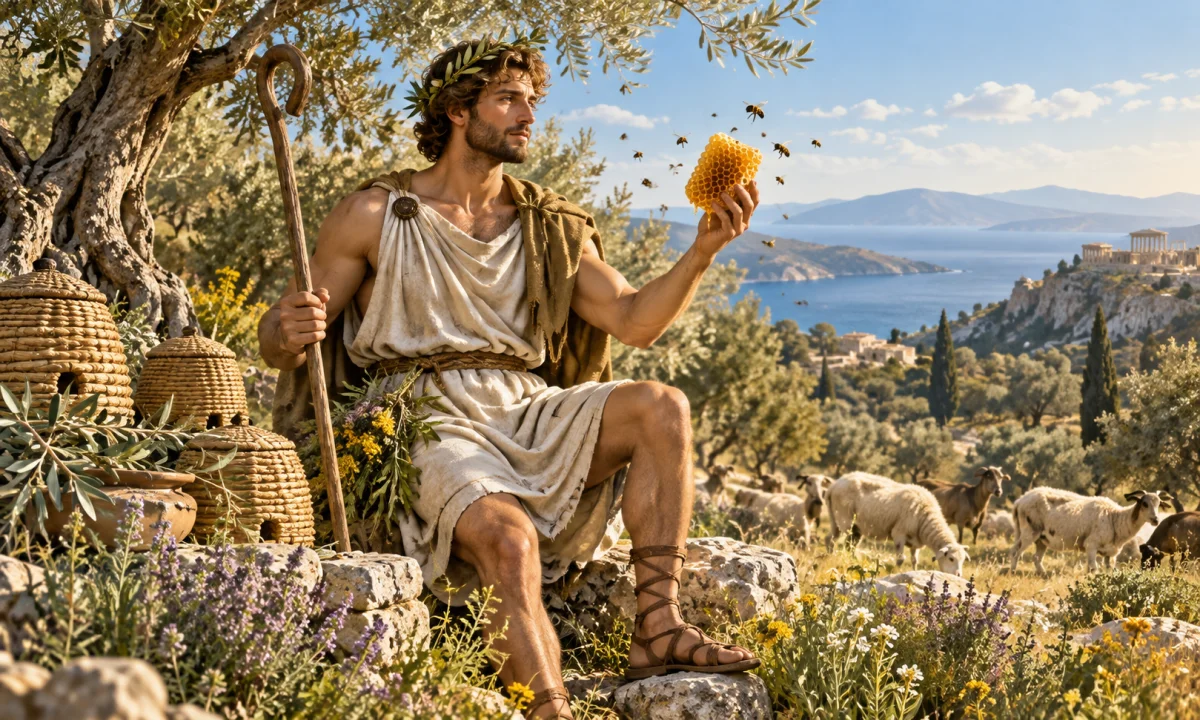
Aristaeus is a Greek mythological figure associated with beekeeping, agriculture, hunting, animal husbandry and other practical arts of rural life. He is usually described as the son of Apollo and the nymph Cyrene, and as the father of the hunter Actaeon. Unlike the major Olympian gods, Aristaeus occupies an intermediate position: ancient traditions treat him variously as a god, a culture hero, a protective spirit or a divinised mortal. His most famous story appears in Virgil’s Georgics, where he seeks an explanation for the death of his bees and is instructed to create new swarms from the bodies of sacrificed cattle.
Origins and cultural setting
Aristaeus belongs to the religious and mythological world of ancient Greece, especially to traditions concerned with the countryside, animal breeding and the transmission of useful skills. Greek communities depended heavily on agriculture, sheep and goat herding, vineyards, olive cultivation and beekeeping. Myths about figures such as Aristaeus gave these activities a sacred history by presenting them as gifts or discoveries associated with divine teachers.
His family connects several different areas of Greek mythology. His father is generally Apollo, the god of prophecy, healing, music, archery and purification. His mother is Cyrene, a Thessalian huntress who becomes the eponymous founder of the North African city of Cyrene. Through Cyrene, Aristaeus is linked with the Greek colonisation of Libya and with the agricultural prosperity associated with that region. Through Apollo, he belongs to a divine lineage, although his own character is more rural and practical than Apollo’s best-known roles.
The surviving evidence is not a single consistent biography. References to Aristaeus appear in different literary, religious and local traditions, and later authors combine or reshape them. Greek poets and mythographers do not always assign him the same skills, destinations or status. The familiar account of his bees, the death of Eurydice and the intervention of Proteus is principally the form given by Virgil, a Roman poet writing in the first century BCE. It should not be assumed that every part of that story was an equally old or universally accepted Greek belief.
Name and identity
The Greek name is usually transliterated as Aristaios, while Aristaeus is the common Latin and English form. The name is connected with the Greek word aristos, meaning “best” or “excellent.” This meaning suits a figure who represents mastery of valuable skills, although the name itself does not prove that a particular title or ritual role belonged to him everywhere.
Aristaeus is difficult to classify in modern terms. Calling him simply a “god of bees” is convenient but incomplete. He is more accurately understood as a divine or heroic patron of several related forms of rural knowledge. Ancient traditions associate him with:
- the keeping and cultivation of bees;
- the production of honey and possibly other forms of animal husbandry;
- the care and breeding of domestic animals;
- the cultivation of olive trees and other useful plants;
- cheese-making and related pastoral skills;
- hunting and the knowledge of wild animals; and
- the transmission of practical arts from divine beings to human communities.
Some writers call Aristaeus a god, while others present him in the manner of a heroic ancestor or a powerful rural spirit. The distinction between god, hero and daimon was not always used in the same way across Greek communities. Aristaeus could therefore be honoured as a protective supernatural figure without being treated as one of the twelve Olympians.
Birth and upbringing
One of the fullest accounts of Aristaeus’s family begins with Cyrene. She is portrayed as a strong and independent huntress, more interested in confronting wild animals than in ordinary domestic life. Apollo sees her wrestling with or overpowering a lion and becomes attracted to her courage. With the approval or assistance of the gods, he carries her to Libya, where she becomes the founder associated with Cyrene.
In Apollonius Rhodius’s Argonautica, Apollo and Cyrene are the parents of Aristaeus. The infant is entrusted to divine or semi-divine nurses, including nymphs, who care for him and teach him useful skills. This pattern reflects an important feature of Greek mythology: a hero or culture-bringer often receives instruction from several supernatural figures before passing knowledge to humankind.
Different traditions vary in the details of his education. Aristaeus is commonly connected with the nymphs, the centaur Chiron and the prophetic sea god Proteus. These relationships should not be treated as one fixed biography. They represent different versions of the idea that his knowledge came from the natural and divine world rather than from ordinary human apprenticeship.
His education is sometimes associated with the Muses, with the nymphs who raised him, or with divine teachers who taught him to manage bees and livestock. Once he has learned these arts, he becomes a travelling instructor and civilising figure. In this role, Aristaeus resembles other Greek culture heroes who introduce specialised knowledge to particular regions.
Skills and attributes
Aristaeus is best known for his connection with beekeeping. Honey was an important food, sweetener and ritual substance in the ancient Mediterranean, while bees themselves were often viewed with wonder because of their organised communities and apparent transformation of flowers into honey. Aristaeus was therefore a natural figure through whom people could explain the origin of apiculture and the religious importance of bees.
He is also connected with pastoral and agricultural production. Ancient authors attribute to him knowledge of olive cultivation, cheese-making, the breeding of animals and the management of flocks. These traditions do not necessarily mean that Greeks believed one historical inventor had created all these practices. Rather, Aristaeus gathered a collection of skills that were central to rural prosperity.
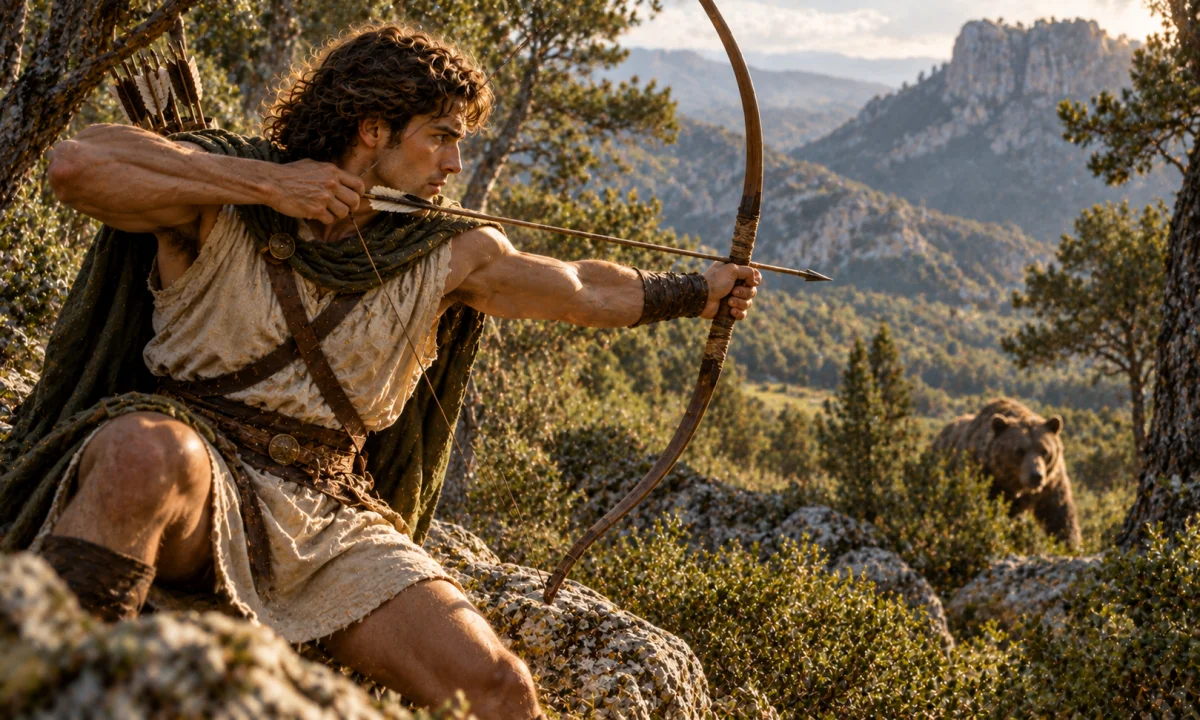
His hunting identity comes chiefly through his mother Cyrene and through his son Actaeon. He is not simply a male counterpart of Artemis, nor is he a god of hunting in the same broad and dominant sense. His relationship with hunting is part of a larger pattern in which wild nature, animal knowledge and the domestication of useful species meet in the same figure.
There is no single canonical description of Aristaeus’s appearance. Ancient literature does not establish that he had horns, goat legs or the animal ears often given to satyrs and woodland spirits in modern visual art. He may be imagined as a youthful hunter or rustic teacher, but such images are interpretive rather than a universal physical description. He should not automatically be represented as Pan, a satyr or a shepherd god.
Aristaeus and Actaeon
Aristaeus is widely identified as the father of Actaeon, the famous hunter who is transformed into a stag and killed by his own hounds. Actaeon’s mother is usually Autonoë, a daughter of Cadmus and Harmonia of Thebes. This makes Aristaeus part of the extended Theban mythological family.
Actaeon’s death has several ancient versions. In one well-known form, he sees Artemis bathing and is punished for the sight, whether because he looked deliberately or because the encounter was accidental. In another tradition, he boasts that he is a better hunter than Artemis. The goddess changes him into a stag, after which his dogs fail to recognise him and tear him apart. The details differ, and not every ancient author gives the same explanation for his transformation.
The connection between father and son creates an interesting contrast. Aristaeus represents the successful acquisition and transmission of knowledge about nature, while Actaeon becomes a victim of the dangerous boundary between human identity and the wild world. Yet ancient mythology does not usually present Actaeon’s fate as a punishment inherited from his father. The two stories belong to different mythic patterns, joined mainly by genealogy.
The bees, Eurydice and Proteus
Aristaeus’s most influential story is told in the fourth book of Virgil’s Georgics. In this version, Aristaeus keeps bees, but his swarms suddenly die. Seeking the cause of the disaster, he consults the prophetic sea god Proteus. Proteus reveals that the bees’ death is connected with Eurydice, the wife of Orpheus.
According to Virgil’s narrative, Aristaeus pursued Eurydice. As she fled from him, she stepped on a snake and died from its bite. Eurydice then returned to the underworld, and Orpheus’s grief became the subject of the famous story in which he attempts to bring her back. Virgil links the two myths by making the deaths of Aristaeus’s bees a consequence of Eurydice’s death and Orpheus’s anger.
This version must be distinguished from the more familiar account in which Eurydice dies after being bitten while fleeing a threatening satyr or shepherd. The identity of her pursuer varies in later retellings. Virgil’s presentation of Aristaeus as the direct cause of the tragedy is especially important, but it should not be projected onto every earlier Greek tradition.
Proteus tells Aristaeus that he must make ritual amends. Aristaeus sacrifices cattle, and from the decaying carcasses new swarms of bees emerge. This practice is known by the modern term bugonia, from Greek words associated with cattle and generation. Ancient writers sometimes treated the emergence of bees from dead animals as a natural fact, although the belief is not an accurate account of insect biology.
In the Georgics, the episode has several layers of meaning. It presents farming as dependent on ritual responsibility, not merely technical skill. It also places human prosperity within a moral and cosmic network in which suffering, sacrifice and restoration are connected. The story then returns to Orpheus, whose loss gives Virgil’s agricultural poem an unexpectedly tragic and philosophical dimension.
Religious significance
Aristaeus illustrates how Greek religion could honour specialised powers without confining them to a single neat category. A community concerned with bees might regard him as their divine instructor; a pastoral society might emphasise his livestock skills; a colony linked to Cyrene might connect him with the prosperity of its land. His identity was therefore shaped by local practice as well as by pan-Hellenic poetry.
His association with Cyrene is especially significant. Greek foundation myths often explained why a city had a particular land, crop or religious character. The story of Apollo and Cyrene links divine desire, heroic courage, migration and colonial foundation. Aristaeus, as their son, becomes a bridge between the Greek mainland and North Africa, and between divine ancestry and productive human settlement.
Aristaeus also expresses an ancient ambivalence about civilisation. Beekeeping and animal husbandry represent the successful organisation of nature, but they depend on an intimate understanding of living creatures and seasonal processes. His myths do not depict nature as merely passive or easily controlled. The death of the bees, the anger associated with Eurydice and the need for ritual repair all suggest that human skill has limits.
Distinctions from similar figures
- Aristaeus and Apollo: Aristaeus is usually the son of Apollo, not another name for him. Their domains overlap in healing, prophecy or purification in some contexts, but Aristaeus has a distinctly rural and agricultural identity.
- Aristaeus and Pan: Pan is a god of wild landscapes, shepherds, flocks and sudden panic. Aristaeus is associated more strongly with learned rural techniques such as beekeeping, breeding and cultivation. Aristaeus is not normally portrayed as a goat-footed god.
- Aristaeus and Dionysus: Dionysus is connected with wine, vegetation, ecstasy and theatre. Although both can be linked with fertility and the countryside, Aristaeus is not a form of Dionysus.
- Aristaeus and Orpheus: Orpheus is Eurydice’s husband and the singer who descends to the underworld. Aristaeus is the figure whose pursuit of Eurydice, in Virgil’s version, contributes to her death. They are not interchangeable characters.
- Aristaeus and Aristides or Aristeas: Similar-looking names can refer to different historical or mythological figures. Aristeas, the name associated with the Greek poet and traveller of Proconnesus, is not Aristaeus.
Later reception
Aristaeus is less prominent in modern popular culture than Apollo, Orpheus, Actaeon or Pan. His principal later influence has come through literary treatments of Virgil’s Georgics, especially the linked stories of the dead bees, Eurydice and Orpheus. Writers and artists interested in pastoral poetry, classical mythology or the relationship between human labour and the natural world have continued to draw on this material.
Modern references often reduce him to a “bee god,” but that label obscures the broader tradition. Aristaeus represents a cluster of skills that support rural life: caring for animals, cultivating plants, managing bees and adapting divine knowledge for human use. His stories also preserve a tension between mastery and responsibility. The person who knows how to produce abundance must still answer for the harm caused by desire, carelessness or an inability to respect the boundaries of the natural and sacred worlds.