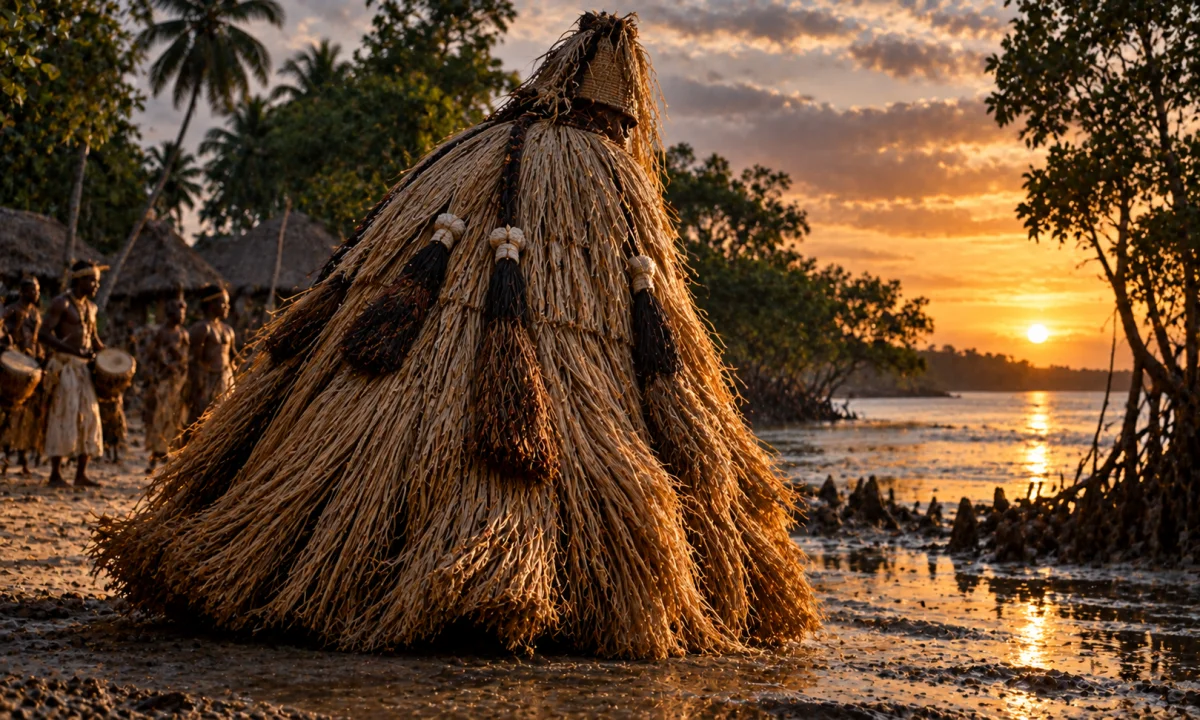
WORLD
WORLD
Andriambahomanana
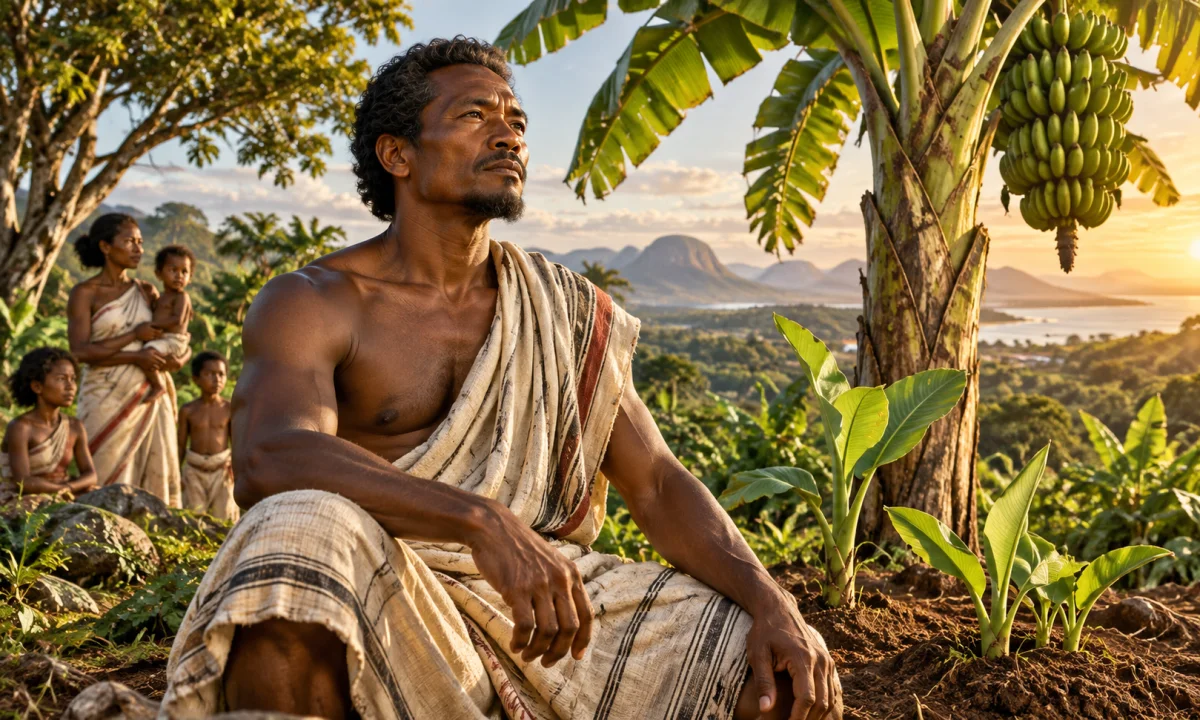
Andriambahomanana is a figure associated with Malagasy mythology, the traditional religious and storytelling cultures of Madagascar. He is commonly described in modern summaries as the first human or an early ancestor of humanity. The name and the stories connected with it are not represented by one universally fixed canon, however. Malagasy traditions differ between regions and communities, and many accounts were transmitted orally before being recorded by outsiders or in later Malagasy writing.
Origins in Malagasy tradition
Madagascar has a rich variety of religious traditions shaped by the island’s Austronesian and African cultural connections, as well as by local historical development. Ideas about creation, the first ancestors, death, the afterlife and the relationship between the living and the dead vary among Malagasy peoples, including the Merina, Betsimisaraka, Betsileo, Sakalava, Bara and other communities.
Andriambahomanana belongs to a group of ancestral or primordial figures found in some Malagasy accounts of human origins. In these narratives, he is placed near the beginning of human history, before ordinary genealogies and political dynasties. He is therefore better understood as a mythic ancestor than as a god in the same sense as a creator deity.
Many descriptions connect the origin of human beings with a supreme or creator power called Zanahary, although the use and meaning of divine names vary across Malagasy traditions. Andriamanitra is also an important term in Malagasy religious vocabulary, but it has had different uses in different historical and cultural settings. Translators and early missionaries sometimes treated Malagasy divine concepts as if they formed a single, neatly organized pantheon. The surviving evidence does not justify assuming that all communities held exactly the same theology.
The name and identity of Andriambahomanana
The spelling Andriambahomanana is the most common form in English-language references, but Malagasy names may appear with different spellings when they are written in older European systems of transcription. The exact meaning of the name is also explained differently. The element andriana can carry associations of nobility, lordship or elevated status, while the remainder of the name has been interpreted in relation to abundance, descendants or human continuity. Such translations should be treated as approximate rather than as definitive word-for-word glosses.
In the accounts that identify him as the first man, Andriambahomanana is not usually described as a ruler with a detailed biography. His importance comes from his position at the beginning of the human line. He represents the first human ancestor through whom mortality, family life and descent become part of the world.
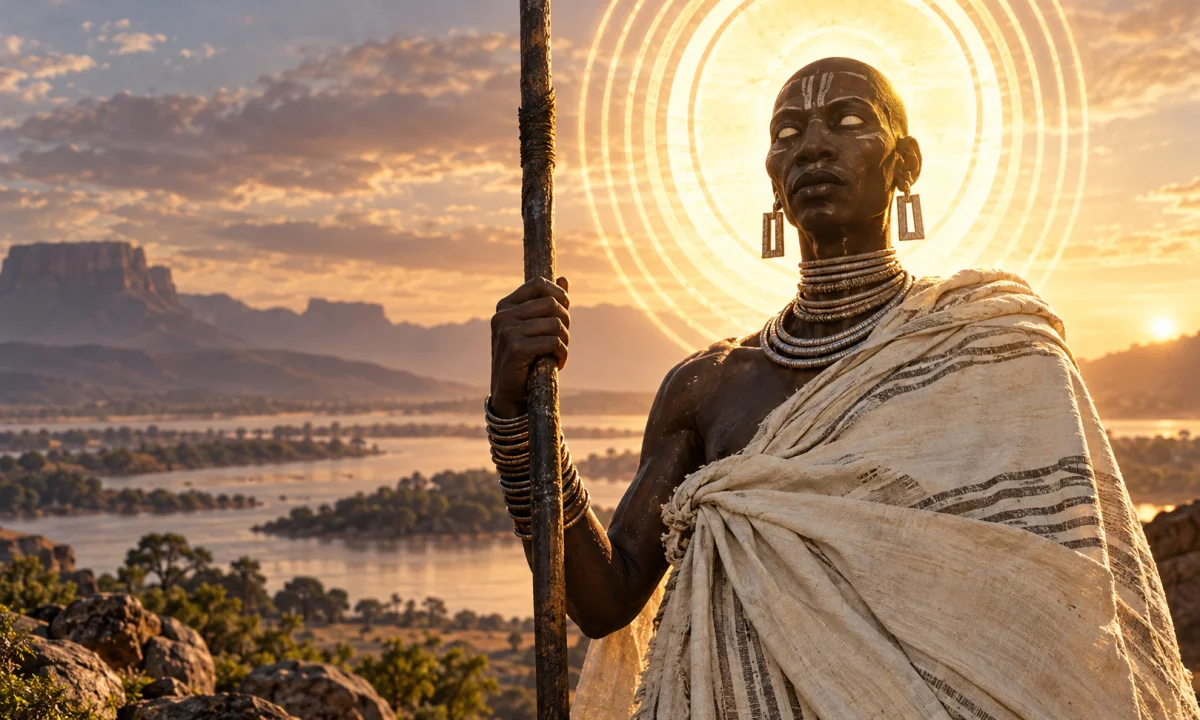
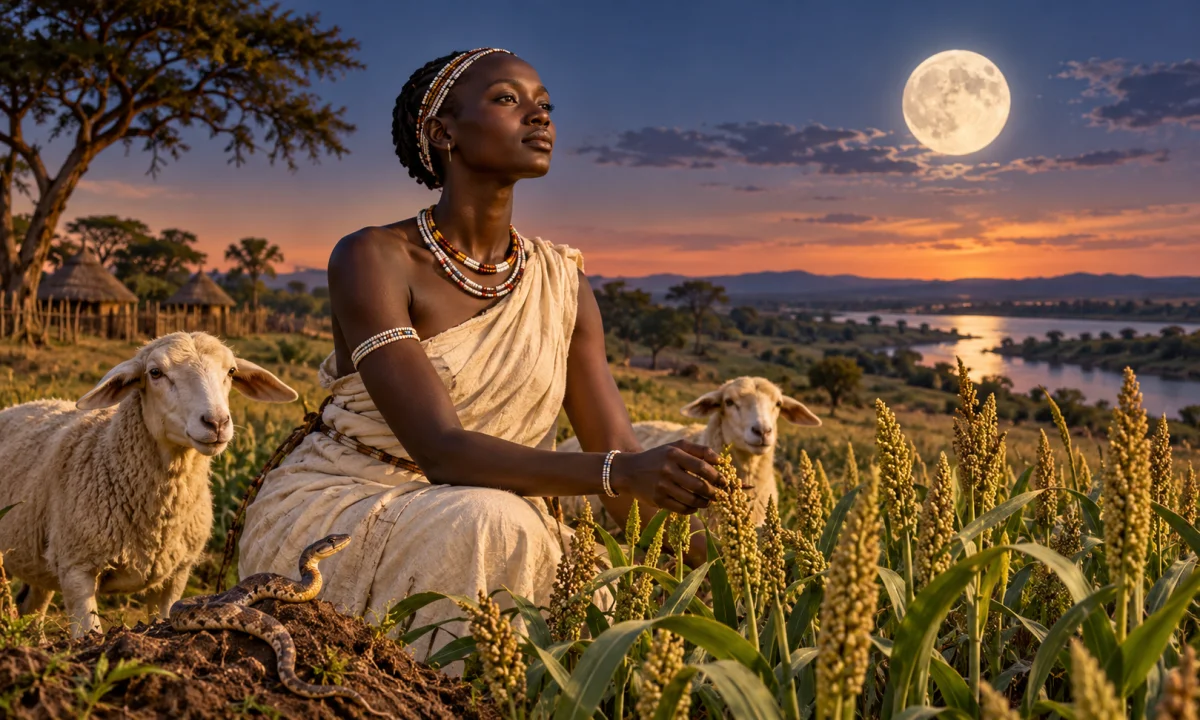
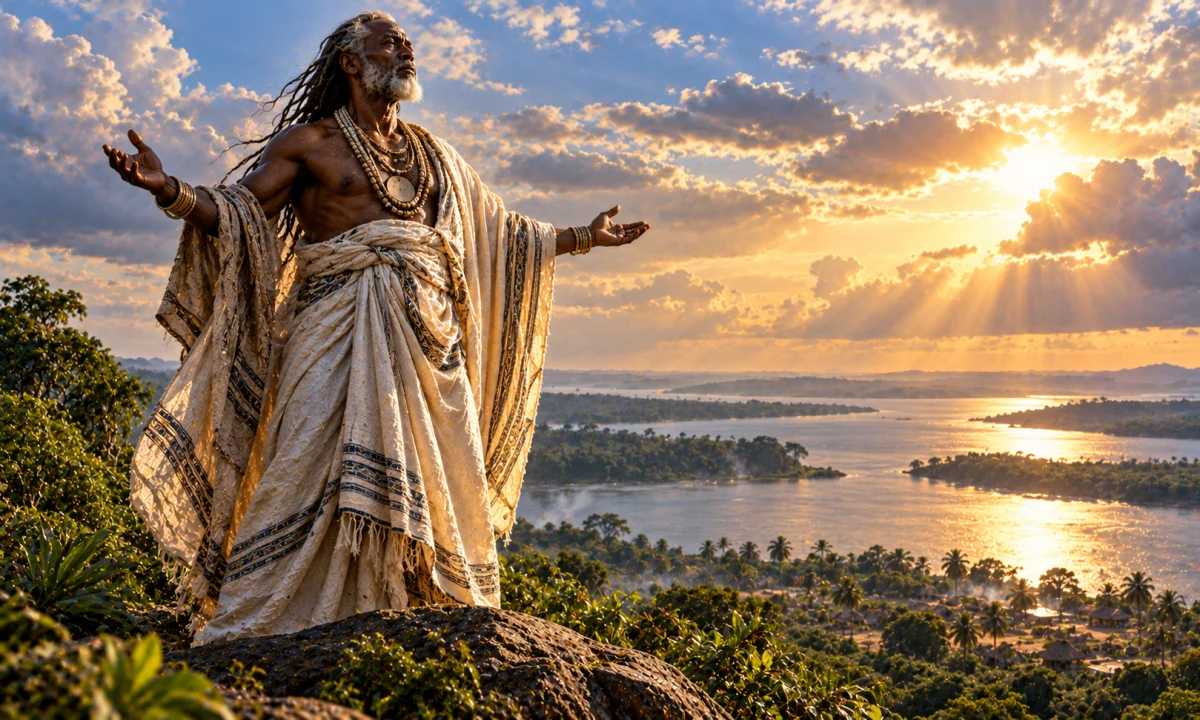
There is no universally recognized physical appearance for him. Unlike certain gods, spirits or legendary animals, he is not generally associated with a stable set of visual features, weapons, sacred animals or supernatural clothing. Artistic representations found in modern compilations therefore tend to be imaginative rather than based on a traditional iconography.
The choice between death and descendants
The best-known story associated with Andriambahomanana presents the origin of human mortality as the result of a choice. In versions of the tale, the first human or first human couple is offered a condition involving continued life, death or the ability to have descendants. The precise details differ, but the central idea is that human beings do not possess endless individual life because a choice was made in favor of reproduction and family continuity.
Some retellings state that Andriambahomanana chose to have children rather than live forever without descendants. Other versions place the decision in the hands of a first couple or describe the choice less as a personal decision than as the establishment of the human condition. Because these stories circulated orally, it is unsafe to treat one English retelling as the single original form.
This episode explains why people die even though life continues through children and later generations. It also gives human mortality a social meaning. Death is not simply the disappearance of an individual; it is part of a cycle in which descendants inherit names, obligations, memories and relationships. The story consequently links the beginnings of humanity with the importance of kinship.
The motif resembles creation stories from many parts of the world in which early humans lose immortality, fail to follow a divine instruction or accept a limited lifespan in exchange for fertility. Similarity of theme does not demonstrate that the stories all came from one source. Mortality, birth and the hope of continued descent are widespread human concerns, and different communities can develop comparable explanations independently.
Ancestorhood and the Malagasy religious setting
To understand Andriambahomanana, it is important to distinguish an origin ancestor from the many revered ancestors who remain part of Malagasy religious life. In several Malagasy societies, the dead are understood as continuing to influence the living. Family ceremonies, burial customs, obligations to ancestors and respect for ancestral places have all played important roles, although practices differ considerably among regions and historical periods.
An origin figure such as Andriambahomanana can express the deepest beginning of this relationship between generations. His story places descendants within a chain that reaches back to the first human. It also helps explain why family continuity is so significant: the individual is temporary, but the ancestral line endures.
This does not mean that every Malagasy community worships Andriambahomanana or addresses him in regular ritual. The available evidence does not establish a uniform cult devoted to him. He is more often known through mythological and genealogical discussion than through a standardized set of temples, priesthoods or annual ceremonies. Calling him a “god” without qualification can therefore obscure his more specific role as a primordial human ancestor.
Variants and limits of the surviving evidence
Much of what is known about Malagasy traditional religion comes from oral performance, family memory, ritual practice, historical records and later written collections. Oral traditions are not fixed texts in the way that a canonical scripture is fixed. A storyteller may adapt a narrative to its audience, emphasize a particular moral point or combine the story with local ideas about the first ancestors.
Written records also require caution. European visitors, missionaries and colonial administrators often interpreted Malagasy beliefs through categories drawn from Christianity or classical mythology. They sometimes translated local divine names as “God,” “creator,” “spirit” or “idol,” even when the original concept did not correspond exactly to those categories. Later encyclopedias and websites have frequently condensed complex traditions into short lists of gods and heroes.
For this reason, statements about Andriambahomanana should normally be qualified with phrases such as “in some Malagasy traditions” or “in later summaries of Malagasy mythology.” It is not possible to assume that a story recorded in one region represents the beliefs of Madagascar as a whole. Nor should every figure with a similar-sounding name be treated as the same person.
Symbolism of the first ancestor
Andriambahomanana’s principal symbolic theme is the relationship between mortality and continuity. Humans die, but human descent continues. The myth therefore gives a traditional explanation for an unavoidable fact of life while presenting family and descendants as a form of lasting existence.
He can also be read as a figure of human limitation. The first human is not an all-powerful being who controls nature or commands the gods. Instead, he stands at the boundary between the divine order and ordinary human experience. His story explains why people must live within the conditions of birth, aging and death.
The tradition also reflects the importance of choice and consequence. Whether the decision belongs to Andriambahomanana alone or to an early human couple, the narrative makes the structure of human life meaningful rather than accidental. Having children brings joy, responsibility and social continuity, but it also means that generations must repeatedly face grief and separation.
In a society where ancestry can be central to identity, land, authority and ritual obligation, an account of the first ancestor has more than abstract philosophical value. It situates living people within a history that extends beyond the remembered past. At the same time, the myth should not be used as a simple description of all Malagasy social customs. Its interpretation depends on the community and the context in which it is told.
Distinction from other Malagasy figures
Andriambahomanana should not automatically be identified with Zanahary, the creator or supreme divine power named in many Malagasy traditions. A creator brings the world or living beings into existence; a first human ancestor belongs to the created human order. Some retellings may place the two figures in the same story, but they are not therefore interchangeable.
He should also be distinguished from the Vazimba, a term associated in different contexts with early inhabitants, ancestral beings or powerful spirits connected with Madagascar’s past. The meaning of Vazimba is itself historically and regionally complex. There is no sound basis for merging every primordial ancestor, early inhabitant and supernatural being into a single character.
Nor is Andriambahomanana simply another name for a Malagasy royal ancestor. Madagascar has many dynastic founders, culture heroes and legendary rulers whose traditions are tied to particular peoples or political histories. A story about the first human belongs to a different level of mythic time from a genealogy that explains the origin of a specific kingdom.
Modern reception
Andriambahomanana has not achieved the same international visibility as figures from Greek, Norse or Egyptian mythology. His name is most often encountered in encyclopedic lists, comparative discussions of creation myths and popular online accounts of African or Malagasy mythology. These presentations can preserve the broad theme of the first ancestor who accepts descendants in place of immortality, but they often remove the regional context and the variation among traditions.
There is no widely established modern canon of novels, films, games or comics devoted to Andriambahomanana. When he appears in contemporary retellings, the character may be expanded into a generic “first man,” a heroic patriarch or a conventional mythological deity. Such adaptations can be creative, but those added powers, relationships and visual features should not be confused with the limited and varied traditional material.
The most responsible understanding of Andriambahomanana keeps several levels of interpretation separate: the oral Malagasy traditions in which a primordial ancestor may explain human mortality; the later records and translations through which those traditions became known to wider audiences; and modern popular summaries that often simplify them. Within that context, Andriambahomanana is best described as a Malagasy mythic ancestor whose story connects the beginning of humanity with the choice, or condition, that makes human beings mortal yet capable of continuing through their descendants.