WORLD
WORLD
Anapiel

Anapiel is an obscure angelic name associated with Jewish mystical and angelological traditions. The name is more often written as Anaphiel, Anpiel, or Anafi’el, and the surviving evidence does not establish a single, universally defined figure. References connected with these forms appear chiefly in writings related to the Jewish Hekhalot or “heavenly palaces” tradition, in which visionary journeys through the heavens reveal angelic guardians, celestial officials, and immense divine structures.
Origins and religious setting
Anapiel does not belong to the standard angelic narratives of the Hebrew Bible, the New Testament, or the Qur’an. Nor is Anapiel one of the universally recognised archangels in Jewish, Christian, or Islamic religious practice. The name instead belongs to the more specialised world of Jewish mystical angelology.
The principal cultural setting is the Merkabah tradition, named after the divine chariot described in the vision of the prophet Ezekiel. From late antiquity into the early medieval period, Jewish mystics developed elaborate accounts of ascending through heavenly palaces, or hekhalot, in order to behold the divine throne. These accounts describe powerful angels stationed at gates, guarding access to higher realms, testing those who approach, or accompanying the visionary.
The texts associated with this tradition are not a single book written by one author. They are collections of visionary materials, prayers, hymns, instructions, names, and dialogues that circulated in different forms. Important examples include writings commonly known as Hekhalot Rabbati, Hekhalot Zutarti, and the Third Book of Enoch, also called 3 Enoch. Their manuscripts vary, and angelic names can be copied with different spellings or attached to different roles.
That textual background is important for understanding Anapiel. The name should not be treated as belonging to a simple, fixed hierarchy shared by all Jewish sources. Anapiel’s identity is uncertain because the forms of the name are unstable and because mystical texts often present angels through brief, difficult passages rather than through complete biographies.
The name Anapiel and its variants
Anapiel is one of several English transliterations used for a Hebrew angelic name. Other forms include Anaphiel, Anpiel, Anafi’el, and forms beginning with Anf- or Anaf-. Transliteration from Hebrew is not completely uniform, especially when texts survive in manuscripts with variant spellings.
These forms may represent different spellings of the same name, but that cannot always be assumed. A name that looks similar in English may reflect a different Hebrew spelling, a scribal alteration, or a modern editorial choice. Consequently, references to Anapiel should be examined in relation to the particular text or catalogue in which the name occurs.
The meaning of the name is also uncertain. Some modern lists attempt to translate it through Hebrew roots connected with branches, foliage, or covering, while others leave it untranslated. These proposed meanings are not sufficiently secure to serve as a definite description of the angel. A supposed translation should therefore be distinguished from an established religious interpretation.
Anapiel in heavenly-palace mysticism
In the Hekhalot tradition, angels are frequently presented as officials of the heavenly court. They may stand at the entrances to palaces, control the passage between celestial regions, proclaim divine glory, or protect the sanctity of the throne room. Their authority does not make them gods. They remain servants of the God of Israel, although their appearance and power can be terrifying to human beings.
Passages associated with the Anaphiel or Anpiel name place the figure within this general environment of heavenly guardianship and celestial administration. The name is treated as belonging to a powerful angelic being encountered in descriptions of the upper palaces or the divine presence. The exact office varies in secondary accounts, and the surviving mystical material does not provide a biography comparable to the stories of Michael, Gabriel, or Raphael.
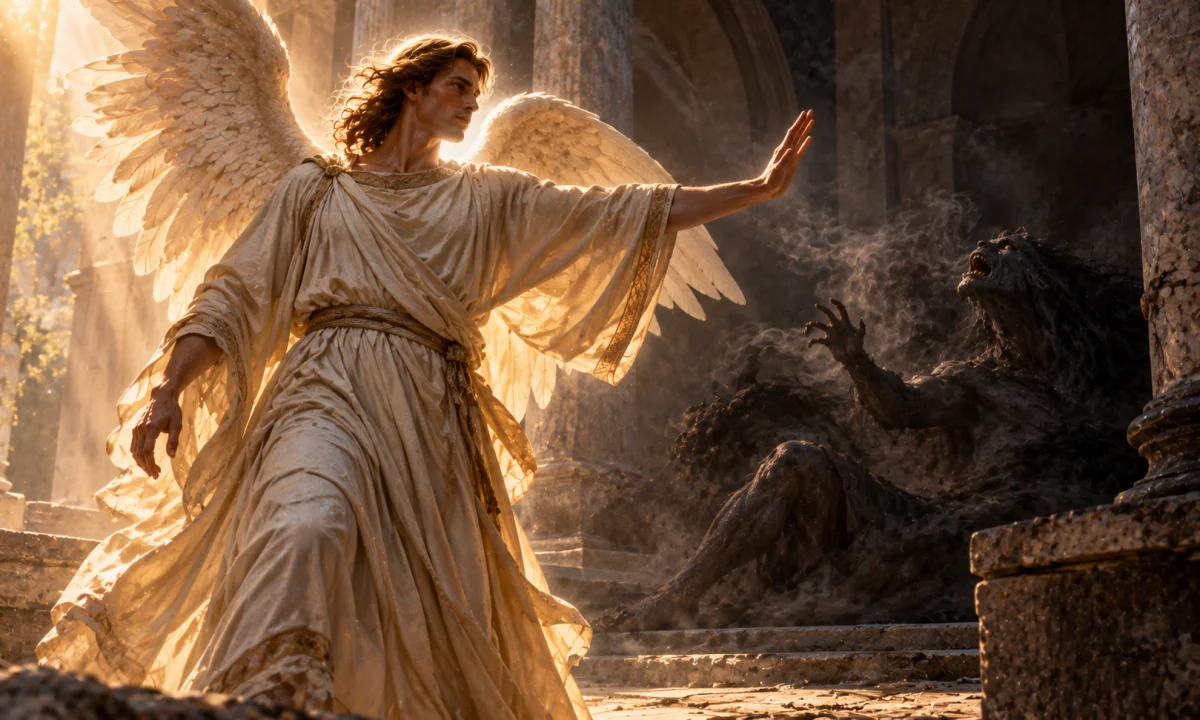
Some descriptions of angels in this literary world emphasise overwhelming size, fiery radiance, multiple faces, wings, crowns, or bodies composed of light. Such imagery is part of the visionary language of Merkabah literature. It should not automatically be assigned to Anapiel specifically. Modern summaries sometimes collect general Hekhalot imagery and present it as though it were a fixed portrait of this angel, but the evidence for a standard appearance is weak.
Likewise, claims that Anapiel has a particular number of faces, rules a specific planet, governs a particular day, or commands a named order of angels often come from later occult compilations rather than from the earliest Jewish mystical context. Those associations may be interesting examples of reception history, but they should not be confused with securely attested ancient tradition.
Role and symbolism
The most useful way to understand Anapiel is through the symbolism of the heavenly threshold. In Merkabah visions, the distance between the human world and the divine throne is represented by successive gates and palaces. A guardian at such a boundary embodies both protection and restriction: the angel preserves the holiness of the celestial realm and prevents an unprepared or unauthorised visitor from entering.
This function reflects a broader theme in Jewish angelology. Angels often appear as messengers, protectors, warriors, witnesses, scribes, or attendants at the divine court. They express the order of heaven rather than personal independence. Even when an angel is described as immensely powerful, the narrative usually stresses that the being acts under divine authority.
In a mystical setting, a guardian angel can also represent the danger of approaching sacred knowledge. The visionary does not simply travel through an open, welcoming universe. He must pass through guarded spaces, know the correct names or seals, and conduct himself with reverence. The angelic gatekeeper therefore symbolises the boundaries between ordinary human perception and revealed divine reality.
These themes are more securely supported than many of the specific attributes assigned to Anapiel in modern angel directories. The name’s significance lies less in a universally agreed portfolio and more in its participation in a tradition that imagines heaven as structured, guarded, and filled with ranks of powerful servants.
Relationships with other angels
There is no stable body of stories establishing Anapiel as the sibling, companion, opponent, or subordinate of a particular famous angel. In some modern sources, the name is inserted into elaborate hierarchies alongside archangels and planetary spirits. Such arrangements are not consistent across Jewish sources and should not be treated as part of a single traditional genealogy.
Anapiel also should not automatically be identified with Metatron. Metatron is a major figure in some Jewish mystical writings, especially those concerned with the transformed heavenly status of Enoch. Because both Metatron and Anapiel can appear in accounts of the heavenly palaces and divine presence, later writers sometimes place them in close proximity or confuse their functions. Similar setting does not prove that they are the same being.
Nor should Anapiel be merged with Haniel, Anael, or other names beginning with similar syllables. Haniel is a separate angelic name with its own history in later Jewish, Christian, and occult traditions. Anael is likewise used in different angelological systems. English spelling can make these names appear more closely related than the underlying traditions warrant.
Sources and limits of the evidence
The evidence for Anapiel is difficult to evaluate because Hekhalot texts were transmitted through manuscripts with considerable variation. They combine materials from different periods and settings, and their angelic catalogues were not organised according to one universally accepted system. A name may appear in a prayer, a visionary dialogue, a list of guardians, or a magical formula without receiving a detailed explanation.
There is also a difference between a name appearing in a primary or relatively early mystical text and a name becoming popular in a later catalogue. Medieval Jewish magical writings, Renaissance angelologies, nineteenth-century occult works, and modern internet lists frequently preserve, alter, or reorganise angelic names. Each stage may attach new meanings to an older name.
For Anapiel, this means that assertions should be qualified. It is reasonable to describe the name as belonging to the wider field of Jewish mystical angelology and to associate its variants with heavenly-palace traditions. It is less reliable to state without qualification that Anapiel is the angel of a particular virtue, element, planet, profession, or human activity. Those descriptions are not part of a clearly consistent ancient profile.
Jewish angelology and the status of angels
Jewish traditions have never possessed only one theory of angels. In biblical texts, angels generally appear as divine messengers or agents. In later rabbinic and mystical writings, they may be organised into ranks and assigned specialised duties. Some texts emphasise their obedience and lack of independent power, while others describe them in highly imaginative and exalted forms.
The Hekhalot materials belong to the latter kind of religious imagination. They portray heaven as a court whose officials possess names, titles, seals, voices, and immense authority. This does not mean that every named angel became an object of ordinary Jewish worship. The central focus remains the God whose throne the visionary seeks to behold.
Anapiel’s obscure status illustrates how religious traditions preserve more than famous, widely worshipped figures. Angelic names can survive in specialised mystical literature even when they never become part of common prayer or popular devotion. Their importance may be literary and symbolic rather than institutional.
Later esoteric interpretations
In modern occult and esoteric writing, Anapiel or Anaphiel sometimes appears in lists of angels that assign each name a precise function, colour, zodiacal connection, planetary correspondence, or magical purpose. These systems often combine Jewish names with Christian, Hermetic, astrological, and ceremonial traditions. They may offer a much more detailed portrait than the older sources do.
Such interpretations belong to later reception, not automatically to ancient Jewish tradition. A modern list may be drawing on a nineteenth- or twentieth-century classification, on an unsourced compilation, or on a creative reconstruction. It should not be used as evidence that Anapiel was historically understood as an angel of a particular planet or personal quality.
Anapiel has little firmly established presence in mainstream modern fiction compared with angels such as Michael, Gabriel, Lucifer, or Azrael. When the name is used in fantasy, role-playing games, novels, or online angel lore, creators generally have considerable freedom because the traditional profile is so limited. A fictional Anapiel may therefore be a guardian, warrior, archivist, or celestial ruler without those traits representing an inherited religious tradition.
Why Anapiel remains significant
Anapiel is significant not because a single universally accepted story survives about the angel, but because the name reveals how complex Jewish angelic traditions can be. The figure belongs to a world in which heavenly knowledge is approached through guarded palaces, sacred names, and encounters with beings whose splendour exceeds ordinary human categories.
The name also demonstrates the importance of distinguishing textual evidence from later interpretation. Anapiel, Anaphiel, and Anpiel may be connected, but the relationship between them is not always certain. The role of the figure is associated with the atmosphere of Merkabah and Hekhalot mysticism, yet individual attributes vary. Treating that uncertainty honestly gives a more accurate picture than assigning the angel a neat but unsupported place in a universal hierarchy.