WORLD
WORLD
Anpiel

Anpiel is a name associated in some angelological lists with an angel who governs or protects birds. The figure belongs to the broad field of Jewish and Christian angel lore rather than to a clearly defined biblical tradition. Information about Anpiel is limited, and the name is not attached to a substantial narrative in the Hebrew Bible, the New Testament, or a universally recognised religious scripture. Its identity, spelling and relationship to similarly named angels vary between sources.
Origins and religious setting
Angel names often developed through several overlapping traditions. Biblical passages provide the foundation for Jewish and Christian ideas about heavenly messengers, but later writings expanded the angelic world with additional names, ranks, guardians and cosmic functions. These developments can be found in apocalyptic literature, mystical texts, prayers, magical manuals, theological speculation and later reference works.
Anpiel belongs to the less securely documented part of this tradition. Unlike Michael, Gabriel, Raphael and a small number of other widely recognised angels, Anpiel does not have a consistent scriptural profile. There is no major biblical episode describing Anpiel, and no broadly accepted ancient narrative establishes the angel's appearance, history or relationship with a particular prophet or saint.
The best-known description of Anpiel presents the angel as having authority over birds. This association appears especially in later compilations of angelic names and functions. Such lists often assign individual angels responsibility for animals, natural phenomena, planets, days, hours or specific human activities. They are useful evidence for the history of angelological imagination, but they should not automatically be treated as evidence of a single, continuous ancient cult or universally accepted doctrine.
The name Anpiel
The spelling Anpiel is not completely stable. Angel names transmitted through Hebrew, Aramaic, Greek, Latin and modern European languages can change considerably when they are transliterated. A name may acquire several forms because different writers represented the same consonants in different ways, or because a copyist, translator or compiler misunderstood an earlier form.
Anpiel is sometimes placed beside names such as Anaphiel, Anafel or Anfiel. In some modern sources these forms are treated as variants of one name; in others they refer to different angels. The similarity of spelling is not enough to prove that all of them describe the same figure. Researchers and readers should therefore distinguish between an angel called Anpiel in bird-related lists and the more elaborate mystical figure known in some texts as Anaphiel or Anfiel.
The meaning of the name is also uncertain. Proposed interpretations sometimes connect it with Hebrew words relating to branches, foliage or covering, but these suggestions are not a secure consensus. A meaningful resemblance between a name and a word in a related language does not by itself establish the name's original etymology. In the absence of a clear ancient explanation, the safest description is that Anpiel is a name of uncertain derivation found in later angelological tradition.
Anpiel as an angel of birds
The principal attribute associated with Anpiel is dominion over birds. The phrase can be understood in several ways. It may mean that Anpiel supervises birds as part of the ordered natural world, protects them, or represents their place within creation. It does not necessarily mean that the angel is a bird-like creature or that Anpiel commands every bird in a literal mythological narrative.
Angelological lists frequently organise the universe into spheres of heavenly administration. In this framework, an angel assigned to birds reflects the belief that creation is not spiritually chaotic. Animals, stars, weather, seasons and earthly events can all be imagined as subject to divine order, with angels serving as guardians, ministers or intermediaries. Anpiel's association therefore fits a wider religious idea: the natural world may possess invisible custodians even when scripture does not name them individually.
Birds also carry powerful symbolism in Jewish and Christian traditions. They inhabit the boundary between earth and sky, move through the air, and appear to human observers to possess unusual freedom. Some birds are associated with purity, sacrifice, prophecy, peace or divine care, while others can symbolise danger, desolation or ominous signs. The biblical traditions of ravens, doves, eagles and other birds give the category considerable symbolic range.
Because of this symbolism, an angel connected with birds might be interpreted as representing the relationship between the earthly and heavenly realms. That interpretation is broader than the surviving evidence warrants as a specific doctrine, but it helps explain why bird-related angelic offices could appeal to later religious writers. Anpiel should not, however, be credited with a fixed symbolic meaning unless a particular source explicitly gives one.
Attributes and appearance
No consistently transmitted physical description of Anpiel is available. Popular angel books and occult catalogues sometimes assign colours, seals, planetary correspondences, magical hours or distinctive wings to angels whose earlier traditions are extremely thin. These details should be treated as later additions unless they can be tied to a specific historical text.
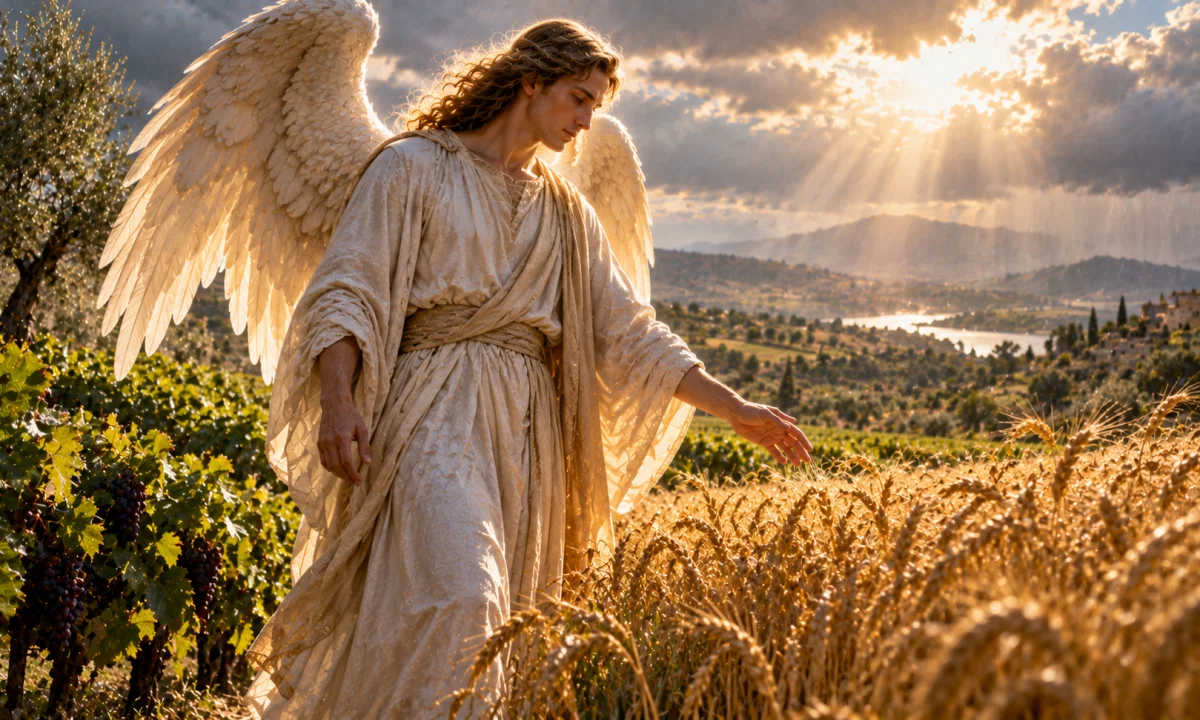
The same caution applies to claims that Anpiel has the body of a bird, commands a celestial flock, carries a particular weapon, or appears with a specified number of wings. The surviving association with birds does not prove any of these features. In Jewish and Christian art, angels may be shown with wings, but artistic convention should not be confused with an individual description of Anpiel.
Nor is there a firmly established feast day, prayer, sacred animal or liturgical office for Anpiel in the major Jewish or Christian traditions. The name is not comparable in institutional status to angels who are invoked in recognised prayers, celebrated in religious calendars or discussed extensively by theologians.
Stories and relationships
Anpiel has no widely preserved cycle of myths. There is no famous account of the angel appearing to a human, fighting a demon, delivering a revelation or participating in a heavenly rebellion. The surviving material associated with the name is primarily classificatory: it identifies a function rather than narrating a sequence of events.
This absence is significant. Many named angels in religious literature are known through stories, visions or dialogues. Others occur only in lists of heavenly officials. Anpiel belongs mainly to the second category. Treating a short functional entry as though it were the foundation of a complete mythology can create details that the tradition itself does not support.
Some confusion arises because Jewish mystical literature contains several important angels with names resembling Anpiel. These figures may act as guardians of heavenly palaces, attendants of the divine presence or beings connected with the celestial throne. Their descriptions can be grand and highly elaborate, but they should not automatically be assigned to Anpiel merely because of a similar transliteration.
Anpiel and Anaphiel
Anaphiel is the name most likely to be confused with Anpiel. In discussions of Jewish esoteric and heavenly literature, Anaphiel or related forms may appear as a powerful angelic figure associated with the heavenly court. Different texts and modern discussions give varying accounts of this being, and the spelling itself is not uniform.
The relationship between Anpiel and Anaphiel is unresolved. Some later writers may have shortened, altered or standardised one name into the other. Alternatively, similar names may have been treated as separate entries by different traditions. A reference that calls Anpiel a ruler of birds should not automatically be used as evidence for the mystical attributes of Anaphiel, and a description of Anaphiel as a heavenly guardian should not automatically be transferred to Anpiel.
This distinction illustrates a wider problem in the study of angel names. Transliteration can conceal differences in the original language, while modern lists can combine material from scripture, medieval manuscripts, occult literature and contemporary invention without clearly marking the transitions. Careful discussion should identify which spelling a source uses and should avoid presenting uncertain identifications as established fact.
Religious and cultural significance
Anpiel's importance lies less in a large body of stories than in what the name reveals about the structure of angelic imagination. Religious communities have often conceived the cosmos as layered and purposeful. The divine realm may include messengers of immense power as well as guardians assigned to apparently humble parts of creation. A bird-associated angel reflects the possibility that even ordinary animals participate in a sacred order.
This idea has parallels in broader religious thought, though the parallels do not prove a direct connection. Jewish and Christian traditions contain teachings about divine care for animals and the natural world. Biblical poetry can portray birds as witnesses to divine providence, while later devotional writing often treats animals as signs of God's wisdom. Anpiel can be placed within this general context, but the specific angelic name should not be projected backward into passages that do not mention it.
The figure also demonstrates the difference between official doctrine and para-scriptural tradition. A name may circulate in mystical, magical or encyclopedic writing without being accepted by every synagogue, church or theological school. The existence of an angelic name in a manuscript or later catalogue shows that someone used or recorded it; it does not establish universal religious authority.
Later reception
Anpiel is most visible today in modern angel dictionaries, occult websites, esoteric catalogues and lists of angels connected with animals or natural forces. These sources often present concise statements such as “angel of birds,” sometimes adding devotional or magical details. The briefness of such entries can give the impression of a well-documented ancient figure even when the historical record is much narrower.
Contemporary spiritual practice may use Anpiel as a symbolic guardian of birds, wildlife or the freedom associated with flight. Such use can be meaningful within a modern personal or esoteric system, but it represents a later interpretation rather than a universally recognised ancient practice. Claims about invocations, colours, sigils or ritual correspondences should likewise be identified as modern or source-specific when they occur.
Anpiel is not a major figure in mainstream popular culture. The name may occasionally appear in fantasy fiction, role-playing games or online angelology, but these appearances generally draw on the name's modern catalogue description rather than on an extensive traditional mythology. Fictional portrayals may therefore give Anpiel a personality, appearance or set of powers that should not be mistaken for historical religious tradition.
How to understand the tradition
The most responsible description of Anpiel is a poorly documented angelic name associated in later angelological tradition with birds. The bird connection is the central feature commonly attached to the name, while the name's etymology, age and relationship to similar figures remain uncertain. There is no secure basis for supplying a detailed biography, fixed appearance or elaborate mythology.
Reading Anpiel in this cautious way preserves both aspects of the subject: the imaginative richness of angelic classifications and the limits of the evidence. The figure can represent the spiritual ordering of the natural world, especially the place of birds between earth and sky, without being presented as a universally recognised biblical or doctrinal angel.