WORLD
WORLD
Amphion

Amphion is a legendary musician, prince and culture hero of Greek mythology, best known from the Theban cycle. He is traditionally the twin brother of Zethus and the son of Zeus and Antiope. His music was said to possess extraordinary power: when Amphion played his lyre, stones moved into place and helped form the walls of Thebes. He was also the husband of Niobe, whose children were destroyed by Apollo and Artemis in one of the most famous tragedies of Greek myth.
Origins and cultural setting
Amphion belongs to the mythology of Boetian Thebes, one of the most important legendary centres of mainland Greece. Thebes was associated with a large group of interconnected stories involving Cadmus, Oedipus, the Sphinx, the Seven against Thebes and the war of the Epigoni. Amphion’s story belongs to an earlier generation, before the birth of Oedipus, and explains a legendary stage in the foundation and fortification of the city.
The traditions about him survive in several ancient forms rather than in one complete, authoritative biography. His family history is connected with the myths of Antiope, a woman of Thebes who was pursued by Zeus and later mistreated by Lycus and Dirce. The story appears in different literary treatments, including the lost tragedy Antiope by Euripides, which is known through fragments and later summaries. Important details are also preserved in mythographical works such as the Bibliotheca attributed to Apollodorus, in Ovid’s Metamorphoses, and in the writings of Pausanias.
These sources do not always agree in their details. Greek mythology was transmitted through poetry, drama, local traditions and later compilations, so variations in parentage, the number of Niobe’s children and the circumstances of Amphion’s death are part of the ancient tradition rather than signs of a single fixed version.
Name and identity
The Greek name is usually written Amphíōn in transliteration as Amphion. Its precise etymology is not securely established. The name has sometimes been discussed in relation to Greek words suggesting being “around” or “on both sides,” but no single explanation is universally accepted. The uncertainty is linguistic rather than mythological: the figure himself is clearly established in the Theban stories.
Amphion is usually classified as a heroic king and musician, although he is also a descendant of gods through his father Zeus. He is not normally treated as an Olympian deity or as a god of music. His exceptional musicianship places him among the divinely favoured culture heroes of Greek myth, alongside figures such as Orpheus, whose music could also affect the natural world.
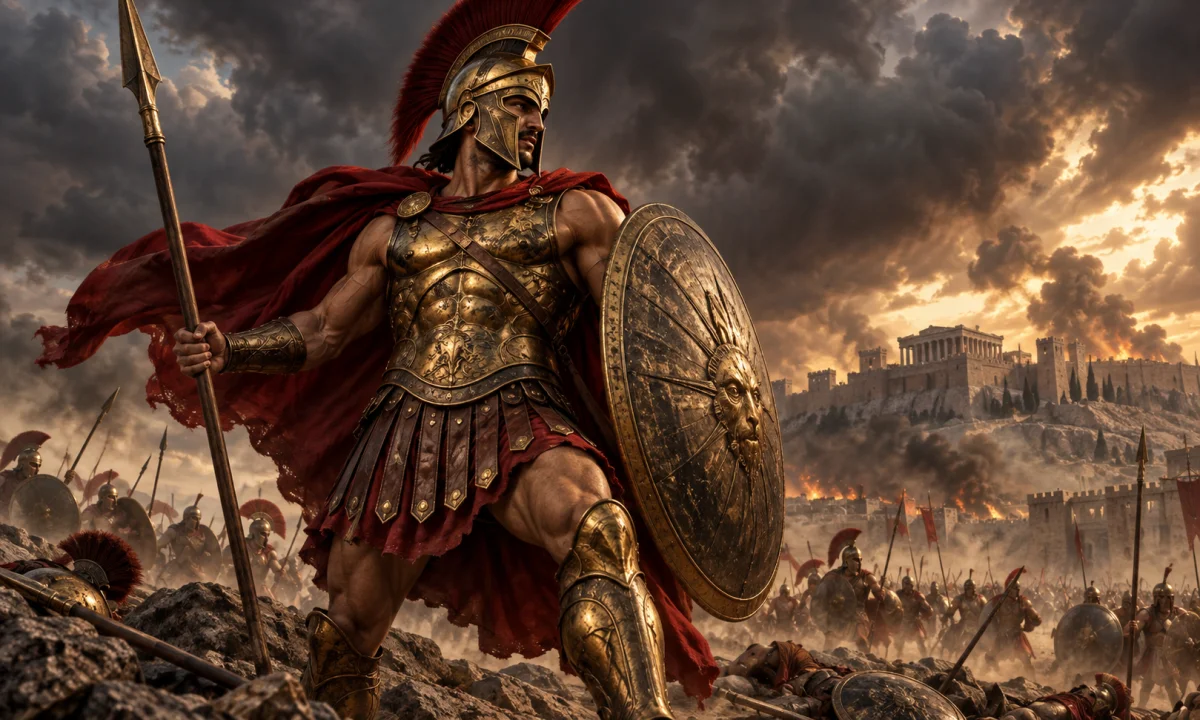
Amphion and Zethus function as a complementary pair. Amphion represents music, poetry and contemplative or intellectual power, while Zethus is associated with physical strength, hunting and practical action. This contrast is especially clear in Euripides’ treatment of the brothers. Their partnership reflects a recurring Greek idea that a city requires both force and culture: walls may protect a community, but music, law and shared traditions help make it a civilisation.
Antiope and the birth of the twins
Antiope was traditionally the daughter of Nycteus, a ruler of Thebes, or in some accounts of another Theban lineage. Zeus desired her and approached her in the form of a satyr, according to a widespread version of the story. Antiope became pregnant with twins, Amphion and Zethus. The identity of their human or divine father is not entirely consistent in every retelling, but the most influential tradition makes Zeus their father.
Antiope fled or was driven from Thebes and eventually came into the power of Epopeus, king of Sicyon. The circumstances vary: some accounts describe her as having sought refuge, while others present Epopeus as having abducted her. Nycteus, distressed by what had happened, either died or entrusted his brother Lycus with the task of recovering her. Lycus defeated Epopeus and brought Antiope back to Thebes.
During this period Antiope gave birth to the twins. Because of the dangers surrounding her, they were exposed or abandoned on Mount Cithaeron. Shepherds found and raised them, a familiar feature of heroic birth narratives. Amphion and Zethus therefore grew up separated from their mother and unaware, at least for a time, of their royal and divine ancestry.
Antiope’s suffering continued after her return. Lycus and his wife Dirce treated her cruelly, and the young twins eventually learned who she was. In the revenge sequence, Amphion and Zethus killed Lycus or deprived him of power, while Dirce was punished by being tied to a wild bull. The exact order and motivation differ between versions, but the central pattern is stable: the abandoned twins recover their identity, rescue their mother and overthrow the oppressive rulers of Thebes.
The walls of Thebes
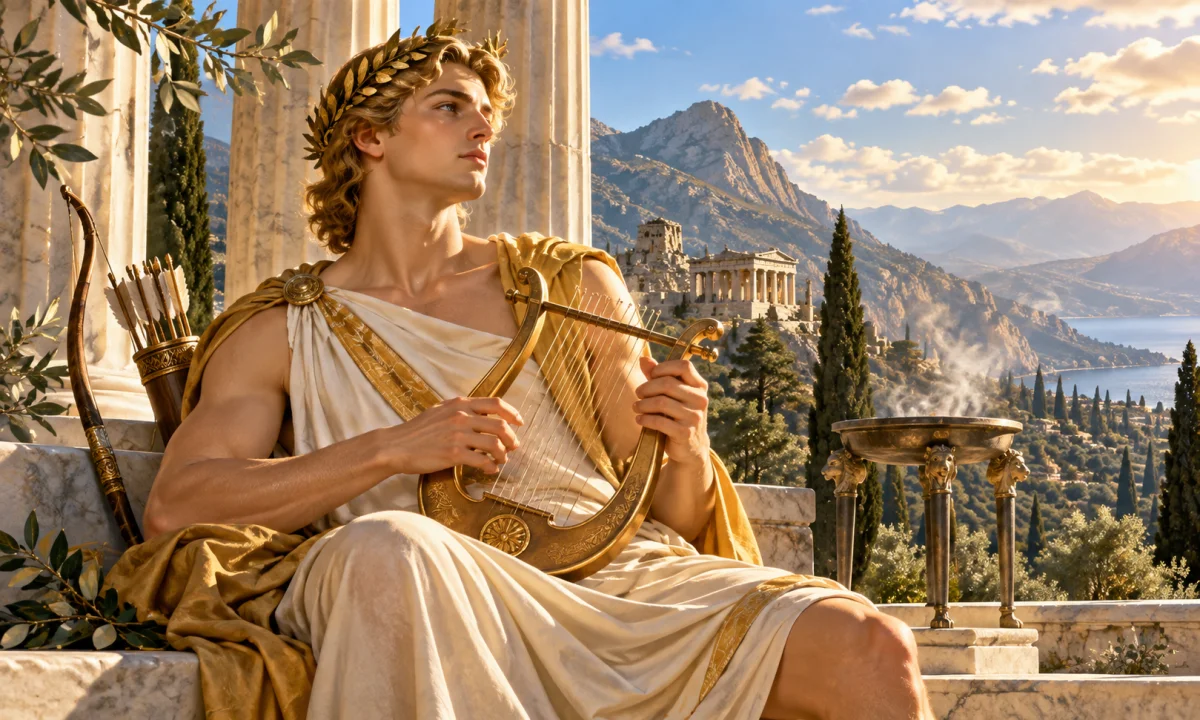
The most famous story about Amphion concerns the building of Thebes. After taking control of the city, Amphion and Zethus fortified it. Zethus carried and placed stones through his physical strength, whereas Amphion played a lyre. The stones were enchanted or irresistibly attracted by the music and moved into position of their own accord.
In some traditions Hermes gave Amphion the lyre, while other accounts simply present him as possessing an extraordinary musical gift. The instrument is not necessarily the same as the fully developed seven-stringed lyre associated with later musical history; ancient accounts differ concerning the number of strings and the development of the instrument. The story’s essential point is not technical musicology but the magical effectiveness of harmony.
The myth turns music into a force capable of creating civic order. Amphion does not build by wielding tools or commanding labourers. He persuades the stones through sound. This image has often been interpreted as a poetic expression of the power of song, speech and cultural cohesion. A city is more than a defensive structure: it is also an arrangement of people, customs and shared memory. Amphion’s music gives visible form to an invisible organising power.
The story also creates a deliberate contrast between the brothers. Zethus’s labour represents physical construction, while Amphion’s song represents the cultural and symbolic work of founding a city. Neither brother is wholly sufficient on his own. The Theban foundation thus joins bodily strength and artistic intelligence rather than presenting one as a complete replacement for the other.
Amphion and Niobe
Amphion married Niobe, daughter of Tantalus and a princess associated with Sipylus in western Anatolia. Through this marriage, the Theban royal family became connected with one of the great houses of Greek myth, the family of Tantalus, which also included Pelops and later the tragic lines of Atreus and Thyestes.
Niobe was famous for having many children, known collectively as the Niobids. Their number varies by source. Homer’s Iliad gives a smaller number than later accounts, while later poets commonly describe seven sons and seven daughters, or fourteen children in total. Other traditions provide different totals and individual names. These variations demonstrate that the Niobe story developed over time and should not be reduced to one universally fixed family list.
Niobe boasted that her large family made her superior to Leto, the mother of Apollo and Artemis, who had only two children. The boast was an act of hubris: Niobe treated fertility and motherhood as grounds for challenging divine honour. Apollo and Artemis responded by killing the Niobids. Apollo killed the sons and Artemis the daughters in the most common version, although the distribution and survival of particular children vary.
Niobe was transformed into stone, usually identified with a rock on Mount Sipylus from which tears continually flow. The stone was a powerful image of grief, and ancient visitors associated the landscape with the myth. Amphion’s position in this episode varies in emphasis. He is generally presented as the father of the Niobids and as a victim of the destruction of his household, but the story focuses more strongly on Niobe’s pride, the deaths of the children and her transformation.
Amphion’s death
The ancient tradition does not preserve one completely consistent account of Amphion’s death. In a widely known version, after Apollo and Artemis killed the Niobids, Amphion attempted to attack or destroy a sanctuary of Apollo. Apollo then killed him. This detail presents Amphion’s grief as turning into an act of defiance against a god, extending the theme of human limits and divine retribution.
Other literary treatments may give less prominence to this episode or handle the aftermath differently. Ovid’s version of the Niobe story concentrates on the destruction of the children and Niobe’s transformation, while later summaries vary in how they describe Amphion’s final fate. Pausanias, who recorded local traditions and monuments, knew of a tomb attributed to Amphion at Thebes. The existence of such a claimed tomb does not establish the historical existence of the hero, but it shows that the myth was attached to a real landscape and local memory.
The ending of Amphion’s story is therefore closely linked with the limits of his special power. His music could move stones and help establish a city, but it could not protect his family from divine anger. The contrast between creative power and helplessness before the gods is central to his role in Greek tragedy and mythic interpretation.
Attributes and symbolism
- The lyre: Amphion’s principal attribute is the lyre, a symbol of song, poetic intelligence and the ability of art to influence the world.
- The moving stones: The stones of Thebes represent the power of harmony to organise matter, labour and society.
- The city wall: The wall connects Amphion with foundation myths and the creation of a stable political community.
- The twin relationship: His partnership with Zethus contrasts artistic and physical strength while showing that both can contribute to civic life.
- The Niobid tragedy: His marriage to Niobe places him within a myth about pride, divine authority, family grief and the fragility of prosperity.
Amphion is sometimes compared with Orpheus because both are legendary musicians whose playing has supernatural effects. The comparison is useful, but they are not the same figure. Orpheus is primarily associated with Thrace, the Argonaut expedition, Eurydice and the attempt to retrieve her from the underworld. Amphion is primarily a Theban hero, a royal founder and the twin of Zethus. Their musical powers belong to related storytelling traditions, but their families, cities and major myths are distinct.
Ancient literary and artistic reception
Amphion was an established figure in early Greek epic and local legend. The Odyssey refers to Amphion in connection with his parentage and his marriage to Niobe, while the Iliad refers to Niobe’s grief. These brief epic references suggest that the audience already knew larger stories that the poems did not need to narrate in full.
Euripides’ lost tragedy Antiope was especially important for the philosophical contrast between Amphion and Zethus. Although the play survives only in fragments and quotations, its influence can be seen in later discussions of music, education and the proper basis of political life. Amphion’s preference for music and thought was set against Zethus’s preference for labour and practical action. The contrast was not simply between good and bad values; it explored competing ideas about what makes a successful ruler and a durable city.
Greek and Roman writers also treated Amphion as an example of the civilising power of music. At the same time, his association with Niobe connected him with the darker side of heroic prestige. Royal birth, artistic excellence and divine favour did not guarantee happiness. The myth placed exceptional talent within a moral universe governed by limits that even kings and heroes could not escape.
Later visual artists often represented Amphion with a lyre or showed the stones of Thebes responding to his music. Such images usually draw on the broad classical tradition rather than on one specific ancient description. The motif became especially attractive in periods that valued music as a force capable of shaping character, society and political order.
Modern significance
Amphion is less prominent in modern popular culture than Orpheus, Hercules or Oedipus, but his image remains important in discussions of music and architecture. The idea of a musician causing stones to assemble has inspired literary, artistic and musical references to the relationship between sound and structure. It can also function as a metaphor for artistic creation: the singer gives form to what was previously scattered and inert.
Modern interpretations should not mistake this metaphorical use for a separate ancient cult of Amphion. The surviving evidence presents him chiefly as a mythic hero within Theban genealogy and foundation legend. His story combines the establishment of a city, the cultural prestige of music and the devastating consequences of conflict with the gods.