WORLD
WORLD
Alouroua
Alouroua is a name associated in some modern reference lists with African mythology, especially the religious traditions of the Fon of present-day Benin. It is sometimes described as a solar deity or a god connected with light. However, the evidence for a distinct traditional figure called Alouroua is limited, and the name does not have the securely documented status of major Fon deities such as Mawu, Lisa, Legba, or Sakpata. Its identity, spelling, and cultural origin should therefore be treated as uncertain rather than established.
Origins and cultural setting
The name Alouroua is most often placed in the wider religious setting of the former Kingdom of Dahomey, a powerful state in the region now known principally as southern Benin. Dahomey was founded by the Fon and developed a complex religious system that included creator powers, ancestral spirits, divinities connected with natural forces, and deities associated with royal authority and particular occupations.
Fon religious traditions were not a single fixed mythology preserved in one canonical book. Knowledge was transmitted through ritual, priestly training, oral narratives, songs, proverbs, family traditions, royal institutions, and local cults. Names and descriptions could consequently vary between communities. Religious concepts were also shared, adapted, and reinterpreted among neighbouring Fon, Ewe, Aja, and related peoples.
This cultural setting is important when considering Alouroua. A short entry in a modern catalogue may make the name appear to represent a clearly defined god with a fixed genealogy and a standard set of powers. The available evidence does not support that level of certainty. The name may preserve a local or poorly recorded tradition, reflect a transcription from an oral source, or have been repeated by later compilers without enough explanation of its original context.
Name and identity
The spelling Alouroua is not accompanied by a widely accepted etymology. It is therefore unsafe to assign a precise meaning to the name or to assume that it can be translated simply as “sun,” “light,” or “creator.” African religious names were often recorded by outsiders using changing systems of spelling, and similar-looking forms can represent different sounds in local languages.
Some modern descriptions identify Alouroua as a sun god. That classification may be the source of the name’s inclusion in general collections of African deities, but it is not supported by a substantial body of widely known Fon mythology. In well-documented Fon cosmology, solar and cosmic functions are more commonly discussed in relation to Lisa, while Mawu is associated with the moon and with the maternal or generative aspect of the supreme creative power. Mawu and Lisa may be understood as complementary divine principles or as a paired supreme deity, depending on the tradition and the interpreter.
Because Lisa already occupies an important solar position in many accounts of Fon religion, Alouroua should not automatically be treated as another name for Lisa. Nor should it be presented as a universally recognized member of the Fon pantheon. The relationship, if any, between the names remains unclear.
Possible solar associations
When Alouroua is described as a solar being, the attribution usually implies a connection with the sun’s visible power: daylight, heat, order, growth, and the rhythm of time. These are common symbolic associations of solar divinities throughout the world, but they should not be mistaken for securely recorded myths about Alouroua.
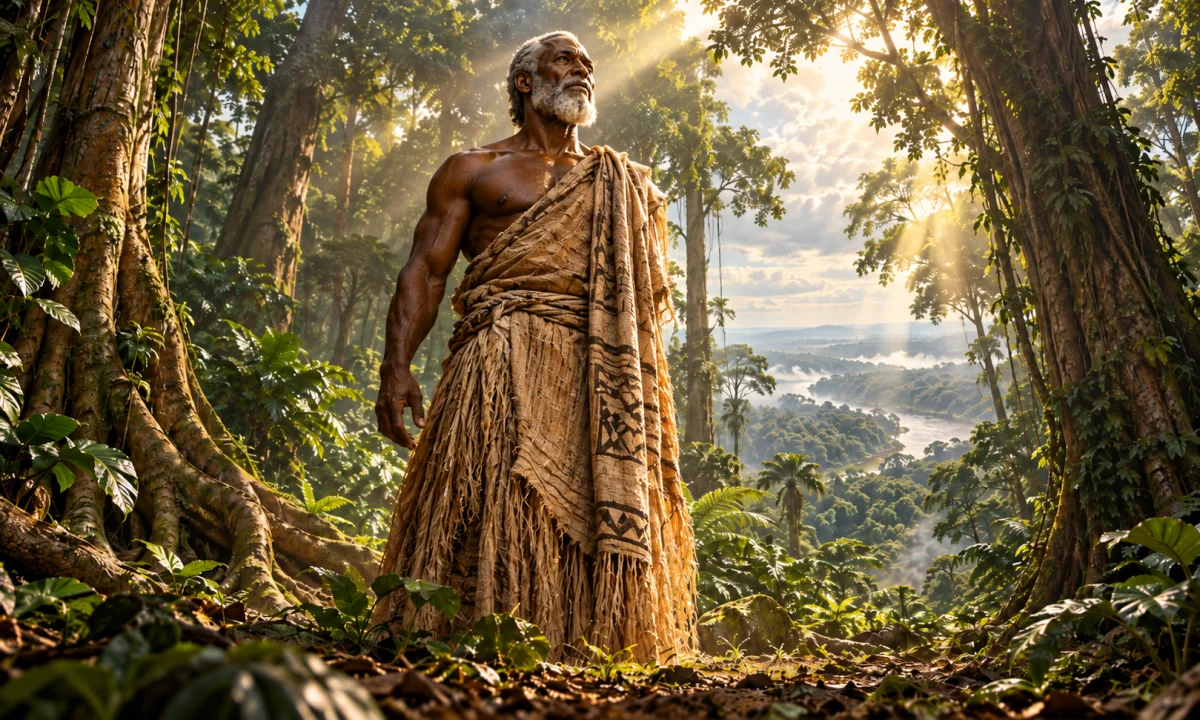
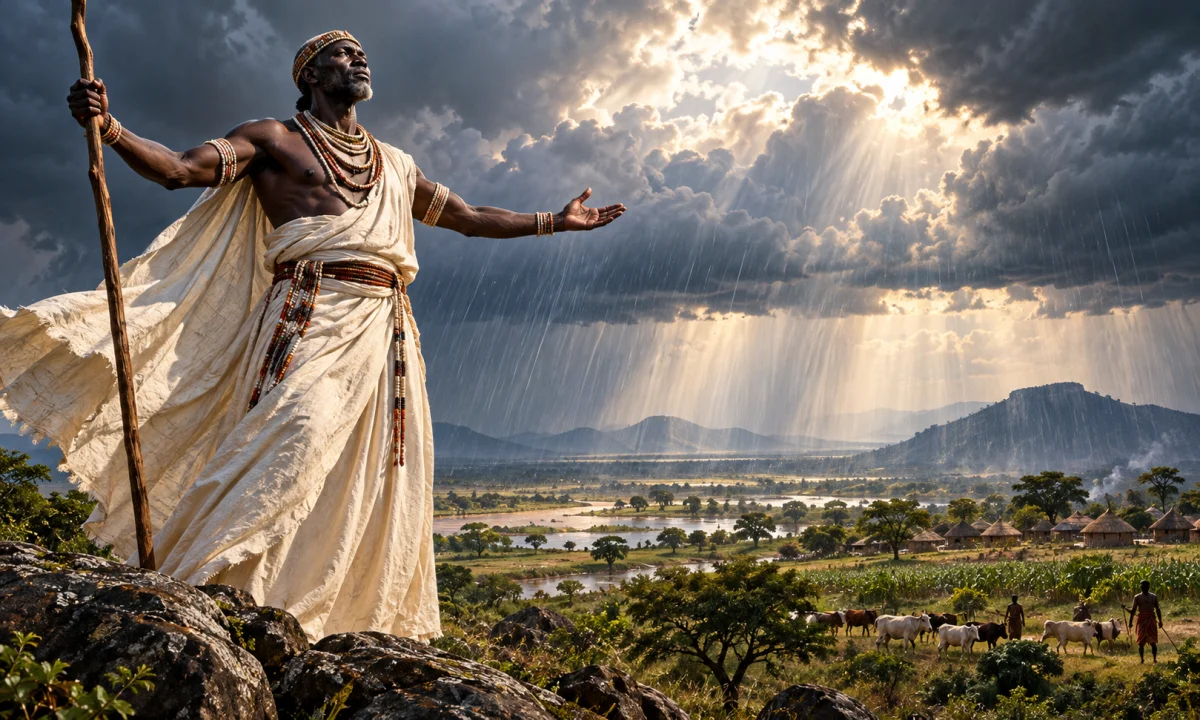
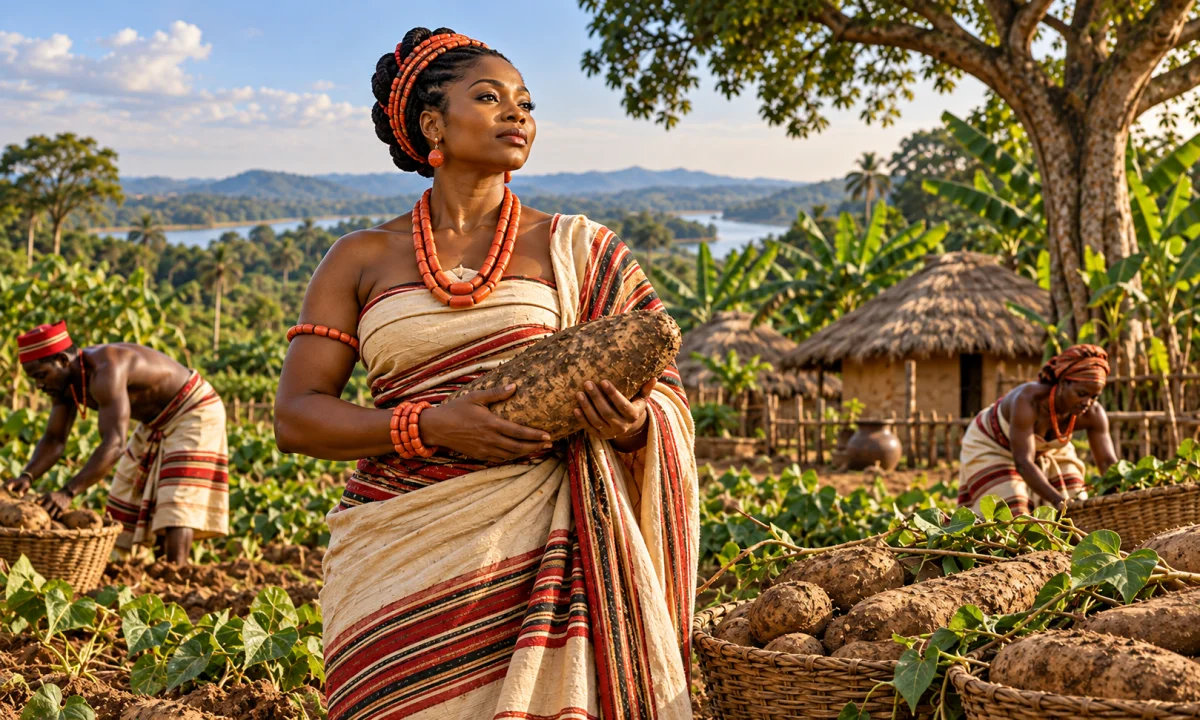
No broadly attested cycle of stories establishes Alouroua’s birth, family, residence, sacred objects, ritual specialists, or conflicts with other gods. There is also no reliable basis for assigning a distinctive appearance, animal form, weapon, colour, or emblem to the figure. Images sometimes produced for modern mythology websites or fantasy projects should be understood as artistic inventions unless they are explicitly tied to a documented local tradition.
The uncertainty does not make the name meaningless. It shows instead how easily an oral and regionally varied religious tradition can be reduced to a single label. A deity connected with sunlight in one local account might have been a broader creator power, an epithet of another god, a spirit associated with a particular shrine, or a figure belonging to a neighbouring people rather than to the Fon as a whole.
Fon religious concepts relevant to the name
Mawu and Lisa
Mawu and Lisa are the best-known supreme powers in many accounts of Fon religion. Mawu is commonly associated with the moon, coolness, fertility, and the nurturing or receptive side of creation. Lisa is commonly linked with the sun, heat, strength, and the active side of the cosmic order. In some interpretations they are separate but complementary beings; in others they form a unified divine principle often called Mawu-Lisa.
This pairing reflects a pattern of complementary forces rather than a simple opposition between good and evil. Coolness and heat, night and day, moisture and dryness, and feminine and masculine qualities can be understood as mutually necessary aspects of the world. If Alouroua was genuinely a local solar name, it might have been interpreted within such a structure, but there is no firm evidence that it was a standard title of Lisa or a separate member of the Mawu-Lisa complex.
Dan or Aido-Hwedo
The great serpent known in related traditions by names such as Dan or Aido-Hwedo is associated in different accounts with the support of the world, movement, fertility, water, and the rainbow. Some stories describe the serpent as helping to shape or sustain the ordered universe. These traditions later became connected, through the history of the Atlantic world, with serpent symbolism in Haitian Vodou.
Alouroua should not be identified with Dan or Aido-Hwedo merely because both may appear in broad surveys of West African religion. Their names, symbolic roles, and traditions are distinct. Nor is there evidence that Alouroua was a serpent deity.
Legba and other divinities
Legba is a prominent intermediary and guardian of crossings, entrances, communication, and the relationship between human beings and the divine realm. He is often encountered at thresholds and may be involved in opening or controlling access to other spiritual powers. His importance illustrates that Fon religious systems included many different kinds of divine roles rather than a hierarchy made up only of natural forces such as sun, moon, earth, and storm.
Other important figures include Gu, associated with iron, tools, warfare, and technological power; Sakpata, connected with the earth and epidemic disease; and Hevioso, a thunder deity in traditions of the region. These better-documented figures should not be folded into the identity of Alouroua. A general list of “African gods” can conceal major differences between deities who belong to separate cults or perform very different religious functions.
Stories and surviving tradition
There is no widely recognized narrative cycle centred on Alouroua. In particular, the figure is not associated with a securely attested creation story comparable to accounts involving Mawu-Lisa or the cosmic serpent. There is also no established story explaining a conflict between Alouroua and a rival deity, a journey to the human world, or a relationship with a particular hero or royal ancestor.
The absence of a famous story should not be taken to prove that no local tradition ever existed. Oral religions often preserve knowledge in forms that do not enter general mythology collections. A spirit may be known principally through a shrine, a priestly lineage, a ritual formula, or a community’s explanation of a natural event. Such material can disappear, change, or remain inaccessible to outsiders without leaving a detailed written record.
At the same time, caution is necessary. When a name appears only in repeated modern lists and is not accompanied by a traceable narrative or ethnographic context, it cannot be expanded into a complete mythology without speculation. Claims that Alouroua created the world, ruled the sky, married another god, or demanded particular sacrifices would require evidence that is not generally available.
Interpretation and cultural significance
Alouroua is significant partly as an example of the problems involved in presenting African religions as collections of universally standardized gods. The word “mythology” is useful for discussing traditional stories, but it can suggest a fixed pantheon similar to those constructed from Greek or Roman literary sources. Many African religious traditions are instead local, living systems in which ritual practice, community memory, and relationships with ancestors are as important as narrative.
The uncertain status of Alouroua also shows why a deity should be studied in its linguistic and regional setting. “African mythology” covers thousands of communities and numerous religious histories. A name associated with southern Benin should not automatically be generalized to the whole continent, or even to every Fon-speaking community. Nor should similarities in the themes of sunlight, creation, or kingship be treated as proof that two named beings are the same.
If the name refers to a solar power, its possible symbolism would fit a wider religious concern with the forces that sustain life and maintain cosmic balance. Yet symbolic interpretation must remain separate from historical evidence. It is reasonable to discuss what a solar deity might represent; it is not reasonable to claim that Alouroua definitely had a particular theology or cult without documentation.
Distinction from similar figures
- Lisa: A major Fon-associated cosmic power commonly linked with the sun, heat, strength, and the active principle of creation. Alouroua should not be assumed to be another name for Lisa.
- Mawu: Commonly associated with the moon, fertility, coolness, and the generative aspect of creation. Mawu is sometimes paired with Lisa as Mawu-Lisa.
- Dan or Aido-Hwedo: A cosmic serpent in related West African traditions, associated in different accounts with the support and ordering of the world. There is no established basis for identifying this serpent with Alouroua.
- Hevioso: A thunder deity connected with storms and divine punishment in traditions of the region. A possible solar association does not make Alouroua a thunder god.
- Olorun or Olodumare: Supreme divine names in Yoruba religious traditions. These belong to a different cultural and linguistic context and should not be substituted for a poorly documented Fon name.
- Damballah: A major serpent spirit in Haitian Vodou. Although Haitian religious history includes West and Central African influences, Damballah is not simply another name for Alouroua.
Later reception
Alouroua has little established presence in major modern popular-culture traditions. The name may appear in encyclopedic websites, lists of deities, role-playing material, or independently created fantasy settings, where it can be given powers and visual features that are not supported by traditional evidence. Such portrayals belong to modern interpretation rather than to documented Fon religion.
For the same reason, a responsible depiction of Alouroua should preserve the uncertainty surrounding the name. It is more accurate to describe it as a possibly West African, often supposedly Fon-associated figure with reported solar connections than to present a detailed divine biography as fact. The distinction matters: it respects the complexity of the communities from which African religious traditions come and avoids turning an obscure or poorly recorded name into a fictional certainty.