WORLD
WORLD
Sakpata
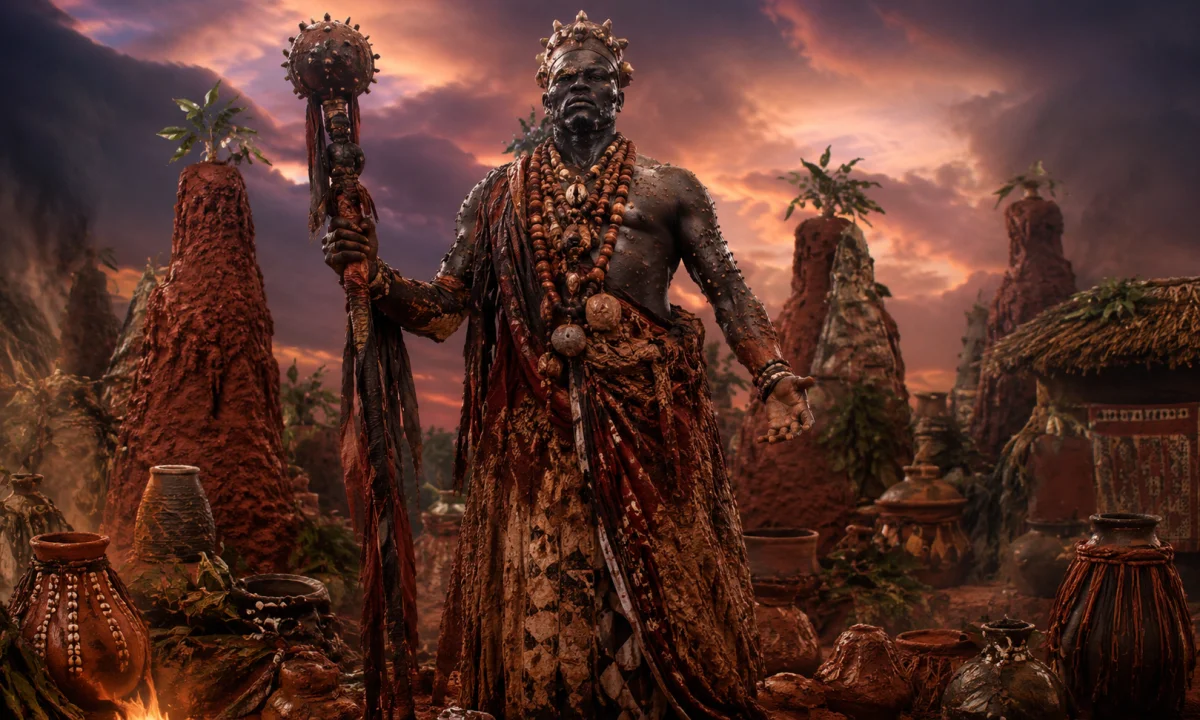
Sakpata is a major spirit of Vodun traditions in parts of West Africa, especially among Fon-speaking communities in present-day Benin and neighbouring areas of Togo, Ghana and Nigeria. He is strongly associated with the earth, contagious disease and the power to inflict or remove illness. Smallpox is the disease most closely connected with Sakpata in historical accounts, although his religious significance is broader: he can represent the dangerous, fertile and morally responsive power of the ground itself.
Sakpata is not a single figure with one universally fixed biography. His name, gender, relationships, rituals and precise attributes vary between communities and between different Vodun traditions. In some contexts he is treated as a male deity; in others, aspects of Sakpata are described in ways that do not fit a simple male-female division. His worship also overlaps historically with traditions concerning Yoruba deities such as Ṣọ̀pọ̀na and Obaluaye, but these figures should not automatically be treated as identical.
Origins and cultural setting
Sakpata belongs to the religious world commonly called Vodun, a family of traditions especially associated with the Fon, Ewe and related peoples of the region around the Bight of Benin. The word vodun generally refers to a sacred power, divinity or spirit, although its meaning and use differ according to language and community. Vodun religion includes supreme creator powers, celestial beings, earth spirits, ancestors and numerous local or specialised divinities.
In Fon religious thought, Sakpata is often described as an earth Vodun. The earth is not merely a physical substance in this setting. It is a source of food and fertility, the place where the dead return, and a power that can sustain or punish human communities. Disease therefore fits naturally within Sakpata’s sphere. Illness may be understood not only as a biological event but also as a sign of disturbed relationships, broken prohibitions, ritual pollution or the action of a powerful spirit.
Traditions about Sakpata have circulated across political and linguistic boundaries for centuries. Trade, migration, warfare, marriage, slavery and the movement of priests helped carry religious practices throughout southern Benin, Togo, southwestern Nigeria and parts of Ghana. As a result, it is difficult to identify one original form of the deity that remained unchanged everywhere. Local communities have incorporated Sakpata into their own pantheons, ritual systems and histories.
The name Sakpata
The spelling Sakpata is common in English-language discussions, but many other forms occur, including Sakpatè, Ṣàkpàtá, Sakpatah and names influenced by local pronunciation. The exact origin and meaning of the name are not entirely settled. Some interpretations connect it with words or titles associated with disease, the earth or striking power, while others emphasise its relationship to Yoruba religious vocabulary. Transliteration from African languages also creates variations that do not necessarily indicate different beings.
The similar Yoruba name Ṣọ̀pọ̀na, often written Sopona or Shopona in older English sources, refers to a deity associated particularly with smallpox. In Yoruba-speaking areas, the same religious complex may also be connected with Obaluaye or Babalu-Ayé. Historical contact between Fon and Yoruba peoples encouraged exchange and reinterpretation, and some scholars compare Sakpata with these Yoruba figures. Nevertheless, comparison is not the same as proof that all the names describe one original deity. Each tradition has its own ritual history and theological vocabulary.
Earth, disease and dangerous power
Sakpata’s most famous attribute is his control over serious epidemic illness, especially smallpox. In the period before vaccination and modern public health, smallpox could devastate entire settlements. A religious power believed capable of sending such a disease would naturally be approached with fear, respect and caution. Sakpata was not simply imagined as a demon of sickness. He could also protect people, end an epidemic and restore health when properly honoured.
This combination of danger and protection is central to Sakpata’s character. A deity who controls disease occupies a position between destruction and healing. Priests and devotees may seek to calm him, discover the ritual cause of an illness, or ask for relief. The same power that punishes violations can restore balance. Such ideas should not be reduced to a primitive explanation of disease: they form part of a wider religious system in which physical, social and moral disorders are closely related.
Sakpata’s connection with the earth gives his worship an additional dimension. The ground provides crops, receives offerings and contains the remains of ancestors, yet it can also be unstable, polluted or dangerous. In several West African traditions, earth divinities are approached with particular respect because they govern both human survival and the limits placed on human behaviour. Sakpata’s authority therefore concerns not only epidemics but also fertility, land and the obligations that bind a community to its environment.
Appearance and sacred objects
There is no single canonical image of Sakpata comparable to the fixed statues of some classical gods. Traditional Vodun worship often focuses on sacred spaces, consecrated objects, vessels, mounds, staffs, cloth, plants and ritual arrangements rather than on a standard human-shaped image. The appearance of a Sakpata shrine depends on the community, priestly lineage and local practice.
Descriptions of Sakpata shrines frequently mention earthen forms, pots, bundles and covered objects. Such materials express his relationship with the ground and with hidden or dangerous forces. Raffia, leaves, cloth and other natural substances may also appear in ritual settings. Their meaning is not uniform, and an object used in one shrine cannot automatically be treated as a universal symbol of Sakpata.
Later artistic representations sometimes show a dark-skinned figure covered with spots, carrying a staff or surrounded by signs of illness. These images can communicate the deity’s association with smallpox, but they are interpretations rather than a single traditional standard. Some modern depictions also borrow visual features from Yoruba images of Obaluaye, from ceremonial photographs or from the broader international image of African deities. They should be identified as particular artistic or religious interpretations rather than definitive portraits.
Priests, shrines and ritual caution
Sakpata worship is mediated through priests, priestesses and ritual specialists who possess knowledge of songs, prohibitions, offerings, divination and initiation. Their authority is not merely theatrical. In a traditional setting, they may diagnose the spiritual dimensions of an illness, maintain a shrine, preserve a lineage’s ritual knowledge and guide people through ceremonies intended to repair relations with the deity.
Because Sakpata is associated with contagious disease, his worship has often involved strict rules concerning contact, movement and ritual purity. Certain persons, foods, places or actions may be forbidden to devotees. The particular prohibitions differ among communities, and general descriptions should not be mistaken for a universal code. Avoiding careless contact with sacred objects is especially important because the objects represent a power that can be beneficial but is not treated casually.
Offerings and ceremonies may include food, drink, animals, music, drumming, dance and spoken or sung prayers, depending on the tradition. The purpose is not simply to buy favour from a god. Offerings can acknowledge dependence on the earth, repair a broken relationship, thank the deity for protection or mark a transition in the life of a devotee. Initiation and possession ceremonies, where practised, are understood within the community’s own religious framework and should not be confused with performance for outsiders.
Stories and relationships
Unlike figures preserved in one extensive canonical epic, Sakpata appears in many local narratives, ritual explanations and oral histories. Some traditions place him within genealogies of Vodun powers and connect him with the creator divinity Mawu, with Lisa, or with other major spirits. These relationships vary, and there is no single genealogy accepted by all Fon or Ewe communities.
One recurring type of story explains why Sakpata became associated with a particular territory, shrine or ritual lineage. Another may describe conflict between Sakpata’s priests and royal authorities. Such narratives can preserve memories of political competition as well as religious beliefs. A shrine’s origin story may present the deity as arriving from another region, being discovered in the earth, or revealing himself through an epidemic or other crisis.
Stories of Sakpata often emphasise the consequences of disrespect. A ruler, village or individual who violates a taboo may be punished by sickness, while humility and correct ritual action can end the danger. These accounts do not all function as literal historical records. They also explain why priests possess authority, why particular customs must be followed and why communities should treat the earth and the vulnerable with care.
Sakpata and the royal state of Dahomey
The historical kingdom of Dahomey, centred in southern Benin, maintained a powerful royal religious system. Its rulers supported some cults, regulated others and sometimes attempted to suppress religious movements that challenged royal authority. Sakpata traditions are frequently discussed in this context because the worship of an earth and disease deity could operate through independent priestly networks outside the palace.
Accounts of conflict between Dahomean rulers and Sakpata priests differ in detail. Some traditions and historical interpretations describe efforts by the monarchy to control, restrict or expel Sakpata specialists. These conflicts should not be explained simply as opposition between “religion” and “politics”. Royal power, local land rights, priestly authority and control over responses to epidemics were closely connected. A ruler who could not fully control an influential cult might regard it as a political threat, while local communities could view the priests as essential protectors.
The history also shows why it is misleading to describe Vodun as a single centralised religion. Different shrines and lineages could preserve distinct teachings, maintain separate political relationships and give different accounts of Sakpata’s origin. The deity’s importance survived changes in royal policy and continued through local religious institutions.
Relationship to Ṣọ̀pọ̀na and Obaluaye
Confusion between Sakpata and Yoruba disease deities is common because the traditions developed in neighbouring regions and share important themes. Ṣọ̀pọ̀na is a Yoruba deity strongly associated with smallpox, while Obaluaye and Babalu-Ayé are names used in Yoruba religious contexts for a related complex of healing, illness, ageing and earthly power. In some communities, names and practices have influenced one another.
However, the terms do not have exactly the same history everywhere. “Obaluaye” is sometimes interpreted as a title or later name rather than an original name for all forms of the deity, and religious specialists may distinguish Ṣọ̀pọ̀na from Obaluaye in different ways. Sakpata belongs particularly to Fon and related Vodun settings, even though Yoruba religious traditions have shaped and interacted with his worship. Treating every spotted or disease-associated figure in West African religion as the same god erases these distinctions.
Historical change after smallpox
Smallpox vaccination and the global eradication of smallpox changed the practical context in which Sakpata was worshipped. The disease no longer has the same everyday presence that it had for earlier generations, but the deity’s significance did not necessarily disappear. Religious traditions can preserve a deity’s authority while adapting the interpretation of that authority to new circumstances.
Sakpata may continue to be approached as a power of healing, bodily vulnerability, the earth and collective danger rather than only as a personification of smallpox. Epidemics and other public health crises can also renew reflection on the relationship between spiritual responsibility, social conduct and care for the community. Such interpretations belong to living traditions and should not be treated as evidence that traditional worship is merely a disguised form of modern medicine.
Cultural significance and the African diaspora
Religions carried from West Africa to the Caribbean and the Americas preserved, transformed and recombined many Vodun and Yoruba traditions. Names related to Sakpata may therefore appear in discussions of Haitian Vodou, Brazilian Candomblé, Cuban religious traditions and other diasporic systems, although the forms and meanings differ by region. The presence of a similar name does not prove that a diaspora figure has exactly the same identity as Sakpata in Benin.
In these contexts, disease-associated African deities may be connected with healing, protection, the dead, the poor or those who live at the margins of society. The resulting traditions reflect African continuities as well as local histories, Catholic influence, Indigenous elements and later changes. They should be studied on their own terms rather than presented as simple copies of an African original.
Modern representation
Sakpata has appeared less often in global popular culture than better-known figures such as Anansi, but he is increasingly visible in writing, visual art, theatre, music and discussions of African religious heritage. Contemporary artists may use his imagery to explore epidemics, colonial descriptions of African religion, environmental destruction, bodily difference or the politics of medical knowledge.
These modern works can be meaningful without being traditional accounts. A horror story that portrays Sakpata as a monster, for example, uses only one aspect of his dangerous reputation and may omit his role as healer, earth power and guardian of ritual order. Likewise, an image that treats him as simply “the African god of smallpox” narrows a complex religious figure into a label shaped by modern genre conventions. Traditional worship, historical interpretation and creative adaptation should remain clearly distinguished.