WORLD
WORLD
Aha-njoku
Aha-njoku is a figure associated with yams, cultivation and agricultural prosperity in some Igbo traditions of southeastern Nigeria. The name is also written Aha Njoku, Ahia Njoku, Njoku Ji or, in related contexts, Ifejioku. These names are not always treated as exact equivalents. Depending on the community and source, Aha-njoku may be understood as a female yam spirit, a household or village deity connected with yam farming, or a name closely associated with another yam divinity.
Because Igbo religious life has historically been organised through autonomous communities, lineage practices and local shrines rather than a single central institution, no universally fixed account of Aha-njoku exists. Descriptions of the figure’s gender, powers, stories and relationship to other deities vary. The most consistent association is with the yam, an important food crop and a major symbol of labour, wealth, status and continuity in many Igbo societies.
Origins and cultural setting
The Igbo peoples live primarily in southeastern Nigeria, with related communities in adjoining areas. Igbo religious traditions recognise a supreme creator, often called Chukwu or Chineke, together with numerous spiritual powers connected with the earth, ancestors, rivers, forests, occupations, health, fertility and particular settlements. The precise names and roles of these beings differ considerably between Igbo-speaking communities.
Aha-njoku belongs to this wider religious environment of local and occupational spiritual powers. Her or its significance is best understood through the importance of yam cultivation. Yams require substantial work: preparing the soil, planting seed yams, constructing supports for the vines, controlling weeds and protecting the crop until harvest. Successful yam farming could contribute to a household’s food supply, prestige and ability to participate fully in social and ritual life.
In many communities, a man’s achievement as a yam farmer was historically connected with ideas of diligence, maturity and social standing. Yam production could also involve women’s labour, especially in processing, storage, preparation and the management of household food. A deity or spirit associated with yams therefore stood at the meeting point of agriculture, household welfare, gendered labour and community prosperity.
Yams are especially prominent during the New Yam Festival, known by different names in different Igbo areas, including Iri Ji and Iwa Ji. The festival marks the arrival of a new harvest. Rituals may include offerings, prayers, feasting, public ceremonies and the symbolic eating of newly harvested yams. The festival is not solely a ceremony for Aha-njoku, and it should not be assumed that every community celebrating a new yam harvest worships a deity by that name. Nevertheless, the agricultural world represented by the festival provides important context for understanding yam spirits and deities.
Name, identity and classification
The spelling Aha-njoku is common in English-language discussions, but it is not the only form encountered. The names Aha Njoku and Ahia Njoku appear in accounts of an Igbo yam goddess or yam spirit. Other sources use Njoku Ji, meaning a figure associated with yams, or connect the name with Ifejioku, another important yam divinity in some Igbo traditions.
These variations reflect more than simple differences in spelling. Igbo religious terms can have local forms, and early written accounts often recorded names according to an outsider’s hearing, orthography or interpretation. Later writers sometimes treated distinct local traditions as if they were parts of a single pan-Igbo mythology. For that reason, it is safer to say that Aha-njoku is a yam-associated figure in some Igbo traditions than to present one rigid genealogy or universal identity.
Some accounts describe Aha-njoku as a goddess, particularly a female spiritual patron of yam cultivation and fertility. Others use less gendered language, calling the figure a yam spirit or agricultural power. Still others identify the name with Njoku Ji or with a local manifestation of a yam deity. The use of “goddess” can therefore be appropriate for particular traditions but should not be treated as an uncontested classification across all Igbo communities.
The name should also not be confused with unrelated words or figures merely because English spellings resemble one another. Transliteration from Igbo can produce several written forms, and similar-looking names do not by themselves prove that two beings are identical.
Association with yams and farming
Aha-njoku’s central sphere is the cultivation and well-being of yams. In traditional interpretations, a yam deity may be approached for a productive growing season, protection of crops, favourable weather, fertile soil and a plentiful harvest. Such a being could also be connected with the knowledge required to farm successfully, since agriculture depends not only on supernatural favour but on skill, timing and sustained work.
Yam symbolism extends beyond food. A large harvest could signify the prosperity of a household and the competence of the farmer. Seed yams represented continuity between one season and the next, while stored yams helped protect a community against scarcity. The spiritual importance of the crop thus included nourishment, inheritance, social reputation and the survival of the community.
In traditions that treat Aha-njoku as female, her femininity may be linked with the generative power of the earth, the protection of crops and the continuity of household life. This does not mean that yam cultivation was exclusively women’s work or that every Igbo community understood agricultural powers through a simple male-female division. Igbo ideas of gender, ritual authority and agricultural labour are varied, and local practice is more complex than a single symbolic formula.
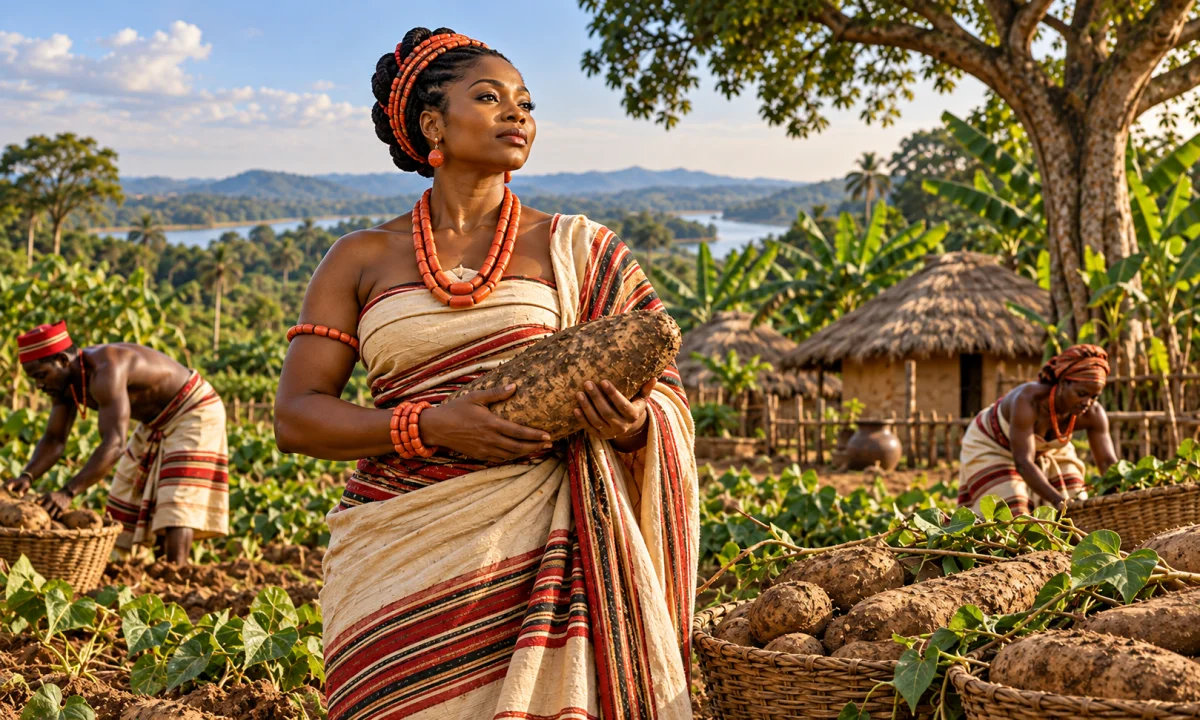
Descriptions of Aha-njoku’s appearance are not standardised. Popular summaries sometimes portray the figure as a woman holding or standing beside yams, but such imagery should not automatically be treated as an ancient canonical form. Traditional Igbo religious images were often local, and many spiritual beings were represented through shrine objects, offerings, trees, stones, staffs or symbolic materials rather than through a single uniform human-shaped statue.
Worship and ritual context
Information about the worship of Aha-njoku is limited and uneven. Igbo religious practice was commonly conducted at household, lineage or village level, and rituals were often transmitted orally. A shrine might be maintained by a particular family, priest, priestess or designated ritual specialist. The form of an offering, the identity of the officiant and the occasions for consultation could therefore differ from one locality to another.
Yams could be presented as offerings or used in ceremonies concerned with planting, harvest and thanksgiving. Prayers might ask for protection, abundance or the continuation of the agricultural cycle. These practices belonged to a larger religious system that could also involve the earth deity, ancestors, personal spiritual forces and the supreme creator. It would be misleading to isolate a yam spirit from the wider network of relationships through which Igbo communities understood land, kinship and moral order.
Some accounts place special emphasis on women’s relationship with Aha-njoku. This may reflect the role of women in household food production, agricultural processing and fertility symbolism, or it may arise from particular local traditions in which women served as devotees or ritual custodians. Such claims should be qualified, however. There is no single evidence-based rule that women everywhere, or women alone, worshipped Aha-njoku.
As with many African religious traditions, ritual practice was disrupted and transformed by colonial rule, Christian missionary activity, changing political structures and the spread of new economic systems. Some shrines ceased to function, while other practices survived in altered forms, family memory, festival observance or cultural symbolism. The disappearance of a public shrine does not necessarily mean that every associated belief vanished, but surviving evidence may be fragmentary.
Stories and relationships with other powers
No single cycle of universally recognised myths about Aha-njoku is known. Stories told about the figure may explain the origin of yams, the obligations of farmers, the relationship between human beings and the land, or the consequences of neglecting ritual duties. Yet these narratives are not preserved in one standard scripture, and versions reported in one area should not automatically be projected onto all Igbo communities.
Accounts sometimes describe a yam deity as having taught people how to cultivate yams or as having provided the crop to humanity. Such stories fit a widespread pattern in which an agricultural power gives, protects or regulates an essential food. However, the details and attribution of these stories vary, and it is not safe to present one origin narrative as the definitive myth of Aha-njoku.
Aha-njoku may be discussed alongside Ala, the major earth deity in many Igbo traditions. Ala is associated with the earth, fertility, morality, ancestors and the social order, although her exact role also varies by community. Since yams grow in the earth, the domains of Ala and a yam deity can overlap. Overlap does not necessarily mean that the two figures are the same. One may represent the earth as a moral and ancestral power, while the other focuses more specifically on yam cultivation and harvest.
The figure may also be compared with Ifejioku, often described as a deity of yams and agriculture. In some accounts the names are treated as alternatives; in others they refer to distinct beings or local forms. The same caution applies to Njoku Ji. “Ji” is an Igbo term associated with yam, but the appearance of that word in a name does not by itself establish an identical identity in every tradition.
Interpretation and cultural significance
Aha-njoku illustrates how an agricultural crop can become a focus of religious thought without being reduced to a simple “crop goddess” label. The yam links soil, labour, household organisation, food security, social recognition and ritual time. A yam spirit therefore expresses the dependence of human life on ecological processes and collective work.
The figure also helps reveal the local character of Igbo religion. Rather than a single mythology with a universally agreed pantheon, Igbo traditions have often been shaped by village histories, lineage relationships, local landscapes and particular ritual institutions. A deity important in one area might be unknown, differently named or differently understood in another. Variation is not a flaw in the tradition; it is one of its defining historical features.
Modern discussions sometimes turn Aha-njoku into a neatly defined fertility goddess with a fixed appearance, family tree and list of powers. That presentation can make the subject easy to recognise, but it may conceal the uncertainty of the surviving evidence. The more historically responsible interpretation preserves the central agricultural association while acknowledging local differences and the limited nature of written documentation.
Distinction from similar figures
- Ala: A major earth deity in many Igbo traditions, associated with land, fertility, morality and the ancestors. Ala is not simply another name for Aha-njoku.
- Ifejioku: A yam-associated deity whose relationship with Aha-njoku varies by source. Some writers equate them, while others distinguish them as separate local figures.
- Njoku Ji: A name connected with yams that may be used for a yam spirit or deity. It should not automatically be treated as identical to Aha-njoku in every context.
- Chukwu or Chineke: Names associated with the supreme creator in different Igbo usages. Aha-njoku is not a creator deity of equivalent scope.
- New Yam Festival: A broad group of harvest celebrations, not a single universal festival devoted exclusively to Aha-njoku.
Later reception
Aha-njoku appears today in discussions of Igbo heritage, African religions, agricultural symbolism and the cultural history of the yam. The figure may be invoked in writing about indigenous knowledge, women’s roles, food sovereignty and the survival of precolonial religious concepts. Contemporary cultural references can preserve an important connection to Igbo history, but they may also combine material from different local traditions.
Modern retellings, fantasy works and online mythology lists sometimes present Aha-njoku as a fully standardised African goddess with powers and visual features that are not consistently supported by traditional evidence. Such portrayals belong to modern interpretation or popular culture unless they can be tied to a specific community’s tradition. The older and more securely supported association remains Aha-njoku’s connection with yams, agricultural prosperity and the religious meaning of cultivation in parts of Igbo society.