WORLD
WORLD
Achelois

Achelois is a Greek mythological name associated with healing, relief, and the soothing of pain. In surviving ancient material, the name does not belong to a single, fully developed goddess with a large myth cycle. Instead, it appears as an epithet and divine name connected especially with Apollo and with the broader idea of “relieving” or “warding off” suffering. Because the tradition is limited and sometimes ambiguous, Achelois is best understood as a minor but meaningful figure in the religious language of ancient Greece rather than as a major Olympian deity with a fixed biography.
Origins and cultural setting
The name Achelois belongs to the religious and poetic world of ancient Greece, where gods and goddesses were often addressed by many descriptive names. Such names could highlight a deity’s function, local cult, or beneficent power. In this setting, Achelois is associated with the act of driving away distress or easing pain. The meaning of the name is commonly explained from Greek roots suggesting “to ward off” or “to soothe,” which fits the healing associations attached to it.
The ancient Greek religious landscape did not always separate divine identities as neatly as later readers might expect. A name could function as an epithet, a cult title, or the name of a distinct divine being depending on place and period. Achelois sits within that flexible tradition. In some contexts the name is treated as a title of Apollo, especially in his healing aspect. In later discussion and modern reference works, Achelois is sometimes presented as a separate goddess, but the ancient evidence for such a standalone deity is limited and not entirely secure.
Greek religion also linked healing powers with sounds, hymns, purification, and the proper appeasement of divine forces. A name like Achelois therefore belonged not only to mythology in the narrow sense, but also to ritual language. It expressed a hope that divine power would turn aside sickness, pain, or dangerous influence.
Name, identity, and classification
Identifying Achelois is not always straightforward. The tradition varies, and that variation matters.
- In some ancient usage, Achelois is an epithet of Apollo, emphasizing his power to relieve illness or protect people from harmful forces.
- In some later mythographic or interpretive traditions, Achelois is treated as a goddess of healing or a protective female divine being.
- In modern retellings and encyclopedic summaries, Achelois is sometimes listed among minor Greek goddesses, but this classification should be handled cautiously because the surviving ancient record is sparse.
The uncertainty is important. Unlike major deities such as Athena, Artemis, or Aphrodite, Achelois does not have a rich body of narratives, iconography, or widespread cult evidence that clearly establishes a single identity. The name is better understood as part of the broader Greek tendency to use functional divine titles. Ancient worshippers could invoke a god by the aspect most relevant to the moment: healer, protector, avenger, guide, or bringer of calm.
Achelois is sometimes mentioned alongside other figures connected with health or deliverance. That can lead to confusion, especially because Greek mythology contains many names with similar themes. The name should not be confused with Achelous, the river god, whose name is similar but whose nature and stories are different. It also should not be conflated with deities such as Asclepius, who had a much more developed healing cult, or with moon- and dawn-related figures that modern sources occasionally and incorrectly mix together.
Attributes and symbolic meaning
The central quality associated with Achelois is relief. Depending on interpretation, this can mean relief from physical pain, the removal of illness, the calming of fear, or the protection of a person or community from threatening forces. Ancient Greek religious thought often understood healing not only as medical restoration, but as a broader return to harmony.
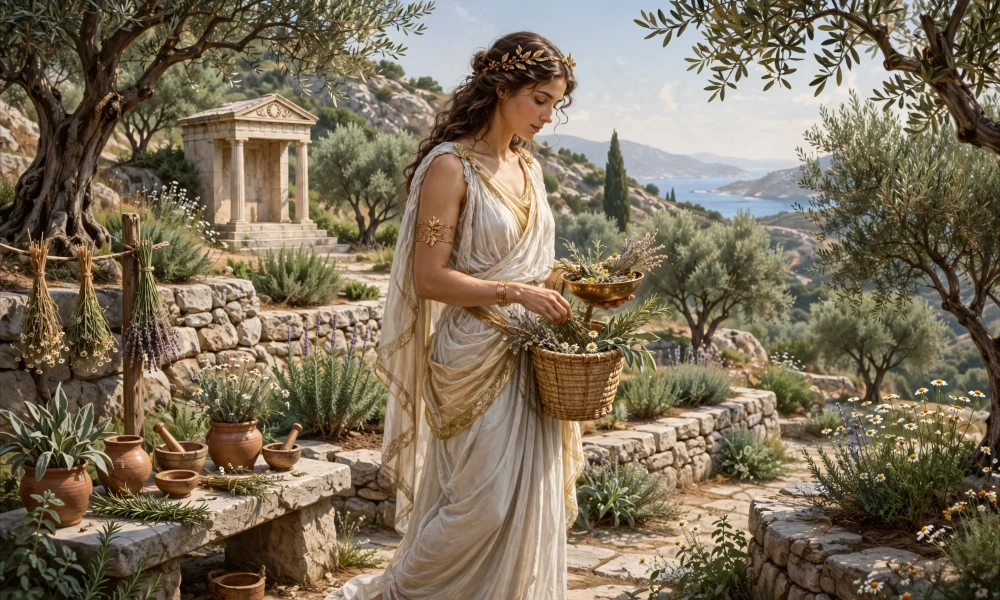
Because Achelois is not a major mythic personality, she is not strongly defined by a standard set of visual attributes in the surviving tradition. There is no secure canonical description of her appearance comparable to the familiar images of Athena’s helmet or Artemis’s bow. When modern artists or writers give Achelois specific iconography, they are generally creating a later interpretation rather than reproducing a fixed ancient model.
Symbolically, the name points to several linked ideas:
- Healing: the easing of sickness or pain.
- Protection: defense against harmful influences.
- Restoration: the return of balance after distress.
- Mercy: the gentle, compassionate side of divine power.
These themes fit well within Greek religious practice, where gods were not only forces of awe and danger, but also sources of assistance and care. The same deity who could send illness might also remove it. A title like Achelois captured that beneficial aspect.
Association with Apollo
The strongest ancient association for Achelois is with Apollo, one of the most complex gods in Greek religion. Apollo was not only a god of music, prophecy, and archery, but also a deity linked with cleansing, plague, and healing. In some contexts he could be invoked as the one who sends disease; in others, as the one who removes it. Achelois belongs to this latter sphere.
This connection is culturally significant because it reflects the Greek understanding of divine functions as multiple and overlapping. Apollo’s healing power was not isolated from his other roles. A title such as Achelois emphasizes his compassionate and restorative side, making clear that relief from suffering was one of the outcomes sought in his worship.
Because the evidence is limited, it is difficult to say exactly how widespread this title was, or whether it belonged to a specific local cult, poetic usage, or a broader religious vocabulary. What can be said with confidence is that the ancient Greek world often used descriptive divine names in this way, and Achelois fits that pattern well.
Surviving traditions and evidence
The surviving evidence for Achelois is not extensive. She is not known primarily from a major epic story, a dedicated mythological cycle, or a large set of temple inscriptions. Instead, the name appears in the margins of the tradition, where divine names, epithets, and local or learned interpretations survive in fragmentary form.
This kind of evidence is typical of many minor Greek divine names. Modern understanding often depends on a combination of poetic references, later lexicographical material, and scholarly reconstruction. That means some details remain uncertain. For Achelois, the key point is the limited but meaningful association with healing and divine relief. Claims that go beyond that core idea should be treated carefully unless directly supported by ancient evidence.
Because the source base is thin, later writers sometimes expanded Achelois into a more fully personified goddess than the ancient record clearly supports. Such expansions belong more to interpretation than to secure mythology. The distinction between attested ancient usage and later reconstruction is especially important here.
Roles in myth and religious imagination
Even without a large narrative tradition, Achelois belongs to a recognizable religious pattern. Greek worshippers frequently sought gods who could address very specific human needs. Healing was one of the most urgent of those needs, and divine relief could be imagined in many forms: the stopping of pain, the calming of fever, the removal of impurity, or the protection of a household under stress.
Achelois therefore represents a type of divine aid rather than a mythic heroine with a sequence of adventures. Her importance lies in what she signifies: the power to lessen suffering. This made the name fitting for prayer, ritual invocation, or poetic description. In a religious culture where names were often performative, speaking or writing the right divine title could itself be an act of appeal.
In broader Greek thought, healing was not purely mechanical or medical. Illness could have divine, moral, or ritual dimensions. Relief likewise could involve divine favor, purification, or reconciliation with higher powers. Achelois belongs to that world of meaning, where spiritual and physical well-being were closely linked.
Distinction from similar figures and names
Several similar or nearby names can cause confusion, so distinctions are useful.
Achelois and Achelous
Achelois should not be confused with Achelous, the river god. Their names are related in sound but not in identity. Achelous is a major river deity with mythic contests and a strong association with water, transformation, and river power. Achelois, by contrast, is associated with healing or relief, not with rivers.
Achelois and Asclepius
Achelois is also different from Asclepius, the best-known Greek god of medicine. Asclepius had a far more developed cult, a richer mythic profile, and clearer ritual centers. Achelois belongs to the same broad world of healing, but on a much smaller and more ambiguous scale.
Achelois and the personified abstractions of later tradition
Greek and later Greco-Roman literature often personified qualities such as victory, peace, shame, or grief. Some modern treatments place Achelois in that company, as if she were a fully personified abstraction of relief or soothing. That reading is plausible as an interpretation, but it should not be overstated as a firmly established ancient cult identity unless the context specifically supports it.
Interpretation and cultural significance
Achelois is significant precisely because she shows how Greek religion could name and honor very specific aspects of divine activity. Ancient Greek divinity was not always organized around large, singular personalities. A god could be approached through multiple names, each emphasizing a different presence or function. Achelois exemplifies that flexibility.
The name also reveals how closely the Greeks connected language and divine action. To name a healing power was to define it, invite it, and perhaps make it ritually available. In that sense, Achelois is less a narrative character than a religious concept embodied in divine form.
From a historical perspective, this kind of figure helps explain why Greek religion can seem both richly personal and highly abstract. The same pantheon included vivid mythic beings and also titles or personifications that conveyed benefits, dangers, and ritual hopes. Achelois stands at that intersection.
Scholarly interpretation therefore tends to be cautious. Some readers prefer to call Achelois a goddess; others describe the name as an epithet or cult title. Both approaches have merit, but the evidence does not allow complete certainty. The safest statement is that Achelois is a Greek divine name tied to healing and the alleviation of suffering, sometimes attached to Apollo and sometimes treated as an independent feminine figure in later tradition.
Modern reception and use
In modern reference works, fantasy settings, and popular retellings, Achelois sometimes appears as a minor Greek goddess with a clearly defined domain of healing, moonlight, or comfort. Those portrayals are modern developments and should not be mistaken for ancient orthodox belief. They often draw on the attractive sound of the name and on the general Greek tendency to associate divine femininity with gentleness or restoration.
Because the ancient tradition is sparse, modern writers have considerable freedom in shaping Achelois. Some emphasize compassion and soothing power; others use her as a ceremonial or literary figure. These uses are creative elaborations rather than continuations of a robust ancient myth cycle.
Where modern culture is concerned, Achelois is not one of the Greek names that has entered broad popular familiarity. She appears more often in specialist discussions, mythological dictionaries, or imaginative reconstructions than in mainstream retellings. That relative obscurity, however, is part of her historical interest. Achelois illustrates how many ancient divine names survive only in fragments, preserving a small but suggestive glimpse of religious life.
Key points in the tradition
- Achelois is a Greek divine name associated with healing, soothing, and relief from pain.
- The name is sometimes treated as an epithet of Apollo, especially in his healing aspect.
- Later or modern sources may present Achelois as a separate goddess, but the ancient evidence is limited and not fully decisive.
- She should not be confused with Achelous, the river god, or with major healing deities such as Asclepius.
- Her importance lies in what the name expresses: divine aid, restoration, and protection against suffering.
As a figure of Greek mythology and religious language, Achelois belongs to the subtle edge of tradition, where names, functions, and devotional hopes overlap. Her surviving identity is modest, but her meaning is clear: the power to calm, to heal, and to lift pain away.