WORLD
WORLD
Woyengi
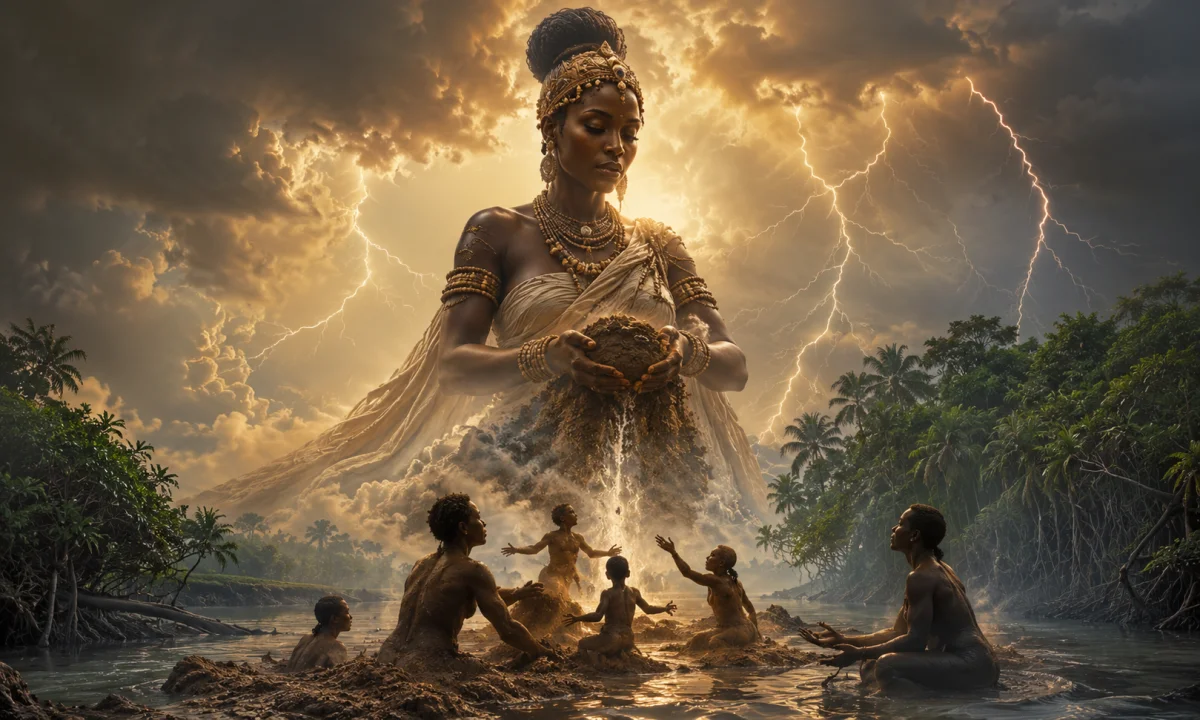
Woyengi is a creator figure in the religious tradition of the Ijaw people of the Niger Delta region of present-day Nigeria. In the best-known accounts, Woyengi is a primordial being associated with the creation of human life, the shaping of human destiny, and the granting of free choice. Because the tradition is oral and locally varied, details are not fixed in a single authoritative text, and descriptions of Woyengi can differ from one telling to another.
Woyengi belongs to the wider religious and mythic world of the Ijaw, one of the major peoples of southern Nigeria. Ijaw traditions are not uniform across all communities, and the name, attributes, and narrative details of divine beings may vary by dialect, clan, and locality. In some retellings, Woyengi is presented as a supreme creator; in others, the figure is more specifically a primordial force or deity responsible for the origin of human beings. Because the tradition is primarily oral, later written versions have sometimes shaped how the story is understood outside its original cultural setting.
Origins and cultural setting
Woyengi is part of an indigenous African religious worldview in which creation, destiny, morality, and communal life are closely connected. Among the Ijaw, spiritual power is not always separated from everyday existence in the way that some later Western readers might expect. Deities, ancestors, and sacred forces are often understood as active within the natural and social world. Within that setting, Woyengi is remembered as a being who stands at the beginning of human existence and who gives shape to what people will become.
The tradition survives mainly through oral narration, ritual memory, and modern ethnographic or literary retellings. That means there is no single fixed “canon” comparable to a scripture with one official version. Instead, the story of Woyengi should be understood as a living tradition that may have been told differently in different villages or periods. This also means that some popular summaries simplify or generalize the figure in ways that do not fully reflect local variation.
As with many African cosmological traditions, the account of Woyengi cannot be separated from the social values of the people who preserved it. The story is not only about how human beings came to exist; it also reflects ideas about choice, limitation, identity, and the consequences of desire. The myth has therefore often been read as both a creation story and a reflection on human life as a moral and social condition.
Name and identity
The name Woyengi is usually treated as the proper name of a divine or primordial creator figure in Ijaw tradition, but spelling and pronunciation can vary in English-language sources. As with many names transcribed from African languages into English, the form seen in print may not capture all regional or phonetic differences. It is safest to say that Woyengi is an Ijaw creator being rather than to assume one fixed spelling or title across all communities.
Some modern writers describe Woyengi as female. That interpretation is common in several retellings, and the figure is often referred to with feminine pronouns in English. However, gendered description in oral tradition can be fluid, and readers should be careful not to impose rigid categories without checking the specific source or community context. What is clear in the traditional narrative is that Woyengi is a powerful creator associated with the beginning of human life and the allocation of destiny.
Woyengi is not generally known as a trickster, culture hero, or warrior deity. The figure is instead tied to origins, formation, and the shaping of human existence. This sets Woyengi apart from many other African mythic beings whose main roles involve travel, conflict, or social instruction through deception and reversal.
Role in creation
In the best-known story, Woyengi creates human beings by bringing them into existence in a primordial place before sending them into the world. The exact details vary, but the central idea is that human life does not begin randomly or purely biologically; it begins through divine making and choice. Woyengi is linked not only to the physical creation of people but also to the granting of individual fate or destiny.
One widely repeated motif in the tradition is that Woyengi gives each person choices before birth. Human beings are said to have been offered possibilities concerning identity, life path, and the conditions under which they would live. In this sense, destiny is not presented as entirely arbitrary, nor as wholly self-made after birth. Rather, a person’s life is shaped by a combination of divine allocation and the choices made within the limits set at creation.
This motif gives the tradition an important philosophical dimension. Woyengi is not merely a maker of bodies. The figure is also a giver of personhood. The story suggests that life includes both freedom and constraint: people may choose, but their choices unfold within a preexisting framework established by the creator. The myth thus reflects a deep concern with why people differ from one another and why lives take such different courses.
Appearance and attributes
Traditional accounts do not consistently describe Woyengi’s appearance in detailed visual terms. Unlike some deities who are linked to specific animals, regalia, or bodily features, Woyengi is more often defined by action and function than by iconography. The figure is best understood through the roles performed in the creation narrative rather than through a fixed image.
The main attributes associated with Woyengi include:
- Creatorship: Woyengi brings human beings into existence.
- Authority over destiny: the figure is linked to the assignment of fate or life-path.
- Primordial status: Woyengi belongs to the beginning of the world or the beginning of human life.
- Moral significance: the myth explores responsibility, choice, and the limits of human control.
Because the tradition is oral, there is no single agreed set of symbols attached to Woyengi across all Ijaw-speaking communities. Any claim about temples, priestly images, or fixed ritual emblems should be treated cautiously unless supported by a specific local source. What can be said with confidence is that Woyengi functions as a sacred origin figure rather than a minor spirit or local ancestor.
The story of choice and destiny
The most distinctive aspect of the Woyengi tradition is the story that human beings were granted choices before entering the world. In one common form of the narrative, people are brought before Woyengi and allowed to make decisions about their future. They may choose aspects of their life, but they must also accept the consequences of what they choose. This idea makes the myth especially memorable because it combines divine control with personal responsibility.
Some tellings emphasize that people choose their lot with imperfect understanding. A human being may select beauty, status, strength, wealth, or success, while failing to grasp the costs associated with such choices. Other versions stress that Woyengi gives each person what they ask for, making later dissatisfaction a result of human desire rather than divine injustice. In either case, the story offers a powerful reflection on the unpredictability of life.
The tale also helps explain suffering and inequality. If people entered the world having chosen different destinies, then difference is not merely accidental. At the same time, the story can be read as warning against blaming Woyengi alone for the hardships of life. Human beings must live with the consequences of decision, even when those decisions were made in a sacred or pre-birth setting.
As with many oral myths, the narrative may exist in several forms. Some versions focus more on creation; others focus more on the choice of destiny; still others may stress the obligations attached to living in accordance with one’s allotted path. The essential idea remains the same: Woyengi is the being through whom human existence becomes individualized and morally structured.
Religious and moral significance
Woyengi’s story expresses a worldview in which life is not accidental and persons are not interchangeable. Every human being has a unique place, but that place carries responsibility. The myth therefore speaks to social order, personal conduct, and the tension between ambition and acceptance. It acknowledges desire, but it also warns that desire does not eliminate consequence.
In a broader religious sense, the tradition also reveals how Ijaw cosmology connects the unseen world to lived experience. The creator does not remain distant. Instead, the origin of life continues to matter in the present. A person’s character, fortune, and suffering can all be interpreted in relation to the choices made or conditions assigned in the sacred beginning.
This makes Woyengi significant not only as a mythic figure but also as a source of ethical reflection. The story can encourage humility, because people do not control everything about their lives. It can also encourage accountability, because the myth frames human life as shaped by choices that have lasting effects. In that sense, Woyengi occupies a place similar to other creator figures whose stories explain not just how the world began, but how people should understand themselves within it.
Historical record and scholarly interpretation
There is limited historical documentation for Woyengi compared with the better-known gods and mythic figures of some other traditions. Much of what is known in English comes through oral transmission, later transcription, and anthropological or literary interest. That means scholarly interpretation must be careful and modest. It is possible to discuss the tradition meaningfully, but not to treat every published paraphrase as a fully authoritative version.
Scholars of religion and folklore often interpret Woyengi as an example of an African creator deity whose story centers on destiny rather than on the making of the physical universe alone. This is an important distinction. In many creation myths, the emphasis falls on separating sky and earth, naming animals, or forming land and water. In the Woyengi narrative, the emphasis falls on the making of human life and the pre-ordination of individual fate.
Some interpretations also connect the myth with broader themes in African religious thought, including the relationship between divine purpose and human agency. However, such comparisons should be handled carefully. It is easy to overgeneralize across very different traditions. Woyengi belongs specifically to Ijaw culture, and any comparison with other African creator figures should remain sensitive to local meaning.
Distinction from similar figures
Woyengi should not be confused with other African deities, even where stories may seem broadly similar. Many African traditions include creator beings, destiny-givers, or primordial mothers and fathers, but names, functions, and cultural settings are distinct. Similar-sounding names in other languages do not indicate the same figure, and it is important not to merge separate traditions.
Woyengi is also distinct from the Ijaw supreme being often referred to in other contexts by different names. Depending on the community, there may be layered understandings of the highest deity, lesser divine beings, spirits, and ancestors. The fact that a creator function is assigned to Woyengi in some stories does not automatically mean that every Ijaw tradition uses the name in exactly the same way.
Because the tradition concerns creation and destiny, modern readers sometimes compare Woyengi to fate goddesses or pre-birth chooser figures from other mythologies. Such comparisons can be illuminating as long as they remain cautious. They are interpretive parallels, not evidence of shared origin or direct influence.
Modern relevance and cultural reception
Woyengi has attracted attention in modern discussions of African spirituality, literature, and cultural identity, especially where writers seek to recover or honor indigenous religious traditions. In these settings, the figure may appear as a symbol of ancestral memory, African cosmology, or female creative power. That modern reception is significant, but it should not be confused with the older oral tradition itself.
In contemporary literature and cultural discourse, Woyengi sometimes functions as a powerful emblem of selfhood and destiny. Modern authors may draw on the myth to explore questions of gender, freedom, fate, or postcolonial identity. Such uses belong to modern interpretation rather than traditional religious practice, and they may emphasize themes that are only one part of the original story.
Outside scholarly and literary contexts, Woyengi is not as widely known in global popular culture as some gods and heroes from larger mythological canons. There is no single dominant film, game, or television portrayal that defines the figure for a mass audience. When Woyengi does appear in modern media, the representation is usually secondary to the figure’s significance in oral tradition and cultural memory.
Why the tradition remains important
Woyengi remains important because the story addresses questions that are universal but deeply rooted in Ijaw thought: Why are people different? How much of life is chosen? How much is given? What does it mean to live with the destiny one has been assigned? The myth does not answer these questions in a simplistic way. Instead, it presents them through a sacred narrative that binds creation, identity, and responsibility together.
The enduring value of the Woyengi tradition lies in that balance. It is at once a creation account, a moral reflection, and a cultural expression of Ijaw understanding of personhood. Its flexibility across oral tellings is not a weakness but part of how the tradition has survived. Even without a single fixed text, Woyengi continues to represent an important way of thinking about the beginning of life and the meaning of human choice.