WORLD
WORLD
Waaq
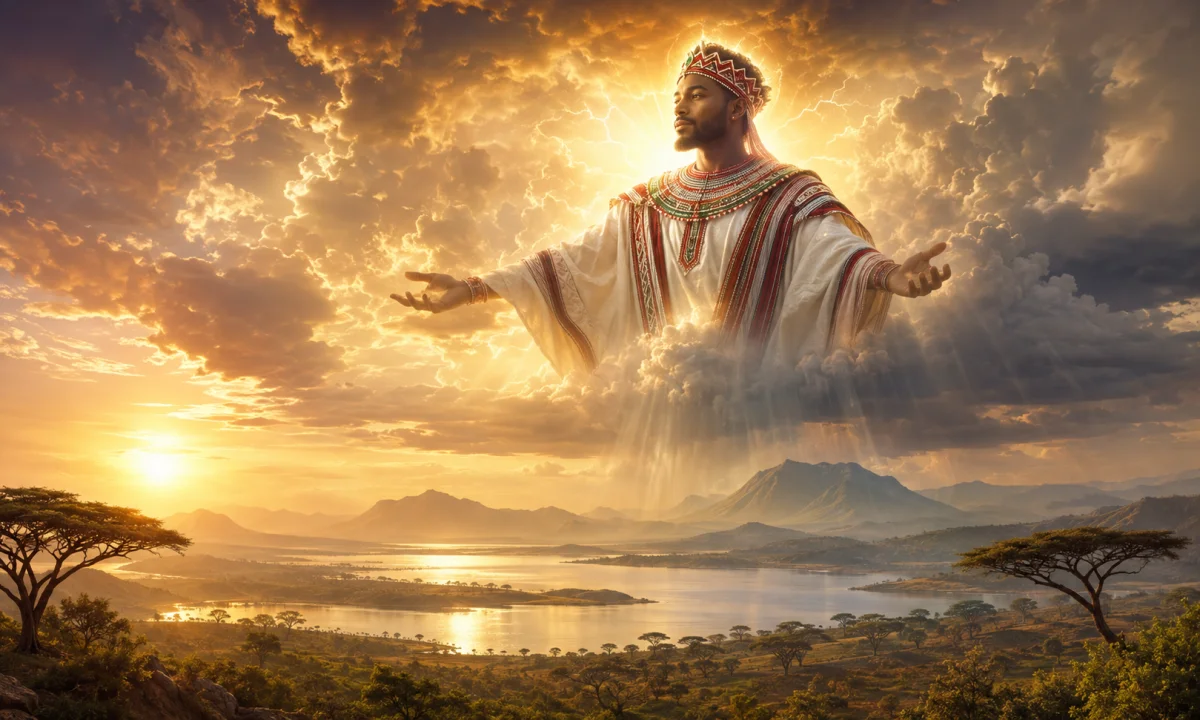
Waaq, also written Waaqa, is the supreme creator and sustaining power in the traditional religious thought of many Oromo people of the Horn of Africa. Oromo communities are especially associated with Ethiopia and northern Kenya, although Oromo migration and settlement have created a wider diaspora. Waaq is commonly understood as the source of life, the order of the world and the forces of nature, particularly rain and fertility. The name is sometimes translated simply as “God,” but that translation can conceal important features of Oromo religious culture.
Oromo traditional religion is not based on a single canonical scripture or one universally fixed mythology. Its teachings have been preserved through prayer, ritual, oral tradition, ethical principles, proverbs, songs and the authority of religious specialists. As a result, descriptions of Waaq differ between Oromo groups and regions. Borana, Guji, Arsi, Macha and other Oromo communities share important ideas but do not necessarily express them in identical ways. Accounts recorded by outsiders have also been shaped by the language, assumptions and historical circumstances of the observers.
Origins and cultural setting
The Oromo are a large Cushitic-speaking people whose traditional institutions include the Gadaa system, an age-grade and generational system that historically regulated political authority, social responsibilities and ritual life. Gadaa is not itself a god or a separate religion. It is a social and political framework within which ideas about moral conduct, community balance and the proper relationship between human beings and the sacred world have been expressed.
In Oromo religious thought, Waaq is generally placed above other spiritual beings and ritual powers. Waaq creates and sustains the world, gives rain, permits life to flourish and upholds a moral order. Human beings are expected to live in accordance with safuu, a concept often described as a principle of moral, social and cosmic propriety. Safuu concerns the boundaries that should not be violated and the obligations that connect individuals, families, communities and the natural world.
Traditional Oromo religion has survived primarily through living practice rather than through an ancient written scripture. Oral transmission does not make a tradition less complex, but it does mean that no single authoritative version of every story or belief exists. Many descriptions of Waaq therefore use cautious language. They identify broad patterns shared across communities while recognising that Oromo religious life is locally varied and historically changing.
The name Waaq and the question of identity
Waaq and Waaqa are common forms of the name in discussions of Oromo religion. The longer form, Waaqa, is widely used in Oromo-language contexts, while Waaq is often used in English-language writing and in comparative discussions of Cushitic religions. Spelling and pronunciation may vary according to dialect, transcription system and the language in which the name is written.
Waaqa is not best understood as one character in a large divine family resembling the pantheons of ancient Greece or Scandinavia. In Oromo tradition, Waaq is usually the highest divine reality rather than one competing god among equals. Other beings and powers may have important ritual roles, but they do not necessarily possess the same status as Waaq.
Scholars differ over how to classify the religion. Some have described it as monotheistic because Waaq is the supreme and ultimate creator. Others have preferred terms such as supreme-being religion or have emphasised the presence of multiple spiritual agencies, including ancestral powers, sacred places and ayyaana. Applying categories such as “monotheism” and “polytheism” too rigidly can impose concepts developed in other religious settings. Oromo understandings of Waaq can include both a single highest creator and a richly populated spiritual environment.
Waaq as creator and sustainer
Waaq is commonly associated with the creation and continuing maintenance of the universe. The world is not treated as an abandoned object that was made once and then left alone. Life, rain, fertility, health and social well-being depend on an ongoing relationship between human beings, the land and the sacred order represented by Waaq.
Rain has particular importance in Oromo communities whose livelihoods have traditionally depended heavily on pastoralism and agriculture. In this setting, Waaq’s connection with rain is not merely a symbolic association. Rain determines the availability of pasture, the health of livestock, the growth of crops and the survival of communities. Prayers for rain and expressions of gratitude after rain therefore have religious, economic and communal significance at the same time.
Waaq may be spoken of as dwelling above or in the sky, but this should not automatically be treated as a simple claim that Waaq is only a sky-god. The sky is a visible sign of divine power, especially through rain, clouds, sunlight and thunder, while Waaq is also understood as the source of life and moral order. Oromo religious language can present the divine as both beyond ordinary human reach and active throughout the natural world.
Power, morality and human responsibility
Waaq’s power is associated with life, fertility, order and justice. In many traditional religious systems, a supreme creator is not approached only to obtain personal benefits; the relationship also involves obligations. Oromo concepts of safuu emphasise that actions have consequences for the community and for the balance between human beings and the wider world.
Truthfulness, respect for elders, responsible leadership, hospitality and the fulfilment of social obligations have often been connected with proper conduct. The exact formulation differs between communities and historical accounts, and it would be misleading to present one fixed list as a universal Oromo creed. More broadly, the idea is that human beings should not act as though they have unlimited authority over other people, animals, land or sacred institutions.
Waaq can therefore be understood as a source of both blessing and judgement. Drought, illness, social disorder or other misfortunes may be interpreted in different ways, including natural, social and spiritual terms. Traditional explanations do not always reduce every misfortune to punishment from Waaq. They may instead involve broken relationships, ritual imbalance, harmful actions, offended spiritual powers or ordinary environmental causes.
Ritual life and religious specialists
Prayer to Waaq may take place in homes, at sacred natural sites, during community gatherings or in connection with major events such as rainmaking, initiation, marriage and reconciliation. Oromo ritual traditions have often treated rivers, lakes, mountains, trees and open landscapes as places where communication with the sacred can occur. The presence of a sacred site does not necessarily mean that the physical object itself is identical with Waaq. It may be regarded as a fitting place for approaching or honouring the divine.
The annual Irreecha festival is one of the best-known Oromo celebrations associated with gratitude and renewal. It is commonly held near water or another natural setting, and participants give thanks to Waaq for life, rain, peace and the renewal of the natural world. Contemporary Irreecha gatherings can also express Oromo cultural identity and political solidarity. Their public form has changed over time, but the religious language of gratitude to Waaq remains central for many participants.
Ritual specialists and custodians of religious knowledge have different names and functions in different Oromo areas. The Qaalluu, for example, may serve as a religious authority, ritual specialist or custodian of inherited institutions. Qaalluu traditions are not identical everywhere, and the term should not be treated as the name of a single office with a universally agreed definition. Some religious specialists conduct blessings, prayers, rites of passage or ceremonies intended to restore harmony.
Another important term is ayyaana. Ayyaana can refer to spiritual powers, sacred agencies or manifestations connected with particular persons, places, times or forms of ritual activity, depending on context and interpretation. Ayyaana are not simply interchangeable with Waaq. In accounts of Oromo religion, they are generally subordinate to or distinct from the supreme creator, although the precise relationship is described differently by different communities and scholars.
Stories and oral traditions
There is no single universally recognised “myth of Waaq” comparable to a canonical creation narrative. Oromo oral traditions include accounts of creation, the origin of human conditions, the ordering of society, the coming of rain and the consequences of violating moral or ritual boundaries. These accounts may be transmitted through stories, blessings, prayers, songs and proverbial speech rather than through one fixed text.
Many descriptions of Waaq focus less on adventures, family relationships or human-like conflicts than on divine agency. Waaq is invoked as the source of creation and as the power on which life depends. This helps explain why Waaq may appear less frequently as a dramatic character than gods in literary mythologies with extensive written narratives. The limited number of published stories does not demonstrate that Oromo religion lacks mythology; it reflects the character of oral transmission and the uneven recording of Oromo traditions.
Some accounts describe a close relationship between Waaq and the natural processes that sustain pastoral and agricultural life. In other accounts, the central concern is the relationship between Waaq, human society and the spirits or powers involved in ritual practice. Because versions vary, a story recorded in one region should not automatically be presented as the belief of all Oromo people.
Relationships with Islam and Christianity
Over many centuries, Oromo communities have encountered Islam and Christianity through trade, migration, state expansion, missionary activity, schooling and changing political structures. Today, many Oromo are Muslim or Christian, while others identify with traditional religion or combine formal religious affiliation with inherited Oromo customs and concepts. These identities are not uniform, and individual practice can be shaped by family history, region and personal conviction.
In some contexts, Waaqa has been used in Oromo translations or explanations of the Abrahamic God. This linguistic overlap does not mean that all Oromo religious concepts are identical to Islamic or Christian theology. A word meaning “God” can be used across traditions while carrying different histories and associations. Conversely, older ideas connected with Waaq, sacred places, ritual specialists and safuu may continue to influence cultural practice even when a person belongs formally to another religion.
Waaq and similar names in neighbouring traditions
Confusion can arise because forms of the word Waaq also appear in discussions of other Cushitic-speaking peoples, especially Somali traditional religion. Some historical and scholarly accounts refer to Waaq, Waaqo or related forms as a pre-Islamic Somali deity or divine concept associated with the sky, rain or a supreme power. The surviving evidence is limited, and reconstructions of pre-Islamic Somali religion are not equally accepted by all scholars.
The Somali and Oromo names may reflect linguistic or historical connections within the broader Cushitic-speaking region, but a similar name does not prove that every tradition describes one identical deity. Oromo Waaq should not be automatically merged with figures reconstructed from Somali, Sidama, Konso or other neighbouring religious traditions. Each tradition has its own language, social setting and evidence. Comparisons can be useful, but they must be presented as comparisons rather than as proof of a single pan-African god.
Waaq should also be distinguished from Waaqeffanna, the name often used today for Oromo indigenous religion or for contemporary efforts to renew and publicly articulate Oromo traditional religious practice. Waaqeffanna is related directly to Waaq, but it is not the name of a separate ancient deity. Modern organisations and writers may organise traditional teachings in ways that differ from the less formal, locally transmitted practices of earlier generations.
Cultural significance today
Waaq remains important in discussions of Oromo identity, language, history and cultural renewal. Public references to Waaq may express religious devotion, respect for ancestral tradition or a broader commitment to Oromo cultural continuity. The meaning can vary according to whether the speaker is participating in a ritual, discussing theology, celebrating Irreecha or using Oromo cultural vocabulary in a predominantly Muslim or Christian setting.
Modern public celebrations have sometimes brought traditional Oromo religious symbols into national and international attention. These events should not be mistaken for evidence that every Oromo person follows the same religious practice. They are also shaped by contemporary questions of cultural recognition, political representation and the preservation of indigenous heritage.
In popular culture outside Oromo communities, Waaq is still far less familiar than gods from Greco-Roman, Norse or Egyptian mythology. When the name appears in general mythology lists or fantasy settings, it may be reduced to a generic “African sky god.” Such portrayals usually omit the cultural setting of Oromo religion, the significance of safuu and Irreecha, and the distinction between Waaq and other spiritual beings. A more accurate understanding presents Waaq as the supreme creator within a living and diverse Oromo religious tradition, rather than as a stock figure detached from the people whose language and practices give the name its meaning.