WORLD
WORLD
Vichama
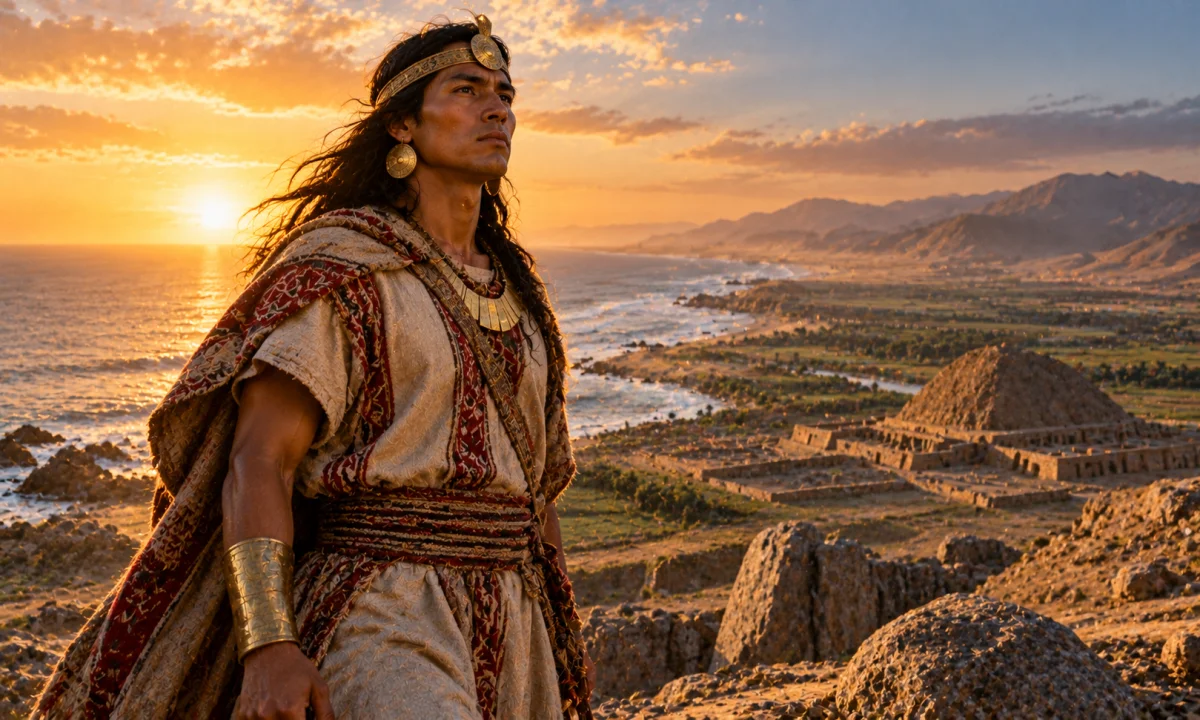
Vichama is a culture hero and divine figure associated chiefly with the central coast of Peru, especially the Huaura and Végueta region. Although often placed under the broad label of Inca mythology, his surviving legend belongs more precisely to the religious traditions of coastal Andean communities that existed before, and alongside, Inca rule. In later interpretations, Vichama appears as a son of the Sun, an enemy or counterpart of Pachacamac, and a figure connected with the creation and renewal of humanity.
Origins and cultural setting
Vichama is linked with the fertile valleys and coastal settlements north of present-day Lima. This region had its own long-established religious traditions before the expansion of the Inca state. Several powerful sanctuaries operated along the central Peruvian coast, including the famous oracle and temple complex of Pachacamac. Religious ideas moved between these communities, and later Inca rule incorporated many local sacred places rather than replacing every regional deity.
The surviving account of Vichama comes primarily from the early colonial period. The Augustinian writer Antonio de la Calancha recorded a version of the story in the seventeenth century, drawing on Indigenous traditions from the Peruvian coast. His account is important, but it is not a direct pre-Columbian record. It was written after the Spanish conquest, through the language and religious assumptions of a Christian chronicler. The story may therefore preserve older local beliefs while also reflecting the circumstances in which colonial clergy collected and interpreted them.
No securely identified pre-Hispanic text gives a complete account of Vichama. Archaeological evidence demonstrates the importance of coastal religion, ancestor veneration, sacred landscapes and creator figures, but it cannot by itself confirm every detail of the later written legend. The narrative should consequently be treated as a colonial record of an Indigenous tradition, not as an untouched transcript of ancient belief.
Name and classification
The name is generally written Vichama. Spelling can vary in colonial and modern publications because Spanish writers represented Indigenous names using Spanish orthography. The term Vichama Raymi is also used in connection with celebrations and cultural revivals centred on the figure. “Raymi” is a Quechua word commonly translated as “festival” or “ceremony,” but the presence of that word does not prove that the original Vichama tradition was created by the Incas or was originally expressed in Quechua.
Vichama is sometimes described as an Inca god, but this classification is too narrow if it suggests that he belonged only to the imperial religion of Cusco. The strongest association is with the central coast, where local traditions had developed independently for centuries. A more precise description is an Indigenous coastal Andean culture hero or creator-related deity later recorded within the wider colonial understanding of Inca and Peruvian mythology.
His identity is also not entirely uniform. In some retellings, he is presented as the son of the Sun and a mortal woman. In others, he is discussed mainly as the adversary of Pachacamac and the restorer of humanity. The surviving material does not provide a single canonical theology comparable to a formal sacred scripture.
Family and relationship with Pachacamac
Vichama’s story is closely connected with Pachacamac, one of the most important divine figures of the central Peruvian coast. Pachacamac was associated with the great sanctuary of the same name and was feared and respected as a powerful deity capable of causing earthquakes. His name is often connected with the idea of animating or ordering the world, although the precise interpretation of Indigenous names and titles remains debated.
In the Vichama narrative, Pachacamac and Vichama occupy opposing roles. Vichama is associated with the Sun, fertility and the restoration of human life, while Pachacamac appears as a jealous or destructive power. Some retellings describe the two as brothers or half-brothers, but the precise family relationship varies. It is safer to say that they are presented as closely related or rival sacred figures than to insist on one universal genealogy.
This rivalry may express the meeting of different local religious traditions. Pachacamac was an established coastal deity with a major pilgrimage centre, whereas Vichama was particularly connected with the Huaura area. Their opposition in the story may preserve a memory of competing cults, regional identities or contrasting explanations of how the world became habitable.
The creation of the first people
The opening of the legend concerns the creation of humanity and the problem of survival. In the account associated with Calancha, Pachacamac creates a man and a woman. The man dies, leaving the woman alone and without sufficient food. She laments her condition and appeals to the Sun for help.
The Sun responds by impregnating her, and she gives birth to Vichama. This birth marks him as a being between the divine and human worlds. He is not simply an immortal god descending from the sky, nor is he an ordinary human hero. His mixed origin allows him to act as an intermediary between celestial power, the human community and the forces represented by Pachacamac.
The story then becomes violent. Pachacamac is angered by the birth or by the Sun’s intervention. In versions based on the colonial account, he kills Vichama’s mother and attempts to destroy or seize the child. Vichama survives, often through the protection of the Sun, and eventually grows into a powerful young figure. The precise sequence differs among summaries, and some modern retellings simplify or rearrange the events.
The death of Vichama’s mother is significant because it turns a creation story into a story of loss and vengeance. Humanity is not introduced into a peaceful, finished world. Its existence is threatened almost immediately by rivalry among divine powers. Vichama’s later actions are driven by the desire to avenge his mother and to repair the damage caused by Pachacamac.
Vichama’s conflict with Pachacamac
After discovering what happened to his mother, Vichama seeks Pachacamac. Their conflict is not usually described as a long battle with a clear winner. Instead, Pachacamac escapes or withdraws, and in many versions he disappears into the sea. The coastal landscape becomes part of the myth: offshore islands or prominent features of the shore are associated with Pachacamac’s retreat.
This episode may explain the sacred character of the coastline and the presence of islands near the central Peruvian shore. Like many origin stories, it joins divine action to visible places. A sea, mountain, rock or island is not merely a natural feature; it can be understood as a trace of an event involving the gods or culture heroes.
With Pachacamac gone, Vichama turns his anger toward the people who are left behind. One of the most striking features of the legend is that he transforms them into stones. This action may be interpreted as punishment for their failure to protect his mother, for their association with Pachacamac or for the disorder caused by the divine conflict. The story does not present Vichama as an uncomplicated benevolent creator. Like many ancient culture heroes, he can punish, destroy and renew as well as create.
Vichama later regrets the destruction or recognises that the world cannot remain empty. He appeals to the Sun, his divine parent, for a new human population. The Sun provides the means for humanity to be restored, commonly described as three eggs.
The three eggs and social order
In the best-known version of the story, the eggs have different materials and produce different social groups. One egg is made of gold, another of silver and a third of copper. From them come distinct classes of people. The golden egg is associated with rulers or nobles, the silver egg with women of the elite or their partners, and the copper egg with ordinary people.
The details vary in translation and retelling, but the broad pattern is clear: the rebirth of humanity is also an explanation of social hierarchy. The different origins of social groups are presented as part of the structure of the renewed world. This does not necessarily mean that the story was originally designed as a formal theory of class. It may instead reflect a common mythic tendency to explain social distinctions through different ancestral or material origins.
The three eggs can also be read symbolically. Gold and silver were highly valued materials in the Andes, while copper was widely used and associated with practical tools and objects. Their arrangement creates a hierarchy of value, but it also establishes a complete human community in which different groups have assigned places. Colonial writers may have interpreted or recorded these distinctions in ways influenced by the social divisions familiar to them.
The transformed stones remain important in some interpretations. Stones could represent petrified ancestors, sacred beings or the continuing presence of earlier inhabitants. Andean religious traditions frequently treated unusual rocks, mountains, springs and other natural features as spiritually powerful. The stone people of the Vichama story therefore belong to a wider Andean pattern in which humanity, landscape and ancestry are closely connected.
Attributes and symbolic roles
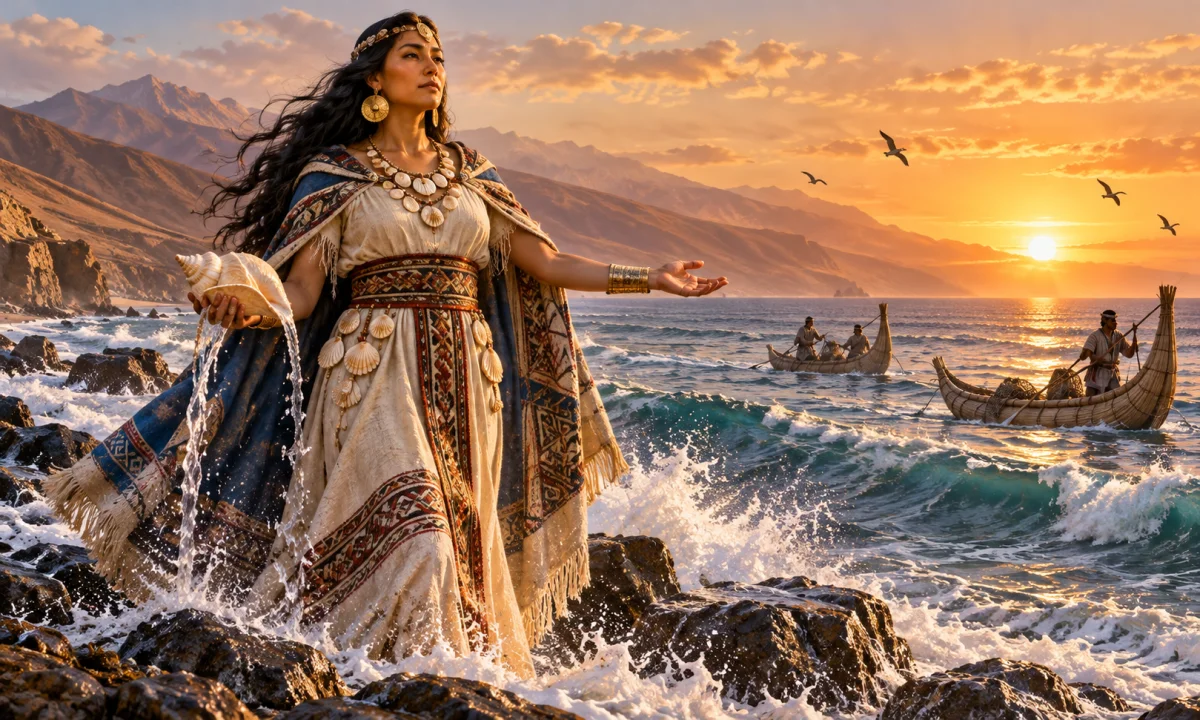
Vichama does not have a single standard physical appearance preserved in ancient images. There is no universally accepted iconographic form that allows him to be identified with confidence in pre-Hispanic art. Modern illustrations may show him as a radiant young man, a warrior or a royal figure, but these are artistic interpretations rather than established ancient attributes.
His most consistent characteristic is his connection with the Sun. Through his mother, he belongs to the human world; through his father, he possesses divine ancestry. This dual origin helps explain his role as a mediator and restorer. He carries celestial power into the earthly community and later calls upon the Sun to repopulate the world.
Vichama is also connected with fertility and renewal. His story moves through several stages: the first creation of human beings, their destruction, the transformation of survivors into stones and the generation of a new population. This cycle resembles the agricultural experience of coastal Peru, where life depended on the controlled use of water, fertile valleys and the restoration of productive land in an otherwise arid environment.
At the same time, Vichama embodies the danger of divine anger. His grief leads to mass transformation, and his revenge threatens the continued existence of humanity. The narrative therefore presents creation as morally and emotionally complicated. Order is not automatic; it must be recovered after conflict.
Relation to coastal religion
The story’s emphasis on Pachacamac, the Sun, islands, stones and the origins of social groups reflects the religious environment of the central coast. Coastal Andean peoples honoured local sacred places and ancestral powers while also participating in wider networks of pilgrimage and exchange. A deity’s influence could extend beyond one settlement, but local communities often preserved distinctive versions of myths and ceremonies.
Vichama may have served as a regional ancestral figure for communities near Huaura and Végueta. His legend provides a sacred explanation for the identity of the local population and for the landscape in which it lived. Rather than functioning only as a distant sky god, he belongs to a particular place and its historical memory.
The story also illustrates how the categories “god,” “ancestor” and “culture hero” can overlap in Andean traditions. Vichama has divine parentage, but he experiences family loss and acts within human history. He creates or restores people, yet he also behaves like an avenging ancestor defending his mother. Modern labels are useful for comparison, but they should not be treated as exact equivalents of Indigenous religious categories.
Distinction from similar figures
Vichama should not be confused with Viracocha, the better-known creator figure associated with the highland Andes and later Inca religious tradition. Viracocha is commonly described in colonial sources as a creator who fashions the world and humanity, although the surviving accounts differ considerably. Vichama’s story is more specifically rooted in the central coastal region and centres on conflict with Pachacamac, the death of his mother and the renewal of humanity through the Sun.
He should also be distinguished from Pachacamac himself. The two figures are linked in the same narrative, but they are not alternative spellings of one deity. Pachacamac was a major coastal god with an important sanctuary, while Vichama is a related but separate figure associated especially with the Huaura area. Their rivalry is one of the defining features of Vichama’s legend.
Nor should Vichama be automatically equated with every Andean sun deity or with the Inca Sun god Inti. The Sun is his father or divine source in the recorded story, but Vichama is not simply another name for Inti. The traditions come from different regional settings, even though Inca expansion later brought many Andean religious systems into contact.
Historical interpretation
Scholars approach the Vichama story with caution because its principal written form was recorded after the conquest. The account may preserve pre-Hispanic motifs, but the form in which it survives reflects translation, Christian missionary interests and the colonial practice of arranging Indigenous beliefs into categories such as “gods,” “idols” and “fables.” Details that appear precise may therefore have passed through several stages of interpretation.
The legend can nevertheless be valuable evidence for the religious imagination of the central coast. It shows how communities could connect ancestry, landscape, social organization and divine conflict. It also demonstrates that coastal traditions were not merely local versions of an Inca imperial religion. They had their own sacred geographies and powerful figures, some of which were later absorbed into broader accounts of Andean mythology.
Because there is no single pre-Columbian text or universally fixed oral version, differing details should not be treated as errors automatically. Variations in Vichama’s parentage, his exact relationship with Pachacamac, the fate of the first people and the meaning of the eggs may reflect the normal flexibility of oral tradition as well as colonial recording practices.
Vichama in modern cultural memory
Vichama remains important in regional cultural identity, especially in communities connected with Huaura and Végueta. Festivals and public cultural events using the name Vichama Raymi present the figure as a symbol of local heritage, Indigenous ancestry and the ancient history of Peru’s central coast. Such events are modern acts of remembrance and cultural expression; they should not be assumed to reproduce an unchanged pre-Hispanic ceremony.
Contemporary artists, educators and heritage projects may portray Vichama as a heroic founder, a defender of his people or a representative of ancient coastal civilization. These interpretations can bring attention to a tradition overshadowed in popular discussions by more famous figures such as Viracocha, Inti and Pachamama. They are part of the continuing life of the myth, while remaining distinct from the limited colonial evidence through which the older story is known.