WORLD
WORLD
Untunktahe
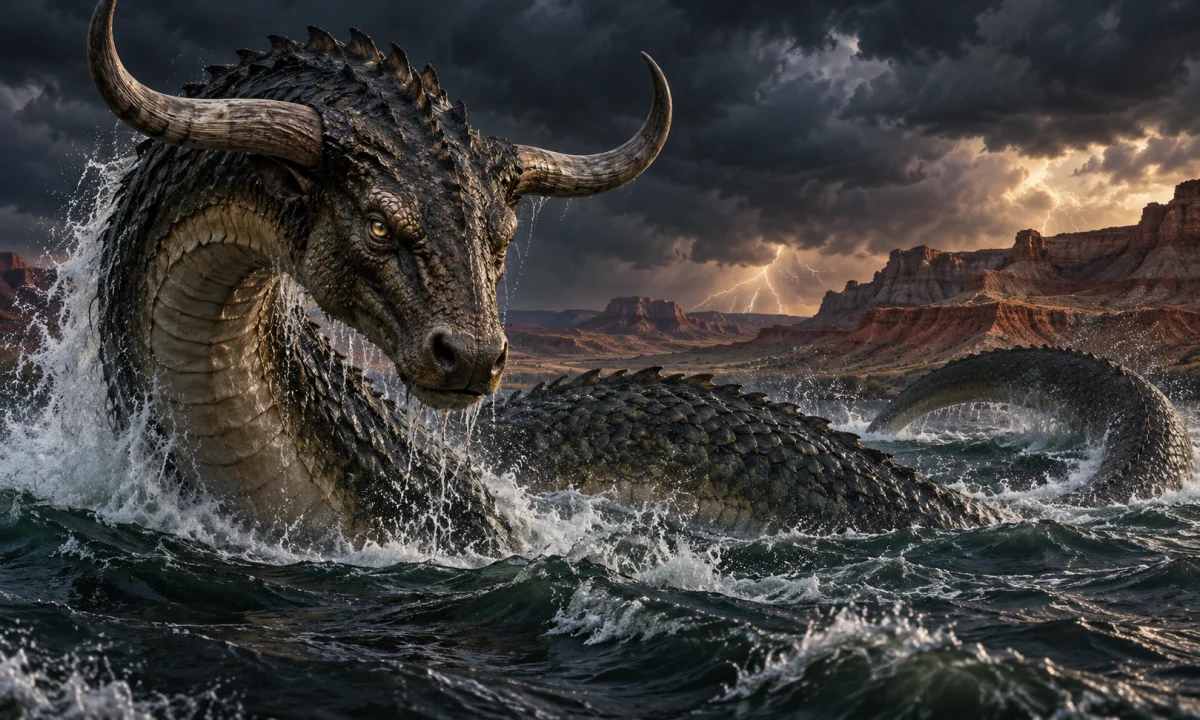
Untunktahe is a name associated with a powerful water being in traditions connected with the Lakota and other Dakota-speaking peoples of the northern Great Plains. The spelling is not uniform, and the form “Untunktahe” may represent a variant transcription of names more commonly written as Unktehi, Unktehila, or with other spellings. These forms should not automatically be treated as identical in every source. In the traditions where the figure is described, the being belongs to a sacred world inhabited by powerful forces of water, weather, earth and sky, rather than to a simple category of “monster” in the modern sense.
Name and identity
The name is difficult to represent accurately in English because Lakota and related languages have sounds and grammatical distinctions that older English-language writers recorded inconsistently. Spellings such as Unktehi, Unktehila, Unk’téhi, and Unktehe appear in discussions of Lakota sacred narratives and ethnographic materials. “Untunktahe” is therefore best treated as a variant or transcription rather than as a securely standardized spelling.
The word is generally connected with a water being or water monster. Depending on the tradition or translation, the name can refer to a particular supernatural being, a class of beings, or a powerful water-associated presence. Some accounts distinguish male and female forms, while others speak more generally of water monsters or aquatic powers. Because the surviving written records were produced through translation and often outside the communities themselves, it is unsafe to impose one fixed definition on all uses of the name.
The term “monster” can also be misleading. English-speaking collectors frequently used that word for beings that were dangerous, enormous or physically unfamiliar, but Native sacred traditions do not necessarily classify such figures as merely evil creatures. A being connected with deep water, storms, fertility and catastrophe may be feared and respected at the same time.
Cultural setting
Untunktahe belongs to a religious and mythological environment in which the natural world is spiritually alive. Water is not simply a resource or a landscape feature. Rivers, lakes, springs and underground waters may be associated with powers that sustain life, threaten communities or participate in the ordering of the world. The boundaries between animal, spirit, deity and natural force are not always equivalent to categories used in European mythology.
In Lakota and related traditions, powerful beings of the sky are often known as Wakíŋyaŋ, commonly translated as Thunder Beings or Thunderbirds. They are associated with thunder, lightning, storms and dramatic manifestations of sacred power. Water beings such as Unktehi are frequently presented as opponents or counterparts of these sky powers. This opposition is not simply a battle between good and evil. It expresses a profound relationship between the forces of the upper world and those of water and earth.
Traditional knowledge has been preserved through oral transmission, ceremonial practice and the teachings of particular communities. Written versions are comparatively late and vary in detail. A story recorded by one observer may combine information from several speakers, translate sacred terms too freely or omit the ceremonial context that gives the narrative its meaning. For that reason, descriptions of Untunktahe should be read as interpretations of a diverse tradition rather than as a single universally fixed biography.
Appearance and nature
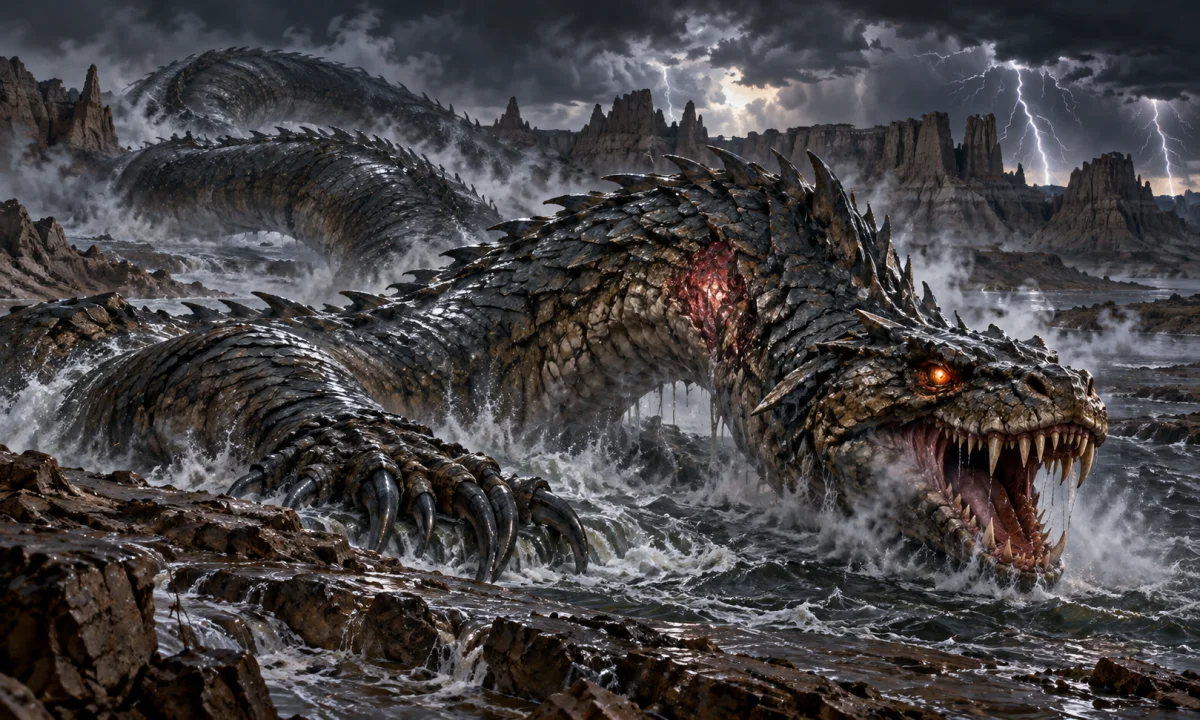
Descriptions associated with Unktehi or related water beings vary considerably. In some accounts, the being is imagined as enormous and reptilian, serpentine or amphibious. In others, it has features associated with a buffalo or another powerful land animal. Horns, a massive body and a connection with deep or dangerous water are recurring motifs in summaries of the figure, but no single appearance can be regarded as authoritative for every tradition using a similar name.
The contrast between aquatic and terrestrial features is significant. A horned or buffalo-like water being does not necessarily reflect confusion between separate creatures. Sacred beings may cross ordinary categories, combining the strength of a land animal with the mystery and danger of water. Such combinations can express the being’s status as an ancient power rather than as a zoological species.
Some modern descriptions portray Untunktahe as a gigantic serpent. That image may be appropriate for certain retellings, especially where the name has been connected with serpent-like water monsters, but it should not be assumed to describe every Lakota account. The written record includes different forms and translations, and the figure’s identity is sometimes blurred with broader references to water spirits or water monsters.
The water beings and the Thunder Beings
One of the most important themes connected with Unktehi is the conflict between the powers of water and the powers of the storm. In narratives of creation or world ordering, water beings and Thunder Beings may struggle for control, dominance or balance. Thunder and lightning strike the waters, while the waters threaten to spread across the land. Their opposition helps explain the arrangement of the world and the continuing power of storms.
Some versions describe a great conflict in which the Thunder Beings attack water monsters. The struggle may produce floods, violent storms, changes in the landscape or the destruction of ancient beings. In other tellings, the conflict is less a single historical battle than a mythic pattern that continues whenever thunder and storm confront dangerous waters.
Flood traditions associated with water beings should not be reduced to a single standardized story. Accounts differ in their characters, sequence and purpose. Some portray the waters as escaping their proper boundaries; others emphasize the Thunder Beings’ role in drying, restraining or reshaping the world. The stories can be understood as explanations of why water is both life-giving and perilous, and why storms are treated as manifestations of sacred power.
The opposition also has a relational dimension. Water and thunder are not independent forces. Rain comes from the sky and enters the earth and waterways; storms can nourish the land but also destroy it. A narrative conflict between a water being and a Thunder Being may therefore dramatize an enduring tension within nature rather than present an absolute moral division.
Role in sacred understanding
Untunktahe is associated with the unpredictable and potentially dangerous aspect of water. Deep water can conceal powerful life, cause drowning and flooding, and mark a boundary between ordinary human space and a more mysterious realm. A being living in or ruling such a place represents forces that people cannot safely treat as ordinary or controllable.
At the same time, water is essential to life. This makes a water being more complex than a simple villain. The figure may embody abundance, generative power and the hidden origins of living things as well as danger. Sacred narratives often preserve this ambiguity: the same natural force can sustain a community under one condition and threaten it under another.
The conflict with the Thunder Beings can also be interpreted as a story about order. Land must remain inhabitable, waters must occupy their proper courses, and powerful beings must be held in a relationship that permits the world to continue. Such interpretations are scholarly readings, not replacements for the meanings held by Lakota communities themselves. The religious significance of a sacred figure cannot be separated entirely from language, ceremony, place and living cultural authority.
Relationship to other figures
Untunktahe is sometimes discussed alongside Unktehi and Unktehila. These names may be alternate spellings, related forms or attempts to distinguish a singular being from a broader group. The evidence does not justify treating every occurrence as one identical character with a fixed family tree. Some sources use a name for a class of water beings, while others describe a particular powerful being.
The figure is also frequently compared with the Thunder Beings, especially the beings represented in English as Thunderbirds. This comparison is appropriate when discussing the traditional opposition between sky and water powers, but Untunktahe should not be presented as simply the “enemy” of a single Thunderbird character. In many traditions, the Thunder Beings are themselves a collective or a complex category of sacred powers rather than one individual hero.
Untunktahe should not automatically be identified with every water monster in Indigenous North American mythology. Many peoples have their own aquatic beings, including horned serpents, underwater panthers, giant snakes and lake monsters. Similar themes may arise because water is widely understood as powerful and dangerous, but resemblance does not prove a shared origin. The traditions of the Great Plains, the Great Lakes and other regions have distinct languages, histories and religious systems.
Sources and uncertainty
Knowledge of Untunktahe comes through a combination of oral traditions, linguistic records, ethnographic writing and later popular summaries. These kinds of evidence do not carry the same authority. A community-held tradition and an outsider’s nineteenth- or twentieth-century transcription should not be treated as equivalent. Translations may also turn a sacred name into a generic phrase such as “water monster,” removing distinctions that are meaningful in the original language.
Older records sometimes arranged Native traditions according to categories borrowed from classical mythology or Christian demonology. As a result, a powerful water being could be labelled a demon, dragon or monster even when those labels did not match the original cultural understanding. Contemporary discussion generally uses more careful language, describing the figure as a water being, sacred power or mythological being while noting the limits of the available evidence.
There is no universally accepted canon that fixes Untunktahe’s exact appearance, gender, habitat, powers or individual identity. Claims that give the figure a single definitive origin story should therefore be treated cautiously unless they specify which tradition or source they represent. Variations are not necessarily errors; they may reflect differences between communities, speakers, historical periods and translation practices.
Modern reception
Untunktahe appears far less often in globally popular fiction than better-known figures such as the Thunderbird or the Wendigo. When the name does appear in modern encyclopedias, games, fantasy writing or internet lists, it is often presented as a giant serpent, horned lake monster or enemy of thunder spirits. These portrayals may draw on genuine themes but frequently simplify the cultural setting and combine details from unrelated traditions.
Modern fantasy commonly treats such beings as creatures to be fought, captured or classified by size and powers. That approach can obscure the traditional emphasis on sacred relationships between water, weather, land and human responsibility. A respectful adaptation should distinguish creative invention from Lakota tradition, identify uncertain spellings rather than presenting them as interchangeable without explanation, and avoid treating Native religious beings as generic monsters available for use without cultural context.
For cultural and historical purposes, Untunktahe is best understood as a name linked to the powerful water beings of Lakota-related traditions, especially in narratives concerning the relationship between water and the Thunder Beings. Its precise identity remains dependent on spelling, source and community context. The uncertainty surrounding the name is part of the historical record and should be acknowledged rather than filled with invented details.