WORLD

White Buffalo Calf Woman
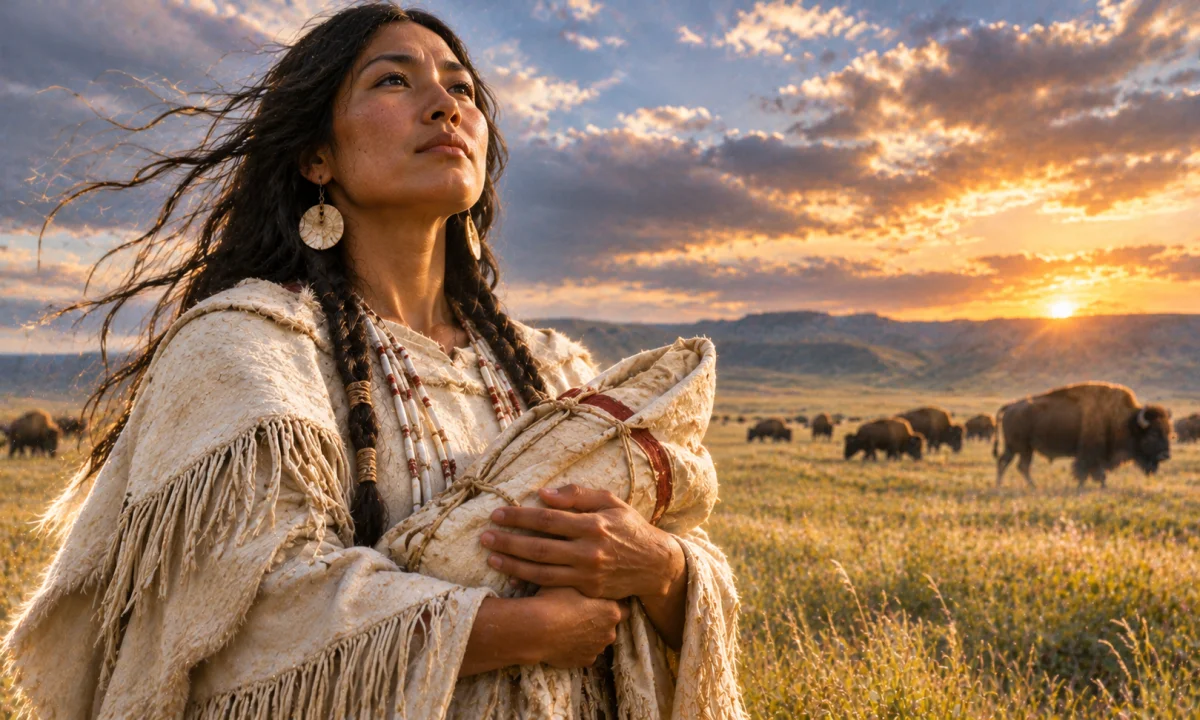
White Buffalo Calf Woman is a sacred female figure in Lakota religious tradition, especially known for bringing the sacred pipe and important ceremonial teachings to the Lakota people. Her name is commonly rendered in English as White Buffalo Calf Woman, although Lakota spellings and English translations vary. She is not simply a “goddess” in the classical European sense. In Lakota understanding, she is a powerful sacred being associated with revelation, right living, prayer, reciprocity and the renewal of relationships among human beings, the natural world and the spirit world.
Her story belongs specifically to Lakota tradition and should not automatically be treated as a single, pan-Indigenous “Native American” myth. Related ideas about sacred women, buffalo, pipes and ceremonial renewal appear in other Plains cultures, but the White Buffalo Calf Woman narrative is most strongly associated with the Lakota. The story continues through oral transmission, ceremonial practice and accounts shared by Lakota religious authorities. Details differ between tellings, and not every version presents the same sequence, name or interpretation.
Origins and cultural setting
The Lakota are one of the seven constituent peoples of the Oceti Sakowin, often called the Great Sioux Nation. Their traditional homelands include parts of the northern Great Plains, particularly areas now within the Dakotas, Minnesota, Wyoming, Montana and Nebraska. Historically, Lakota life was closely connected with buffalo, whose meat, hide, bones and other materials supported communities in practical, social and spiritual ways.
Within this setting, buffalo were not merely animals used for food. They were part of a sacred relationship involving generosity, dependence and responsibility. The buffalo provided for human life, while human beings were expected to show respect, restraint and gratitude. White Buffalo Calf Woman is understood within this broader religious world as a sacred visitor and teacher who gave ceremonial knowledge intended to restore harmony and guide the people.
Her teachings are often connected with čhaŋnúŋpa, usually written in English as chanunpa or “sacred pipe.” The pipe is used in prayer and treaty-making, and it can mark a solemn relationship among people and between people and the sacred. It is not simply an object for smoking socially. In ceremonial contexts, its preparation, handling, filling, lighting and passing are governed by teachings and responsibilities that may vary according to community and ritual setting.
Name and identity
The figure is known by several spellings and forms of her Lakota name, including Ptesáŋwiŋ, Pte San Win, Ptesanwin and other phonetic renderings. English-language writers frequently translate the name as “White Buffalo Calf Woman,” but translations are not perfectly uniform. The name is associated with a buffalo calf that is white, and some interpretations understand the figure as a woman who appears in buffalo-related form or as a sacred woman connected with the arrival of the white buffalo calf.
Her classification is also easy to oversimplify. Calling her a “goddess” can suggest a system of individual deities modeled on ancient Greek or Roman religion, which does not accurately describe Lakota theology. She is better described as a sacred woman, holy being, culture-bringer or spiritual teacher. Some discussions identify her with broader Lakota concepts of sacred power, while others emphasize her distinct personality and role in the narrative. These descriptions should not be treated as interchangeable without qualification.
The word “white” carries sacred importance in many accounts, but its meaning should not be reduced to a simple color symbol. White may be associated with purity, sacredness, the north, age, peace or other meanings depending on the teaching and context. Interpretations that assign one fixed meaning to every color or direction are often modern summaries rather than universally accepted explanations of the tradition.
The meeting with the hunters
A widely known version of the story begins with two Lakota hunters who encounter a mysterious and beautiful woman while travelling across the prairie. She is sometimes described as approaching in a cloud or surrounded by unusual light. The hunters recognize that she is not an ordinary human being.
One hunter responds to her with disrespectful desire. In many tellings, a cloud covers him, and when it lifts only his bones remain. The story presents his fate as the result of failing to recognize the visitor’s sacred nature and violating the proper boundaries of conduct. The other hunter approaches her with respect and reports what he has seen to his people.
Details differ among versions. Some accounts describe the disrespectful hunter as being consumed or reduced to bones; others use different imagery. The important point is not a fixed supernatural punishment but the contrast between arrogance and reverence. The encounter teaches that sacred power cannot be approached through entitlement, violence or sexual possession. Respectful conduct is a condition for receiving spiritual knowledge.
The woman instructs the surviving hunter to tell the Lakota leader that she will come to the people. A ceremonial lodge is prepared, and she arrives carrying or bringing sacred teachings. In some tellings, she carries the pipe in a bundle or presents it to the people as part of a larger body of ritual knowledge.
The sacred pipe and the seven rites
White Buffalo Calf Woman is particularly associated with giving the Lakota the sacred pipe. She explains how it should be used in prayer and how it represents a relationship between different aspects of existence. The bowl is often interpreted as feminine and the stem as masculine, although explanations of this symbolism vary. The assembled pipe can represent unity, complementarity and the joining of earthly life with spiritual intention.
When the pipe is offered in prayer, the smoke is commonly understood as carrying words or intentions toward the sacred. The pipe also establishes obligations. Those who use it are not merely asking for benefits; they are affirming kinship, truthfulness, generosity and responsibility. In some Lakota teachings, the pipe is described as a living relative or sacred presence rather than an inanimate tool.
Traditional accounts often connect White Buffalo Calf Woman with seven sacred rites. Lists and names vary, and ceremonial knowledge is not identical in every Lakota community. Commonly mentioned rites include:
- Inípi, the purification or sweat-lodge ceremony, in which participants pray and seek cleansing and renewal.
- Hanbléčheyapi, the seeking of a vision, traditionally involving prayer, solitude and fasting under appropriate guidance.
- Wanáǧi Yuhápi, often translated as the keeping or treatment of the spirit, associated with mourning and the care of the relationship between the living and the dead.
- Wi Wányank Wacípі, the Sun Dance, a major communal ceremony involving prayer, sacrifice and renewal.
- Hunkálowaŋpi, the making of relatives, through which relationships and social bonds are formally established.
- Išnáti Awíčalowaŋpi, a puberty or womanhood ceremony for girls, marking an important stage of life.
- Tȟápa Waŋkályeyapi, usually called the throwing of the ball, a rite associated with the movement of a ball through the directions and the continuity of life.
English lists sometimes use different names, combine rites, or place them in a different order. Some descriptions also present the pipe ceremony itself as a separate gift rather than one of the seven rites. The rites should therefore be understood as a common framework in accounts of White Buffalo Calf Woman, not as a universally standardized list detached from living Lakota ceremonial practice.
Her departure and promised return
After teaching the people, White Buffalo Calf Woman prepares to leave. She instructs them to care for the pipe and to follow the ceremonial ways she has given them. In many versions, she promises that she will return if the people lose their way or when the time is right.
As she departs, she walks away from the camp and eventually disappears or changes into a buffalo calf. Some tellings say that she becomes a white buffalo calf; others emphasize her movement between human and buffalo forms. This ending links her teaching directly to the sacred importance of buffalo and to the continuing possibility of renewal.
A number of modern retellings describe her as changing through four buffalo colors—black, yellow, red and white—or connect those colors with the four directions and the peoples of the world. Such explanations are widely circulated, but they are not presented identically in all Lakota accounts. Some are influenced by later intertribal, pan-Indigenous or New Age interpretations. They should not be assumed to be an unaltered feature of every traditional version.
The promise of her return is also associated with the birth of a white buffalo. A white buffalo calf may be regarded by many Lakota people and other Plains communities as a powerful sign, but its meaning is interpreted within particular religious and cultural contexts. Contemporary claims about individual animals, prophecies or world events should be distinguished from the older narrative itself.
Symbolism and religious significance
White Buffalo Calf Woman represents the arrival of sacred knowledge, but her teachings are not limited to private mystical experience. They concern the ordering of communal life. Prayer, family relationships, treatment of the dead, rites of passage, purification and seasonal renewal are all connected. The story therefore presents religion as a pattern of conduct rather than a collection of supernatural beliefs.
Her association with buffalo emphasizes reciprocity. Buffalo give their lives to sustain the people, and human beings must respond through gratitude and responsible behavior. The story also presents femininity as a source of sacred authority. She is not a passive helper to a male hero; she is the one who arrives, evaluates conduct, gives the ceremonial knowledge and establishes the obligations surrounding it.
The encounter with the two hunters gives the story an ethical dimension. Physical beauty, spiritual power and unfamiliarity do not justify possession or exploitation. The respectful hunter succeeds because he recognizes that the visitor must be approached with humility. This lesson is particularly significant in a tradition where sacred knowledge is not treated as material that anyone may claim without permission or preparation.
The sacred pipe also expresses the importance of relationship. In Lakota thought, humans exist within networks that include relatives, ancestors, animals, the land and sacred powers. Prayer with the pipe can affirm these relationships, but it does not make them automatic. The person praying is expected to live in a way that does not contradict the words spoken.
Relationship to other sacred figures
White Buffalo Calf Woman should not be casually merged with every female supernatural figure found in Plains traditions. Indigenous nations of North America have distinct languages, histories, ceremonial systems and sacred beings. Similar motifs—such as a mysterious woman who brings knowledge, a female culture-bringer, or a sacred animal associated with renewal—do not prove that the figures are the same.
She is also distinct from the generic image of a “buffalo goddess” sometimes found in modern spiritual writing. That label may be used as a loose comparison, but it can obscure the specifically Lakota context of her story, the role of the pipe and the ceremonial responsibilities connected with her teachings. Likewise, she should not be automatically identified with Lakota creator figures, tricksters or other powerful beings merely because they appear in the same religious universe.
Surviving tradition and modern reception
Accounts of White Buffalo Calf Woman became widely known outside Lakota communities through twentieth-century books, lectures and popular retellings. Some of these presentations preserved important elements of the tradition, while others simplified the story, rearranged the rites or combined Lakota teachings with ideas drawn from other Indigenous nations and modern spirituality.
In contemporary culture, the figure appears in books about Native American spirituality, environmental ethics, women’s religious leadership and the symbolic meaning of white animals. She is sometimes presented as a universal Mother Earth figure or as a prophecy of global transformation. These interpretations may hold personal meaning for readers, but they are modern interpretations rather than neutral descriptions of Lakota religious tradition.
Respect for the living tradition requires recognizing that some ceremonies are restricted, some teachings are shared only under particular circumstances, and public summaries cannot replace instruction from qualified Lakota elders or ceremonial leaders. White Buffalo Calf Woman is not merely a character from a freely available mythological catalogue. She remains connected to a living religious tradition in which the sacred pipe, the rites and the responsibilities they express continue to matter.