WORLD

Quaoar
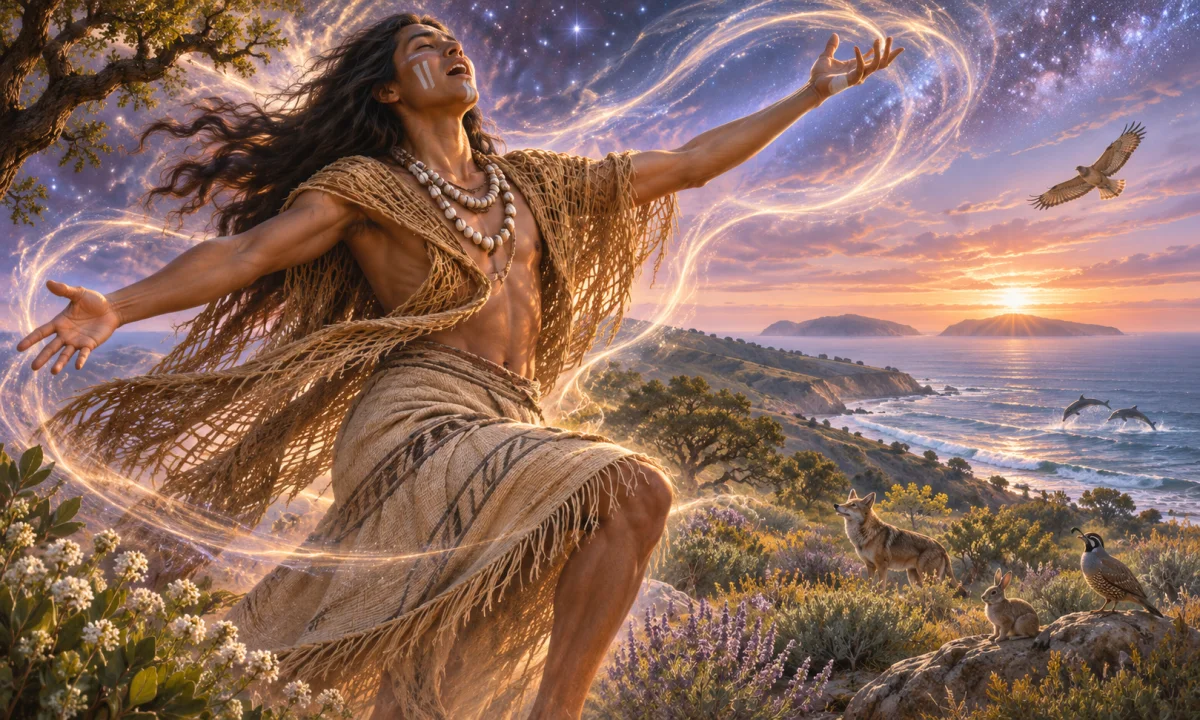
Quaoar is a creator figure associated with the Tongva people of Southern California, a Native American nation whose traditional territory included the Los Angeles Basin, the southern Channel Islands and surrounding coastal regions. In English-language writing, Quaoar is often described as a creator god, although surviving accounts do not provide a single, universally fixed version of Tongva religious tradition. Stories about Quaoar were transmitted orally and later recorded by outsiders, and details such as the being’s gender, relationships and sequence of creation vary between accounts.
Cultural setting
The Tongva are also widely known by the names Gabrielino or Gabrieliño, terms connected with Mission San Gabriel Arcángel. “Gabrielino” is therefore a colonial designation rather than the name used by the people for themselves before Spanish missionization. Tongva is a widely used modern self-designation, although questions of naming and identity remain important within the community, and some people use other names, including Kizh. These naming differences should not be treated as evidence of separate mythological beings.
Tongva homelands were ecologically diverse. They included coastal wetlands, oak-covered inland areas, river valleys, islands and mountain regions. Religious knowledge was connected with this landscape, with ancestral beings, animals, celestial bodies, sacred places, ritual specialists and the continuing obligations of human communities. Quaoar belongs to this broader cultural world rather than to an isolated system of “mythology” comparable to a single written canon.
Traditional Tongva knowledge was preserved primarily through oral transmission. Spanish colonization, epidemic disease, forced settlement at missions and the suppression or disruption of Indigenous practices caused profound damage to the continuity of cultural traditions. Later ethnographers and collectors recorded fragments of stories, sometimes through interpreters or informants working under difficult circumstances. Such records are valuable, but they are not neutral transcripts of an unchanging ancient religion. Their wording may reflect the recorder’s assumptions, translation problems or attempts to fit Indigenous ideas into European categories such as “god,” “devil” or “myth.”
Name and identity
The form Quaoar is the spelling most familiar to the general public, especially because it was later given to a distant body in the Solar System. Other spellings and attempted transcriptions appear in discussions of Tongva tradition. English pronunciation is also inconsistent: the name is commonly rendered approximately as “kwa-war” or “kwah-o-ar,” but an English approximation cannot necessarily reproduce its original pronunciation.
Quaoar is generally identified as a creator being. English descriptions often call Quaoar a male god, but some accounts describe the figure as genderless or do not assign a human gender. This difference may reflect distinct traditional tellings, translation choices or the influence of Christian and European ideas about creator figures. It is more accurate to acknowledge the variation than to insist that one modern description is the only authentic one.
Nor should Quaoar automatically be treated as the equivalent of a supreme deity in the theological sense familiar from some monotheistic traditions. “Creator god” is a useful short description, but Tongva cosmological beings do not necessarily fit neatly into a hierarchy based on omnipotence, exclusive worship or a fully systematized pantheon. The surviving evidence is fragmentary, and the meaning of Quaoar’s creative activity is best understood within Tongva cultural concepts rather than through a direct comparison with figures from Greek, Norse or biblical traditions.
Creation through song and movement
The central feature associated with Quaoar is creation through song and dance. In commonly repeated versions, Quaoar existed before the ordered world and brought elements of the cosmos into being through sacred performance. Creation is therefore not portrayed simply as the manufacture of matter by command. Voice, rhythm, movement and the repeated enactment of an order are fundamental to the story.
Some retellings begin with Quaoar alone in a condition described as emptiness, darkness or a primordial void. Quaoar sings and dances, and from this creative action other beings and parts of the world emerge. In certain versions, a sky being named Weywot is created first or appears among the earliest beings. Other accounts present a sequence involving additional supernatural figures, the earth, celestial powers, animals and human beings. The exact order is not consistent across all published summaries.
These stories should not be reduced to a simple explanation of how the physical universe began. The creative dance can also be understood as an ordering act: it establishes relationships among the sky, earth, living beings and the powers that inhabit the world. The story gives sacred importance to performance and suggests that order is generated through proper relation and action rather than existing as an abstract structure independent of life.
Because much of the material was recorded from oral tradition, it is difficult to determine whether apparently different episodes once belonged to one long narrative, to separate local traditions or to later attempts by informants and collectors to arrange related stories into a sequence. A concise version found in a modern encyclopedia may therefore appear more definite than the historical evidence permits.
Weywot and other associated beings
Weywot is the figure most frequently connected with Quaoar in modern accounts. Weywot is commonly described as a sky being and, in many retellings, as Quaoar’s son. The relationship is especially familiar because the name Weywot was later assigned to the moon of the astronomical object Quaoar. However, the surviving accounts of Tongva tradition do not function like a single canonical genealogy. Descriptions of Weywot’s role and relationship to Quaoar may differ according to the source.
Some versions say that Quaoar and Weywot participate together in the further creation of the world. Other summaries mention a succession of supernatural beings who help establish the structure of the cosmos. Names and identities can be difficult to standardize because early recorders wrote Indigenous words using English or Spanish spelling conventions. A name that appears in one source may have variant forms in another, and similar-looking forms should not automatically be treated as separate figures or as exact equivalents.
There is no reliable basis for presenting every figure listed in one retelling as part of a universally accepted Tongva pantheon. The available material is too limited for that level of certainty. It is safer to describe Quaoar as a central creative presence within a group of related cosmological traditions, while noting that the surviving versions preserve only part of the original oral and ceremonial context.
Attributes and symbolism
Quaoar’s defining attribute is creative power expressed through performance. Rather than being known primarily for a distinctive animal form, weapon or physical appearance, Quaoar is characterized by action: singing, dancing and bringing the world into ordered existence. This makes the figure different from many culture heroes whose stories focus on journeys, battles or the acquisition of fire and other useful resources.
The association with dance has cultural significance beyond entertainment. In many Indigenous traditions, ceremonial movement and song can preserve knowledge, renew relationships and connect human communities with ancestral or supernatural powers. It would be inappropriate to assume that every modern performance or dance is a direct enactment of a Quaoar creation story, but the traditional emphasis on song and movement shows that creative and sacred knowledge was not confined to written texts.
Quaoar can also be discussed as a figure of cosmic ordering. The world is not merely present; it is made meaningful through relationships among its parts. Sky, earth, animals, people and supernatural beings belong to a network whose order is established and maintained through acts of creation and cultural practice. This interpretation is scholarly and comparative rather than a quotation from a single authoritative Tongva theological statement, and it should not replace community-specific explanations.
Sources and limits of reconstruction
Information about Quaoar comes from a combination of Indigenous oral traditions, historical ethnographic records and later summaries. The most important limitation is that the written record was produced after colonization had already transformed Tongva life. Missionization altered settlement patterns, religious practice and language transmission. Some traditional specialists and elders died without their knowledge being recorded, while other knowledge may have been deliberately withheld from outsiders.
Ethnographic texts can preserve valuable names and narrative elements, but they often present oral traditions as if they were fixed literary myths. A published story may represent one speaker, one community, one moment or one translator’s interpretation. Modern retellings sometimes smooth out contradictions, add family relationships or turn a complex cosmology into a linear creation narrative. Those changes can make the story easier to read while concealing uncertainty.
For this reason, descriptions of Quaoar should distinguish between what is broadly repeated and what is securely established. The association with creation and with song and dance is widespread in modern presentations. Claims about an exact sequence of creation, a complete list of divine relatives, or Quaoar’s precise gender and appearance require more caution.
Quaoar and the astronomical object
In 2002, astronomers discovered a distant trans-Neptunian object beyond Pluto. It was initially identified by a provisional designation and later given the official name Quaoar, drawing on the Tongva creator figure. The choice brought a name from Southern California Indigenous tradition into international scientific usage, but the astronomical body and the traditional being are not the same subject.
The object is a large icy body in the outer Solar System, and its scientific properties belong to astronomy rather than Tongva religion. Its naming does not turn Quaoar into an astronomical deity, nor does the celestial body provide evidence for ancient Tongva observations of that particular object. The connection is a modern act of naming made by astronomers, not an ancient identification between the creator figure and a known planet or star.
The object’s moon was later named Weywot, after the being associated with Quaoar in Tongva tradition. This pairing has made the relationship between the two names especially visible in popular science. Even so, astronomical references to Quaoar and Weywot should not be used to fill gaps in the traditional record. The modern names reflect selected elements of Tongva tradition, while the scientific objects themselves have no role in the original stories.
Modern cultural significance
For contemporary Tongva people, Quaoar is connected with the survival and renewal of Indigenous identity in a region where colonial institutions often treated the Tongva as a vanished people. The continued use of Tongva names, language work, community education and cultural revitalization challenges that erasure. A creator figure should not be treated merely as an exotic character from a closed mythological past.
Modern popular culture and astronomy have made Quaoar more widely known, but this visibility can produce distortions. Short descriptions may call Quaoar “the Tongva equivalent of a creator god,” present one version as definitive, or repeat an English spelling and pronunciation without discussing their limitations. Respectful treatment keeps the traditional and modern contexts separate: Quaoar is a figure of Tongva cosmological tradition, while the distant Solar System object is a contemporary scientific namesake.
Quaoar is therefore best understood as a powerful creative presence whose tradition emphasizes song, dance and the ordering of the world. The story survives through incomplete historical records and continuing Indigenous cultural memory, making precision about uncertainty as important as recounting the creation narrative itself.