WORLD
WORLD
Wendigo
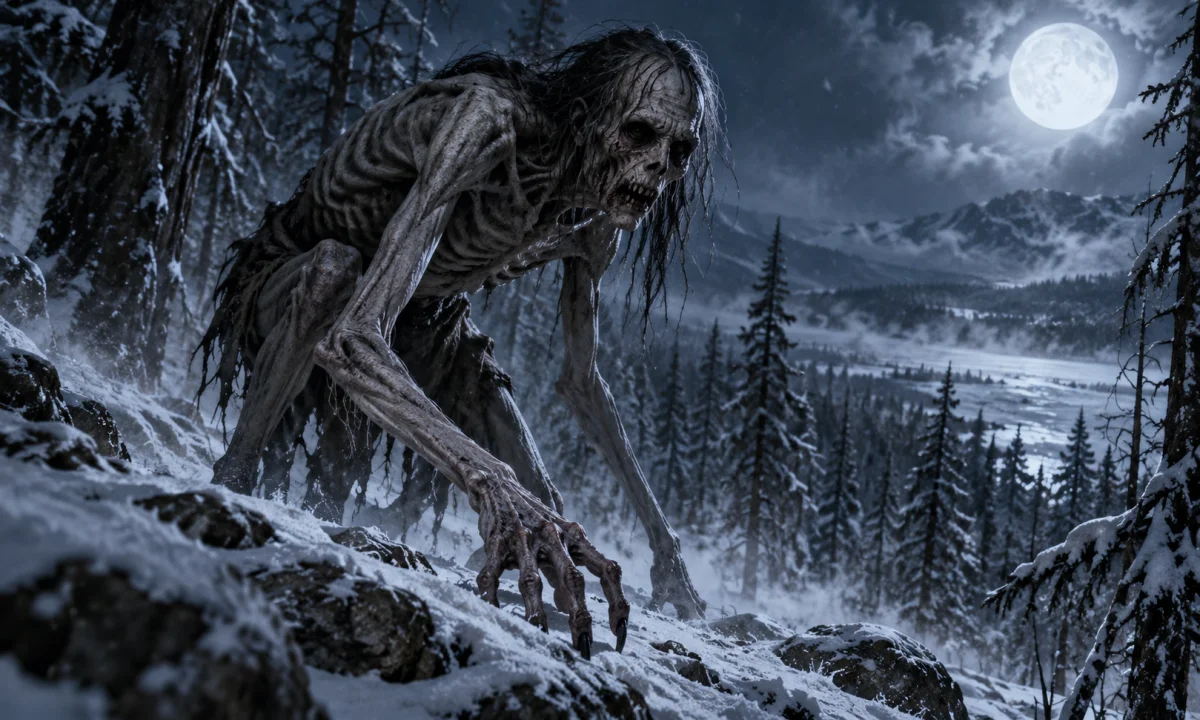
Wendigo is a powerful and dangerous being associated chiefly with Algonquian-speaking peoples of the Great Lakes, the northern woodlands and parts of subarctic North America. The name appears in several related forms, including wiindigoo in Anishinaabe languages and wîhtikow or similar spellings in Cree traditions. Although English-language writing often treats the Wendigo as a single, universally defined monster, Indigenous traditions differ considerably in their names, stories, emphasis and religious interpretation.
In many traditions, the Wendigo is connected with extreme hunger, winter hardship, cannibalism, greed and the destruction of social bonds. A person may become Wendigo-like through cannibalism, spiritual corruption or possession, while other stories present the being as a dangerous supernatural presence already inhabiting the wilderness. The figure is therefore not simply an animal, demon or giant. Its meaning often concerns the moral and communal consequences of placing insatiable appetite above human responsibility.
Origins and cultural setting
Wendigo traditions belong to a broad cultural region rather than to one single nation. Related accounts have been recorded among several Algonquian-speaking peoples, including Anishinaabe communities, Cree-speaking peoples and groups in the Great Lakes and subarctic regions. The precise form of the tradition varies from community to community, and Indigenous storytellers may use different names for related beings or for different kinds of spiritual danger.
These traditions developed in environments where winter travel, isolation, hunger and sudden shortages could pose serious threats. A small hunting party might become separated from its community, and a period of famine could turn survival into a moral crisis. Stories about the Wendigo reflect these realities, but they should not be reduced to simple tales of starvation. They also express teachings about restraint, reciprocity, hospitality and the obligations that hold a community together.
Much of the surviving written information comes from missionaries, colonial officials, linguists and ethnographers who recorded oral traditions in translation. Such records can preserve valuable details, but they are not neutral transcripts of an entire religious system. Outsiders sometimes classified Indigenous spiritual beings as “devils,” “demons” or “monsters,” and may have misunderstood distinctions made by the people whose traditions they recorded. Oral traditions themselves continue to change through performance, teaching and local interpretation.
The name and identity of the being
The English word Wendigo represents several spellings used in different periods and languages. Windigo, Windikouk, Witiko, Wiindigoo and Wîhtikow are among the forms encountered in scholarship and popular writing. These forms are related in some cases, but they should not automatically be treated as interchangeable names with exactly the same meaning.
The etymology is discussed by linguists and cultural historians, and a single universally accepted translation should not be assumed. The word may refer to a supernatural being, a person affected by a dangerous spiritual condition, or a broader pattern of destructive behaviour, depending on the language and context. In some accounts, the term describes a monster that consumes human beings. In others, it can describe someone who has become morally or spiritually transformed by an excessive desire to consume.
For that reason, “Wendigo” is best understood as a convenient English label for a family of related traditions, not as the name of one standardized creature with a fixed appearance and biography. The category also has to be handled carefully: different communities may distinguish between a dangerous spirit, a cannibalistic human being and a person believed to be under supernatural influence.
Appearance and physical characteristics
Traditional descriptions vary widely. Some accounts describe a tall, thin or emaciated figure whose body shows the effects of endless hunger. Other descriptions give the being a more ordinary human form, especially when it has transformed from a person or is believed to be hiding among human beings. The association with cold, the forest and winter darkness is common in many retellings, but not every tradition emphasizes the same visual details.
The familiar modern image of a skeletal humanoid with enormous antlers is not a universal feature of Indigenous Wendigo traditions. Antlers and deer-like characteristics became especially prominent in twentieth- and twenty-first-century horror art, film, television, games and online storytelling. Some older accounts do mention unusual size, gauntness or frightening bodily changes, but the widely recognized antlered design is a modern composite rather than a reliable description shared by all traditional sources.
Other features found in different accounts include a huge stature, a heart made of ice, a body that remains unsatisfied no matter how much it eats, or a voice and presence associated with the wilderness. These details should be treated as variants, not as a single canonical list. The absence of one feature in a particular tradition does not make that tradition incomplete.
Hunger, cannibalism and insatiability
The most persistent theme is insatiable appetite. A Wendigo may consume human flesh and still remain hungry. This endless hunger distinguishes the being from an ordinary predator. It represents desire that has lost all limit: the more it takes, the more it needs, and no amount of consumption restores balance.
Cannibalism is especially significant in stories about famine and survival. Under ordinary conditions, eating human flesh violates profound social and spiritual rules. A person who resorts to it, or who is believed to desire it, may be understood as crossing a boundary between human community and destructive otherness. In some stories, the transformation begins with an act of cannibalism; in others, a supernatural force causes a person to develop the appetite first.
The danger is not only physical. A Wendigo threatens the trust on which a small community depends. During a harsh winter, people must share information, food and labour. Someone driven by limitless appetite may betray companions, conceal resources or treat other human beings as objects for consumption. The Wendigo therefore embodies both famine and the selfishness that can intensify famine.
Transformation, possession and human responsibility
Many Wendigo narratives involve a human being who becomes dangerous. The change may follow starvation, isolation, a forbidden act, contact with a supernatural power or an overpowering desire to eat human flesh. In some traditions, the transformed person is physically altered; in others, the change is recognized through behaviour, appetite or spiritual condition.
Accounts differ over whether the person remains responsible for the transformation. Some stories present Wendigo-making as the result of a deliberate choice or a failure to observe important rules. Others portray the victim as afflicted by a hostile spiritual influence. The distinction matters because it affects how the community responds: a dangerous person may be treated as a threat, a sufferer, a transgressor or some combination of these.
Traditional responses likewise vary. Stories may describe a Wendigo being confronted, killed or ritually neutralized. In other settings, healing specialists, ceremonies, confession, communal intervention or strict separation from others may be important. It is not accurate to claim that every Wendigo tradition prescribes one universal method of dealing with the being.
Social and religious meaning
Wendigo stories are often interpreted as teachings about reciprocity and restraint. In many Indigenous societies, survival depends on relationships among people, animals, places and spiritual powers. Hunting is not merely an economic activity, and food is not simply a private possession. Obligations govern how animals are treated, how meat is distributed and how members of a community support one another.
Against this background, the Wendigo can symbolize a person who takes without giving back. The figure is sometimes connected with greed in a broad sense: the desire to possess more land, food, wealth or power than one could responsibly use. Modern interpreters frequently extend the symbol to colonial exploitation and environmental destruction. Such interpretations can be meaningful, but they are interpretations rather than evidence that every traditional story originally referred to modern capitalism or colonialism.
The being can also mark a boundary between human society and a dangerous wilderness. That boundary should not be understood as a simple opposition between “civilized” people and “nature.” In many Indigenous worldviews, forests, animals and spiritual beings are parts of a living and morally significant world. The danger lies not in nature itself but in breaking relationships and losing the discipline required to live within them.
Stories and regional variations
There is no single Wendigo epic comparable to a standardized literary mythology. Instead, the tradition consists of many narratives, warnings, teachings and accounts of encounters. Some tell of an isolated hunter or traveller who becomes cannibalistic. Others describe a community threatened by a person who has acquired a supernatural appetite. Still others focus on a spirit or monster in the forest that stalks travellers during periods of severe winter.
Some narratives emphasize the being’s ability to imitate or conceal itself among humans. Others focus on signs such as unnatural hunger, disturbing behaviour, unusual size or an atmosphere of spiritual danger. In certain accounts, the being’s body is associated with cold or ice, while other versions stress its speed, strength or ability to track people. These differences reflect distinct local traditions and the flexibility of oral storytelling.
Related Algonquian traditions should not be combined indiscriminately. A figure in an Innu, Cree, Anishinaabe or another community may share themes with the Wendigo but have its own name, history and ceremonial context. Similarity of subject matter does not prove that all such beings are identical. The names used in English-language books may conceal distinctions that are clear in the original languages.
The “windigo psychosis” debate
In the twentieth century, some writers used the phrase windigo psychosis for an alleged mental disorder in which an Indigenous person supposedly developed an irresistible desire to eat human flesh. The concept appeared in psychiatric and anthropological discussions, but its historical evidence and interpretation have been strongly debated.
Critics have argued that colonial observers sometimes misunderstood stories, medical crises, accusations, starvation events or acts of violence, then turned them into evidence for a culture-specific disorder. The category has also been criticized for portraying Indigenous people as inherently primitive or psychologically unusual. It is not a standard diagnosis in contemporary psychiatric practice, and claims about a clearly defined, uniquely Indigenous syndrome should not be repeated as settled fact.
This debate does not make Wendigo traditions unreal or insignificant. It shows the danger of treating a religious and cultural concept as though it were automatically a clinical label. Traditional accounts of spiritual danger, moral transformation and cannibalistic appetite belong to their cultural settings and cannot be explained adequately by a sensational psychiatric term.
Distinguishing the Wendigo from similar figures
The Wendigo is sometimes confused with every cannibalistic or forest-dwelling being in Indigenous North American folklore. That approach erases important differences. Some Algonquian traditions include giants, cannibal beings, witches, harmful spirits and predatory monsters that are not Wendigos. Names may also refer to more than one kind of entity, depending on the community and the circumstances of the story.
The Wendigo should also be distinguished from the Skin-walker, a figure associated particularly with Diné or Navajo traditions. The two belong to different cultural and linguistic contexts. Skin-walker traditions concern harmful practitioners of witchcraft and should not be treated as another name for a Wendigo. Nor is the Wendigo equivalent to the Sasquatch or Bigfoot, which belongs to a different set of stories and modern interpretations.
Comparisons with European werewolves, vampires or demons can help modern audiences identify broad themes of transformation and predation, but they can also mislead. The Wendigo’s associations with famine, social obligation, human appetite and winter survival give it a distinct cultural significance that is not captured by simply calling it a North American vampire or cannibal monster.
Colonial records and later interpretations
European missionaries and colonial writers often interpreted Wendigo-related beliefs through Christian categories of sin, demonology and devil worship. Later ethnographers sometimes recorded the traditions more carefully, but their work still depended on translation, selective interviews and the assumptions of their time. Written accounts therefore need to be read alongside Indigenous scholarship, community knowledge and the continuing authority of oral tradition.
In some Indigenous communities, Wendigo stories have continued as teachings about selfishness, violence, addiction, colonial harm and the loss of connection to family or land. Contemporary Indigenous authors and artists may also reclaim or reinterpret the figure, sometimes presenting it as a symbol of historical trauma or systems that consume people and environments. These uses are not identical to older narratives, but they can emerge from the same concerns about destructive appetite and broken relationships.
Modern popular culture
The Wendigo has become a recognizable horror figure in novels, films, television series, comics, role-playing games and video games. Modern adaptations commonly portray it as an antlered, skeletal humanoid with supernatural strength, speed or a craving for human flesh. That image is effective as visual horror, but it should not be mistaken for a universally traditional form.
Popular culture often removes the figure from its Indigenous religious and ethical context, leaving only an exotic monster in a snowy forest. Such portrayals can repeat stereotypes when they treat diverse Native nations as one interchangeable source of frightening folklore. More responsible adaptations identify the specific tradition they are drawing from, avoid presenting disputed details as universal and acknowledge that the Wendigo is not merely a decorative monster but a figure connected to hunger, community, spiritual danger and the consequences of limitless consumption.