WORLD

Qamaits

Qamaits is a name associated in some modern references with the traditional religious and mythological heritage of the Quileute people of the north-western Olympic Peninsula in Washington State. The identification is not entirely secure. Qamaits is not as well documented in published ethnographic material as better-known Quileute figures such as K’wati’, often written Kwatee or K’wati, the Transformer. Accounts that mention Qamaits may differ in spelling, classification and description, and it is therefore important not to present a single fixed version as though it represented a universally shared Quileute belief.
Cultural setting
The Quileute are an Indigenous people whose traditional homeland lies on the Pacific coast of present-day Washington, especially around the Quillayute River and the village now known as La Push. Their language, Quileute, belongs to the small Chimakuan language family. The closely related Chemakum language is no longer spoken, leaving Quileute as the surviving member of that family.
Quileute traditional knowledge developed within a landscape of dense forests, rivers, ocean beaches and offshore waters. Salmon, halibut, shellfish, sea mammals, cedar and other resources were central to life. As in many Indigenous societies of the Pacific Northwest, stories about supernatural beings were not simply imaginative tales separated from daily affairs. They could preserve historical memory, explain places and customs, teach proper conduct, describe relationships between humans and animals, and express obligations within a living world.
Quileute stories also belong to an oral tradition. They were transmitted through particular communities, families and knowledgeable speakers rather than through one canonical scripture. The forms in which names and stories were recorded by outsiders may reflect differences in pronunciation, transcription and translation. A short name written in an English-language source may consequently conceal distinctions that would be clearer in the Quileute language or in a fuller telling.
Name and identity
The spelling Qamaits is used in some secondary discussions of Native American mythology, but its precise linguistic form and meaning are not consistently established across readily available sources. Alternative spellings or transliterations may occur. The use of a letter such as q can reflect an attempt to represent a sound that does not have a straightforward equivalent in ordinary English spelling.
Qamaits is sometimes labelled a god, creator, spirit or supernatural being. Those labels should be treated cautiously. The word “god” is often applied by English-language writers to any powerful non-human figure, even when the original tradition does not organise spiritual beings according to the categories familiar from Greek, Roman or Christian religion. A figure described in one source as a deity may be understood in another context as an ancestral being, transformer, culture hero, powerful spirit or person from an earlier mythic age.
There is no reliable basis for assuming that every reference to Qamaits describes the same figure. Some brief online or popular accounts attach broad powers such as creation, weather control or dominion over nature without identifying a recorded Quileute narrative behind those claims. Such summaries may combine information from different Pacific Northwest traditions or turn a complicated oral tradition into a simple list of divine attributes.
Qamaits in relation to Quileute tradition
Quileute mythology is especially known in published accounts for stories of K’wati’, the Transformer. K’wati’ travels through the world before its present order has been established and changes people, animals, landscapes and customs. These narratives explain why places have particular forms, why certain beings possess distinctive characteristics and how human ways of living came to be. K’wati’ is not identical with every creator or supernatural figure mentioned in connection with the Quileute, and Qamaits should not automatically be treated as another name for K’wati’.
The limited and inconsistent information about Qamaits makes it difficult to assign a firm role within this wider mythological landscape. Some modern descriptions portray Qamaits as a powerful creator-like being, while others treat the name as belonging to a more local or specialised supernatural figure. The surviving evidence does not justify a detailed genealogy, a fixed set of adventures or a definitive hierarchy of powers.
It is also unsafe to assume that a figure connected with the Quileute can be interpreted through the mythologies of neighbouring peoples simply because the communities share a region. The Pacific Northwest contains many related cultural patterns, including transformer stories, animal-human relationships and flood traditions, but neighbouring nations have their own languages, histories and religious frameworks. Similar themes do not prove that two named beings are the same.
Attributes and powers
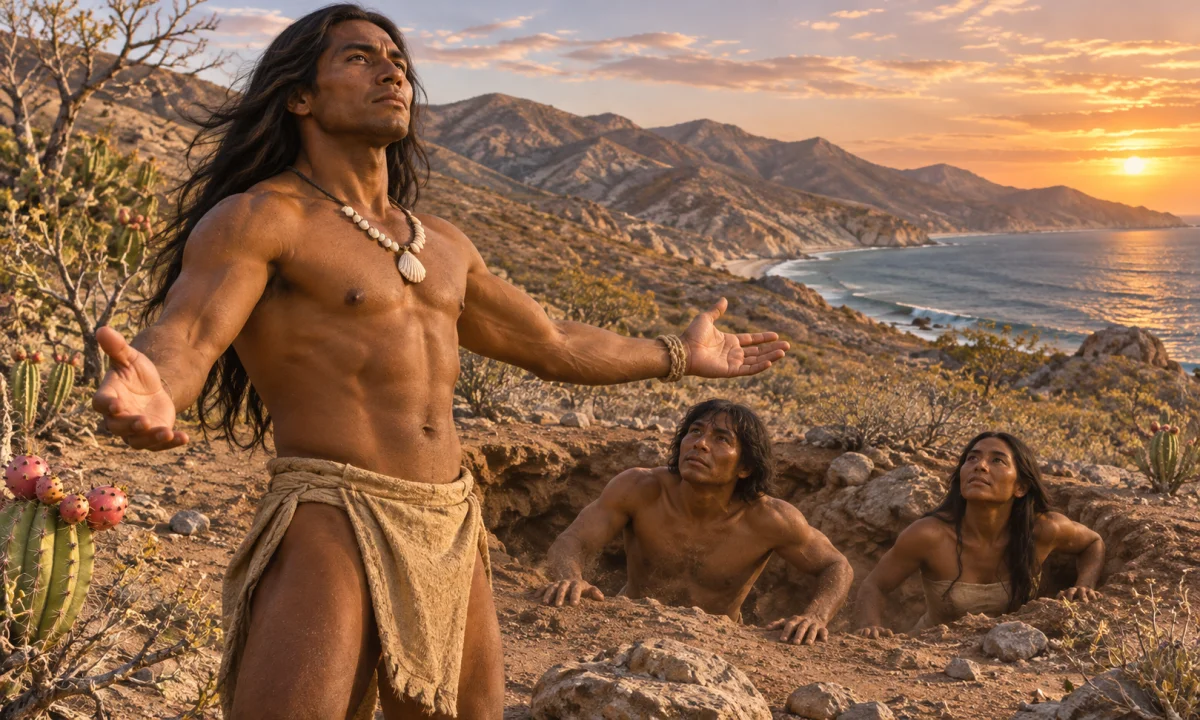
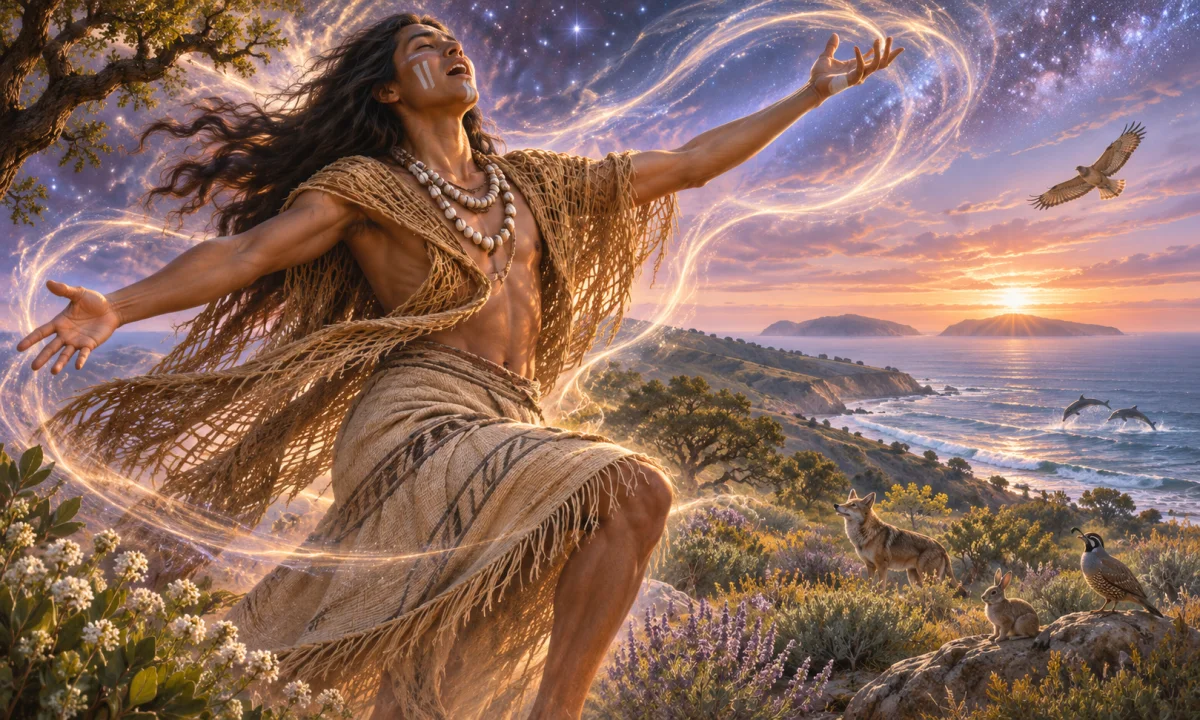
Descriptions of Qamaits are too uncertain to support a standard physical appearance. No single traditional image, animal form or costume can be securely identified as belonging to the figure. Modern illustrations that give Qamaits a human body, horns, wings, weapons or an animal form should therefore be understood as artistic inventions unless they are explicitly based on a particular Indigenous account.
The same caution applies to supernatural powers. General statements that Qamaits created the world, controls storms, rules the sea or governs animals are repeated in some popular summaries, but these claims are not equally well supported. They may result from loose translation, conflation with another being or the tendency of mythological reference works to assign a single “domain” to every named figure.
Within Quileute religious thought, however, power should not be imagined only as a magical ability. Supernatural potency may be connected with particular places, animals, inherited knowledge, dreams, ritual practices and relationships of respect. A being’s significance can lie in the obligations created by an encounter or story rather than in a clearly defined list of powers. This broader context is more appropriate than treating Qamaits as a fantasy character with a standard set of skills.
Stories and narrative tradition
There is no widely attested cycle of Qamaits stories comparable to the substantial body of narratives associated with K’wati’. Short reference entries often name Qamaits without preserving a complete traditional narrative, and isolated statements can be difficult to interpret without knowing who told the story, in what language, and for what purpose.
This absence should not be taken to mean that the name had no meaning for Quileute people. Oral traditions are not required to leave behind a large written record in order to be culturally important. A name may occur in a local account, a family tradition, a ceremonial context or a story that was never intended for unrestricted publication. Indigenous communities also have the right to control how sacred, private or culturally sensitive knowledge is shared.
Recorded material about Native American religions was frequently collected by outsiders under unequal conditions. Translators and researchers sometimes selected stories according to their own expectations, separated narratives from their social setting or substituted familiar terms such as “god” and “myth” for Indigenous concepts. Earlier records may also have altered spellings or omitted details that did not seem relevant to the collector. These circumstances help explain why a name such as Qamaits may appear in modern reference material without a stable, well-documented body of stories.
Interpretation and cultural significance
Qamaits is best approached as a figure whose documentation is uncertain rather than as a fully defined member of a universal Native American pantheon. “Native American mythology” is a broad modern category covering hundreds of distinct nations and cultural traditions. There is no single Native American religion, and a being connected with the Quileute should not be presented as representative of Indigenous peoples throughout North America.
The most responsible interpretation separates three levels of information. First, there is the cultural setting: Qamaits is associated in some sources with Quileute tradition and should be considered in relation to Quileute language, land and oral history. Second, there are the recorded or repeated descriptions, which may call the figure a deity or creator-like being. Third, there is the uncertainty surrounding those descriptions, including variant spellings, limited narratives and possible confusion with other figures.
This distinction matters because apparently simple labels can change the meaning of a tradition. Calling Qamaits a “god of nature,” for example, may suggest a system of specialised divine departments, while Quileute stories may instead emphasise reciprocal relations among people, animals, places and powerful beings. Calling the figure a “monster” or “demon” would be even more misleading if based only on unfamiliarity or on a modern desire for dramatic categories.
Distinguishing Qamaits from similar figures
Qamaits should not be automatically identified with K’wati’, the Quileute Transformer. K’wati’ is a prominent culture hero and world-shaping figure in published Quileute narratives, but similarity in broad descriptions such as “creator” or “powerful spirit” does not establish that the names refer to one being.
Qamaits should also not be merged with supernatural figures belonging to the Makah, Hoh, Quinault, Hohokam or other peoples. Some of these communities have their own transformer beings, creator traditions and powerful animal figures. Geographic proximity can produce shared themes, but it does not erase cultural boundaries.
Nor should Qamaits be confused with the figures sometimes called Qamaits or similar names in unrelated modern fantasy works, occult writing or internet lists. A name may be copied from one unsourced page to another, acquiring new powers and relationships in the process. Repetition online is not evidence that a description belongs to an Indigenous tradition.
Later reception
Qamaits has had little clearly documented presence in mainstream popular culture. Where the name appears today, it is more often in encyclopedic lists, mythology websites, speculative fiction or modern discussions of lesser-known Indigenous beings than in a major film, novel or established religious movement. These appearances frequently simplify the figure, supply an invented appearance or describe Qamaits as a conventional “god” with a neat sphere of influence.
Such adaptations may be creative works, but they should not be mistaken for Quileute tradition. A respectful modern treatment would identify the uncertainty of the historical record, avoid presenting invented stories as authentic, and recognise that Quileute cultural knowledge belongs to a living Indigenous community rather than to a freely available catalogue of fantasy characters.
For that reason, the most accurate description of Qamaits remains a careful one: a name associated by some sources with Quileute mythology, probably referring to a supernatural or deity-like figure, but one whose exact identity, attributes and traditional stories are not securely established in the surviving published record.