WORLD
WORLD
Tore
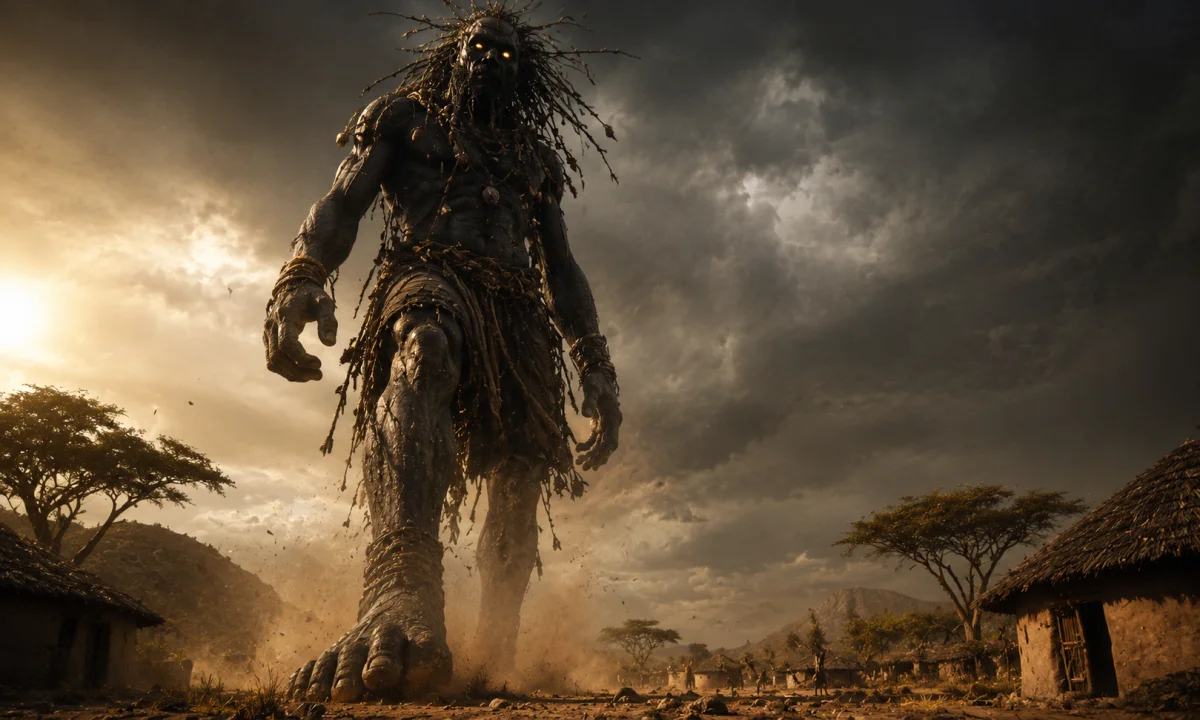
Tore is a name associated in some ethnographic accounts with the sacred forest and a supreme or powerful forest being among certain Mbuti communities of the Ituri Forest in the northeastern Democratic Republic of the Congo. The name does not describe a universally defined African deity. Mbuti peoples have diverse languages, histories and religious practices, and accounts of Tore differ considerably. In some descriptions Tore appears as a creator or high god; in others, the name is closely identified with the forest itself or with a spiritual power present throughout the forest.
Cultural setting
The Mbuti are Indigenous forest peoples of the Ituri region. “Mbuti” is a broad term that includes communities with different languages and local identities, including groups commonly identified as Efe, Sua and others. Older outside writings often used “Bambuti” as a collective name, but such labels can conceal important differences between communities.
The Ituri Forest is not simply a geographical background in Mbuti religious thought. It is a source of food, shelter, medicine, identity and social order. Hunting, gathering, movement through the forest and relationships with neighbouring farming communities all shape religious life. The forest is often understood as a living and responsive presence that gives generously but also demands respect.
Within this setting, Tore is sometimes described as the spiritual power of the forest. The term may be translated as “forest god” or “forest spirit,” although such translations can suggest a more clearly individualised deity than the original traditions necessarily imply. For some Mbuti, the forest itself may be the primary sacred reality, rather than a separate god who merely rules it.
Name and identity
There is no single surviving scripture or authoritative mythology that establishes one definitive identity for Tore. Knowledge of Mbuti religion has been recorded mainly through oral traditions, ritual observation and ethnographic reports. These records were produced by outsiders and do not always preserve local terms or distinctions accurately. They also reflect the beliefs of particular communities and individuals rather than a uniform Mbuti theology.
Because of this, Tore may be presented in different ways:
- as a creator or high god responsible for the existence of the world;
- as the personification or spiritual agency of the forest;
- as a powerful being who governs animals, hunting and the well-being of forest people;
- as a name used in particular stories, songs or ritual contexts rather than as the name of a fully separate deity.
These descriptions should not automatically be treated as contradictory. Oral religious traditions can use one name at several levels: for a cosmic power, a sacred place, a ritual presence or a force encountered in everyday life. The meaning of Tore may therefore depend on who is speaking, which community is being described and whether the discussion concerns ordinary conversation, a myth, a song or a ceremony.
Tore and the sacred forest
The most consistent association of Tore is with the forest. In many Mbuti religious ideas, the forest is regarded as a parent, protector and provider. It supplies meat, honey, fruits, roots and materials, while also offering concealment and a place of belonging. The relationship is reciprocal: people must hunt with restraint, observe customary practices and maintain harmony with the living environment.
When Tore is understood as the forest’s divine presence, the figure is less like a ruler seated in a distant heavenly realm and more like an immanent power. Tore may be encountered through the forest’s abundance, the success or failure of a hunt, the behaviour of animals, illness, dreams and the atmosphere of particular places. The sacred is therefore not separated from ordinary subsistence activities.
This religious outlook differs from the image of nature as an inanimate resource. Animals and plants are not merely objects for human use. They participate in a moral and spiritual order. Hunting can be both practical work and a religious act, requiring appropriate conduct toward the forest and its animals.
Creation and cosmic order
Some accounts identify Tore as a creator who made the forest, animals and human beings. Other accounts describe creation more generally through the power of the forest without presenting a detailed sequence of cosmic events. There is no securely established, standard creation story of Tore comparable to a written cosmogony in a canonical religious text.
Where Tore is treated as a creator, the role usually expresses dependence on the forest and its life rather than a theological system with a large hierarchy of gods. The creator is close to the environment that sustains people. Human beings are not imagined as independent owners of the world; they belong within a network linking humans, animals, ancestors, spirits and the forest.
Reports sometimes describe Tore as concerned with human conduct and with the maintenance of balance. Such descriptions should be read cautiously. Ethnographic language such as “supreme god,” “creator” or “judge” may be an attempt to compare Mbuti beliefs with categories familiar to European or Christian observers. It does not necessarily mean that Mbuti religious life has a single supreme deity in precisely the same sense as Christianity or Islam.
Animals, hunting and power
Tore’s connection with animals follows naturally from the figure’s relationship with the forest. In Mbuti life, the forest is known through its animal inhabitants, their tracks, calls and movements. Hunting success can be interpreted as evidence that the forest is favourably disposed, while repeated failure may call for ritual attention or a reconsideration of human behaviour.
It is sometimes said that Tore is specifically a god of hunting. This is a reasonable shorthand for the deity’s reported connection with the forest economy, but it should not be taken as a universal title accepted by every Mbuti group. The religious significance of hunting is broader than asking a separate hunting god for assistance. It involves relationships with game animals, hunting companions, ancestors, ritual specialists and the forest as a whole.
Some modern summaries assign Tore a fixed animal form, especially that of an elephant. Such claims are not consistent across the available descriptions and should not be presented as a universal attribute. The elephant is an important and powerful forest animal, and it can carry strong symbolic meaning, but a reported association with elephants does not establish that all Mbuti communities imagine Tore as an elephant or as an anthropomorphic being with a stable physical form.
Ritual life and the molimo
Discussion of Mbuti religion often includes the molimo, a sacred trumpet or ritual instrument used in ceremonies connected with the forest. The molimo is especially associated in ethnographic descriptions with collective rites held when the community faces serious trouble, such as death, illness, danger or a period of misfortune. During these ceremonies, songs and performances express a desire to restore harmony between the people and the forest.
The molimo should not simply be identified with Tore. It is a ritual object and a ceremonial institution, not necessarily the name of the forest deity. Some descriptions connect molimo ceremonies with the forest’s voice or presence, which can make the relationship with Tore appear direct. However, the two terms represent different aspects of religious life and should not be merged without qualification.
In ritual settings, the forest may be addressed as a living power, praised through song and treated as a source of healing and renewal. This helps explain why Tore is difficult to classify using categories such as “god,” “spirit” or “nature deity.” Those terms are useful approximations, but each leaves out part of the relationship between Mbuti people and their environment.
Stories and variations
Unlike mythologies preserved in extensive written collections, Mbuti traditions have been transmitted primarily through performance and oral teaching. Stories can change according to the occasion, the narrator and the community. A narrative told to explain death, hunting, social behaviour or the origin of an animal may not form part of a single, consistent cycle about Tore.
For that reason, a supposed “myth of Tore” should be treated carefully. Short summaries found in encyclopedias or popular mythology collections may combine details from separate ethnographic reports, convert symbolic statements into literal events or treat one local account as representative of all Mbuti peoples. There is no reliable basis for assigning Tore a fixed family tree, a standard spouse, a complete genealogy or a universal set of enemies and companions.
Several themes recur in descriptions of Mbuti religious storytelling:
- the forest as a generous but powerful source of life;
- the dependence of human beings on animals and plants;
- the consequences of disrespect, greed or social disorder;
- the importance of singing, dancing and communal ritual;
- the restoration of balance after death, illness or misfortune.
These themes provide a better understanding of Tore than an artificially precise list of adventures. The figure’s significance lies less in a fixed biography than in the way the name expresses the sacred character of the forest and the obligations arising from that relationship.
Religious meaning and interpretation
Tore can be interpreted as a symbol of interdependence. The forest gives people food and protection, but people must live within its limits. This is not merely an ecological principle in a modern conservationist sense. It is a religious relationship involving gratitude, fear, respect, ritual and belonging.
The figure also illustrates the difficulty of separating “religion” from “daily life” in many Indigenous traditions. Hunting, gathering, preparing food and moving through the forest may all have spiritual dimensions. Sacred power is not confined to a temple or a specialised class of priests. Community songs, seasonal activities and responses to crisis can all express religious knowledge.
Some older interpretations portrayed Mbuti religion as simple or incomplete because it lacked temples, written scriptures or an elaborate pantheon. That judgement reflects an overly narrow definition of religion. Mbuti traditions possess complex concepts of personhood, social responsibility, the living environment and ritual renewal, even though these ideas are not organised in the form of a large written mythology.
It is also important not to romanticise Tore as evidence of an unchanging “nature religion.” Mbuti communities have experienced displacement, exploitation, political violence, economic pressure and changing relationships with neighbouring populations. Religious ideas exist within these historical realities. The forest is sacred, but access to it and the ability to live there have been affected by colonial and postcolonial policies, commercial interests and conservation practices.
Distinguishing Tore from similar names
Tore should not be confused with Thor, the Norse god of thunder. The similar spelling in some Latin-alphabet forms is coincidental, and there is no historical connection between the two traditions. Tore is also not a pan-African deity shared by all peoples of Africa. “African mythology” covers thousands of distinct cultural and linguistic traditions, and a figure associated with Mbuti communities should not be attributed automatically to Yoruba, Akan, Kongo, Maasai or other religious systems.
Nor should Tore be merged with creator figures from neighbouring Central African traditions. Bantu-speaking farming peoples in the region have their own names and concepts for creator gods and spirits, and exchanges between communities do not erase these differences. A similar role—such as control of rain, animals or creation—does not prove that two named beings are the same.
Later representation
Tore has had little presence in major global popular culture. The name appears mainly in reference works, mythology websites and discussions of African traditional religions. These treatments often reduce the figure to the phrase “forest god,” which is convenient but can conceal the uncertainty and diversity of the underlying traditions.
Modern retellings sometimes give Tore a standard appearance, a detailed family, elemental powers or a place in a worldwide pantheon of gods. Such additions belong to modern invention or comparative fantasy, not to securely documented Mbuti tradition. A responsible portrayal keeps the cultural setting visible: Tore is associated with the Ituri Forest and with particular Mbuti religious understandings, while the exact identity of the being varies among sources and communities.