WORLD
WORLD
Tewi’xilak
Tewi’xilak is a name associated with the traditional narratives of the Kwakwaka’wakw, an Indigenous peoples of the central and northern coast of British Columbia. In English-language summaries, Tewi’xilak is usually described as a frightening cannibalistic or ogre-like being. The available information is limited, however, and the name does not have the same level of documentation or widespread recognition as figures such as Dzunukwa, Sisiutl or Baxbaxwalanukwsiwe’. Spellings, descriptions and classifications may therefore vary.
Cultural setting
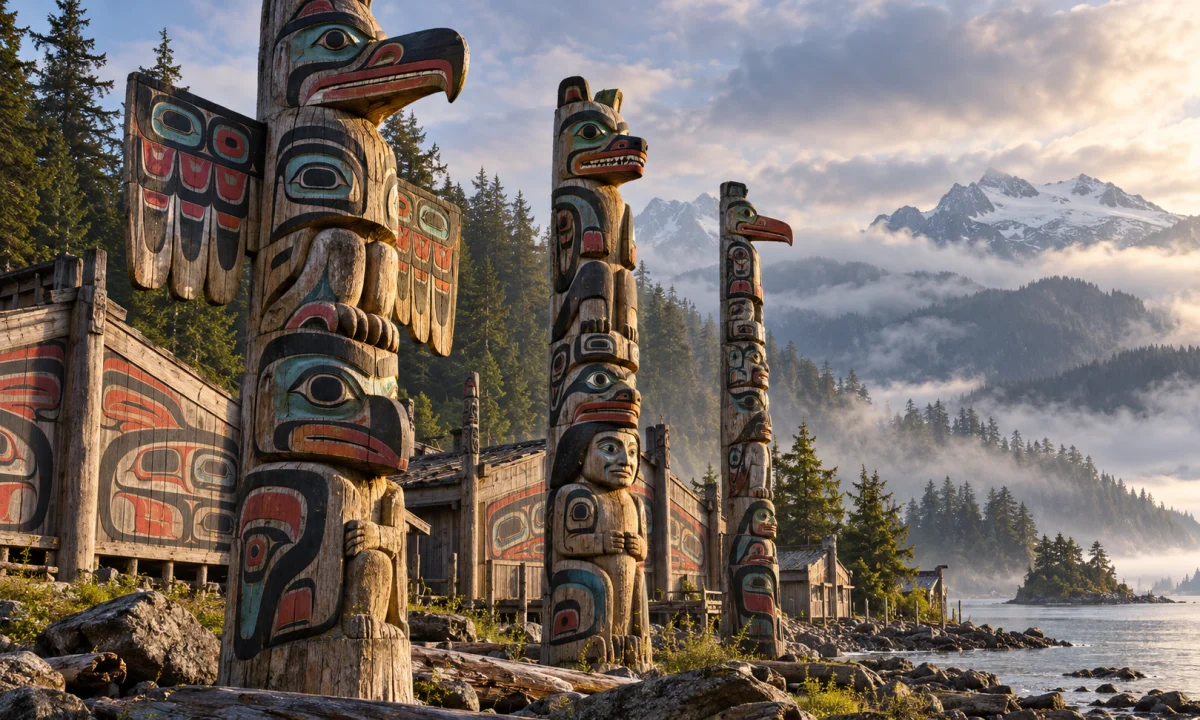
The Kwakwaka’wakw are not a single undifferentiated historical community but a group of related nations whose territories include parts of northern Vancouver Island, the adjoining mainland coast and nearby islands. Their languages, families, villages and ceremonial traditions have their own histories and distinctions. The name Tewi’xilak should be understood within this specific Northwest Coast cultural setting rather than treated as a representative figure of “Native American mythology” in general.
Kwakwaka’wakw traditional knowledge has been transmitted through oral histories, family-owned narratives, songs, names, dances and winter ceremonial performances. Some stories concern events in the distant mythic past, when powerful beings shaped the world or established relationships between humans and supernatural forces. Others are connected with particular families, villages or hereditary rights. A being’s meaning can therefore depend on who is telling the narrative, the ceremonial setting and the rights of the people presenting it.
Much of the material available to outsiders was recorded by missionaries, ethnographers, collectors and museum workers. These records are valuable but incomplete. They often use older spellings, English approximations or names detached from the performances and relationships in which they originally had meaning. A short entry in a modern mythology dictionary may consequently preserve only a fragment of a much larger oral or ceremonial tradition.
Name and identity
The form Tewi’xilak is not the only spelling that may appear. Older publications and popular reference works can omit the apostrophe, alter the vowels or use different systems for representing sounds in Kwakw’ala and related languages. An apostrophe in an Indigenous-language spelling may represent a glottal stop, but the presence or absence of punctuation in English sources is not enough to establish an exact pronunciation or a definitive linguistic analysis.
Descriptions of Tewi’xilak commonly place the being among dangerous supernatural or monstrous figures. It is often labelled a cannibal, man-eater or ogre in English. These words should be treated as approximate translations rather than exact equivalents of a single traditional category. “Monster” in a modern fantasy sense can suggest a creature designed merely to frighten, whereas Northwest Coast narratives frequently connect dangerous beings with social order, ceremonial authority, transformation and the boundary between human and non-human worlds.
There is no universally established canonical description of Tewi’xilak. Accounts that identify the being may not agree about its body, dwelling place, powers or relationship to other supernatural figures. It is safer to describe Tewi’xilak as a figure reported in some Kwakwaka’wakw-related material than to present every detail found in a later summary as part of a single, consistent mythology.
Appearance and character
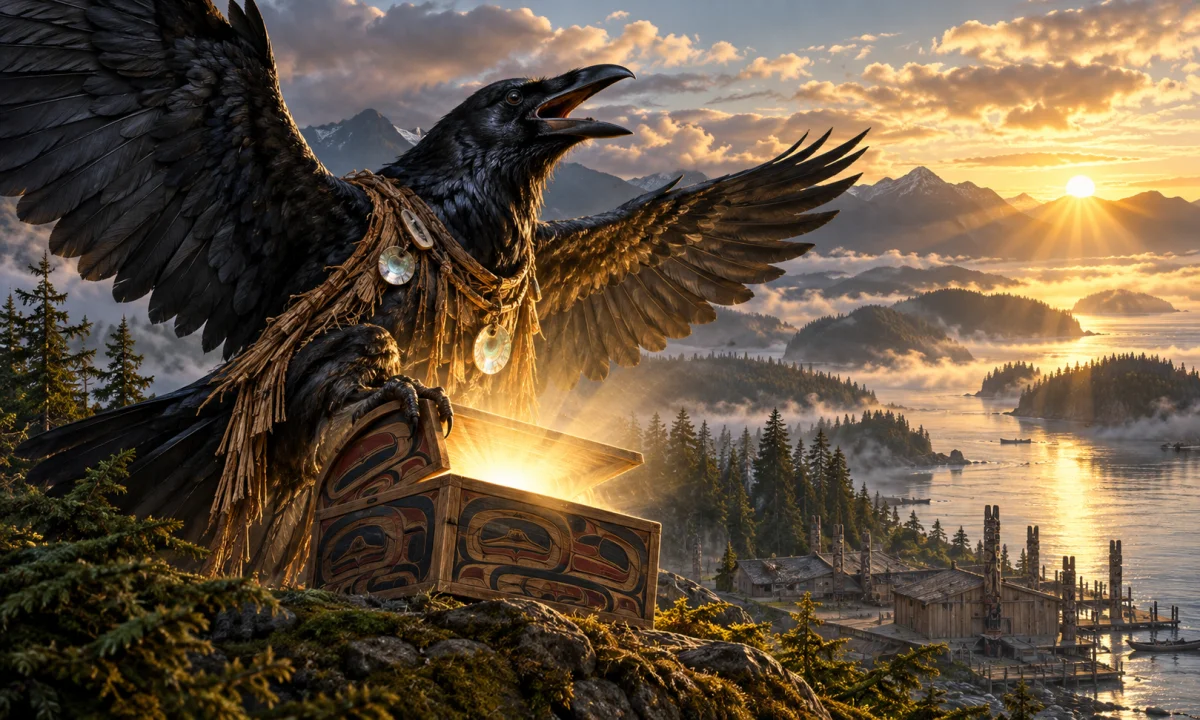
In general descriptions, Tewi’xilak is presented as a predatory being associated with the threat of human consumption. The emphasis is usually on its danger rather than on a stable visual portrait. Some modern retellings give the figure the appearance of a giant or humanoid monster, but such illustrations should not automatically be treated as traditional representations.
There is no securely documented universal image of Tewi’xilak comparable to the recognisable masks and forms associated with some better-recorded Northwest Coast beings. Details such as a particular number of limbs, extra mouths, horns, wings or animal features are especially likely to come from a modern artist, a generalized mythology website or a conflation with another figure. Without a clearly identified traditional source, these features should remain uncertain.
The being’s reported cannibalistic nature is more significant than any supposed anatomy. Cannibal figures in Northwest Coast ceremonial and narrative contexts can express a radical form of danger: the inversion of the social world in which people feed one another, honour obligations and maintain relationships. A human-eating being is not merely hungry. It represents the collapse of the boundary between community and predation, civilization and wilderness, or human identity and uncontrolled supernatural appetite.
Connection with cannibal traditions
Kwakwaka’wakw ceremonial life includes the famous Hamat̓sa, often rendered in English as the Cannibal Dance or Cannibal Society. Its central supernatural figure is Baxbaxwalanukwsiwe’, a powerful man-eating being associated with the far north and with a house filled with cannibal spirits. The Hamat̓sa is a complex initiation and winter ceremonial tradition involving songs, dances, masks, dramatic appearances and the controlled transformation of an initiate.
The existence of this wider cannibal tradition is important when interpreting references to Tewi’xilak. A name translated simply as “cannibal” may be placed by outsiders into the same category as Baxbaxwalanukwsiwe’, even when the traditional figures are not identical. The Hamat̓sa tradition has its own ceremonial history and does not provide evidence that every cannibalistic being mentioned in a reference work is one of its characters.
Tewi’xilak should therefore not be casually identified with Baxbaxwalanukwsiwe’, with the Hamat̓sa initiate or with one of the named attendants of the cannibal spirit. Similar English descriptions do not prove that two Indigenous names refer to the same being. They may reflect related themes, translation choices or the tendency of outsiders to group unfamiliar figures under broad labels such as “cannibal monster.”
Stories and narrative evidence
No single, widely available story of Tewi’xilak can be treated as the definitive account. The surviving references are better understood as scattered documentation than as a complete cycle of myths. This absence may result from several factors: the restricted nature of some ceremonial knowledge, the selective practices of early collectors, differences between communities and languages, and the fact that oral narratives cannot always be separated from the performances, permissions and relationships that give them meaning.
Where Tewi’xilak appears in a summary, the figure is generally connected with the danger posed by a supernatural predator or cannibal. Such a role places the being within a broad pattern found in Northwest Coast storytelling, where a person or community may encounter a powerful being, suffer from its threat and restore balance through courage, transformation, knowledge or ceremonial action. The details of any particular narrative should not be reconstructed simply from this general pattern.
It is also important not to assume that every Indigenous story functions as a simple moral tale. A dangerous being may embody a real spiritual power, a hereditary history, a ceremonial relationship or an origin event rather than standing for one abstract lesson. Interpretations involving “good versus evil” can be too narrow, especially when applied to traditions in which beings are powerful, ambivalent and connected to specific families or ritual responsibilities.
Religious and symbolic significance
Within a Northwest Coast worldview, the distinction between human beings, animals and supernatural persons is not necessarily the rigid division familiar from modern fantasy. Beings may appear in different forms, enter into relationships with humans or belong to an ancestral time in which the present order was established. A predatory figure such as Tewi’xilak can therefore be approached as part of a larger network of transformations and powers rather than as an isolated fictional villain.
The cannibal motif may also be read in relation to the importance of social nourishment and reciprocity. Communities depend on systems of sharing, hospitality, kinship and ceremonial exchange. The cannibal reverses those relationships by taking people as food. This makes the figure a particularly forceful image of antisocial appetite, but it does not reduce the tradition to a universal symbol detached from Kwakwaka’wakw cultural institutions.
At the same time, interpretation must remain modest. There is a difference between what is directly preserved in a traditional account and what a modern scholar or reader infers from comparative themes. It is reasonable to discuss the imagery of predation and social disorder, but it is not justified to claim a single hidden meaning for Tewi’xilak without evidence from the relevant community and tradition.
Distinguishing Tewi’xilak from related figures
- Baxbaxwalanukwsiwe’: The principal man-eating supernatural being associated with the Kwakwaka’wakw Hamat̓sa tradition. Tewi’xilak should not be treated as another spelling of this name without specific evidence.
- Hamat̓sa spirits and performers: The Hamat̓sa ceremonial complex includes several named beings, masks and roles. A general reference to cannibalism does not establish that Tewi’xilak belongs to one of these particular roles.
- Dzunukwa: Also known in older English writing as Tsonoqua, this powerful forest being is often described as a wild woman or giantess. Although Dzunukwa can be frightening and is sometimes involved in stories about children, she is not simply another name for a cannibal monster.
- Sisiutl: The double-headed serpent is a major supernatural figure in Northwest Coast traditions, with associations that differ from those of a human-eating ogre. Similar modern images of monstrous beings should not lead to an identification.
- Wendigo: The Wendigo belongs to Algonquian-speaking traditions of the eastern woodlands and subarctic regions, not to Kwakwaka’wakw tradition. Its association with cannibalism does not make it a North American equivalent of Tewi’xilak.
Sources, spelling and interpretation
The uncertainty surrounding Tewi’xilak is part of the subject’s history, not a reason to fill the gaps with invented detail. Names recorded outside their original languages may have been heard incorrectly, translated loosely or copied from one reference work to another. A short modern description may also detach a being from the ceremonial context in which its name was meaningful.
For that reason, claims about a fixed appearance, a specific lair, a precise family relationship or a complete set of supernatural powers require caution. When two accounts disagree, the disagreement may reflect genuine variation, different communities, different genres of tradition or the limitations of the record. It should not automatically be “solved” by combining the details into one composite character.
Modern representation
Tewi’xilak has little established presence in mainstream film, television or popular fiction. The name is more likely to appear in online lists of mythological creatures, generalized encyclopedias of monsters or modern fantasy discussions. In these settings, the being may be reduced to a generic cannibal giant and illustrated with features borrowed from unrelated Indigenous traditions.
Such adaptations are modern interpretations rather than evidence for the traditional figure. A respectful representation should preserve the uncertainty surrounding the name, identify its Kwakwaka’wakw context and avoid presenting a pan-Indigenous “monster” assembled from unrelated cultures. It should also distinguish the limited record concerning Tewi’xilak from the much more specifically documented ceremonial traditions associated with Baxbaxwalanukwsiwe’ and the Hamat̓sa.