WORLD

Tatzelwurm
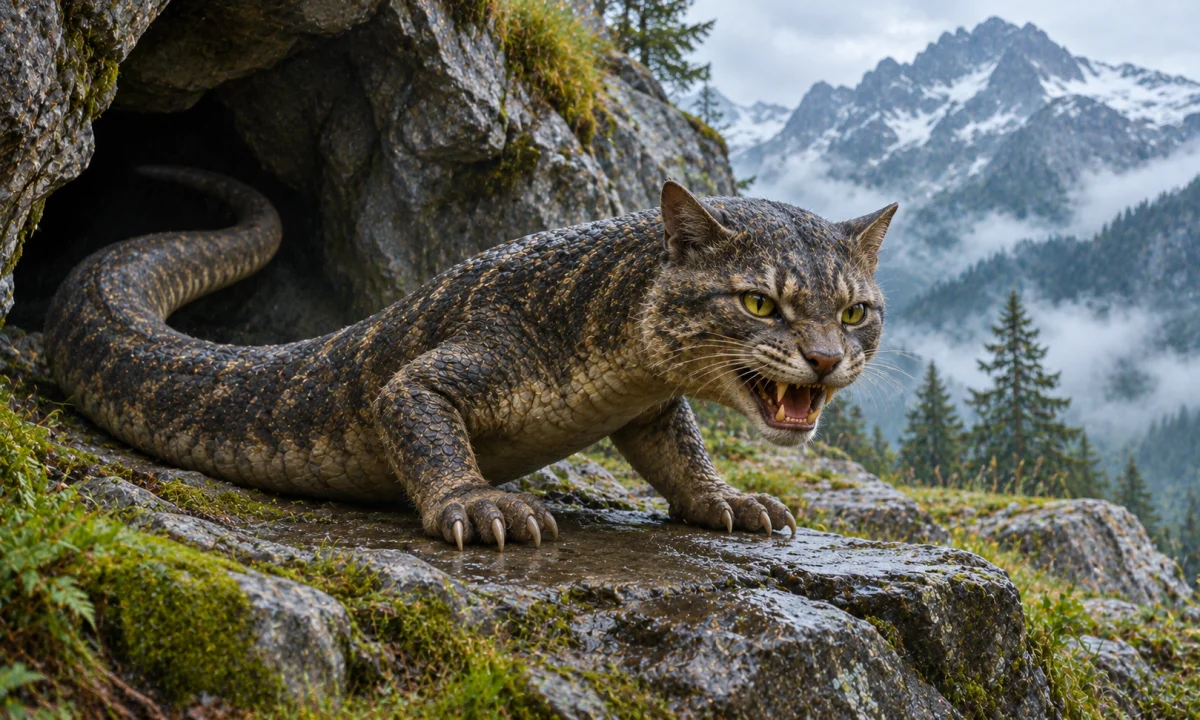
The Tatzelwurm is a legendary creature associated with the German-speaking Alps, especially regions of Switzerland, Austria, Bavaria and, in some accounts, northern Italy. Its name is usually understood as a combination of German Tatze, meaning “paw” or “claw,” and Wurm, meaning “worm” or “serpent.” The name therefore suggests a “clawed worm” or “pawed serpent.”
Unlike a god, demon or figure from a single sacred mythology, the Tatzelwurm belongs chiefly to Alpine folklore and tradition. Reports describe it as a small, dangerous animal with a long, serpentine or lizard-like body and one or more pairs of short legs. Its appearance varies considerably from place to place, and many details became more standardized through later folklore collections, natural-history speculation and cryptozoological writing.
Origins and cultural setting
The Alpine world provided a natural setting for stories about hidden creatures. Steep valleys, forests, caves, scree slopes and remote summer pastures could be difficult to explore, while sudden changes in weather and unfamiliar animal tracks encouraged speculation. In rural communities, tales of dangerous creatures could explain frightening encounters, missing livestock or unusual sounds coming from rocks and mountain hollows.
Accounts of the Tatzelwurm are most closely connected with oral traditions from the Alps rather than with an ancient written mythology. There is no single authoritative text that defines the creature, and no universally accepted original story. Descriptions were recorded unevenly by travellers, folklorists and local writers, often long after the traditions had been circulating orally.
German-speaking Alpine folklore contains many reports of unusual animals that were said to live in caves, beneath rocks or in isolated valleys. Some were presented as ordinary but rarely seen creatures; others acquired clearly marvellous traits. The Tatzelwurm occupies an uncertain position between these categories. In some accounts it is a supernatural monster, while in others it is treated as a supposedly undiscovered species.
Older Alpine traditions also contain stories about dragons, giant serpents, basilisk-like animals and cave-dwelling beasts. These should not automatically be treated as Tatzelwurm stories. Similar descriptions may arise independently from the same landscape, and later writers sometimes grouped different local reports under the more familiar name.
Name and regional forms
The spelling Tatzelwurm is the most widely recognized form, but historical and regional variations occur. Names such as Stollenwurm, Stollwurm and Bergstutz have been associated with similar Alpine creatures in different sources. These names do not necessarily refer to one identical being. A Stollenwurm, for example, may be connected specifically with mine workings, tunnels or mountain passages, while another local term may describe a creature with a different shape.
Words connected with claws or paws reflect one of the creature’s most distinctive reported features. The Tatzelwurm is not generally imagined as a fully legless serpent. Instead, it is often said to have a long body ending in a tapering tail, with short legs near the front. Some descriptions give it four legs, and others make it more like a lizard or salamander. The uncertainty is part of the tradition rather than a problem that can be resolved by selecting one official form.
Appearance
Descriptions vary, but several features recur in popular accounts:
- a short, thick or elongated body resembling a serpent, lizard or salamander;
- very short legs, often two in number and sometimes four;
- a broad, cat-like or reptilian head;
- a wide mouth containing sharp teeth;
- large, staring eyes;
- a body covered with scales, smooth skin or short hair, depending on the report; and
- a length usually described as modest rather than gigantic.
Its size is not consistent. Some witnesses reportedly described a creature small enough to fit beneath a rock or in a crevice, while other accounts make it several feet long. It is often portrayed as thicker and more compact than an ordinary snake. The resemblance to a cat appears particularly often in modern descriptions, which sometimes call it cat-faced or give it a feline head and an amphibious body.
Colour also varies. Grey, brown, green and dark or mottled colouring are all found in descriptions. Such colours would make a low-moving animal difficult to see among rocks, vegetation and shadow, although the camouflage may be an interpretation added by later writers rather than a stable feature of older tradition.
Behaviour and dangerous qualities
The Tatzelwurm is generally described as secretive and aggressive. It is said to hide in caves, under rocks, in abandoned mine workings or among mountain vegetation. A person who approaches its hiding place may be threatened, chased or attacked. Some stories portray it as capable of leaping suddenly, which helps explain why a short-legged creature could still be feared as a dangerous predator.
Claims about its powers differ sharply. In some versions, the creature has a poisonous bite. Other accounts say that it can kill with foul breath, a venomous exhalation or an unpleasant odour. These details are not present in every tradition and should not be treated as universal characteristics. They may reflect the wider European habit of attributing poison or deadly breath to dragons, basilisks and other monstrous animals.
Reports sometimes associate the Tatzelwurm with attacks on livestock, especially animals grazing in remote mountain areas. Yet it is not consistently portrayed as a supernatural enemy of humans or as a deliberate scourge sent by a deity. The creature’s role is usually local and immediate: it is an animal-like danger encountered in an isolated place.
Stories and reported encounters
There is no single canonical Tatzelwurm legend comparable to a well-known heroic cycle. Instead, the tradition consists of scattered anecdotes, local names and claimed sightings. A shepherd, hunter, farmer or traveller may encounter an unfamiliar creature near a rock shelter, cave or mountain path. The witness sees only part of its body before it disappears, leaving the description open to doubt and embellishment.
In some narratives, a person discovers a Tatzelwurm while looking into a crevice or entering a cave. The creature may rear up, hiss, open its mouth or rush forward. The witness then retreats, sometimes claiming to have been physically attacked. Other accounts are less dramatic and describe only an animal moving quickly through grass or across a rocky slope.
The lack of a shared plot is significant. The Tatzelwurm does not have a fixed family, origin story, ruler, magical object or relationship with a named hero. It is better understood as a folkloric creature type than as one individual monster with a continuous biography. Different communities could attach the name to different beings or unexplained encounters.
Some stories have been connected with dragons or serpents already present in Alpine legend. This association does not mean that the Tatzelwurm is simply an Alpine dragon. Dragons are often imagined as large, ancient and symbolically powerful, while the Tatzelwurm is usually smaller, more secretive and more animal-like. The overlap reflects the fluid way in which folklore develops rather than a precise equivalence.
Tradition and alleged natural history
From the nineteenth century onward, European interest in folklore increasingly overlapped with the study of natural history. Collectors recorded local beliefs, while some writers wondered whether reports of the Tatzelwurm might preserve sightings of an unknown reptile, amphibian or mammal. Later enthusiasts proposed a range of explanations, including an unusually large lizard, a surviving prehistoric animal or a misidentified wild creature.
There is no accepted zoological evidence that the Tatzelwurm exists as a distinct species. The reported descriptions are too inconsistent, and the available evidence consists mainly of oral accounts, anecdotal testimony, ambiguous tracks and disputed images. No specimen has been scientifically documented, and no reliable population has been identified.
Ordinary animals may have contributed to some reports. Large lizards, snakes, martens and other quick-moving Alpine animals can be difficult to identify at a distance, particularly in poor weather or low light. A startled animal may also appear larger or more unusual than it is. Fossils, bones and unfamiliar animal remains could have encouraged stories about hidden mountain creatures, although particular explanations cannot be proved for individual tales.
Folklore and zoology ask different questions. A zoologist requires repeatable physical evidence before recognizing a species, whereas a folklorist may study how a creature is described, remembered and used within a community. The lack of zoological proof does not make the Tatzelwurm unimportant as folklore; it simply means that the legendary creature should not be presented as a confirmed animal.
Symbolism and cultural significance
The Tatzelwurm reflects the cultural experience of the Alps as both a lived environment and a landscape of danger. Mountain communities depended on forests, slopes and high pastures, but those same places could conceal falling rocks, predators, unstable ground and sudden storms. A hidden creature gave narrative form to the risks of travelling beyond familiar settlements.
Its unusual body also expresses a fear of categories being mixed. The Tatzelwurm combines the long body of a snake with the limbs of a lizard and, in some accounts, the face of a cat. It is neither a conventional reptile nor an ordinary mammal. Such hybrid forms are common in monster traditions because they make the creature seem both recognizable and unnatural.
The creature’s underground or rocky habitat adds another layer of meaning. Caves and fissures are places where the visible landscape gives way to darkness. In folklore, they frequently serve as entrances to hidden worlds, dwellings of monsters or locations where ordinary rules appear suspended. A Tatzelwurm emerging from a crevice therefore carries more imaginative force than an unusual animal seen in an open field.
At the same time, the Tatzelwurm is not consistently a moral symbol. It is not universally associated with sin, evil, punishment or a particular religious teaching. Christian interpretations of Alpine monsters sometimes connected dangerous creatures with the Devil or with demonic forces, but such readings are not a defining feature of the Tatzelwurm tradition. In most accounts, its significance remains local, environmental and experiential.
Distinction from similar creatures
The Tatzelwurm is often confused with other legendary reptiles and dragons, but the distinctions matter:
- Alpine dragons: These are broader categories of mountain serpent or dragon lore and may be much larger, winged or associated with heroic and religious legends. They are not automatically Tatzelwurms.
- Basilisks: Basilisks traditionally possess deadly powers, sometimes through their gaze or breath, and have a different European history. A Tatzelwurm may be given poisonous qualities, but it is not simply a basilisk.
- European lindworms: Lindworms are usually long, dragon-like serpents, often with two legs or no legs. Their traditions extend well beyond the Alps and are not identical to local Tatzelwurm reports.
- Sea serpents: Sea serpents belong to maritime folklore and alleged sightings in oceans or lakes. The Tatzelwurm is primarily a creature of mountain terrain.
- Fossil or prehistoric animals: Modern attempts to interpret the Tatzelwurm as a surviving reptile are speculative and belong to cryptozoology, not established folklore or zoology.
Terms such as Stollenwurm can also cause confusion. In some contexts they are treated as alternative names for the Tatzelwurm, while in others they designate a related but distinct local creature. The safest approach is to examine the description and region in each source rather than assume that every “worm” of Alpine legend is the same being.
Later reception and popular culture
During the nineteenth and twentieth centuries, the Tatzelwurm became increasingly visible outside the Alpine communities where related traditions had circulated. Folklore books, travel writing, newspapers and collections of monster stories helped turn a group of local reports into a recognizable legendary creature. Illustrations often regularized its appearance by giving it a cat’s head, a long reptilian body and two clawed forelegs.
Cryptozoological writers later presented the Tatzelwurm as a possible undiscovered animal. Alleged photographs and encounter reports have been discussed as evidence, but such materials have not established the creature’s existence. Their importance lies more in the history of modern monster belief than in the scientific discovery of an Alpine species.
In contemporary fantasy, games, illustrated bestiaries and monster fiction, the Tatzelwurm may be redesigned as a dragon, dungeon creature or combatant. These versions can give it wings, magical powers, armour or a much larger size. Such adaptations draw on the traditional name and general silhouette, but they are modern inventions rather than fixed elements of Alpine folklore.
The traditional Tatzelwurm remains most accurately understood as a variable Alpine legend: a secretive, clawed, serpent-like creature reported in regional stories and later folklore collections, with no single agreed appearance and no confirmed existence as a zoological species.