WORLD
WORLD
Basilisk
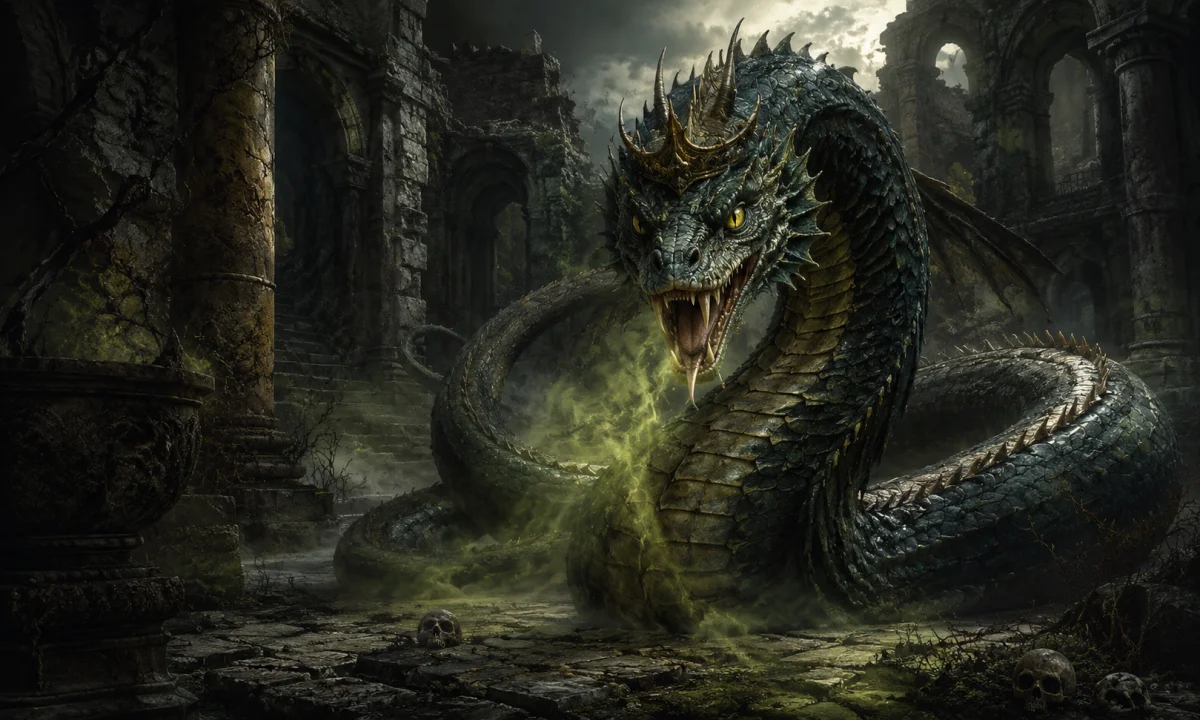
The basilisk is one of the best-known monster figures of European tradition: a serpent or serpent-like creature feared for its deadly gaze, venom, and breath. Its earliest literary appearances belong to the ancient Mediterranean world, especially Greek and Roman natural history and lore, where it was described not as a fantasy beast in the modern sense, but as a dangerous creature placed within the wider attempt to classify animals, poisons, and marvels. Over time, the basilisk became a strongly Christianised symbol of death, corruption, and the perils of pride, while also remaining a creature of folklore, bestiary tradition, and heraldic imagination.
Origins and cultural setting
The basilisk is first attested in ancient Greek sources under forms of the name basiliskos, meaning “little king” or “small king.” The word is usually connected with the later Latin basiliscus. Ancient writers such as Pliny the Elder described it as a serpentine creature of extraordinary power, but the details vary from source to source, and later medieval authors often expanded or altered the older accounts. In antiquity and the Middle Ages, such descriptions belonged to a literary world where real animals, legendary creatures, marvels from distant lands, and moral symbolism could overlap without sharp boundaries.
The basilisk’s enduring importance comes from that mixture of natural history and imagination. It was not simply a monster in a tale; it was treated by many writers as a real, if rare, creature whose existence explained certain deaths, poisonous wounds, and dangerous places. At the same time, it served as a literary emblem for evil and fatality. Medieval encyclopedias and bestiaries helped spread its fame throughout Latin Christendom, where it was increasingly associated with Christian moral interpretation.
Name and identity
The name basilisk is commonly translated as “little king,” and that has shaped its image for centuries. Some traditions explain the title by imagining a small crown or crest on the head of the creature, while other explanations connect it with the basilisk’s supposed supremacy over other serpents. The exact origin of the name is not certain, but the royal element was readily understood by ancient and medieval readers.
Identity is one of the most complicated aspects of the basilisk tradition. In ancient and medieval texts, the basilisk may appear as:
- a small but deadly serpent;
- a snake with a crown-like mark;
- a creature able to kill by sight, breath, or even touch;
- in some later medieval and early modern sources, a more composite beast, sometimes with bird-like features.
These forms are not always consistent. Different texts do not describe one fixed species, and the basilisk should not be confused with later fantasy reinterpretations that present it as a giant reptilian dragon. Traditional sources are more varied and often much smaller in scale, though no less terrifying in effect.
Ancient descriptions
In classical literature the basilisk is usually presented as a serpent of unusual lethality. Pliny the Elder’s Natural History is among the most influential sources. He describes a very small snake, marked in some accounts by a white spot or crown-like sign, whose breath and gaze were fatal and whose venom could damage plants and crack stones. The details are exaggerated in ways typical of ancient natural lore, but the basilisk is still framed as an animal within a natural world populated by extraordinary creatures.
Later Greek and Latin writers repeated and embellished these claims. The basilisk’s ability to kill at a distance became its defining feature. In some traditions it poisoned the ground around it, withered vegetation, and frightened other animals into flight. These traits helped separate it from ordinary snakes and gave it a reputation as a creature whose very presence was destructive.
Ancient accounts are not uniform about its habitat. Some place it in desert regions or North Africa, a common setting for dangerous and exotic animals in classical writing. This geographical uncertainty reflects the broader tendency of ancient authors to associate marvels and threats with distant lands, where direct knowledge was limited and reports could easily blend observation with hearsay.
Medieval bestiaries and Christian interpretation
In the Middle Ages, the basilisk became a favourite example in bestiary literature. Bestiaries did not aim for zoological accuracy in the modern sense; they presented animals as morally meaningful creations, using real and imaginary creatures alike to teach spiritual lessons. The basilisk was therefore interpreted not only as a deadly animal but also as a symbol of sin, corruption, and hidden danger.
Medieval writers often expanded its powers. Besides the lethal gaze, the basilisk might kill by breath, scorch with its presence, or leave a trail of death behind it. Its venom became a model of spiritual contamination. Christian interpreters could also moralise the basilisk as an image of the Devil, heresy, or pride: something small in appearance but devastating in effect.
In some texts, the basilisk is linked with the weasel as its natural enemy, an idea that appears in several medieval traditions. The weasel was sometimes said to defeat the basilisk through special herbs, medicinal resistance, or divine providence. This conflict was popular in bestiary moralisation, where smallness and humility triumphed over monstrous power. Such stories are not consistent across all sources, but they were influential in shaping the basilisk’s later fame.
Appearance and powers
The basilisk is usually imagined as serpent-like, but its appearance varies significantly by period and source. In early accounts, it is small. In later medieval and Renaissance art, it can become a more elaborate hybrid creature. Commonly attributed features include:
- a snake-like body;
- a crown, crest, or white mark on the head;
- deadly eyes capable of killing at a glance;
- poisonous breath or vapour;
- venom so strong that it could supposedly damage the earth or stones;
- in some traditions, the ability to die only by seeing its own reflection.
The reflective-death motif is especially important in later folklore and literary imagination. The basilisk could be killed by a mirror, allowing the danger of its own gaze to return upon itself. This motif is not equally prominent in all early sources, and its exact development is difficult to trace, but it became one of the creature’s most enduring traits in later European storytelling.
Its powers should be understood within the symbolic language of premodern thought. Fatal sight, poisonous breath, and a corrupting presence all point toward a creature whose danger is not merely physical. The basilisk represents harm that cannot easily be contained: invisible, swift, and absolute.
Birth and reproduction in later tradition
One of the best-known medieval and early modern legends about the basilisk concerns its origin. In several traditions, a basilisk is said to arise from an egg laid by an old rooster and incubated by a toad or serpent, or from a similar unnatural conjunction. This story is not part of the earliest ancient descriptions in a consistent form, and its details vary widely. It belongs more securely to later folklore and symbolic elaboration than to the classical basilisk tradition itself.
This birth narrative is striking because it reverses natural categories. Roosters do not lay eggs, toads do not incubate birds’ eggs in ordinary life, and the outcome is a monster born from impossibility. The story gave the basilisk a place in discussions of unnatural generation, corruption, and the violation of the natural order. It also connected the monster to the language of alchemy, occult philosophy, and learned marvel literature in later centuries.
How the basilisk could be defeated
Traditional accounts usually present the basilisk as nearly invincible, but they also preserve a small number of methods by which it might be overcome. These include:
- the use of mirrors to force the basilisk to meet its own gaze;
- the intervention of the weasel, said in some stories to be immune to its poison;
- special herbs or purifying agents;
- the spear or sword of a brave human hero, sometimes only after the monster has been weakened or distracted.
Such remedies should not be read as stable folklore in a single unchanging form. They belong to a family of recurring motifs found across bestiaries, medieval natural lore, and later storytelling. The mirror episode is the most famous because it gives the basilisk a poetic defeat: its own death-dealing power destroys it. The weasel motif is equally important in bestiary symbolism, where the smallest creature may triumph over the most terrible.
Symbolism and interpretation
The basilisk’s symbolism is rich and layered. In ancient natural history, it is a marvel and a danger. In medieval Christianity, it becomes a moral emblem. In both settings, it stands for a kind of concentrated destruction. Its small size in some traditions makes the danger more alarming, because the creature embodies the idea that the least visible threat may be the most lethal.
Its name, “little king,” may also carry symbolic weight. A kingly creature that rules by terror rather than nobility can be read as a distorted sovereignty: power without justice, dominance without legitimacy. Medieval writers could use the basilisk to warn against tyrants, heretics, or seductive sins that appear minor at first but prove fatal in consequence.
The basilisk also occupied a place in natural philosophy as an example of how rumor, fear, and observation interact. Ancient and medieval authors often cited marvels as though they were facts, yet those facts were shaped by inherited authority, travel reports, and interpretive habits. The basilisk survives partly because it sat at the boundary between knowledge and wonder.
Distinction from similar creatures
The basilisk is sometimes confused with other snake-like monsters, especially dragons and wyverns, but the traditions are not the same. A dragon is usually larger, more composite, and more strongly associated with treasure, warfare, and heroic combat. The basilisk, by contrast, is often smaller and deadlier through poison or sight rather than brute force.
It should also be distinguished from the cockatrice, a related but not identical figure in European tradition. In some later English usage, the terms overlap or even become interchangeable, and some texts describe the cockatrice as a kind of basilisk or vice versa. Yet their histories are not perfectly identical. The cockatrice more often appears in medieval and early modern English sources with bird-serpent features, while the basilisk’s older literary identity is more firmly rooted in the ancient serpent tradition. Because the terminology varies by language, period, and author, any strict separation must be made carefully.
Likewise, the basilisk should not be merged with the many local serpent spirits and dragon-like beings of other cultures unless the evidence truly supports comparison. Similar powers or appearances do not mean the figures share a common origin. The basilisk is specifically a creature of Mediterranean antiquity and European literary tradition, even though later fantasy media borrowed freely from it.
Later literary and artistic reception
From the Renaissance onward, the basilisk remained a vivid image in European art, emblem books, scientific writing, and poetry. Artists often emphasized its strange hybrid form, while writers used it as a conventional symbol of deadly beauty or destructive glance. In emblem literature, the basilisk could represent envy, malice, or the danger of prideful vision. It was also useful in sermons and moral teaching because it combined the memorable and the frightening.
Early modern natural historians were more skeptical than medieval bestiary writers, but the basilisk still persisted in learned discussion as a traditional marvel. Even when scholars doubted its literal existence, they often repeated the older accounts as examples of what previous ages had believed. In that sense, the basilisk became both a monster and a historical artifact of belief.
Modern popular culture has greatly expanded the basilisk’s visibility, but often in forms that depart from older tradition. Contemporary fantasy frequently presents it as a giant reptile, a dungeon guardian, or a magical enemy with a deadly stare. These versions draw loosely on older ideas but are usually not faithful to the ancient or medieval creature in all respects. The best-known modern literary adaptation is the giant basilisk of fantasy fiction, which popularised the creature for new audiences but is best understood as a modern reimagining rather than a direct continuation of the classical image.
Why the basilisk endured
The basilisk lasted because it combines several powerful ideas in one figure. It is small yet overwhelming, natural yet impossible, visible yet deadly at a distance. It also bridges several forms of premodern knowledge: zoology, medicine, religion, symbol, and folklore. A creature that can kill by glance is easy to remember and hard to forget, and its imagery lends itself to moral, artistic, and literary use.
At the heart of the tradition lies a simple and potent paradox: a being so slight that it can be overlooked, yet so dangerous that looking at it may mean death. That paradox helped the basilisk move from classical lore into medieval Christian symbolism, and from there into modern fantasy, where it still appears as one of the most recognisable monsters of the European imagination.