WORLD
WORLD
Tikbalang
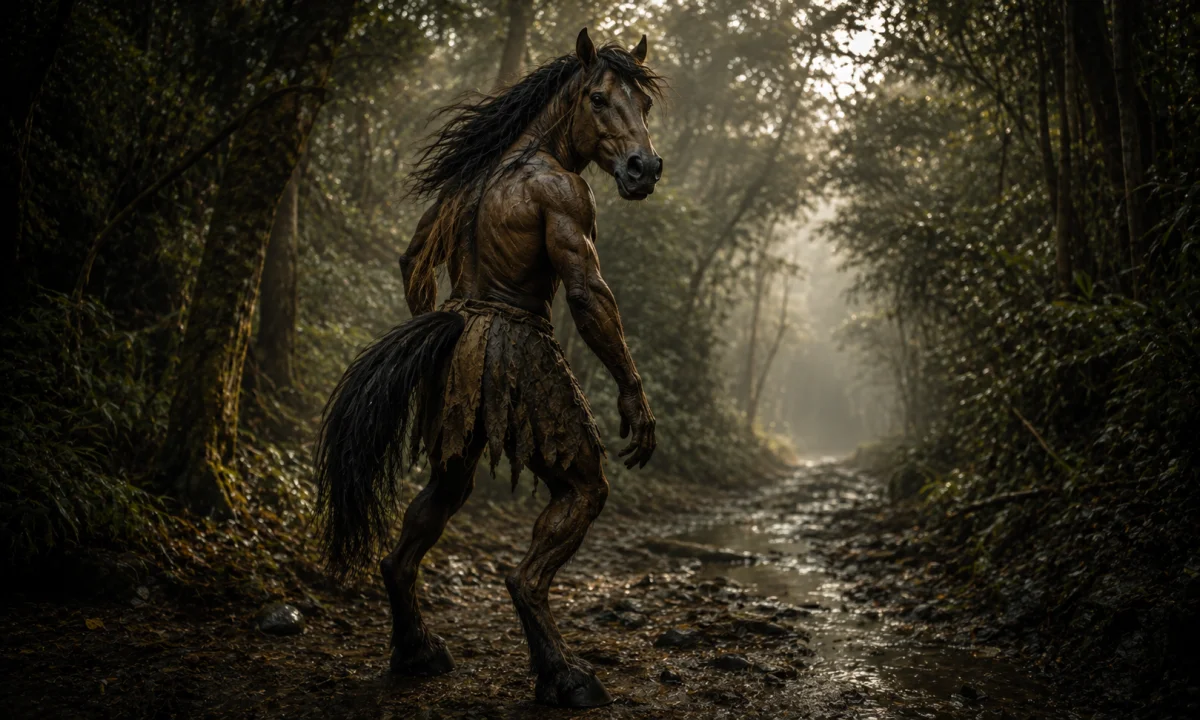
Tikbalang is a legendary being of Filipino folklore, especially associated with forests, mountains, remote paths and other places at the edge of ordinary human settlement. It is commonly described as a tall, thin humanoid with the head and sometimes the legs or hooves of a horse. In stories, a tikbalang may confuse travellers, imitate sounds, lead people in circles or guard a particular wild place. Its character is not fixed: depending on the region and storyteller, it can be a frightening trickster, a territorial spirit, a dangerous monster or a being that can be approached and even befriended.
Origins and cultural setting
The tikbalang belongs to the broad and varied body of Philippine folk belief. The Philippines contains many ethnolinguistic communities, each with its own languages, customs and traditions concerning spirits, ancestors, animals and supernatural beings. For that reason, the tikbalang should not be treated as a figure with one universally authoritative mythology. Descriptions differ between regions, families and periods, and the most familiar modern image combines details from several forms of storytelling.
Many Philippine communities historically understood the landscape as inhabited by unseen beings. Forests, mountains, rivers, caves and large old trees could possess spiritual significance, particularly when they lay beyond the settled areas where people lived and farmed. Such beliefs existed within religious worlds that were often animist or centred on relationships with ancestors, local spirits and powerful natural places. They later interacted with Islam, Christianity and other religious traditions introduced or developed through long processes of trade, migration and colonisation.
There is no single precolonial scripture devoted to the tikbalang, and the figure is not known from one canonical myth. Much of the tradition has been preserved through oral accounts, local storytelling and later written descriptions. Accounts recorded in the colonial and modern periods may reflect the vocabulary and assumptions of the people who collected them as well as those of the communities from which the stories came. This makes it important to distinguish between widespread motifs and claims that belong only to a particular retelling.
Name and classification
Tikbalang is the spelling most often used in English-language discussions, but forms such as tikbalan and tigbalang also appear. Pronunciation and spelling can vary according to language, region and the system used to transcribe Filipino words. These variants should not automatically be treated as the names of separate creatures.
English descriptions frequently call the tikbalang a “horse demon” or a “horse-headed monster.” Those labels are convenient but imperfect. The word “demon” carries strong associations from Christian theology, while the tikbalang belongs to a folk tradition whose categories do not always correspond to the distinction between angel, demon, monster and animal. In one story it may act like a malicious spirit; in another it may resemble a guardian of a forbidden place or a supernatural trickster.
The tikbalang is also sometimes called a nature spirit, forest spirit or elemental being. These terms can help explain its setting, but they are modern comparative descriptions rather than universally agreed traditional classifications. A more cautious description is that it is a powerful and unpredictable supernatural being associated with wild or liminal spaces.
Appearance
The most recognisable form has a horse’s head on a tall, thin human body. It is often pictured with a long face, pointed ears, a mane, a horse-like mouth and prominent teeth. Its body may be unusually angular or skeletal, with arms and legs that seem too long for its frame. Some accounts and illustrations give it horse’s legs or hooves, while others present a predominantly human body with only the head clearly belonging to a horse.
Its height and distorted proportions are important to the creature’s effect. A tikbalang is not simply a person wearing a horse mask. It appears as an unsettling combination of human and animal, familiar enough to be recognised but unnatural enough to inspire fear. Modern visual art often exaggerates its size, claws, teeth and musculature, producing a standard fantasy-monster design that may not represent every local tradition.
Details such as backward-facing feet, reversed knees, a mane covering the body or a voice that sounds like a horse occur in some retellings and popular descriptions, but they are not consistent across all accounts. Similarly, claims that every tikbalang has a particular number of limbs, a fixed colour or a uniform body shape should be treated as later standardisation rather than as universal folklore.
Haunting paths and misleading travellers
The tikbalang’s most persistent role is that of a being that disrupts travel. A person walking through a forest or mountain path may suddenly lose their sense of direction. Familiar landmarks seem to disappear, the route appears to change, or the traveller repeatedly returns to the same place. The victim may hear someone calling from the trees, see a figure at a distance or follow sounds that lead deeper into the wilderness.
These stories are often described as the work of illusion or enchantment. The tikbalang need not physically carry a person away; it can make ordinary surroundings impossible to interpret correctly. This gives the creature a close relationship with uncertainty, isolation and the dangers of travelling beyond the community. A forest that seems familiar in daylight can become threatening when darkness, weather or exhaustion removes the traveller’s confidence.
In some versions, the tikbalang deliberately torments people for amusement. In others, it responds to trespassing, disrespect or careless behaviour. The difference is significant. A creature that attacks everyone it meets is a conventional monster, whereas a being that punishes intrusion suggests a moral relationship between humans and the landscape. The story may warn listeners not to wander into restricted areas, mock local beliefs or assume that the natural world exists solely for human use.
Folk advice for escaping a tikbalang varies considerably. Some modern retellings recommend marking a route, remaining calm or reversing an item of clothing, while others describe asking permission to pass, showing respect or recognising the spirit’s presence. Such practices are not universal rules of Filipino folklore. They belong to particular tellings and should not be presented as a single traditional method known throughout the Philippines.
Trickster, guardian and dangerous spirit
The tikbalang is commonly placed among trickster beings because it confuses perception and disrupts human plans. Tricksters are not necessarily evil. They may be comic, irritating, dangerous or wise, and their actions often expose human arrogance. A traveller who treats the forest casually may be humbled by discovering that ordinary knowledge and physical confidence are not enough.
At the same time, many accounts give the tikbalang a territorial quality. It may occupy a mountain, a grove, a large tree or a secluded route and react when humans enter its domain. This has encouraged interpretations of the tikbalang as a guardian of wild places. The guardian interpretation should not be confused with the claim that every tikbalang protects nature in a benevolent or ecological sense. Traditional stories do not always divide beings into modern categories such as “environmental protector” and “villain.” A territorial spirit can preserve a boundary while remaining frightening and harmful to trespassers.
Some stories describe a tikbalang as capable of entering an agreement with a human being. A person may seek its help, receive protection or obtain an unusual object, sometimes in exchange for service, loyalty or a promise. Other retellings portray the creature as impossible to trust. These contrasting possibilities reflect the broader instability of supernatural beings in folklore: their behaviour depends on place, circumstance and the relationship established with the human character.
Stories and recurring motifs
There is no single epic cycle that defines the tikbalang. Instead, it appears in short encounters, warnings and anecdotes. A traveller might leave home in the afternoon and find that night has fallen without the path becoming any clearer. Children may be told not to enter a particular grove. A person returning from a journey may explain an unexplained delay by saying that a tikbalang confused the route.
One recurring motif is the voice or apparent presence of a familiar person. A traveller may hear a companion calling from somewhere nearby and follow the sound, only to become more lost. This motif connects the tikbalang with a wider international pattern in which wilderness spirits imitate human voices or create false paths. The existence of a similar motif elsewhere does not prove that the traditions share a single origin; it shows that confusion and imitation are powerful ways of representing danger in remote places.
Another motif found in popular Filipino culture is the idea of a tikbalang’s wedding to explain a sunshower, when rain falls while the sun is visible. This saying is not equally recognised in every region, and it should not be treated as a fixed part of every tikbalang narrative. In some communities, sunshowers have other explanations or are associated with different beings and events. The motif demonstrates how a supernatural figure can become part of everyday expressions even when the full story is rarely told.
Stories may also portray the tikbalang as having human relationships, a family or a connection with a particular settlement. These versions soften the boundary between human and nonhuman society, but they do not establish one official genealogy for the creature. Claims that the tikbalang has a universal spouse, parentage or role in a larger divine family are generally products of particular retellings, not features shared across Philippine folklore.
Meaning and cultural significance
The tikbalang gives a supernatural form to the risks of the rural landscape. Before modern roads, maps, mobile communication and widespread electric lighting, getting lost could be a serious threat. Steep terrain, sudden storms, illness, wild animals and nightfall all made travel uncertain. A story about a horse-headed spirit could preserve practical caution while also expressing a deeper belief that the land was not empty or entirely under human control.
Its half-human, half-animal form is especially effective because horses have long been associated with travel, power and movement, while the horse’s size and strength can also appear intimidating. The tikbalang therefore distorts the very animal connected with journeys. A creature that resembles a horse but thinks like a spirit turns the means of travel into a source of uncertainty.
The figure can also be read as liminal: it stands between village and wilderness, human and animal, visible reality and the unseen world. Encounters usually occur at boundaries rather than in ordinary domestic spaces. The tikbalang’s territory is not necessarily evil, but it is governed by rules that human visitors may not understand. Respect, restraint and awareness of local customs become forms of protection.
Scholarly interpretations should remain tentative because oral traditions change and because “the Filipino belief system” is not a single, uniform system. The tikbalang may represent fear of the forest in one context, a guardian of a sacred place in another and a playful supernatural troublemaker in a third. These meanings can coexist without reducing the figure to one symbolic definition.
Distinction from similar beings
The tikbalang is sometimes confused with other Philippine supernatural figures, especially because English-language retellings group many of them under the word “monster.” The kapre, for example, is commonly described as a large, dark, hairy male spirit associated with trees, smoke and tobacco. Although both beings may inhabit wooded places, a kapre is not a tikbalang and does not normally have a horse’s head.
The aswang is a broad and flexible category of frightening supernatural beings in Philippine folklore, often associated with shapeshifting, predation or attacks on people. It is not simply another name for the tikbalang. A story may adapt one figure into the role of another, but their traditional identities should not be merged.
The manananggal, usually depicted in modern descriptions as a woman who separates her upper body and flies at night, is also distinct. The tiyanak, often portrayed as a dangerous childlike or infant spirit, belongs to a different set of stories as well. Similarities in fear, deception or nocturnal danger do not make these beings interchangeable.
Later reception and popular culture
The tikbalang remains one of the best-known figures from Philippine folklore and appears in novels, comics, films, television, visual art, games and online storytelling. Contemporary creators often use its horse-headed form to explore identity, colonial history, wilderness, urban development or the relationship between Filipino tradition and global fantasy. Such works can keep the name visible while giving the creature new powers, personalities and origins.
Modern fantasy frequently presents the tikbalang as a supernatural warrior, a romantic character or a member of a fixed catalogue of Filipino monsters. These portrayals may be imaginative and culturally meaningful, but they are adaptations rather than proof that the same attributes were present in every older story. Digital art and popular reference lists have also encouraged a single standard appearance, even though traditional descriptions vary.
In its folklore setting, the tikbalang is best understood not merely as a horse-headed monster but as a figure of uncertain boundaries. It belongs to stories about travel, wilderness, respect and the possibility that familiar surroundings conceal an agency beyond human control. Its continuing presence reflects both the durability of local supernatural traditions and the ability of Filipino storytellers to reinterpret them for new places and audiences.