WORLD
WORLD
Thunderbird
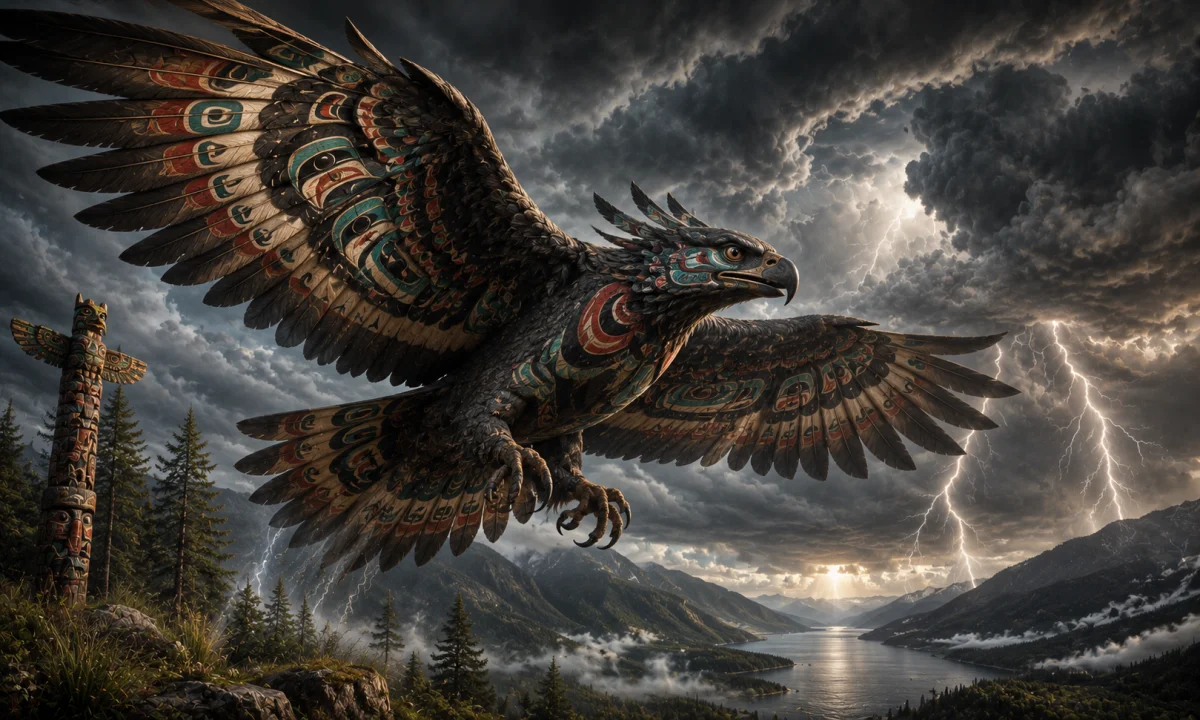
The Thunderbird is a powerful supernatural bird or bird-like being found in the traditional religious and cultural traditions of several Indigenous peoples of North America. It is not a single creature with one universally accepted story. Different nations have their own names, teachings, images and relationships with thunderbirds or thunder beings, and these traditions should not be treated as interchangeable.
Origins and cultural setting
Thunderbird traditions occur across a wide region, including parts of the Great Lakes, the Plains, the Great Basin and the Pacific Northwest. The word “Thunderbird” is an English label used to describe beings whose powers are associated with thunder, lightning, storms, rain or the sky. In some traditions, the being is a gigantic bird; in others, it is one member of a wider class of supernatural sky beings.
Many of these traditions were preserved primarily through oral transmission. Knowledge was—and in many communities remains—connected with family, ceremony, language, place and responsibilities rather than with a single written sacred book. Accounts recorded by missionaries, government officials, collectors and anthropologists may therefore provide only partial or culturally filtered views. A story published in English under the name “Thunderbird” may also combine details that belong to different nations or regions.
The term is especially common in discussions of Indigenous peoples of the Great Lakes and Plains. Among Anishinaabe peoples, for example, thunderbirds are often associated with animikii or related forms of the word for thunder beings, although spelling and usage differ between languages and communities. In Lakota traditions, Wakíŋyaŋ refers to powerful Thunder Beings. The Lakota term should not simply be assumed to mean exactly the same thing as every being called a Thunderbird in English.
On the Northwest Coast, enormous supernatural birds also appear in the traditions and visual arts of several peoples, including Kwakwaka'wakw and Nuu-chah-nulth communities. Their stories, ceremonial contexts and artistic conventions are distinct from those of the Great Lakes or Plains. Similarities in the English descriptions reflect broad themes—large birds, storms and supernatural power—not proof that all these figures originated as one shared character.
Name and identity
“Thunderbird” is best understood as a comparative English name rather than the original name of one pan-Indigenous mythological monster. Indigenous languages contain different terms, and those terms may carry meanings that English does not fully convey. Some refer to thunder, voices, powerful beings or spiritual forces rather than to an animal species.
The singular form can also be misleading. In some accounts, thunderbirds appear as a group, a family, a people or a category of beings. In others, a particular named figure has an individual role. The exact identity depends on the nation, language, storyteller and context.
Classification as a “mythical monster” is likewise a modern category. Thunderbirds are often immense and dangerous, but they are not monsters in the simple sense of villains or animals that exist only to threaten humans. They may be protectors, agents of moral or cosmic order, sources of rain, or beings approached with respect and caution. Their power is frequently sacred rather than merely frightening.
Appearance and powers
Thunderbirds are commonly represented as huge birds with powerful wings, sharp talons and a formidable beak. Eagle-like features are frequent in modern descriptions and Indigenous art, but no single physical design applies everywhere. Some visual representations use stylised forms rather than naturalistic anatomy, and some traditions describe supernatural qualities without giving a fixed appearance.
Their most widely recognised power is the control or manifestation of storms. The beating of the wings may be associated with thunder, while lightning can be represented as flashing from the eyes, the beak or the wings. In other accounts, thunder is the sound of the bird or being itself. Such descriptions are often symbolic, poetic or part of a sacred explanatory tradition; they should not be reduced to claims about a literal animal hidden in the wilderness.
Rain is another important association. Storms can bring life-giving water, especially in regions where seasonal weather strongly affects crops, animals and travel. At the same time, violent storms can destroy homes, forests and fields. The Thunderbird therefore embodies both the benefit and danger of atmospheric power.
Some traditions connect thunderbirds with strength, protection and victory over dangerous supernatural forces. Others place them in relationships with water beings, serpentine creatures or inhabitants of the underworld. These relationships vary significantly. A conflict between a sky being and a water being in one tradition should not automatically be imported into another.
Descriptions of enormous size are common in popular retellings, but size is not always the central feature in traditional accounts. “Giant bird” may communicate extraordinary power rather than provide a zoological measurement. Claims that thunderbirds have a precise wingspan, leave identifiable footprints or carry away whales and humans often come from later retellings, sensational reports or mixtures of different stories. Such details should be treated cautiously unless tied to a clearly identified tradition.
Thunder, sky and sacred power
The connection between thunder and spiritual beings is widespread in Indigenous North America, but it has different meanings in different cultures. Thunder may be understood as the activity of powerful persons or beings rather than as an impersonal natural event. The storm is then part of a relationship between the human world and a larger living cosmos.
Thunderbirds can express the authority of the upper world or the sky. Their movement between regions of the cosmos may place them in opposition to forces associated with deep water, caves, serpents or other dangerous powers. However, the contrast between sky and water is not a universal doctrine. It is a recurring pattern that must be interpreted within each community's own teachings.
Some communities regard thunder beings with reverence and may connect them with ceremony, seasonal change or obligations to the natural world. Sacred knowledge is not necessarily intended for unrestricted publication. Public descriptions are therefore often less detailed than the teachings held within a community, and a respectful account should acknowledge that limit rather than attempt to fill it with speculation.
Stories and regional variants
Great Lakes and Anishinaabe traditions
In a number of Anishinaabe traditions, thunderbirds are powerful sky beings associated with storms and lightning. Stories may describe them as opposing underwater beings or giant serpents. This opposition can be presented as a struggle between forces of the upper air and the depths, although the precise characters and meaning differ among Anishinaabe nations.
In some versions, thunderbirds attack or drive away dangerous water beings, while in others the relationship is part of a broader sacred geography. The stories are not simply adventure tales: they can express ideas about power, danger, balance and the boundaries between different realms. An account from one Ojibwe community should not be treated as a complete description of all Anishinaabe traditions.
Plains traditions
Among Plains peoples, thunder beings may be associated with storms, warfare, protection and spiritual power. The Lakota Wakíŋyaŋ, often translated into English as Thunder Beings or Thunderbirds, are an important example of a tradition that is sometimes flattened by the single English label. Their significance is connected with Lakota religious concepts and language, not merely with the image of a giant bird producing lightning.
Other Plains nations have their own stories, names and ceremonial understandings. Some accounts describe bird-like beings confronting dangerous creatures or assisting humans; others focus more directly on the storm itself. The presence of similar motifs across the Plains does not mean that the traditions are identical or that every nation recognises a being called Thunderbird.
Northwest Coast traditions
On the Northwest Coast, supernatural thunderbirds are prominent in the art and stories of several Indigenous peoples. In Kwakwaka'wakw traditions, for instance, the Thunderbird is a powerful supernatural figure represented in masks, carvings, paintings and ceremonial performances. Northwest Coast art often depicts transformation: a figure may be shown as a bird, a human or a being whose forms are connected.
These representations belong to complex artistic and ceremonial systems with their own rules and histories. They should not be treated as illustrations of a generic North American monster. The stylised beak, wings, eyes and facial forms in Northwest Coast art communicate cultural meanings that cannot be fully explained by saying that the being “controls thunder.” Related but distinct thunderbird figures also occur among other peoples of the region.
Thunderbirds in Indigenous art
The Thunderbird is one of the most recognisable figures in Indigenous North American art, but images need to be interpreted in context. A bird painted on a house front, carved on a pole, woven into a design or used on a ceremonial object may have a specific family, community or historical significance. It is not necessarily an illustration intended for general mythological classification.
Northwest Coast formline art, for example, uses conventions of flowing lines, ovoids, U-forms and carefully organised shapes. A thunderbird design within that system is part of a visual language, not simply a naturalistic portrait. On the Plains and in the Great Lakes region, images of powerful birds may likewise be connected with particular communities, dreams, ceremonies or artistic traditions.
Modern commercial use has often separated the image from its cultural setting. Thunderbird designs appear on souvenirs, sports logos, clothing and decorative objects, sometimes without identifying the nation or explaining the meaning. This can turn a sacred or culturally significant figure into a generic emblem. Indigenous artists and cultural organisations continue to shape how these images are made, shared and understood.
Interpretation and cultural significance
Thunderbirds are sometimes interpreted as symbols of nature's power, but this wording can be too general if it suggests that they are only personifications of weather. In many Indigenous worldviews, the distinction between “nature” and “spirit” does not operate in the same way as it does in modern European categories. A thunder being may be a person-like spiritual presence with agency, relationships and responsibilities.
The stories can also communicate ethical ideas. Power is not necessarily admirable simply because it is great. A being that protects a community may still be dangerous, and humans may be expected to behave with humility toward forces they cannot control. Storms offer a vivid setting for considering reciprocity, vulnerability and the consequences of disturbing an established order.
Scholars have compared thunderbird traditions across regions because of recurring images of sky power, giant birds and battles with underwater beings. Comparative study can reveal broad patterns, but it must not erase local differences. Similar stories may result from shared histories, neighbouring cultural exchange, independent development or the broad human tendency to connect dramatic weather with powerful beings. No single explanation applies to every tradition.
Distinction from similar figures
The Thunderbird should not be confused with the roc of Middle Eastern and South Asian literary tradition, the Garuda of Hindu and Buddhist traditions, the phoenix of classical and later traditions, or the simurgh of Persian literature. These are distinct figures with different histories, religious settings and symbolic roles.
It should also be distinguished from the quilen or other horned and winged creatures sometimes grouped with it in modern fantasy art. The Owlman, Mothman and cryptid reports of giant birds belong largely to modern folklore and popular culture, not to the same traditional religious contexts. A large bird reported in a newspaper or internet discussion is not automatically evidence of a Thunderbird tradition.
Thunderbirds are sometimes compared with dragons because both may be powerful and associated with storms. Such comparisons can be useful for general discussion, but they should not imply that thunderbirds are simply “Indigenous dragons.” Their meanings, forms and cultural responsibilities are different.
Later reception and modern popular culture
During the nineteenth and twentieth centuries, collectors and popular writers often presented Indigenous traditions as a single body of “Native mythology.” This habit encouraged the use of Thunderbird as if it were one universal character. It also detached stories from living communities and sometimes treated sacred beings as evidence for an ancient lost race or an unknown animal.
In contemporary popular culture, Thunderbirds appear in fantasy novels, films, television, games, comics, tattoos, sports branding and cryptozoological speculation. These versions often portray a colossal eagle-like creature that generates lightning and can be summoned or ridden. Such adaptations may be imaginative, but they are modern inventions or reinterpretations rather than neutral descriptions of Indigenous tradition.
Some Indigenous writers, artists and filmmakers have reclaimed or reinterpreted thunderbird imagery on their own terms. Other uses are criticised when they commercialise sacred symbols, remove them from their communities or combine elements from unrelated nations. The most responsible modern portrayals identify the cultural setting, avoid treating all Indigenous peoples as one culture and recognise that some teachings are not public entertainment.
Thunderbird traditions remain connected to living Indigenous languages, communities, artistic practices and religious understandings. The name therefore describes more than a spectacular winged monster. It points toward a diverse group of powerful beings whose meanings depend on the people who tell their stories, the places in which those stories belong and the responsibilities attached to them.