WORLD
WORLD
Sosondowah

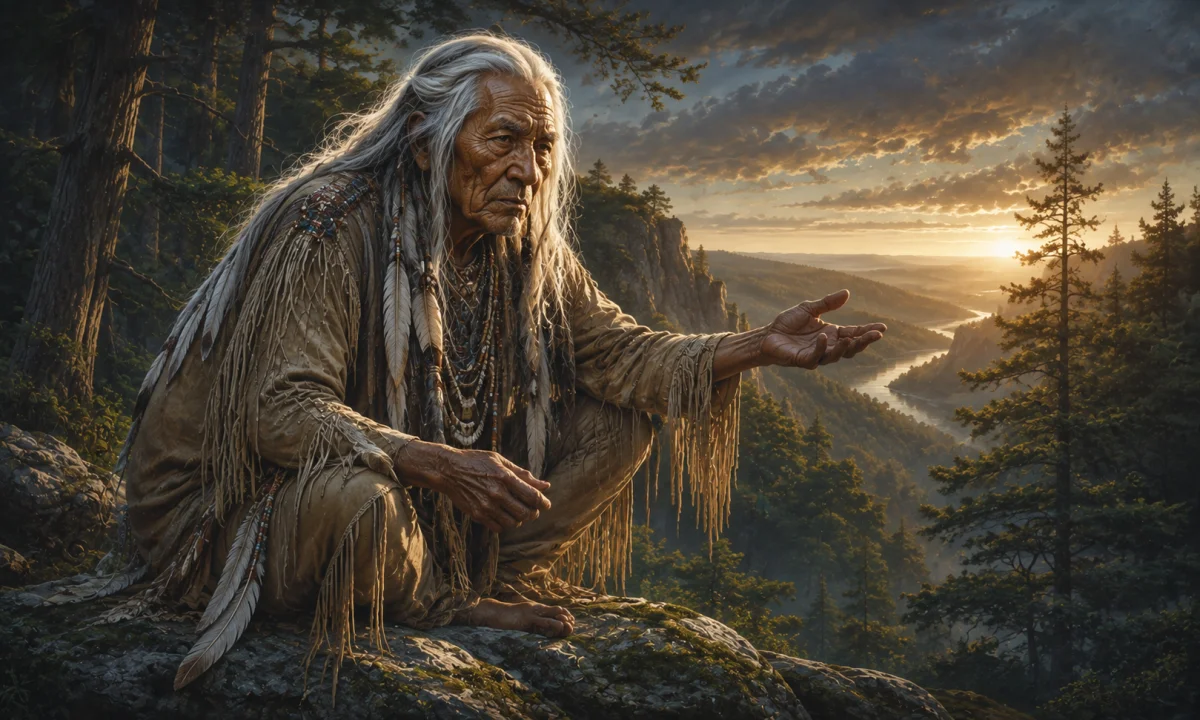
Sosondowah is a figure from Iroquois mythology, especially associated with Haudenosaunee oral tradition as recorded by later collectors and interpreters. He is usually presented as a hunter, a sky-related being, or a powerful male figure whose story is tied to pursuit, loss, and transformation. As with many Indigenous mythic figures, the surviving material comes through a mix of oral tradition, historical retellings, and later literary adaptations, so details can vary by source and should be treated carefully.
Cultural and traditional setting
The name Sosondowah belongs to the broader world of Haudenosaunee, or Iroquois, storytelling. The Haudenosaunee Confederacy includes several nations with distinct communities and storytelling traditions, and mythic figures may be remembered differently from one community or recorder to another. Because much of what modern readers encounter was written down after contact with Europeans, the evidence is uneven. Some versions are clearly traditional in character, while others reflect the style, wording, or interpretive assumptions of the person who recorded them.
In that setting, stories are not only entertainment. They explain the moral order of the world, relationships between humans and the spirit realm, and the powers of animals, celestial beings, and culture heroes. A figure like Sosondowah belongs to that wider religious and narrative landscape. He is not usually treated as a god in the strict sense of the term, and he is not a single fixed personality across all Iroquois traditions. Instead, he is a mythic personage whose role depends on the version told.
Name, spelling, and identity
The spelling Sosondowah is not the only form found in print. As with many Indigenous names written in English, spellings vary according to dialect, transliteration, and the habits of individual collectors. That variation makes it important not to force one spelling or one interpretation as definitive. In some retellings, Sosondowah is described primarily as a hunter. In others, he is more closely tied to the sky or to supernatural pursuit. Modern summaries sometimes compress these traits into a single image, but the older material is more varied.
The identity of Sosondowah is also not always straightforward. In a few later retellings, elements of his story overlap with broader Indigenous sky-lore or with romanticized literary motifs familiar from nineteenth-century writing. That does not mean the character is invented, but it does mean the precise boundaries of the tradition are sometimes blurred in print. For that reason, it is best to describe Sosondowah as a mythic figure attested in Iroquois-related storytelling rather than as a uniformly standardized deity.
Attributes and symbolic character
Sosondowah is commonly associated with hunting skill, persistence, and a relationship to the wild world. He is often presented as active, pursuing, or being pursued. In mythic terms, such qualities matter because hunting is not merely a practical activity in Indigenous North American traditions; it is bound up with respect, reciprocity, and the balance between human beings and other beings that share the world.
Some versions place Sosondowah in a celestial or semi-celestial setting. In those tellings, his story may involve the sky, stars, or a transformation that separates him from ordinary human life. The symbolism can be read in several ways: as an explanation of a natural feature, as a moral tale about desire and consequence, or as a mythic account of how a being changes state without disappearing entirely. Because sources differ, it is better to speak of possible symbolic associations rather than to insist on one fixed meaning.
Like many mythic hunters, Sosondowah can also function as a figure of tension between human ambition and the limits imposed by the spirit world. He is not simply heroic in a modern sense. His stories often carry an undertone of danger, failed pursuit, or the costly consequences of crossing boundaries. That complexity is typical of many Haudenosaunee narratives, where skill and power are never entirely separated from responsibility and restraint.
Stories associated with Sosondowah
The best-known story linked to Sosondowah in modern retellings is usually a hunting or pursuit narrative involving a powerful female figure or a celestial context, though the exact plot varies substantially. Some versions present him as a hunter who becomes infatuated with or captivated by a being beyond ordinary reach. Others frame the tale as an encounter between human desire and the supernatural order of the sky. Because different tellers and writers have shaped the story in different ways, no single summary captures all versions accurately.
One important feature of these narratives is transformation. Sosondowah may undergo a change in status, movement, or form, and the change is often meaningful in a cosmological sense. Indigenous mythic stories frequently explain why a being is connected to a particular feature of the landscape or sky, or why a certain pattern of behavior matters for human life. If a version of Sosondowah’s story links him to a celestial body, that should be understood within that explanatory framework rather than as a casual decorative detail.
There are also variations in whether Sosondowah appears as a protagonist, a warning figure, or part of a larger relational story. In some tellings, the emphasis falls on longing or pursuit. In others, the focus is on loss and the consequences of overreaching. This range is typical of oral traditions, where the same figure can be used to communicate different lessons in different communities or eras.
Relationship to women and other beings
In some retellings, Sosondowah’s story is deeply shaped by his relationship to a female figure who is herself powerful, distant, or associated with the sky. Because such stories are not uniformly preserved, it is risky to name a single “canonical” partner or antagonist. What can be said more securely is that the relationship is often central to the meaning of the tale. It is not merely personal romance in a modern sense; it is a mythic encounter that expresses tension between realms, powers, and obligations.
These relationships often carry broader social and cosmological significance. A hunter’s desire, a spirit’s response, or a transformation into a celestial presence can all point to how Haudenosaunee stories map human emotion onto a world alive with agency. In that sense, Sosondowah is less a lone character than a point of contact between the human, animal, and sky worlds.
Interpretation in Haudenosaunee context
Because the Haudenosaunee tradition is rich and diverse, Sosondowah should not be treated as a simple emblem or reduced to a single moral. Myths in this tradition often preserve layered meanings. A story can explain a natural phenomenon, affirm a social value, and dramatize a relationship between persons and powers all at once. Sosondowah’s recurring links to hunting and the sky suggest that he may embody the movement between earthly life and distant, hard-to-reach realms.
The figure also illustrates an important aspect of Indigenous mythic thought: beings are frequently defined through relationship rather than through isolated identity. Sosondowah matters because of what he does, whom he encounters, and what happens when his actions meet the limits of the world. That relational structure is one reason his story has remained adaptable across tellings.
At the same time, modern readers should avoid imposing outside frameworks too strongly. It is easy to interpret a mythic hunter as a “hero” in the Greek or European sense, but that can distort the story’s cultural meaning. Haudenosaunee stories are rooted in their own ethical and cosmological systems. Respectful interpretation begins by recognizing that the figure’s significance is embedded in an Indigenous worldview, not borrowed from an external one.
Surviving sources and caution about certainty
Most modern knowledge of Sosondowah comes through written accounts produced after contact, including folklore collections, ethnographic notes, and literary retellings. Some of these preserve older oral material; others reshape it significantly. The result is a body of evidence that is useful but uneven. It is not always possible to determine which details belong to older tradition, which were altered by the recorder, and which may have been added to fit nineteenth-century tastes for romantic or picturesque myth.
That uncertainty matters. When a source gives Sosondowah a specific role, family connection, or cosmic function, that detail may be valid only within that particular version. Scholars and careful readers therefore distinguish between traditional attestation and later elaboration. The figure is real within the tradition, but the surviving record does not always allow a single definitive biography.
It is also worth noting that Indigenous oral traditions are not static relics. Communities may retell, adapt, and re-emphasize figures like Sosondowah in ways that remain culturally meaningful. A lack of uniformity in print does not imply confusion in the tradition itself; it often reflects the limits of outside documentation.
Distinction from similar figures
Sosondowah is sometimes confused with other Indigenous sky beings, hunter figures, or characters from neighboring traditions because modern retellings may emphasize broad motifs rather than precise cultural context. That confusion should be avoided. Similar themes do not mean identical identities. A hunter associated with the sky in one tradition should not be merged with a similarly named or similarly described being from another nation’s stories.
He should also not be conflated with more widely known figures from Iroquois or Haudenosaunee mythology such as the culture hero known in English as Hiawatha, nor with the celestial beings sometimes mentioned in Haudenosaunee cosmology. Sosondowah’s story, where preserved, has its own pattern of pursuit and transformation. Even when motifs overlap, the names and narrative roles are not interchangeable.
This caution is especially important because popular summaries often flatten Indigenous mythology into a set of generic “native legends.” Such treatment erases the distinctions between nations, languages, and story cycles. Sosondowah belongs specifically within Iroquois-related tradition, and his identity should be discussed on those terms.
Later reception and modern interest
Modern interest in Sosondowah is mainly literary, educational, and folkloric rather than devotional. He appears in retellings of Indigenous myths, sometimes in collections aimed at general audiences. In those settings, the story is often presented as a poetic or romantic legend, sometimes with greater emphasis on mood than on tribal context. That can make the figure visible to wider audiences, but it can also distort the original cultural framework.
Where Sosondowah appears in modern popular culture, the treatment is usually limited and rarely central. More commonly, the name is encountered in anthologies, educational discussions, or online summaries that draw on older folklore collections. Because such material often repeats a simplified version of the story, readers should remember that popularity does not equal accuracy. Traditional context matters more than a dramatic retelling.
For contemporary Indigenous audiences, the value of such figures is not confined to folklore interest. Stories like Sosondowah’s participate in the continued life of Haudenosaunee narrative heritage. Even when told in edited or translated form, they remain part of a living cultural memory shaped by community, language, and ongoing interpretation.
Why Sosondowah remains significant
Sosondowah is significant not because his story has one fixed “true” version, but because the figure reveals how Haudenosaunee mythology works: relationally, symbolically, and across layers of meaning. He stands at the intersection of hunting, the sky, desire, and transformation. His story reminds readers that mythic beings in Indigenous North American traditions are often dynamic, context-sensitive, and deeply tied to the world they inhabit.
For that reason, Sosondowah is best understood with both care and restraint. The figure is firmly rooted in Iroquois mythology, yet the surviving record is partial and variable. Respectful discussion acknowledges that uncertainty instead of forcing precision where the sources do not support it.