WORLD
WORLD
Sopona
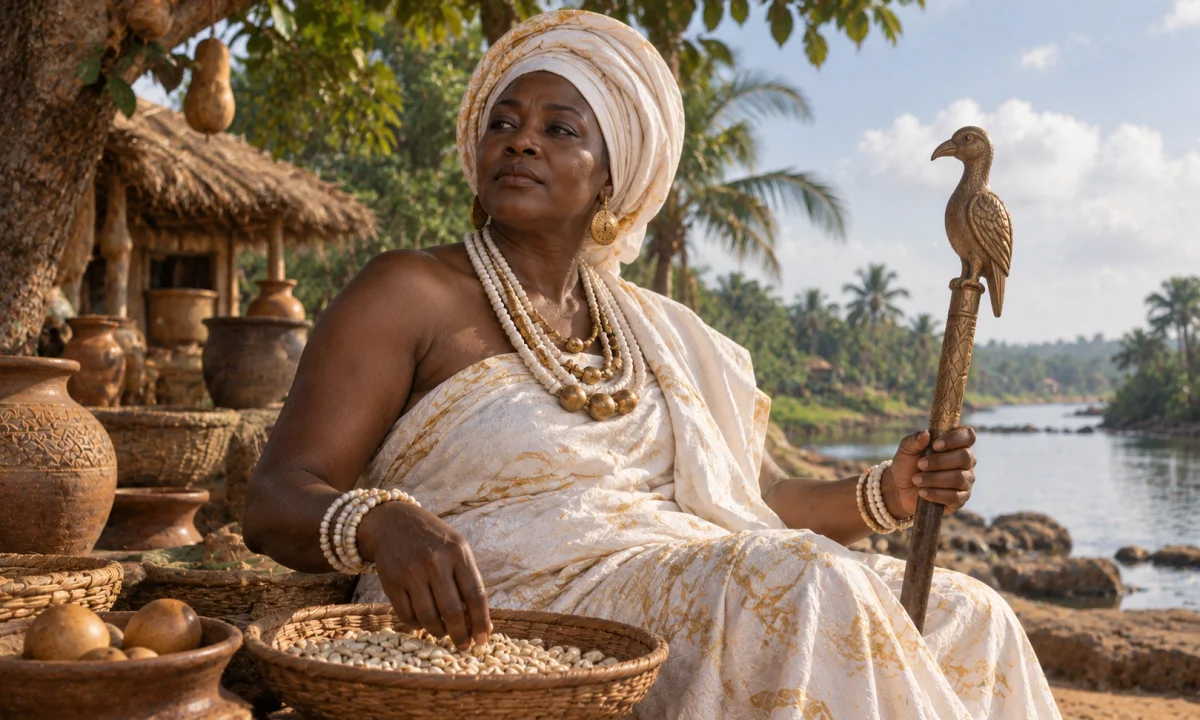
Sopona is a Yoruba divinity associated chiefly with smallpox and other dangerous epidemic diseases. The name appears in several spellings, including Ṣọ̀pọ̀nná, Soponu, Shopona and Shapona. In Yoruba religious thought, Sopona represents a power that can bring illness, protect against it, or remove it. This makes the deity both feared and approached with respect, since disease is not treated merely as a physical event but can also have social, moral and spiritual significance.
Sopona belongs to the religious world commonly described as the Yoruba tradition, a family of related practices found principally in southwestern Nigeria and in parts of neighbouring Benin and Togo. Yoruba religion has never depended on a single authoritative scripture or a universal creed. Knowledge about the òrìṣà, or divine powers, has been transmitted through oral teaching, ritual practice, praise poetry, initiation, divination and local histories. As a result, accounts of Sopona differ between communities. Some traditions treat the figure as a distinct smallpox deity, while others associate Sopona closely with Obaluaye, Babalú-Ayé or other divinities connected with disease and healing.
Name and identity
The spelling Sopona is an English-language form of a Yoruba name whose pronunciation and orthography are more accurately represented by forms such as Ṣọ̀pọ̀nná or Ṣọ̀pọnná. Older colonial and missionary records often use spellings such as Shapona or Shopona because Yoruba sounds were represented inconsistently in European writing. These variations do not necessarily indicate different gods. They often reflect differences in language, transcription and regional pronunciation.
There is less agreement about the exact meaning and grammatical history of the name. It should not automatically be translated as “owner of the earth,” a phrase more commonly associated with the title Obaluaye. The two names are frequently linked in religious writing, but their relationship is not identical in every community. In some accounts, Sopona and Obaluaye are names or aspects of one disease-related òrìṣà. In others, they are treated as distinct but closely related powers.
Sopona is generally presented as a male divinity, although Yoruba religious categories do not always operate through the same rigid divisions used in modern discussions of gender. The deity’s identity is defined less by a fixed human-like biography than by a sphere of power: epidemic illness, the danger of contagion, ritual protection and the possibility of recovery.
Sopona in Yoruba religious thought
Yoruba religion recognizes many òrìṣà, each associated with particular forces, communities, occupations, places or dimensions of life. These powers are not simply “gods” in the sense of independent creators ruling separate universes. They exist within a broader religious order in which Olódùmarè or the supreme divine source occupies the highest position, while the òrìṣà mediate aspects of existence and interact with human beings.
Within this framework, Sopona embodies the terrible unpredictability of epidemic disease. Smallpox could disfigure or kill large numbers of people, and before modern vaccination there was little effective protection against it. A divinity associated with smallpox therefore held extraordinary power over the survival of households and towns. Sopona might be petitioned for mercy, honoured to prevent an outbreak, or approached through specialists who knew the appropriate rituals and restrictions.
The deity’s power was not necessarily understood as an abstract punishment. Disease could be interpreted through several overlapping explanations, including physical exposure, broken taboos, offended spiritual powers, social disorder and the actions of human enemies. These explanations were not always mutually exclusive. Ritual responses could therefore exist alongside practical measures such as isolation, herbal treatment, cleansing and changes in movement or contact.
As with other òrìṣà, Sopona’s worship was connected to a network of priests, devotees and ritual authorities. Accounts from different periods describe specialists who knew the deity’s taboos, offerings, songs and methods of addressing outbreaks. Such specialists might be feared because they were believed to possess access to a dangerous power. Fear, however, did not make them outsiders to Yoruba society. They could also be regarded as custodians of necessary knowledge and as people capable of negotiating with a force that threatened everyone.
Attributes and symbolism
Descriptions of Sopona often emphasize concealment, contagion and the marks left by smallpox. In traditions that identify Sopona with Obaluaye or Babalú-Ayé, the divinity is commonly represented as a figure covered by raffia or other material. The covering can conceal a damaged or diseased body and may also refer to the mystery of illness: the disease is present, but its full source and course are hidden from human beings.
Not every representation of a raffia-covered figure should automatically be labelled Sopona. Raffia costumes are used in several African religious and masquerade traditions, and the particular meaning depends on local ritual context. Likewise, visual descriptions found in museums, popular books or online images may combine practices from different regions. Traditional Yoruba religion is better understood through the relationship between names, praise, ritual roles and community practice than through a single standardized appearance.
Objects linked with disease-related òrìṣà can include staffs, vessels, ritual containers, medicinal materials and ceremonial brooms or brushes, but their precise use varies. Some objects signify the ability to scatter, gather or remove disease; others belong to a particular shrine or priestly office. It is unsafe to assume that every object shown in a modern depiction is a universal attribute of Sopona.
The most important symbolism is the double nature of the deity’s power. Sopona can be destructive, yet the same authority that sends illness may also restrain it. This pattern appears in many religious traditions in which a dangerous force must be respected because it has the capacity both to harm and to heal. Sopona is therefore not simply a personification of death. The deity also belongs to a system of protection, negotiation and restoration.
Stories and ritual traditions
Unlike some better-known òrìṣà, Sopona does not possess one universally recognized cycle of myths. Yoruba religious narratives vary by town, lineage and priestly tradition, and many stories about a divinity are transmitted orally rather than in a fixed literary canon. Existing accounts tend to preserve ritual knowledge, praise names and explanations of the deity’s power more consistently than a single extended biography.
In some traditions, Sopona is described as a powerful and potentially dangerous presence whose anger can bring an epidemic. The appropriate response is not to challenge the deity but to observe taboos, make prescribed offerings and seek the guidance of authorized ritual experts. Other traditions emphasize the deity’s role in curing or preventing disease. These accounts reflect the practical reality that the same cult could be concerned with both the threat of smallpox and the hope of survival.
The deity may be approached through praise poetry and forms of address that acknowledge authority over the earth, illness or afflicted bodies. Such expressions are not always literal descriptions. Yoruba praise poetry frequently uses metaphor, compressed history and evocative imagery, so a title may communicate a relationship of power without defining the deity in a simple dictionary translation.
Ritual practice connected with Sopona has historically included restrictions on contact, food, movement or speech, although the details are not uniform. Taboos can serve several purposes: they distinguish sacred space, discipline devotees, protect ritual specialists and express the seriousness of epidemic danger. Because information about secret or initiatory practices is often restricted, public descriptions provide only a partial view of the tradition.
Sopona and smallpox
Smallpox was one of the most devastating infectious diseases in human history. It spread through close contact and could cause fever, severe skin eruptions, scarring, blindness and death. In societies without modern immunization, an outbreak could disrupt farming, trade, family life and political authority. A divinity connected with smallpox consequently occupied a place of exceptional importance.
Sopona should not be treated as evidence that Yoruba communities lacked practical understandings of infection. People observed patterns of illness, recognized the danger of contact and developed local methods of prevention and care. Religious explanations and empirical observations could coexist. The presence of a disease deity does not mean that every outbreak was interpreted only through supernatural causation.
Colonial accounts sometimes described Sopona priests as deliberately spreading smallpox. Such claims must be handled cautiously. They were produced by colonial officials and medical authorities who were also attempting to regulate African religious institutions and introduce new systems of public health. Some accusations may have arisen from genuine fears about ritual gatherings or from disputes over control of vaccination and disease management; others may have been exaggerated or politically useful.
British colonial authorities prohibited or restricted the worship of Shapona in parts of Nigeria during the early twentieth century. The often-cited prohibition in 1907 occurred within a colonial public-health campaign, but it should not be presented as a simple, neutral medical decision. Suppression of the cult also represented an attempt to weaken the authority of indigenous religious specialists and to place epidemic control under colonial administration. The exact legal and regional circumstances varied, and a ban in one administrative area did not erase the tradition everywhere.
Smallpox was declared eradicated by the World Health Organization in 1980. That medical achievement changed the practical meaning of Sopona’s cult, but it did not automatically remove the deity from Yoruba religious memory. Religious traditions can preserve relationships, stories and ritual identities even when the immediate disease associated with them is no longer present in the same form.
Relationship to Obaluaye and Babalú-Ayé
Confusion is common because several names are used for closely related disease-associated traditions. Obaluaye, often written Ọbalúayé, is widely connected with illness, healing and the earth. Babalú-Ayé, a name especially prominent in Yoruba-derived traditions of Cuba and other parts of the African diaspora, is commonly translated as “Father of the World” or interpreted through titles associated with the earth and afflicted people. In Santería or Regla de Ocha, Babalú-Ayé is a major orisha with a developed ritual identity shaped by Yoruba heritage, Cuban history and interaction with other traditions.
Many contemporary sources state that Sopona, Obaluaye and Babalú-Ayé are simply different names for the same deity. This can be a useful broad comparison, especially when discussing the shared association with epidemic illness and healing. It is not, however, a complete description of every Yoruba tradition. Local priests and scholars may distinguish the names according to region, cult history, ritual function or theological interpretation.
Sopona should also not be confused with Ọ̀ṣun, the Yoruba òrìṣà associated with rivers, fertility, beauty and sweetness, or with Ọ̀rúnmìlà, who is associated with divination and wisdom. Nor is Sopona the same as a general personification of death. Disease, death and healing overlap in religious experience, but they are not interchangeable categories.
Cultural significance
Sopona’s importance lies partly in the way the deity expresses the vulnerability of the community. Epidemic disease does not affect only isolated individuals. It threatens households, markets, ceremonies, political institutions and the continuity of a town. A religious system that gives illness a divine dimension also gives communities a language for fear, responsibility, protection and recovery.
The tradition further shows how religious authority can intersect with medicine and politics. Sopona priests were associated with specialized knowledge at a time when epidemics could not be controlled through modern vaccination. Colonial officials later attempted to replace or subordinate that authority. The history of Sopona is therefore not only the history of a deity; it is also the history of changing ideas about expertise, public health, religious legitimacy and cultural control.
For Yoruba communities and descendants of Yoruba religious traditions, the subject should not be reduced to a sensational image of a “god of smallpox.” That phrase identifies the central association but leaves out the ethical and social dimensions of ritual life. Sopona represents the need to respect forces that exceed individual control, to care for the vulnerable and to maintain correct relationships within a community and with the spiritual world.
Later reception
Sopona appears today mainly in discussions of Yoruba religion, African religious history, epidemic traditions, colonial medicine and the African diaspora. The figure has not become a major standardized character in global popular culture, and modern illustrations often borrow attributes from Obaluaye, Babalú-Ayé or other raffia-clad masquerade traditions. Such images may be meaningful interpretations, but they should not be mistaken for a single universally accepted ancient portrait.
Contemporary descriptions are most reliable when they distinguish between the historical smallpox cult, regional Yoruba practice, diaspora forms of Babalú-Ayé and modern artistic representation. Sopona’s continuing significance does not depend on treating every name as identical. It rests in the enduring religious and cultural memory of a power associated with epidemic danger, ritual responsibility and the possibility of healing.