WORLD
WORLD
Sojobo
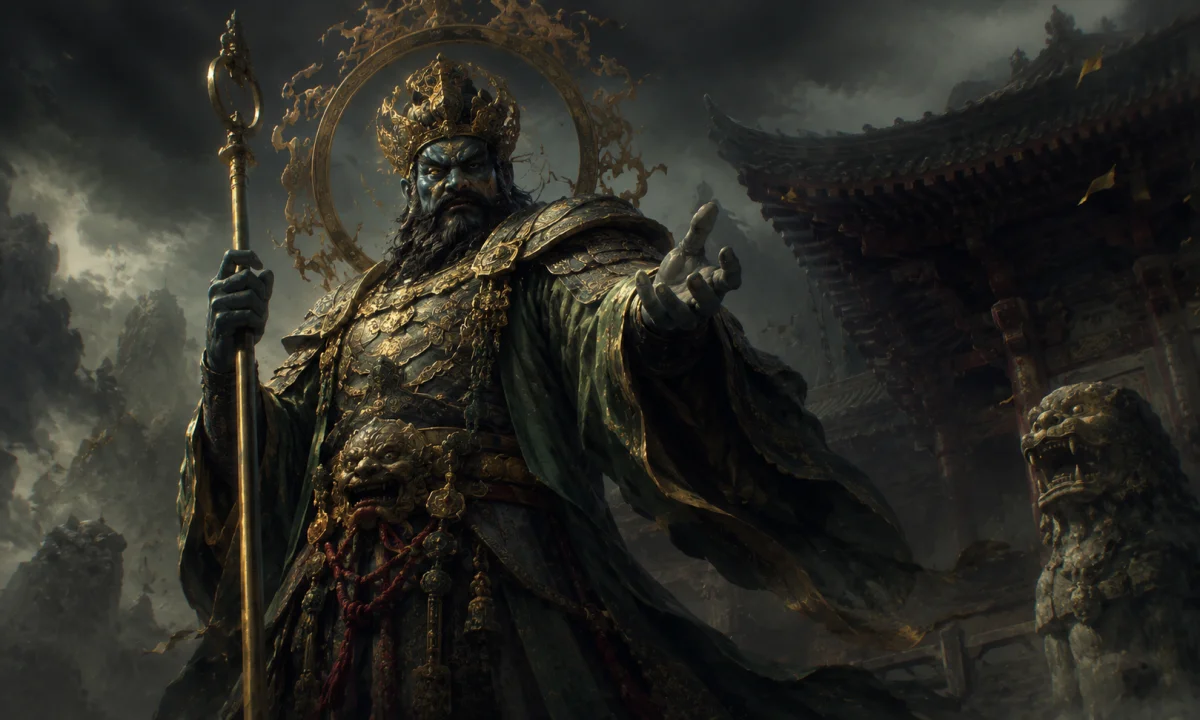
Sōjōbō (also written Sojobo or Sōjōbō) is a powerful tengu associated with Mount Kurama in Kyoto, Japan. In Japanese legend, he is often described as the king or chief of the tengu who inhabit the mountain. His best-known role is as the supernatural teacher of the young warrior Minamoto no Yoshitsune, who was then known by the childhood name Ushiwakamaru. According to later tradition, Sōjōbō taught him martial skills and helped prepare him for the military career that made him one of Japan’s most celebrated heroes.
Sōjōbō belongs to the world of Japanese mountain folklore, Buddhist-influenced religious imagination and warrior legend rather than to a single, universally fixed mythology. His appearance and position vary between artistic and literary sources. The familiar image of a red-faced, long-nosed mountain spirit wearing the robes of a yamabushi is traditional in broad outline, but details such as his exact powers, genealogy and status among the tengu are not consistent across all accounts.
Origins and cultural setting
The stories of Sōjōbō developed within the wider tradition of the tengu, supernatural beings associated with mountains, forests, isolation and unusual spiritual power. Tengu were not always imagined in the same way. In early Buddhist writing, the term could refer to disruptive or dangerous spirits. Over time, Japanese folklore gave tengu increasingly distinctive forms and personalities, including birdlike features, wings, beaks or long noses. They could be arrogant, violent and hostile to Buddhist discipline, but they could also act as guardians, teachers or protectors of sacred mountains.
Mountains held a special place in Japanese religious culture. They were viewed as places where human beings encountered spirits, gods and other-than-human powers, and where ascetics pursued religious training. The mountain ascetic tradition known as Shugendō contributed strongly to later images of tengu. Its practitioners, called yamabushi, travelled through remote mountain regions and performed rigorous religious practices. Because tengu were often imagined as mountain dwellers and masters of hidden knowledge, artists and storytellers frequently depicted them wearing clothing associated with yamabushi.
Mount Kurama, north of Kyoto, became one of the most important settings for tengu lore. The mountain has a long religious history connected with Kurama-dera and with traditions involving Buddhist and esoteric practice. Its forests, steep slopes and temples provided a natural setting for stories about secret instruction and encounters with supernatural teachers. Sōjōbō is therefore best understood as the legendary master of a particular sacred landscape, not simply as a generic “Japanese demon.”
The name Sōjōbō
The name is usually written 僧正坊 and transliterated as Sōjōbō. The first part, sōjō, refers to a high Buddhist clerical rank, often translated as “bishop,” “senior priest” or “priest prelate.” The element bō can mean a monk’s quarters, a religious establishment or a monk-like figure, depending on context. The name consequently gives Sōjōbō a strongly religious and clerical association.
It is not certain that the name should be treated as an ordinary personal name in the modern sense. It may function partly as a title or as a name formed from Buddhist institutional language. Japanese folklore contains other tengu names ending in -bō, and the naming of powerful mountain beings often reflects their supposed territory, religious status or rank. Spellings in English vary because long vowels are represented inconsistently. “Sojobo” is common in popular writing, while “Sōjōbō” more closely indicates the Japanese pronunciation.
Identity as a tengu
Sōjōbō is generally classified as a daitengu, or “great tengu,” a term used for especially powerful and intelligent tengu. Daitengu are often portrayed as imposing figures with humanlike bodies, red faces, long noses and the bearing of mountain ascetics. They contrast with more birdlike or goblin-like forms sometimes associated with lesser tengu.
He is also commonly called the king of the tengu or the ruler of the tengu of Mount Kurama. This description is widespread, but it should not be understood as evidence of a single ancient tengu government with a fixed constitutional hierarchy. Tengu classifications and named leaders differ by region, period and source. “King” is a useful description of Sōjōbō’s legendary authority, particularly in modern reference works and popular retellings, but his exact rank is not uniform throughout Japanese tradition.
Some accounts connect him specifically with the tengu of Mount Kurama, while others treat him as one of several eminent tengu leaders in Japan. These traditions should not automatically be assumed to describe separate beings. In many cases, local names, titles and later storytelling have shaped how the figure is identified. The most stable feature of Sōjōbō’s identity is his association with Mount Kurama and Yoshitsune’s training.
Appearance and attributes
In the best-known visual tradition, Sōjōbō appears as a large, mature male tengu with a red face, a very long nose and a stern or commanding expression. The long nose is one of the most recognizable features of the hanataka tengu, or long-nosed tengu, form. It may suggest pride, supernatural status and separation from ordinary humanity.
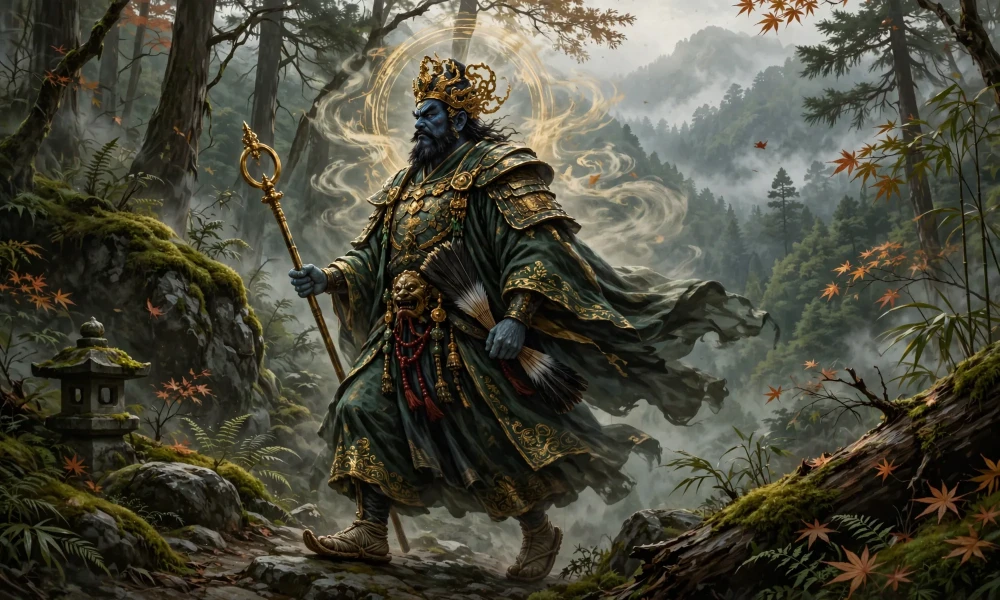
He is commonly shown with thick white hair, a beard or moustache, and garments resembling those of a mountain ascetic. His clothing may include a dark robe, a small cap or head covering, and the distinctive accessories associated with yamabushi. He may also carry a staff, sword or other emblem of authority. Illustrations are not standardized, however, and the exact combination of garments varies according to the artist and period.
A feather fan is another familiar tengu attribute. In legends and popular images, a tengu fan may produce powerful winds, command the weather or symbolize command over the mountain environment. Sōjōbō is often shown holding one, but the fan should be treated as a general tengu symbol rather than as an item uniquely belonging to him in every tradition.
His most important power is not necessarily physical strength but mastery of hidden knowledge. He represents the dangerous and prestigious wisdom of the mountains: swordsmanship, strategy, discipline, supernatural movement and techniques unavailable to ordinary students. As a teacher, he stands between the human and spirit worlds. He can grant access to knowledge, but such instruction is usually connected with demanding discipline and exceptional destiny.
Sōjōbō and Minamoto no Yoshitsune
Sōjōbō’s most famous story concerns Minamoto no Yoshitsune, one of the major military figures of the late Heian period. Yoshitsune was born in 1159 and became involved in the struggles between the Minamoto and Taira clans. His historical life is known through chronicles and other records, but the stories surrounding his childhood and military genius became increasingly legendary.
After the defeat of his father, Minamoto no Yoshitomo, the young Yoshitsune was sent to Mount Kurama. In legend, he lived there under the name Ushiwakamaru. The mountain’s tengu noticed his exceptional potential, and Sōjōbō became his instructor. The young hero is said to have trained at night in the forest, learning swordsmanship, agility and military arts that ordinary human teachers could not provide.
Many retellings emphasize the secrecy and difficulty of this training. The mountain is presented as a place outside normal society, while Sōjōbō is a teacher who possesses knowledge beyond the reach of human warriors. Yoshitsune’s skill is therefore explained not only by talent and practice but also by supernatural instruction. His later victories against the Taira, especially his daring tactics and rapid movements, appear in legend as the result of this extraordinary education.
The most famous related figure is the warrior monk Benkei. In later tradition, Yoshitsune and Benkei meet at the Gojō Bridge in Kyoto, where Yoshitsune defeats or outmaneuvers Benkei. They eventually become loyal companions. Sōjōbō is not Benkei’s teacher, and he should not be confused with Benkei, but the two figures belong to the same broad cycle of Yoshitsune legends. Some dramatic adaptations place the supernatural training, the encounter with Benkei and other episodes into a connected heroic narrative, even though they originate in different strands of tradition.
Sources and development of the legend
The historical Yoshitsune is not evidence that Sōjōbō existed as a literal religious being. The association between the warrior and the tengu belongs to the growth of medieval and early modern heroic literature. Yoshitsune’s life accumulated stories that explained his brilliance, suffering and tragic fate through encounters with extraordinary teachers and allies.
Texts and performance traditions about Yoshitsune developed over centuries, including war tales, oral storytelling, nō drama, puppet theatre and kabuki. The details of his childhood training are not identical in every work. Some narratives speak more generally of tengu or supernatural beings on Mount Kurama, while later retellings give the chief teacher the specific name Sōjōbō. The exact date at which all elements of the familiar story became fixed is uncertain, and it would be misleading to claim that every early account presents the same Sōjōbō.
The famous image of a tengu teaching Yoshitsune reflects a literary interest in the hero’s hidden education. It also expresses a recurring Japanese motif: a gifted human being receives instruction from a powerful spirit in a remote place, then returns to the human world to fulfil a remarkable destiny. Similar patterns appear in stories of sages, mountain ascetics and supernatural martial artists, although the figures and religious meanings differ from one tale to another.
Religious and symbolic significance
Sōjōbō occupies an ambiguous position. He is not simply a benevolent god, and he is not merely an evil demon. Tengu were often associated with pride, deception, violence and opposition to Buddhist teachings. At the same time, their connection with mountains gave them an aura of authority and spiritual force. A tengu could punish arrogance, protect a sacred place or pass on valuable knowledge.
This ambiguity is especially important in Sōjōbō’s role as a teacher. He provides Yoshitsune with skills that help make him a great warrior, but the legend does not necessarily present martial power as morally uncomplicated. Yoshitsune’s later life includes betrayal, political conflict and tragic defeat. The supernatural education contributes to his heroic stature while also placing him within a world of dangerous exceptionalism.
The mountain setting adds another layer of meaning. Mount Kurama is not simply a backdrop for an adventure. It represents separation from ordinary political life, contact with unseen powers and the transformation of a vulnerable child into an extraordinary adult. Sōjōbō personifies the mountain’s hidden authority. His clerical name and ascetic appearance also show how Japanese folklore could blend Buddhist vocabulary, local mountain belief and heroic storytelling without reducing them to a single system.
Distinguishing Sōjōbō from related figures
- Tengu: Tengu are a broad class of Japanese supernatural beings. Sōjōbō is one named and especially powerful tengu, not another word for all tengu.
- Kurama-tengu: This term can refer generally to a tengu associated with Mount Kurama. It is often connected with Sōjōbō, but the terms are not always strictly interchangeable.
- Yoshitsune: Minamoto no Yoshitsune is the human warrior who, in legend, received instruction from Sōjōbō. He is not himself a tengu, although some later stories give him extraordinary or quasi-supernatural abilities.
- Benkei: Benkei is the warrior monk who becomes Yoshitsune’s companion. He is a separate human legendary figure and is not Sōjōbō’s identity or another name for him.
- Shuten-dōji: Shuten-dōji is a famous oni associated with Mount Ōe. He is an ogre-like demon figure, not a tengu and not a form of Sōjōbō.
- Karasu-tengu: Karasu-tengu are crowlike or bird-featured tengu. Sōjōbō is more commonly portrayed as a long-nosed daitengu, although tengu appearances vary in art and folklore.
Later reception and popular culture
Sōjōbō has remained visible through the continuing popularity of Yoshitsune narratives, Japanese theatre, illustrated books, festivals and depictions of tengu. Mount Kurama’s association with tengu and with Yoshitsune makes the figure particularly important in local cultural memory, even when visitors encounter him through tourism, statues or dramatic storytelling rather than through formal religious worship.
Modern manga, anime, games and fantasy fiction frequently use tengu as characters or as sources of supernatural powers. In these settings, Sōjōbō may appear as a masked warrior, an immortal martial-arts master, a strict mentor or a ruler of an organized tengu society. Such portrayals draw on traditional elements—Mount Kurama, the long nose, the fan, mountain training and Yoshitsune—but they may add personalities, abilities and plot relationships that are modern inventions.
Traditional Sōjōbō is best recognized as a legendary Kurama tengu and supernatural instructor, whose authority comes from the meeting of mountain religion, tengu folklore and the heroic biography of Yoshitsune. His story survives because it links a sacred landscape with the making of a legendary warrior, while preserving the characteristic ambiguity of the tengu: powerful and dangerous, proud and wise, remote from humanity yet capable of guiding an exceptional human being.