WORLD

Skan

Skan is a powerful being associated with the sky in Lakota and Dakota religious traditions. The name is commonly translated as “sky,” “the heavens,” or “that which is above,” although English translations do not capture every religious meaning carried by the term. In accounts of Lakota cosmology, Skan is one of a group of great powers connected with the creation and ordering of the world, alongside figures such as Inyan, Maka, and Wi.
Skan should not be treated as a universally defined “god” belonging to every Native American tradition. Native American peoples have distinct religious systems, languages, and sacred histories. The information associated with Skan comes primarily from Lakota and closely related Dakota contexts, especially from recorded oral traditions. Those records preserve important material, but they do not represent a single complete or unchanging Lakota theology. Different communities, ceremonial specialists, narrators, and researchers have described Skan in somewhat different ways.
Cultural setting
The Lakota are one of the major divisions of the Oceti Sakowin, often called the Seven Council Fires. They speak Lakota, a Siouan language closely related to Dakota and Nakota. Lakota religious life traditionally understands the world as filled with powers, presences, relationships, and forms of life that cannot always be neatly separated into the modern categories of “god,” “spirit,” “force,” or “natural object.”
Within this setting, the sky is not merely a physical space above the earth. It is a realm of movement, light, weather, celestial bodies, and spiritual power. A word translated as “sky” can therefore refer both to a visible part of the cosmos and to a sacred reality active in the ordering of existence. Skan’s importance is best understood through this wider relationship between the heavens, the earth, living beings, and ceremonial life.
Many descriptions of Skan come from oral traditions written down by outside observers during the nineteenth and early twentieth centuries. Such records are valuable, but they were shaped by translation, the questions asked by researchers, and the assumptions of Christian or European religious vocabulary. A recorded description of Skan as a “supreme god,” for example, may reflect an attempt to fit Lakota ideas into a familiar model rather than a precise equivalent used by all Lakota people.
Name and identity
The spelling Skan is widely used in English-language discussions of Lakota cosmology. Spellings can vary when Indigenous words are written with different orthographies or represented through older systems of transcription. The exact pronunciation and grammatical associations may also be clearer in Lakota-language contexts than in English sources.
Skan is often identified with the sky itself, but traditional descriptions may give the figure a more personal or active character. In some accounts, Skan acts as a ruling or judging power among the great cosmic beings. In others, the emphasis falls on Skan as the encompassing heavens and on the role of the sky in maintaining the structure of the world.
These descriptions should not be forced into a single definition. Skan may be discussed as a personified cosmic power, a sacred being, or the sky understood as an intelligent and active aspect of the universe. The difference between these descriptions reflects the limits of translating Lakota religious concepts into English, rather than necessarily indicating that one account is correct and all others are wrong.
Skan in Lakota cosmology
Some recorded Lakota accounts describe four major powers or beings connected with the basic structure of the cosmos:
- Inyan, commonly associated with rock, stone, or the primordial substance from which creation begins;
- Maka, associated with the earth;
- Skan, associated with the sky or heavens; and
- Wi, associated with the sun and solar power.
This four-part arrangement is one of the most important contexts for understanding Skan. It presents the world not as the product of a distant creator alone, but as a system of interrelated powers. Earth, sky, stone, and sun are not simply objects placed into the universe. They are connected with agency, identity, and sacred relationships.
In creation narratives involving these beings, the relations between earth and sky are especially significant. The separation or ordering of cosmic realms establishes the conditions in which the world can exist. Skan’s association with the heavens therefore concerns more than altitude. The sky helps define boundaries, governs relationships between upper and lower realms, and participates in the establishment of an ordered cosmos.
The details of these stories vary in surviving accounts. Some describe disputes or tensions among the great powers, while others focus on their distinct roles and relationships. It is safer to speak of a family of related cosmological traditions than of one fixed canonical story. Lakota religious traditions were transmitted through speech, ceremony, teaching, and community memory rather than through a single scripture that standardizes every version.
Attributes and powers
Skan’s principal attribute is the sky. This association may include the visible heavens, the region above the earth, and the wider cosmic order represented by the sky. Since the heavens contain the sun, moon, stars, clouds, winds, and storms, Skan can be connected conceptually with the forces that shape weather and celestial movement, although not every power of the sky should automatically be assigned to Skan in every tradition.
Some accounts present Skan as a figure with authority among the great beings. This has led English-language writers to call Skan a “chief” or “ruler” of the spirits. Such language should be used carefully. It can suggest a rigid hierarchy resembling a human kingdom, whereas Lakota concepts of sacred power may involve relationships and forms of authority that do not correspond exactly to European ideas of monarchy or divine government.
Skan is also associated in some descriptions with judgment or the resolution of disputes among cosmic powers. This role reflects the sky’s position as an encompassing realm: it stands above the earth and may serve as a power capable of witnessing or regulating relationships among other beings. The precise nature of this authority differs between accounts, and there is no universally accepted list of Skan’s powers.
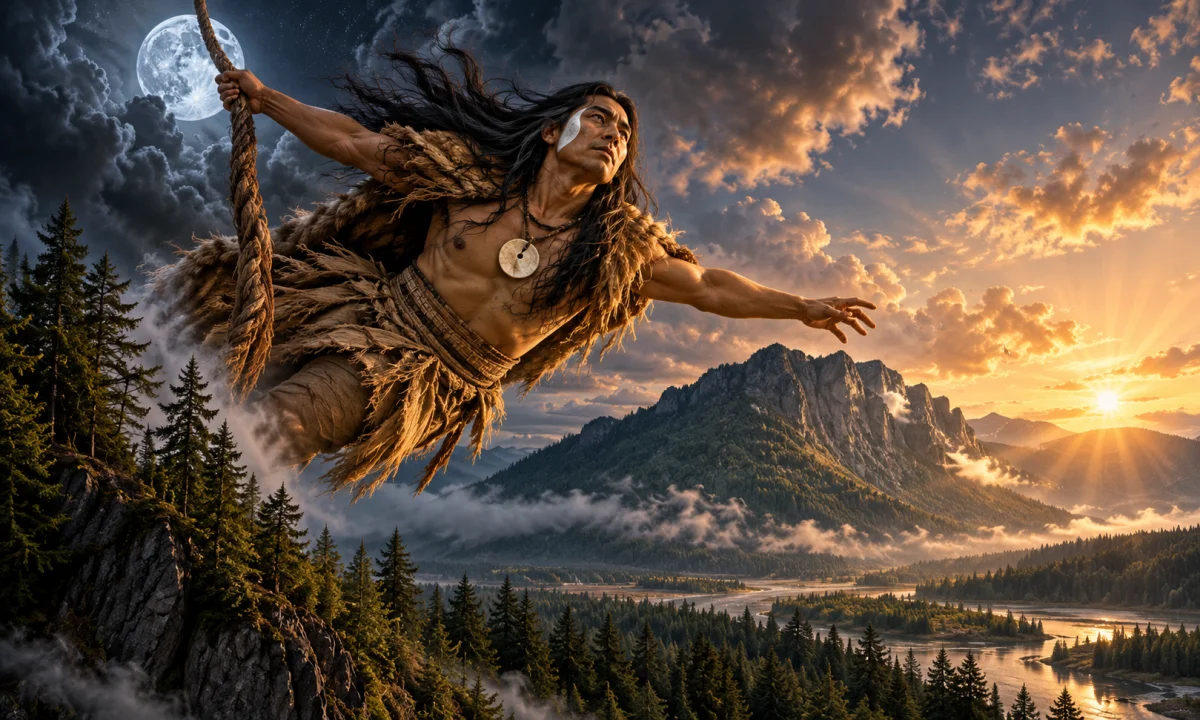
Unlike many legendary beings in popular fantasy, Skan is not primarily defined by a fixed physical appearance. Traditional references may personify the sky, but they do not establish one standard humanoid form, costume, or set of visual attributes. Images showing Skan as a winged man, a blue-skinned deity, or a warrior in elaborate regalia are modern artistic interpretations unless tied to a specific Indigenous source.
Relationships with Inyan, Maka, and Wi
Skan is most often discussed in relation to Inyan, Maka, and Wi. Together, these figures express a cosmological pattern in which the fundamental parts of the universe are alive with sacred significance. Inyan and Maka represent a relationship between primordial substance and earth; Skan represents the heavens; and Wi represents the sun’s light and power.
The relationship between Skan and Maka is particularly important because sky and earth define one another. In many creation traditions around the world, the separation of heaven and earth creates space for life. Lakota accounts also place importance on the ordering of these realms, though the details and symbolism should not be reduced to a generic “sky father and earth mother” pattern. English mythological categories can obscure differences between traditions.
Wi should also be distinguished from Skan. The sun is located in the sky, but Lakota accounts that name both figures treat them as separate powers. Skan is not simply another name for the sun. Likewise, Inyan is not merely a symbol of dead stone in the modern material sense, and Maka is not only a geographical landscape. These figures belong to a sacred cosmological system in which the natural world and spiritual reality are closely related.
Religious significance
Skan’s significance lies in the sacred status of the heavens and in the relationships that connect the different levels of existence. The sky is a source of orientation, weather, light, seasonal change, and celestial knowledge. It is also a reminder that human life exists within a larger order that includes powers beyond ordinary human control.
In a Lakota worldview, sacred relationships are not limited to private belief. They may be expressed through ceremony, prayer, obligations, respect for places and beings, and the proper conduct of communal life. It would be misleading to claim that every Lakota ceremony is directed to Skan or that Skan occupies the same place in all contemporary Lakota religious practice. The surviving descriptions of Skan belong to a wider network of teachings rather than to a separate, standardized cult devoted exclusively to this one figure.
The sky’s distance and vastness can also symbolize a perspective beyond individual concerns. When Skan is described as a judging or ordering power, the image suggests that human beings are part of a moral and cosmic structure larger than themselves. This does not mean that Lakota religion can be reduced to a simple doctrine of divine judgment. Rather, the figure helps express the idea that balance, relationship, and proper order have cosmic dimensions.
Sources and limits of the surviving record
Knowledge of Skan is based largely on oral traditions recorded by ethnographers and other observers, together with information preserved through Indigenous cultural knowledge. Some written accounts identify Skan as one of the principal powers in a Lakota creation system. Other accounts use different emphases, omit the figure, or describe the structure of the cosmos in another way.
This variation is not evidence that the tradition is unreliable. Oral religious traditions commonly change in emphasis according to the community, speaker, occasion, and purpose of the telling. A ceremonial explanation, a story told to a child, and an account given to an outside researcher may not contain the same details. In addition, some sacred knowledge is not intended for unrestricted publication.
Older English-language records also frequently used terms such as “deity,” “god,” “spirit,” and “myth” without explaining their limitations. “Myth” in academic usage can mean a traditional sacred narrative, but in ordinary English it often implies a false story. Skan should therefore be approached as a figure within a living religious and cultural tradition, not simply as a fictional character from a closed ancient mythology.
Distinctions from similar figures
Skan is sometimes confused with other Indigenous beings associated with the sky, weather, or a supreme sacred power. These comparisons are usually misleading unless they are limited to broad themes. The Thunder Beings, often written as Wakíŋyaŋ in Lakota, are powerful beings associated with thunder, lightning, storms, and the protection or punishment of dangerous forces. They are not simply alternate names for Skan.
Skan should also be distinguished from Wakan Tanka, a major Lakota sacred concept often translated inadequately as “Great Spirit” or “Great Mystery.” Wakan Tanka is not just another personal name for the sky. It is a complex expression whose meaning and interpretation have been debated, and it may refer to sacred power or a broad community of sacred beings rather than to one narrowly defined deity. Treating Skan and Wakan Tanka as identical erases important differences.
Similarly, Skan is not the same as the Christian God, even when older writers described him as a “creator” or “supreme god.” Nor should he be merged with sky deities from Greek, Norse, Mesoamerican, or other Indigenous traditions merely because those figures also rule or inhabit the heavens. Shared themes do not establish shared identity or common origin.
Modern representation
Skan has not become a major figure in global popular culture in the way that some Greek, Norse, or Egyptian deities have. When the name appears in modern fantasy, games, online mythology lists, or illustrated encyclopedias, the portrayal may draw from brief summaries of Lakota cosmology rather than from a detailed Indigenous tradition.
Modern adaptations sometimes turn Skan into a generic sky god with a standardized appearance, a list of elemental powers, or a place in a fictional pantheon. Such portrayals should be identified as creative reinterpretations. They should not be presented as though they were traditional Lakota teachings, especially when they add invented family relationships, weapons, symbols, or adventures.
The most responsible understanding of Skan keeps the figure within the Lakota and Dakota religious context in which the name is found. Skan is best approached as a sacred power associated with the sky and with the ordering of the cosmos, whose identity and role are preserved through varied accounts rather than through one universally fixed mythology.