WORLD

Owiot
Owiot is a figure associated with the traditional religious narratives of the Luiseño people, who call themselves the Payómkawichum, in Southern California. He is commonly described in English-language reference works as a creator being, culture hero, or first leader whose actions helped establish the human world. Accounts differ in spelling, detail and classification, and the name should not be treated as belonging to a single standardized mythology shared by all Native peoples of North America.
Cultural setting
The Luiseño homeland lies in what is now coastal and inland Southern California, especially in the region around present-day San Diego, Riverside and Orange Counties. Luiseño traditions belong to the broader cultural world of southern California, where creation narratives, stories of ancestral beings, ceremonial knowledge and accounts of the origins of social practices were transmitted primarily through oral teaching.
The term “mythology” can be misleading if it suggests a collection of fictional stories separated from religion. In Luiseño culture, narratives about the earliest beings could express relationships among humans, animals, landscapes, death, ritual authority and moral obligations. Some stories were connected with particular occasions, families or forms of religious knowledge, and not every traditional account was necessarily intended for unrestricted public narration.
Much of what is now written about Owiot comes from outsiders’ records, comparative works and later summaries rather than from one ancient Luiseño manuscript. The absence of a single canonical text means that short reference descriptions often compress a complex oral tradition into a few statements. Details that appear in one account may be absent from another, and spellings may reflect the conventions of different observers.
Name and identity
The name appears in several forms, including Owiot, Ouiot, Oyot and Wiyot. English-language sources do not always use these spellings consistently. Some accounts present the figure as a creator god; others emphasize his role as a culture hero, ancestral being or powerful first chief. These descriptions overlap, but they are not identical. “Creator god” highlights his relationship to the formation of the world or its inhabitants, while “culture hero” emphasizes his role in organizing human life and establishing customs.
The exact status of Owiot in Luiseño religious thought is therefore best described with care. He is not necessarily equivalent to the supreme deity of every Luiseño tradition, nor is there evidence that all Luiseño communities historically understood him in precisely the same way. In many Indigenous traditions, a being may have several connected roles—ancestor, ruler, creator, teacher and culture hero—without fitting neatly into the categories used by European mythology.
The spelling Wiyot can also cause confusion because Wiyot is the name of a distinct Indigenous people of northwestern California. A similar written form does not by itself establish that the Luiseño figure and the Wiyot people’s traditions are the same. Owiot should be discussed in its Luiseño context unless a particular source demonstrates a different connection.
Owiot as creator and first leader
In the summaries most often associated with Owiot, he belongs to the earliest period of existence, when the boundaries between divine, ancestral and human life were not yet fixed. He is credited with bringing order to the world and with establishing conditions under which human beings could live. Such descriptions place him among the beings who make the world habitable rather than among later spirits who merely inhabit it.
Owiot’s creative role is often understood less as the manufacture of a universe from nothing and more as the shaping, ordering or founding of a living world. In southern Californian Indigenous traditions, creation narratives commonly explain how people, animals, places, customs and ceremonial responsibilities came to be related. A creator figure may therefore be important not only because he makes things, but because he defines proper relationships among them.
As a first leader, Owiot is also associated with the establishment of social order. His authority can be interpreted as ancestral rather than bureaucratic: he represents the beginning of a community’s way of life and the transmission of knowledge from the first beings to later generations. The exact customs or institutions attributed to him vary in published accounts, and broad claims about particular laws, crafts or ceremonies should not be made without identifying the tradition in which they occur.
Death and conflict with Coyote
A recurring feature of accounts of Owiot is his conflict with Coyote, who is described in some versions as his younger brother. The relationship is important because Coyote is a major figure throughout many Native American traditions, although his character and religious meaning differ greatly from one nation to another.
In stories connected with Owiot, Coyote is commonly presented as the agent of his death. The killing is sometimes described as the result of rivalry, resentment or opposition to Owiot’s authority. Published summaries do not agree on all the circumstances, and it is unsafe to turn a brief account into a detailed fixed narrative. What remains consistent in the general outline is the contrast between Owiot’s founding authority and Coyote’s disruptive or oppositional action.
This contrast should not be reduced to a simple division between “good” and “evil.” Coyote figures often combine cleverness, appetite, danger, sexuality, humor, disobedience and transformative power. A trickster can violate order while also helping to produce the conditions of ordinary life. In a story about Owiot, Coyote’s opposition may therefore represent more than personal jealousy: it can dramatize a transition from an early sacred order to a world marked by conflict, mortality and unpredictability.
Some descriptions connect Owiot’s death with the beginning of a changed human condition. Death, cremation, mourning and transformation are significant themes in many southern Californian traditions, but the exact meaning of these themes differs among communities. Accounts that mention the treatment of Owiot’s body should not automatically be treated as a universal Luiseño doctrine or as evidence for one uniform explanation of death.
Attributes and symbolism
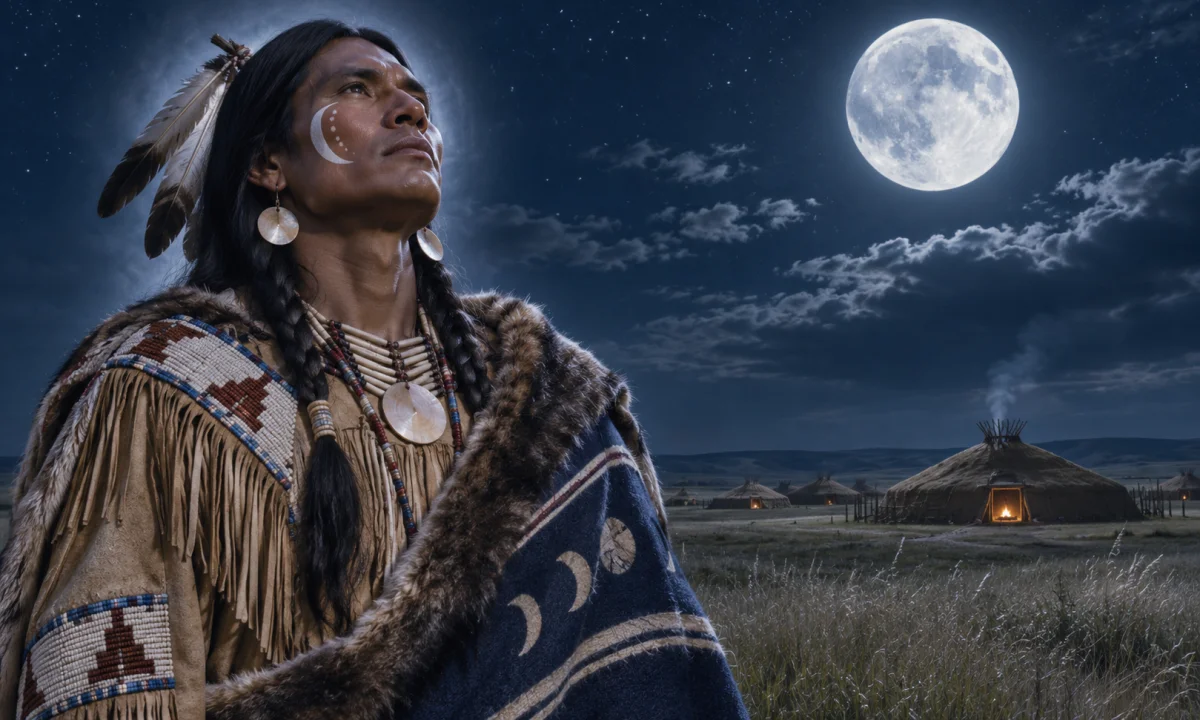
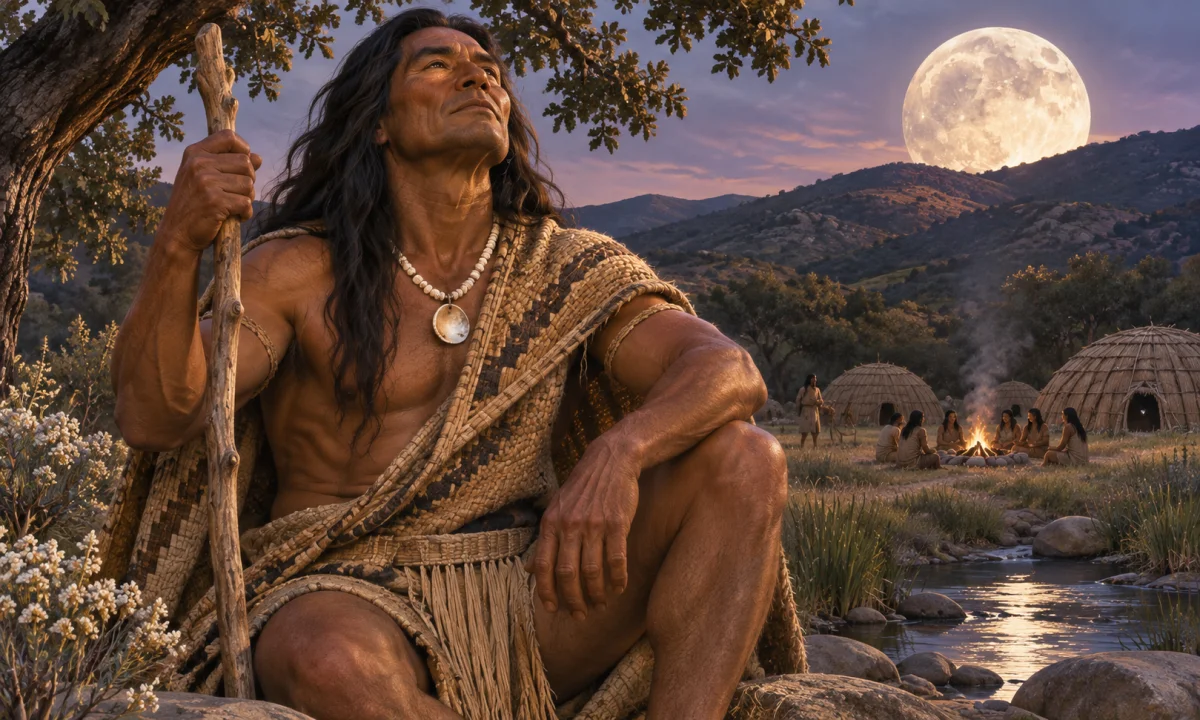
Owiot is not generally known for a standardized physical appearance comparable to the fixed visual forms given to many figures in classical or modern fantasy traditions. Traditional oral narratives may focus on what a being does, says or establishes rather than on a detailed portrait. Descriptions that portray Owiot with a specific costume, weapon, animal body or supernatural emblem may reflect an individual retelling, an illustrator’s choice or a modern reconstruction rather than a widely attested traditional feature.
His most significant attributes are functional:
- Creative authority: he is associated with the formation or ordering of the world and its inhabitants.
- Ancestral leadership: he stands at the beginning of human social life and may be portrayed as a first chief or founding authority.
- Instruction: he represents the transmission of knowledge and the establishment of practices that make communal life possible.
- Mortality and transformation: his death places the boundary between an earlier sacred age and the world experienced by later people.
- Opposition to Coyote: the conflict between the two figures expresses tension between order and disruption, authority and independence, or permanence and change.
These interpretations are useful ways of reading the narratives, but they should not be presented as a single official explanation. Symbolic meanings are often supplied by later scholars or readers, while traditional knowledge may hold several meanings at once. A story can explain the origin of death, preserve a memory of conflict, teach proper conduct and refer to ceremonial concerns without being reducible to one abstract theme.
Stories and variants
The available accounts of Owiot are notably brief compared with the extensive cycles preserved for some better-known figures such as Coyote, Raven or Iktomi. This does not prove that Luiseño traditions contained only a short story about him. It more likely reflects the uneven survival of oral knowledge, the interests of early collectors and the fact that much religious teaching was not recorded in full.
In the broadest version of the narrative, Owiot belongs to the first age, exercises authority over the early world and is eventually killed by Coyote. The death of the founding figure marks a decisive change. Later beings must live in a world without Owiot’s direct rule, and the conditions of ordinary human existence—including suffering and death—become part of the story’s background.
Other retellings may alter the relationship between Owiot and Coyote, the reason for the killing or the events that follow it. A source may call Coyote a brother, younger relative, rival or simply the being responsible for Owiot’s death. Such differences should be recorded rather than silently harmonized. Oral traditions are not necessarily damaged because they contain variation; variation is a normal feature of transmission across communities, narrators, times and circumstances.
It is also important not to fill gaps in the record with details borrowed from unrelated creation stories. Coyote’s appearance in many Indigenous traditions does not mean that every Coyote narrative shares the same plot. Likewise, the presence of a creator figure does not justify assigning Owiot the attributes of creator beings from other California peoples, Mesoamerican religions or pan-Indigenous popular culture.
Religious and cultural significance
Owiot’s importance lies in the way his story links origins with responsibility. A first being who establishes the world is also connected to the question of how people should live in that world. The narrative presents human existence as part of a history that began before ordinary generations and was shaped by powerful ancestral figures.
His death is especially significant because it prevents creation from being imagined as a finished, unchanging state. The world after Owiot is a world of limits, conflict and inherited obligations. People do not live in the presence of an all-controlling founder; they live amid the consequences of earlier actions and must maintain relationships through knowledge, custom and ceremony.
Interpretation must nevertheless remain grounded in Luiseño history rather than in generalized ideas about “Native American spirituality.” Indigenous peoples of North America have distinct languages, territories, ceremonial systems and intellectual traditions. Similar motifs—such as a creator’s death, a trickster’s rivalry or the transformation of a first age—can arise in different societies without proving direct borrowing or identical meaning.
Distinguishing Owiot from related names and figures
Several kinds of confusion surround the name:
- Owiot and the Wiyot people: the similar spelling does not make the Luiseño figure a deity of the Wiyot people of northern California.
- Owiot and Coyote: Coyote is a separate figure who appears as Owiot’s opponent or killer in commonly reported versions. They should not be merged into one being.
- Owiot and other California creator figures: neighboring peoples have their own creator beings, ancestral heroes and origin traditions. Similar functions do not establish identity.
- Owiot and generic “Great Spirit” concepts: translating a specific figure as a universal supreme spirit can obscure the particular Luiseño setting and may impose an outside theological category.
The names Ouiot, Oyot and Wiyot may represent spelling differences for the figure called Owiot in some English references, but each occurrence should be checked in context. Historical records often used inconsistent systems for writing Indigenous languages, and a similar-looking word may not always denote the same personage.
Later reception
Owiot has received far less attention in global popular culture than figures such as Coyote, Raven or Nanabozho. When he appears in modern encyclopedias, mythology websites, games or fantasy writing, the presentation may be based on a short secondary summary rather than on a complete Luiseño narrative. Modern depictions that give him elaborate powers, a fixed appearance, a detailed family tree or a role in a universal “Native American pantheon” should therefore be treated as adaptations, not as established traditional facts.
A responsible modern presentation keeps Owiot connected to the Payómkawichum/Luiseño cultural setting, identifies uncertainty in the surviving record and avoids treating Indigenous traditions as interchangeable folklore. His story is most accurately understood as part of a specific Southern Californian tradition in which a founding ancestral figure, his authority, his death and his conflict with Coyote help explain the difficult transition from the first world to the human one.