WORLD

Pah
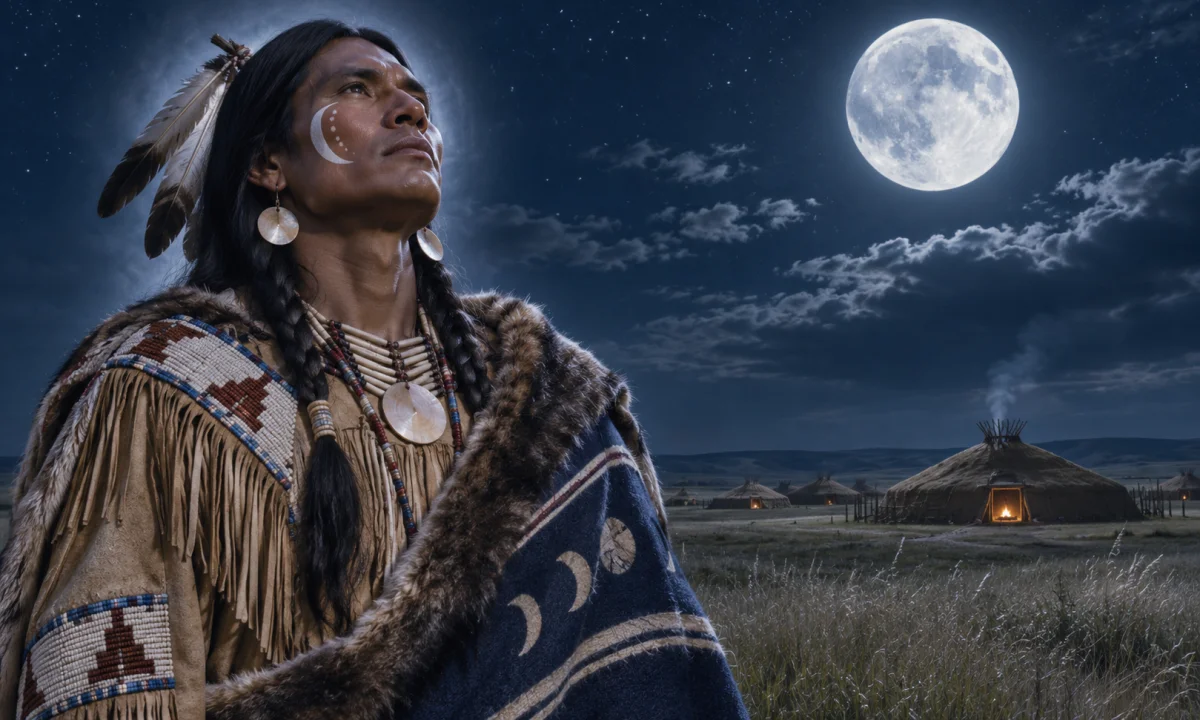
Pah is a lunar deity in Pawnee religious tradition, associated with the Moon and with the ordered movements of the heavens. The Pawnee are a Caddoan-speaking Indigenous nation of the Great Plains, historically centred in what is now Nebraska and later established in Oklahoma. English-language accounts commonly describe Pah as a male or masculine Moon figure and place him within a wider celestial order that includes Tirawa, the supreme creative power, and Shakuru, a solar deity. Because Pawnee religious knowledge was transmitted primarily through oral traditions, ceremonies, and sacred societies, surviving descriptions do not provide one complete, uniform biography of Pah.
Pawnee cultural setting
Pawnee religion understood the sky as an active realm inhabited by powerful beings. Stars, planets, the Sun, and the Moon were not merely physical objects. They formed part of a sacred structure that influenced life on Earth and expressed the intentions of the highest powers. Different Pawnee communities and ceremonial societies preserved particular bodies of knowledge, and not every tradition was shared publicly or recorded in the same way.
The Pawnee were traditionally divided into four principal bands: the Chaui, Kitkehahki, Pitahawirata, and Skidi. Their religious practices were not identical in every detail. The Skidi Pawnee are especially well known in historical ethnography for their elaborate cosmology and star ceremonies, but accounts of Pawnee religion may combine information from several communities or interpret Indigenous concepts through Christian or classical categories. Statements about Pah therefore need to be treated as descriptions of a documented tradition rather than as a single universally fixed doctrine.
Much of the surviving written material was recorded by outsiders, including missionaries, government officials, and ethnographers. Some observers worked closely with Pawnee religious specialists, while others translated names and ideas into terms such as “god,” “spirit,” “husband,” or “father.” These translations can be useful, but they do not always reproduce the meanings of Pawnee religious language exactly. Pah is consequently better understood as a sacred lunar being within Pawnee cosmology than as a simple equivalent of the Moon gods of Greek, Roman, or other mythologies.
Name and identity
The name Pah is the form most often used in English-language references to the Pawnee Moon deity. Spellings can vary in older publications because Pawnee words were transcribed according to changing English and scholarly conventions. The exact linguistic meaning and pronunciation should not be assumed from the English spelling alone.
Some accounts call Pah a “moon god,” while others describe Pah more broadly as the personified Moon. The difference matters. In many Indigenous traditions, a celestial being may be both the visible heavenly body and a powerful person or presence associated with it. Describing Pah only as an abstract deity can hide that relationship; describing Pah as a human-shaped god with a fully developed mythology can impose categories that the surviving Pawnee material does not necessarily support.
Pah is commonly paired with Shakuru, identified in English sources as the Sun or a solar goddess. This pairing reflects the complementary relationship between the Moon and the Sun: night and day, darkness and light, and two great celestial powers moving according to an ordered pattern. Sources differ in how they describe the relationship. Some present Pah and Shakuru as a divine couple, while others simply place them together as corresponding members of the celestial world. The available accounts do not justify treating every version as one standardized Pawnee story.
Place in Pawnee cosmology
Pah belongs to a sacred universe governed by relationships among celestial powers. At its highest level is Tirawa, often called Tirawa-Ahut in English sources. Tirawa is commonly described as the supreme creative power or as the source of the order that sustains the universe. The stars and major celestial bodies were understood as participants in that order, and human life was connected to it through ritual, agricultural practice, prayer, and observation of the sky.
Within this setting, the Moon was significant because it provided a visible measure of recurring time. Its changing phases offered a pattern of growth, disappearance, renewal, and return. The Moon’s regular movement through the night sky could be interpreted as evidence of cosmic order rather than as an isolated natural process. Pah’s importance therefore lies not only in lunar light but also in the place of the Moon within the balanced structure of the heavens.
It would be misleading, however, to assign every lunar association found in world mythology to Pah. Surviving Pawnee descriptions do not consistently give Pah a large collection of myths about tides, romantic love, hunting, madness, or the underworld. Such attributes belong to particular traditions elsewhere and should not be added simply because Pah is a Moon figure.
Attributes and symbolism
Pah’s principal attribute is the Moon itself. In artistic or explanatory representations, the figure may be shown as a human or human-like celestial being, but there is no single ancient Pawnee iconographic image of Pah comparable to the statues and painted forms associated with some Mediterranean gods. Pawnee religious knowledge was expressed through oral teaching, ritual action, sacred bundles, ceremonial objects, and relationships with the landscape and sky.
The Moon’s phases give Pah an association with change that is nevertheless orderly. The Moon appears to grow, diminish, disappear, and return, making it a powerful image of cyclical time. A lunar deity can consequently be connected with the measurement of periods, the planning of communal activities, and the recognition of seasonal patterns. These associations should be understood as interpretations of the Moon’s religious significance, not as a list of personal powers explicitly attributed to Pah in every Pawnee account.
Pah may also be understood in relation to the Sun. The two celestial bodies occupy different portions of the daily and nightly cycle, yet together they help make the world intelligible. Their opposition is not necessarily a conflict. In Pawnee cosmological thought, complementary powers could maintain balance by performing different but related functions. The Moon’s presence at night and the Sun’s power by day express a division that is also a cooperation.
Pah and other Pawnee star beings
Pah is sometimes mentioned alongside the Morning Star and the Evening Star, but these figures should not be confused with the Moon. Pawnee star traditions contain several celestial beings, and their identities can be obscured when English-language summaries reduce them all to “gods of the sky.” The Morning Star and Evening Star occupy an especially important place in accounts of Pawnee creation and ritual, while Pah represents the Moon.
The well-known Pawnee Morning Star ceremony, particularly associated with the Skidi Pawnee, involved the power of the Morning Star and the renewal of cosmic relationships. Historical descriptions of the ceremony are disturbing because they include the sacrifice of a captive girl in some nineteenth-century accounts. This practice was discontinued, and the surviving records reflect a particular historical period rather than an unchanging expression of all Pawnee religion. The ceremony belongs to the tradition of the Morning Star and should not be presented as a rite dedicated to Pah merely because both figures are celestial.
Some older summaries place several heavenly beings in family relationships or describe one celestial power as the offspring, companion, or counterpart of another. These relationships vary according to the source and the Pawnee community being described. Pah’s connection with Shakuru is widely repeated, but claims that Pah is consistently the parent of a particular star being should be treated cautiously unless tied to a specific traditional account. The recorded material does not support a single universally accepted family tree for all Pawnee celestial beings.
Religious significance
The importance of Pah is best understood through the Pawnee view of a living, ordered cosmos. Human beings were not separate from the heavens. Agricultural life, seasonal movement, communal ritual, and individual responsibilities existed within a universe shaped by powerful celestial relationships. Attention to the sky was therefore part of religious knowledge as well as practical observation.
The Moon’s recurring phases could represent continuity through transformation. A phase of darkness did not mean permanent loss, because the Moon returned. This pattern could support ideas of renewal and the persistence of cosmic order, although surviving sources do not provide a single Pawnee interpretation that explains every phase in the same way.
Pah also illustrates the limits of the word “mythology.” In popular English, mythology often means a collection of old stories about imaginary gods. For Pawnee communities, sacred traditions were connected to religious authority, ceremonial practice, kinship, land, and obligations toward the powers of the universe. Pah was not simply a character in an entertaining tale. The figure belonged to a religious world in which celestial beings helped explain how order, time, and human life were related.
Historical records and uncertainty
There is no single surviving Pawnee scripture that presents Pah’s complete identity in a definitive form. Knowledge of Pah comes from a combination of oral traditions, ethnographic records, translations, and comparative accounts of Pawnee cosmology. These materials differ in detail, terminology, and reliability.
Older writers sometimes interpreted Indigenous beings through familiar European categories. A celestial presence might be labelled a “god,” a “spirit,” or a “mythological personage,” even though none of those terms precisely captured the original Pawnee concept. Gender descriptions may also reflect English grammar and the assumptions of the recorder. For that reason, “male Moon god” is a useful conventional description, but it should not be treated as proof that Pah corresponds exactly to a European-style male deity.
It is also important not to generalize from Pawnee tradition to Native American mythology as a whole. Indigenous nations of North America have distinct languages, histories, and religious systems. A Moon being from Lakota, Anishinaabe, Navajo, Haudenosaunee, or another tradition is not automatically another name or version of Pah. Similar celestial themes may arise in different cultures without demonstrating a shared figure.
Distinguishing Pah from similar names
The short spelling Pah can create confusion. It may be mistaken for a word from another Indigenous language, for a place-name, or for a modern fictional character. Similar spellings also occur in unrelated mythological and religious traditions. These names should not be merged without evidence of a connection.
Pah should specifically be identified as the Pawnee lunar figure when the subject is the Moon deity associated with Pah and Shakuru. References that use “Pah” for a different community, a different language, or a different kind of spirit require separate treatment. Even within discussions of Pawnee religion, older transcriptions may not always refer to precisely the same concept, so the surrounding context matters.
Later reception
Pah has had little presence in mainstream modern popular culture compared with figures such as Coyote, Raven, or the Wendigo. The name occasionally appears in generalized lists of Native American gods, but such lists often remove figures from their specific nations and religious settings. Presenting Pah as a universal “Native American Moon god” is inaccurate and erases the distinctiveness of Pawnee tradition.
Modern references are most responsible when they identify Pah as a Pawnee lunar being, acknowledge variations in the surviving records, and avoid inventing a dramatic mythology where the evidence is limited. The figure’s significance rests less on a large catalogue of adventures than on Pah’s place within a Pawnee understanding of celestial order, complementary powers, and the relationship between the movements of the heavens and life on Earth.