WORLD
WORLD
Sakarabru
Sakarabru is an obscure name associated with African legendary tradition, but its identity is not securely established in the surviving English-language record. It is often described in modern compilations as a dangerous serpent or monster, sometimes connected with rivers, forests or remote places in West Africa. The spelling, cultural origin and physical description vary considerably, and there is no widely recognised body of traditional literature that provides a single authoritative account of Sakarabru.
Origins and cultural setting
The name Sakarabru is generally placed within the broad field of West African folklore. That label, however, covers many distinct peoples, languages and religious systems. West Africa is not a single mythological culture: stories from Sierra Leone, Liberia, Guinea, Côte d’Ivoire, Ghana and neighbouring regions belong to different historical and linguistic traditions. A name appearing in an English-language list of African monsters cannot automatically be assigned to all of these cultures.
Much African traditional knowledge has been transmitted orally. Folktales, accounts of spirits, warnings about dangerous places and stories connected with initiation or ritual knowledge were often preserved through performance rather than through written mythological books. Names could therefore acquire different spellings when recorded by travellers, missionaries, colonial officials, folklorists or later popular writers. A single local term may also be represented in several ways in English.
For Sakarabru, the available material is especially limited. The figure is frequently repeated in secondary lists of mythological creatures, but those short notices do not consistently identify a specific ethnic tradition, language or traditional narrative. As a result, claims about a precise homeland or a detailed ancient cult should be treated cautiously. The name may reflect a genuine local belief, a variant transcription, a regional story, or a later compilation that has detached a brief description from its original context.
Name and identity
Sakarabru is not a universally standard spelling. Forms such as Sakrabru or other phonetic variants may occur in retellings, although similar-looking names should not be assumed to refer to the same being. Without reliable information about the original language, it is difficult to determine the meaning of the name or whether the spelling represents an indigenous word accurately.
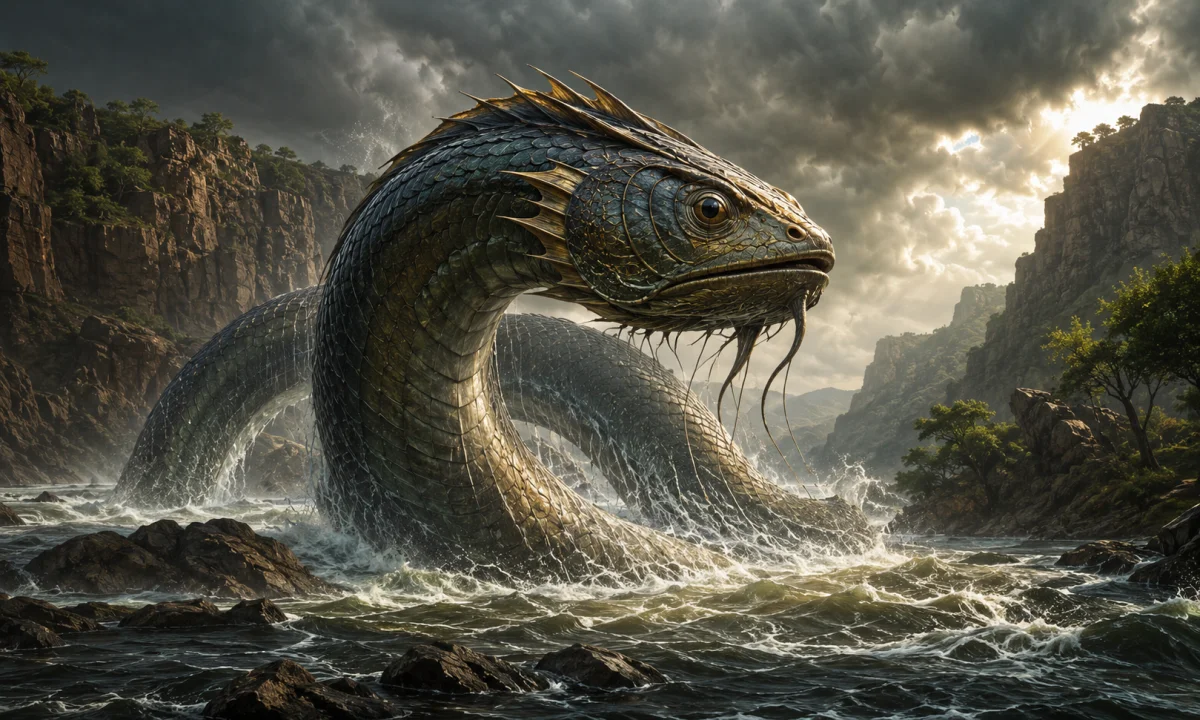
The figure is most often classified as a monstrous serpent in modern summaries. Some descriptions portray it simply as an enormous snake, while others give it unusual features, such as an ability to threaten human beings near water or in the wilderness. These details are not stable enough to serve as a definitive traditional profile. In particular, widely circulated claims about a human head, supernatural size, magical powers or a fixed habitat may belong to particular modern retellings rather than to a consistently documented older tradition.
It is also important to distinguish between a mythological being and a general belief in large snakes. West African environments contain many real snakes, including pythons and other species capable of inspiring fear and respect. A story about a dangerous snake, a river animal or an encounter in the bush does not by itself prove the existence of a named supernatural creature. Sakarabru becomes a distinct legendary figure only where the name and its associated qualities are part of a recognised narrative or belief system.
Appearance and nature
In the descriptions most commonly associated with the name, Sakarabru is a large serpent whose size and danger exceed those of an ordinary animal. The emphasis is usually on its threatening nature rather than on an elaborate appearance. It belongs to the broad family of giant snakes and monstrous reptiles found in the folklore of many parts of the world.
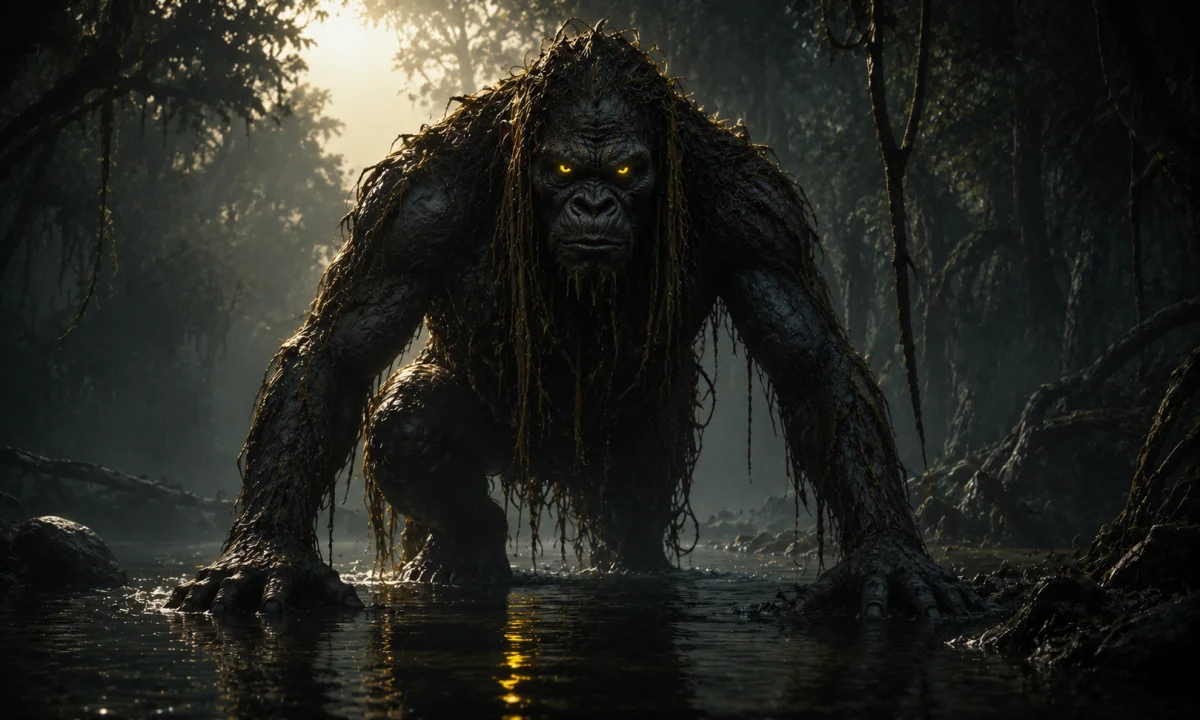
Some modern accounts give Sakarabru a more hybrid appearance, presenting it as a snake-like creature with human or otherwise abnormal features. Such details should not be treated as universal. They may result from attempts to make a short entry more dramatic, or from confusion with another African monster. There is no well-established iconography that defines Sakarabru in the way that the best-known African religious figures are defined through masks, sculptures, ritual objects or repeated artistic conventions.
The creature is commonly imagined as inhabiting places beyond ordinary settlement: thick forest, uncultivated land, caves, swamps or bodies of water. These settings are meaningful in folklore because they mark the boundary between the familiar human community and the dangerous unknown. They are not proof of a single traditional habitat, however. Different local stories may place threatening beings in rivers, groves, rocks or hills according to the landscape and concerns of the community telling them.
Role in folklore
Where Sakarabru is treated as a serpent monster, its narrative function is usually that of a dangerous guardian or predator. Such beings can explain why people should avoid certain places, travel with care or respect restrictions concerning water and wilderness. A monster may also personify the danger of entering territory associated with spirits, ancestors or powers outside ordinary human control.
There is not enough securely documented material to identify a canonical Sakarabru story, a fixed group of enemies or a recognised cycle of adventures. Accounts that present the creature as swallowing people, attacking travellers or dwelling in water should therefore be read as variant descriptions unless they can be tied to a specific local source. These motifs are common in serpent folklore and cannot, on their own, establish a distinctive Sakarabru tradition.
Serpent beings in African religions and folklore can have very different meanings. Some are feared as destructive monsters; others are associated with rain, fertility, rivers, political authority, healing, protection or communication between worlds. The sacred python traditions found in parts of West Africa, for example, should not be merged with stories about a predatory monster merely because both involve snakes. A serpent’s meaning depends on the particular society, ritual context and narrative in which it appears.
Symbolism and interpretation
If Sakarabru is understood as a giant serpent, its symbolic force may be connected with the dangers of the natural environment and with the limits of human control. A huge snake can represent hidden power: it moves silently, lives close to the ground or in concealed places, and can appear suddenly. In a story, this makes it effective as a warning against carelessness and as a personification of fear.
Water imagery, when present in a particular version, may add further significance. Rivers and pools are sources of food, transport and life, but they may also be hazardous. In many traditions, water is a place where human and spiritual realms meet. A being associated with water may therefore be more than an animal enlarged by imagination. It may mark a taboo location, a boundary or a place requiring ritual respect.
At the same time, interpretation must not outrun the evidence. It is tempting to assign Sakarabru a universal meaning such as “the spirit of the forest” or “the embodiment of evil,” but those claims are not supported by a stable, well-documented tradition under that name. The most responsible interpretation is provisional: Sakarabru appears in modern representations as a threatening serpent-like figure, while the original cultural meaning remains uncertain.
Distinguishing Sakarabru from similar figures
Sakarabru is easily confused with better-documented African serpent beings and monsters. Similarity of shape does not establish identity or shared origin.
- Ninki Nanka is a dragon-like or serpent creature associated in modern accounts with parts of West Africa, especially The Gambia. Descriptions vary, and it should not automatically be used to explain Sakarabru.
- Damballa is a major serpent deity in Haitian Vodou, with roots in West and Central African religious traditions. Damballa is a sacred divine figure, not simply a giant man-eating snake, and belongs to a specific religious system.
- Aido-Hwedo is a powerful cosmic serpent in Fon religious tradition, associated in accounts with the creation and support of the world. It should not be merged with a local monster described as a predator.
- Python cults and sacred pythons occur in several West African societies. These traditions involve ritual reverence and social or religious institutions, whereas a monster tale may present a serpent as a danger to be avoided.
- Grootslang belongs to South African colonial-era and modern legendary literature and is usually described as a colossal elephant-serpent hybrid. Its geographic and narrative setting are different from the uncertain material surrounding Sakarabru.
- Amphisbaena-like creatures and dragon figures in general world folklore may resemble modern illustrations of Sakarabru, but visual resemblance does not demonstrate a historical connection.
Sources, transmission and uncertainty
The main difficulty in discussing Sakarabru is the difference between a name’s circulation and the documentation of its tradition. A creature may appear repeatedly in encyclopaedias, websites and lists while still lacking a clearly traceable oral narrative, indigenous-language record or early ethnographic description. Repetition can make an uncertain claim look established even when later entries have copied one another.
Descriptions should therefore be separated into levels of confidence. It is reasonable to say that Sakarabru is commonly presented in modern English-language folklore material as an African serpent monster. It is less certain to identify the exact community from which the name comes, to provide a definitive translation, or to state that every version has the same appearance and powers. Claims that it is an ancient god, a universally known African demon or a major object of worship are not justified by the limited record associated with the name.
This uncertainty does not make the figure irrelevant. It shows how folklore changes as stories move between oral performance, local written records, colonial descriptions, reference books and internet culture. A local being may be renamed, simplified or grouped with unrelated creatures. Conversely, a name may survive in a short notice after much of the surrounding cultural context has been lost. Careful writing should preserve that uncertainty rather than replace it with invented precision.
Modern reception
Sakarabru has little established presence in widely known African religious practice, literature or international popular culture. Its modern visibility comes mainly from reference-style presentations of legendary animals and obscure mythological creatures. In these settings, it may be illustrated as a giant snake or transformed into a more dramatic monster for fantasy use.
Such adaptations are creative interpretations rather than evidence about the original tradition. A fantasy game, novel, illustration or online bestiary may give Sakarabru a fixed size, habitat, magical ability or genealogy that is absent from the uncertain folklore record. Those inventions can be enjoyed as modern fiction, but they should not be presented as traditional African belief without identifying the distinction.
The most accurate description of Sakarabru is consequently a cautious one: an obscure and variably described African legendary name, usually associated in modern accounts with a dangerous giant serpent. Its precise cultural origin, original meaning and traditional narrative remain uncertain, and it should not be conflated with the better-documented serpent deities and monsters of Africa and the African diaspora.