WORLD
WORLD
Quinoa-mama
Quinoa-mama is a name used for a mother or female spiritual presence associated with quinoa, the highland Andean grain known scientifically as Chenopodium quinoa. It is often presented in modern accounts as an Inca goddess of quinoa. That description should be treated cautiously. Unlike major Inca deities such as Inti, Viracocha, or Pachamama, Quinoa-mama is not securely documented as a distinct, widely worshipped goddess in the surviving early colonial records. The name is better understood as part of a broader Andean way of treating cultivated plants as living beings with maternal, protective, and sacred qualities.
Quinoa has been cultivated in the Andes for thousands of years, especially around the high plateaus of present-day Peru and Bolivia, as well as in parts of Ecuador, Chile, and Argentina. It was an important food before the expansion of the Inca state and remained important within the Inca Empire. The plant grows in difficult environments, including cold, dry regions at high elevation, and produces nutritious seeds in soils and climates where many other crops perform poorly. Its value made it economically important, ritually significant, and closely connected with the survival of Andean communities.
The name Quinoa-mama
The name is generally explained through two elements. Quinoa refers to the crop, while mama is a Quechua and wider Andean term meaning “mother.” Depending on context, mama can also convey ideas such as lady, source, origin, or respected female power. A name formed in this way does not necessarily identify a goddess with a fixed human-like personality. It may describe the spirit, life-force, or sacred mother of a crop.
Spelling varies considerably. English-language sources may write Quinoa Mama, Quinoa-mama, Quinua Mama, or use a Quechua-derived form such as Kinwa Mama. “Quinua” is common in Spanish, while “quinoa” is the usual English spelling. Regional Quechua orthographies and pronunciation also vary, so a single standardized spelling should not be assumed to represent all Andean traditions.
The term can therefore be used in two related but not identical senses. It may refer to a traditional conception of quinoa as a motherly or animate power within Andean agricultural religion. It may also refer to a named figure in modern summaries of Inca mythology. These uses should not automatically be treated as evidence that the Inca possessed a single, empire-wide goddess called Quinoa-mama.
Andean agricultural religion
Understanding Quinoa-mama requires attention to the religious world of the Andes rather than to the categories of classical mythology. Andean communities traditionally recognized sacred forces in mountains, springs, lakes, fields, ancestors, animals, and cultivated plants. A mountain could be approached as a powerful being, while a field or household might maintain relationships with protective spirits through offerings and ritual care.
In Quechua contexts, the word huaca or wak'a refers broadly to a sacred being, place, object, or manifestation of unusual power. The term does not correspond exactly to the English word “god.” A huaca might be a natural feature, an ancestral presence, a shrine, or a ritually important object. This flexible understanding helps explain why a crop’s spirit does not have to resemble a fully individualized deity in order to be sacred.
Andean religious relationships were often reciprocal. People gave offerings, observed ritual obligations, and respected the powers that made life possible. In return, they hoped for fertile fields, healthy animals, rain at the proper time, and protection from frost, drought, hail, and disease. Such reciprocity is often described with the Quechua concept of ayni, although its precise meaning and use vary across communities and historical periods.
Within this setting, a crop could be regarded as a relative, child, mother, or living participant in community life. Quinoa-mama belongs to this type of agricultural symbolism. The figure represents not only a plant but also the nourishment, labor, land, and inherited knowledge connected with growing it.
Quinoa in the Inca world
Quinoa was already an ancient Andean crop when the Inca state expanded during the fifteenth century. The Incas incorporated many local peoples, languages, customs, and sacred traditions into an imperial system centered on Cusco. They promoted certain state cults, especially those connected with the Sun, but they did not erase every local religious practice. Regional communities continued to maintain their own sacred places, ancestors, ceremonies, and agricultural customs.
Quinoa was especially important in the highlands where it could be cultivated alongside potatoes, tubers, maize in warmer zones, and other native crops. Its seeds provide substantial protein and can be stored after processing. The plant also has varieties adapted to different elevations and conditions. These practical qualities help explain why quinoa acquired meanings beyond its nutritional value.
Spanish colonial observers recorded aspects of Andean agriculture and religion, but their accounts were selective and shaped by Christian assumptions. Some writers tried to classify unfamiliar beings as “idols,” “devils,” or false gods; others focused on the institutions and ceremonies of the Inca state. Many local traditions were transmitted orally and were not recorded in detail. As a result, the absence of a figure from a colonial account does not prove that no community knew such a figure, but it does mean that broad claims about a universally recognized Inca goddess require caution.
Quinoa-mama and other crop mothers
Quinoa-mama is often compared with Mama Sara, the sacred mother or female spirit of maize. Mama Sara is more clearly represented in accounts of Andean agricultural religion, although the details differ among sources and regions. Maize held a particularly prominent place in Inca state ritual, food production, feasting, and the making of chicha, a fermented beverage. As a result, maize spirits received more attention in historical descriptions than quinoa-related powers often did.
Other Andean crops have likewise been associated with maternal or personified forces. Potatoes and other tubers could be treated as living gifts of the earth, and local communities maintained distinctive relationships with particular varieties. These traditions do not form one simple pantheon in which every crop has an identical goddess. Instead, they show a recurring religious pattern: food plants are active, valued beings whose well-being is connected with the well-being of the people.
Quinoa-mama should not be merged with Pachamama. Pachamama is a major earth-related figure in Andean religious life, especially in Quechua- and Aymara-speaking regions. Her name is commonly translated as “Earth Mother,” but her meaning is more expansive than the soil used for a single crop. Pachamama may be associated with fertility, land, time, mountains, weather, and the conditions of human existence. Quinoa-mama, when the name is used, has a much narrower association with quinoa and its harvest.
Nor should Quinoa-mama be confused with Mama Sara. Both names can be translated using the language of motherhood, and both may be connected with agricultural fertility, but Mama Sara concerns maize, whereas Quinoa-mama concerns quinoa. Their similarity reflects a shared Andean religious vocabulary rather than proof that they are the same being.
Attributes and symbolism
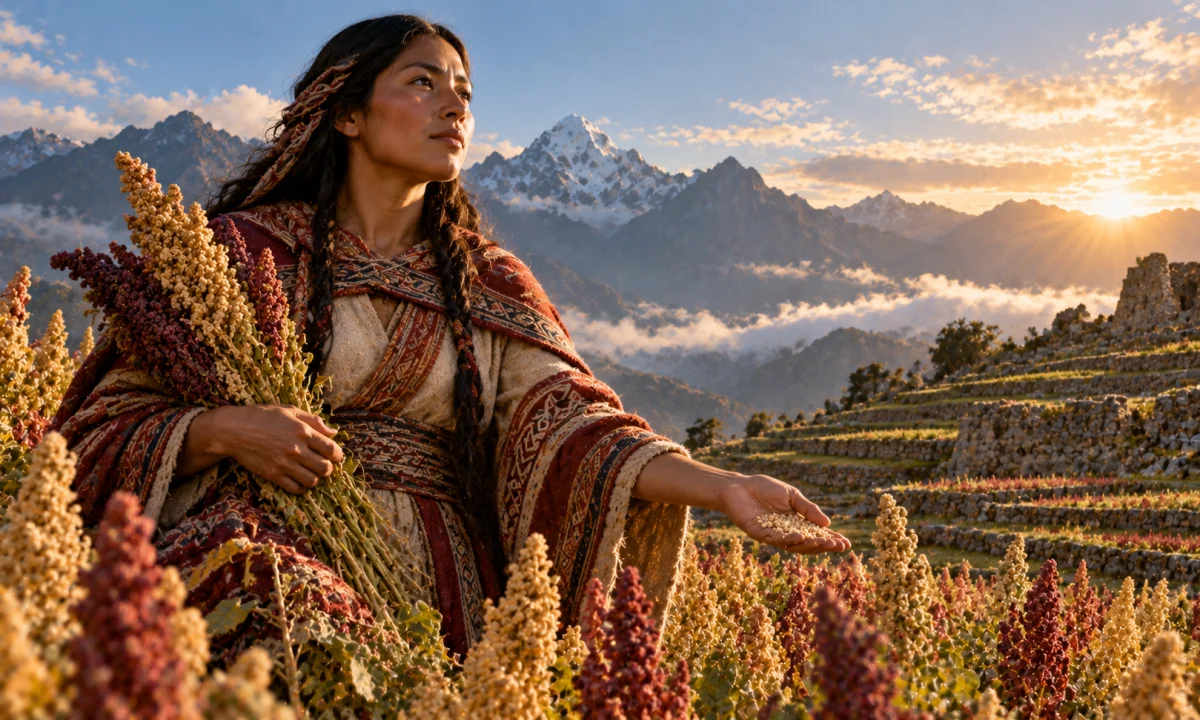
There is no securely established ancient description of Quinoa-mama’s physical appearance. Popular illustrations sometimes depict her as a woman wearing Andean clothing and carrying quinoa stalks, seed-filled baskets, or agricultural tools. Such images can communicate the idea of a crop mother, but they should not be presented as authenticated depictions from Inca art or a known pre-Columbian tradition.
Her most consistent symbolic attributes are therefore agricultural rather than bodily:
- Seeds and nourishment: Quinoa-mama represents the grain that sustains households, particularly in highland environments where food security can be precarious.
- Fertility: The figure expresses the capacity of the land and the plant to produce new life and future harvests.
- Maternal protection: “Mother” suggests care, continuity, and the responsibility of people to treat the crop respectfully.
- Resilience: Quinoa’s ability to grow in cold, dry, and elevated regions gives it a powerful association with endurance.
- Reciprocity: The harvest is not merely a natural resource; it is part of an exchange involving labor, offerings, land, weather, and community.
- Continuity: The seeds connect generations, since farmers preserve varieties and pass cultivation knowledge from one generation to another.
These meanings should not be turned into a fixed list of supernatural powers. There is no reliable evidence that Quinoa-mama was believed everywhere to control a particular disease, command a specific animal, or possess a standardized genealogy. Accounts that assign her an elaborate appearance, family, temple, or set of magical abilities may be drawing on modern invention rather than documented Andean tradition.
Ritual relationships with quinoa
Traditional Andean farming involved ceremonies and offerings whose exact form varied by locality, crop, season, and community. People might offer food, drink, coca leaves, chicha, flowers, or other valued substances to sacred powers. Agricultural work itself could be surrounded by prayers, songs, blessings, and rules concerning the first fruits or the beginning of sowing and harvest.
It is reasonable to associate a quinoa mother with these kinds of relationships, but specific rituals should not automatically be attributed to Quinoa-mama. Surviving evidence more often describes agricultural customs in general or local practices connected with Pachamama, mountain beings, ancestors, and household or field powers. A ceremony involving quinoa in one modern community is not necessarily an unchanged Inca rite, and a practice associated with Pachamama is not automatically a ritual dedicated to Quinoa-mama.
The treatment of the first harvest is particularly important in understanding crop personification. The first produce may be handled with respect, shared ceremonially, or offered to sacred powers before ordinary consumption begins. Such acts acknowledge that the community depends on forces beyond individual human control. Whether or not a local tradition uses the name Quinoa-mama, the underlying principle is consistent with the idea of the crop as a living partner rather than an inert commodity.
Sources, uncertainty, and historical interpretation
Knowledge of Inca religion comes from several imperfect sources: archaeology, Spanish colonial chronicles, Indigenous accounts written in or translated into Spanish, linguistic evidence, later ethnography, and continuing community traditions. Each source preserves some information while leaving other things unclear. Colonial records may describe state ceremonies more readily than household practices, and later writers may generalize from one region to the whole Andes.
For Quinoa-mama specifically, the evidence does not establish a single canonical mythology comparable to the stories told about better-documented Inca figures. There is no universally accepted ancient narrative explaining her birth, marriage, children, residence, or conflict with another deity. Claims that she was one of a fixed group of Inca goddesses, that she had a dedicated temple in Cusco, or that she appeared in a particular canonical creation story should be treated as unverified unless supported by precise historical evidence.
This uncertainty does not make the idea meaningless. A sacred crop need not have a formal temple cult or a detailed mythic biography. Religious concepts can be embedded in planting customs, names, songs, offerings, food preparation, and relationships between families and their land. Quinoa-mama may therefore be useful as a modern descriptive name for a traditional pattern of reverence, while remaining historically uncertain as the name of one standardized Inca deity.
Quinoa-mama in modern culture
Modern references often present Quinoa-mama in short lists of “Inca gods and goddesses.” These lists can make the figure appear more clearly defined than the evidence allows. They may also combine Quechua, Aymara, colonial, contemporary Indigenous, and New Age ideas without distinguishing their origins. A careful account should identify the figure as a crop-associated mother or spirit and state that the available documentation is limited and variable.
Quinoa’s global popularity has created new interest in its Indigenous history. The grain is now sold and discussed internationally as a nutritious food, while Andean farmers continue to cultivate many traditional varieties. This modern attention can raise awareness of the crop’s deep cultural setting, but it can also romanticize or simplify Indigenous religion. Treating Quinoa-mama merely as a decorative “goddess of healthy eating” removes the agricultural labor, community obligations, land relationships, and historical experience connected with quinoa.
The most responsible interpretation is therefore modest. Quinoa-mama names a maternal and sacred understanding of quinoa within the wider religious world of the Andes, but the figure is not securely documented as a single, universally recognized Inca goddess. Her significance lies in the way quinoa can be understood as a living source of nourishment, resilience, continuity, and reciprocal responsibility between people, crops, and the land.