WORLD

Sukreep
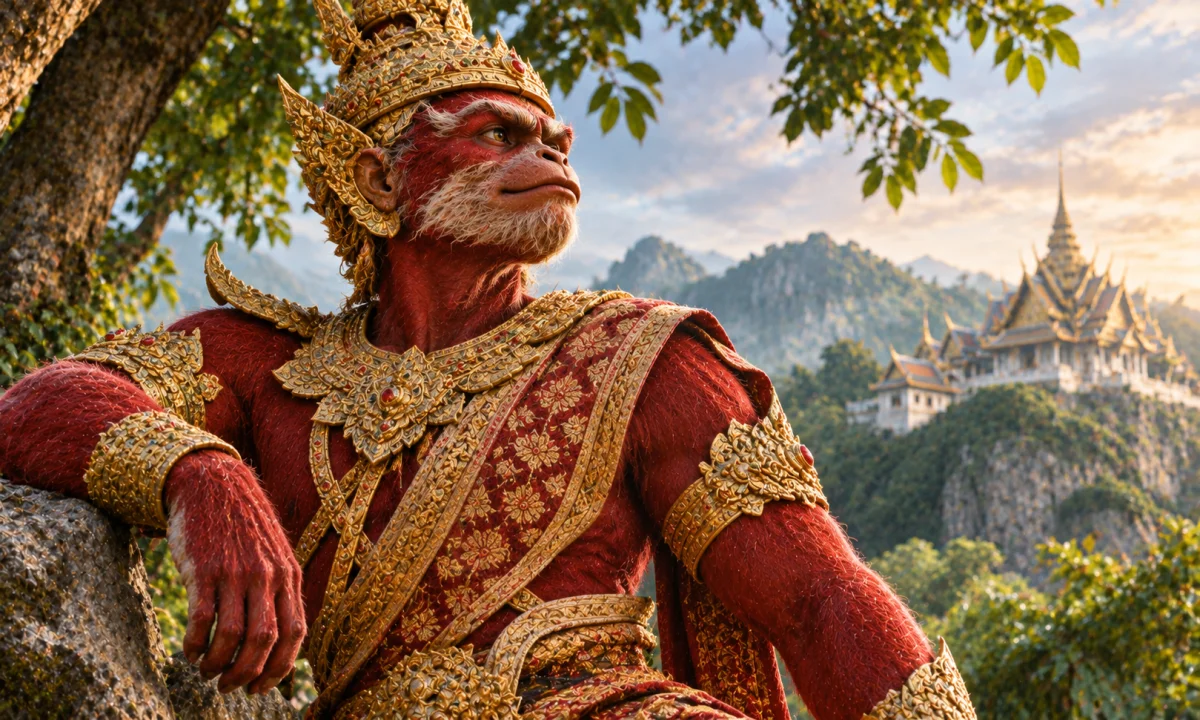
Sukreep is a monkey king and military leader in the Thai Ramakien, Thailand’s national epic and adaptation of the Indian Ramayana. He corresponds broadly to Sugriva, the vanara king who becomes an ally of Rama. Thai tradition presents Sukreep as a powerful but politically vulnerable ruler whose conflict with his brother Phali, the Thai equivalent of Vali, sets up one of the epic’s most important alliances.
Origins in the Ramayana tradition
The story of Sukreep belongs to the wider South and Southeast Asian tradition of the Ramayana. The oldest surviving Sanskrit versions describe Sugriva as one of the vanaras, forest-dwelling beings usually represented as monkeys or monkey-like people. He is the younger brother of Vali and a son of the sun god Surya in the commonly transmitted Sanskrit tradition.
Thailand did not simply translate the Indian epic. Thai poets, court writers, performers and artists reshaped the narrative over many centuries, giving its characters Thai names, visual styles, political relationships and dramatic qualities. The resulting Ramakien is closely related to the Indian story but is a distinct Thai literary and cultural tradition.
Much of the surviving Thai form took shape through royal literary culture during the late Ayutthaya and early Bangkok periods. Earlier versions were lost or damaged during the fall of Ayutthaya in 1767, and later rulers and court poets helped reconstruct and expand the epic. As a result, details can differ between literary passages, performance traditions, murals and modern retellings.
Sukreep is therefore best understood in two connected ways: he is the Thai form of the older Sugriva figure, and he is also a specifically Thai character within the world of the Ramakien. His identity cannot be explained fully by either the Sanskrit epic or modern popular descriptions alone.
Name and identity
The name is written in Thai as สุครีพ. Sukreep is a common English transliteration, although Sukrip, Su Kreep and other spellings may also be encountered. Romanisation varies because Thai vowels and consonants do not always have one universally used English equivalent.
The name ultimately corresponds to Sanskrit Sugriva, often written Sugrīva. English-language discussions sometimes use “Sugriva” when referring to the Indian Ramayana and “Sukreep” when discussing the Thai Ramakien. The two figures are closely related, but the names should not be treated as evidence that every detail of their stories is identical.
Sukreep is a vanara, not an ordinary animal monkey. In the epic tradition, vanaras are intelligent, speaking, organised beings who live in forest kingdoms and can act as warriors, messengers, scouts and rulers. Thai art generally represents them with human bodies, monkey faces and tails. Their animal features coexist with courtly clothing, weapons, titles and military ranks.
Appearance and traditional representation
In Thai visual culture, Sukreep is shown as an anthropomorphic monkey warrior or king. He may wear a crown, ornate armour, a patterned costume and the pointed headgear associated with important figures in Thai epic performance. His face, body colour and costume help distinguish him from other monkey commanders, although these features are not completely uniform across all periods and artistic contexts.
Thai murals, illustrated manuscripts, theatrical costumes and khon masked dance use visual conventions to identify the large cast of the Ramakien. The colours used for Sukreep and other vanara characters can vary between artistic traditions. A particular colour scheme should therefore not be treated as a universal mythological attribute.
Sukreep is usually portrayed as a mature and authoritative warrior rather than as a comic animal. His appearance communicates rank and experience. He belongs to the royal and military world of the monkey kingdom, while figures such as Hanuman are more often emphasised for daring, mobility, wit and extraordinary individual exploits.
Family and conflict with Phali
The central episode in Sukreep’s personal story is his conflict with his elder brother Phali. In the broad narrative shared with the Indian Ramayana, Phali and Sukreep rule the monkey kingdom together or stand within the same royal family. A quarrel arises after a demon challenges Phali to combat and flees into a cave.
Phali enters the cave to fight the demon. Sukreep waits outside, expecting his brother to return. After a long period, blood flows from the cave, and Sukreep concludes that Phali has been killed. In some versions he blocks the entrance and returns to assume royal responsibilities. When Phali eventually emerges alive, he interprets Sukreep’s actions as betrayal rather than as a fearful mistake.
Phali drives Sukreep from the kingdom and takes control of the throne. The precise sequence and emotional emphasis vary among versions, but the basic pattern remains important: a misunderstanding becomes a political rupture, and the younger brother loses both his home and his authority.
Sukreep takes refuge in the forest with a small group of followers. In the Sanskrit tradition, he is protected in a region where Phali cannot safely enter because of a curse connected with the sage Matanga. Thai retellings preserve the idea that Sukreep’s refuge is beyond Phali’s effective power, though the surrounding details may be presented differently.
This period of exile establishes Sukreep as a displaced king rather than a mere subordinate. He still possesses royal legitimacy and military knowledge, but he lacks the power to reclaim his kingdom alone. His need for an ally brings him into contact with Rama.
Alliance with Rama
Rama meets Sukreep while searching for Nang Sida, the Thai counterpart of Sita, who has been abducted by Thotsakan, the Thai form of Ravana. Hanuman helps establish communication between Rama and the exiled monkey king. Sukreep explains the history of his conflict with Phali and asks Rama to help restore him to the throne.
Rama agrees, while Sukreep promises to use the forces of the monkey kingdom to help locate and rescue Sida. Their agreement is a political and military alliance as much as a personal friendship. Rama needs a powerful network of scouts and warriors; Sukreep needs a champion capable of confronting Phali.
To demonstrate the seriousness of his claim, Sukreep presents Phali as a formidable opponent. In many versions, Rama confirms that he can defeat Phali, although Sukreep’s fear and uncertainty remain understandable because Phali has already overcome him. Rama then confronts the elder brother and kills him, commonly by shooting him from concealment while Phali is engaged in combat with Sukreep.
The killing of Phali is one of the most debated moral episodes in the Ramayana tradition. Phali questions Rama’s right to intervene in a quarrel between the monkey brothers and challenges the fairness of attacking him without an open duel. Rama offers reasons connected with justice, kingship and Phali’s conduct. Different retellings place different weight on these arguments.
The episode does not make Sukreep a simple hero or a villain. He is the beneficiary of Rama’s controversial decision, yet the conflict began through fear, misunderstanding and political resentment. His story raises questions about rightful rule, the obligations of allies and the difficult relationship between justice and power.
King and commander in the war
After Phali’s death, Sukreep is restored as king. In the Thai epic, this restoration is essential to Rama’s campaign against Thotsakan. Sukreep can summon the monkey armies, appoint commanders and organise the search for Sida across distant lands.
His royal position gives Rama access to a large and varied force of vanara warriors. The monkey armies are not a disorganised crowd: they include named generals, regional groups and specialised fighters. Sukreep’s authority helps transform Rama’s search from a private quest into a major military undertaking.
Sukreep’s role is particularly associated with command, counsel and responsibility. Hanuman receives greater attention in many famous episodes because of his leaps, disguises, battles and missions in Lanka, but Sukreep represents the political structure that makes those missions possible. He is the king who mobilises the forces, supports the alliance and participates in the campaign against Thotsakan.
He is also connected with other important monkey figures. Ongkhot, the Thai form of Angada, is the son of Phali. This makes Sukreep his uncle after Phali’s death. The relationship carries the memory of the family conflict into the new political order, since Phali’s son must serve in a kingdom now ruled by his father’s former rival.
Descriptions of Sukreep’s individual weapons, powers and battlefield actions vary. He is generally understood to possess the great physical strength and combat ability expected of a vanara king, but the Thai tradition does not always give him the same spectacular magical identity associated with Hanuman. Claims that he has one fixed set of supernatural abilities should therefore be treated cautiously unless they belong to a particular retelling.
Role in Thai religious and cultural life
The Ramakien is not a Buddhist scripture, and Sukreep is not a deity worshipped in the same sense as figures belonging to Thai Buddhist practice or local spirit traditions. Nevertheless, the epic has long occupied an important place in a predominantly Buddhist society. Its stories have been interpreted through ideas about kingship, moral conduct, loyalty, obligation and the consequences of harmful actions.
Thai kingship and court culture have played a major role in the preservation and presentation of the Ramakien. The epic provided a language of heroic rule and ideal authority, especially through the Thai image of Rama as a righteous and disciplined king. Sukreep’s story complements that ideal by showing a ruler whose legitimacy is restored through alliance, military competence and recognition by a greater king.
His character also reflects the importance of political loyalty. Sukreep must depend on Rama, but he is not merely Rama’s servant. He is a sovereign with his own kingdom, followers and interests. The alliance works because both parties exchange support: Rama helps Sukreep regain his throne, and Sukreep provides the forces needed for the campaign against Thotsakan.
The story is also performed through khon, the highly formal Thai masked dance-drama associated with the Ramakien. In khon, monkey characters are distinguished by masks, movements, costumes and choreographed combat. Sukreep’s stage identity depends on the conventions of the performance tradition rather than on a single fixed description found in every written version.
Large painted cycles of the Ramakien, especially those associated with the Temple of the Emerald Buddha in Bangkok, present episodes involving Rama, the monkey armies and the war against Thotsakan. Such images have helped preserve Sukreep’s place in public visual culture, even for people who have not read the full epic.
Meaning and interpretation
Sukreep can be interpreted as a figure of dispossessed kingship. He has a legitimate claim to rule but cannot secure it without outside assistance. His exile demonstrates that royal status alone does not guarantee safety or authority. Political power depends on alliances, military strength and the ability to command loyalty.
His relationship with Phali explores the danger of judging another person’s actions without knowing their intentions. Sukreep believes that Phali has died; Phali believes that Sukreep has deliberately betrayed him. Neither brother is free from responsibility, but the consequences of the misunderstanding are severe and irreversible.
The alliance with Rama introduces another layer of interpretation. Sukreep receives justice from a powerful outsider, yet that justice comes through a morally troubling act. The story therefore resists a completely simple division between right and wrong. It presents royal duty, personal grievance and political necessity as competing forms of obligation.
In the wider epic, Sukreep also represents the difference between leadership and individual heroism. Hanuman may carry out extraordinary missions, but Sukreep embodies the organisation of collective power. His importance lies less in a single magical feat than in his capacity to rule, recruit, advise and place a kingdom at the service of a larger cause.
Sukreep and similar figures
Sukreep should not be confused with Hanuman. Both are monkey warriors in the Thai Ramakien, but they have different identities and functions. Sukreep is a king, brother of Phali and political ally of Rama. Hanuman is a principal commander and heroic agent whose missions often drive the action forward.
He should also be distinguished from Phali, his elder brother. Their names can appear together in lists of monkey generals, but their stories are defined by opposition. Phali is the powerful ruler who expels Sukreep; Sukreep is the displaced ruler restored after Rama kills Phali.
Nor should the Thai figure be merged uncritically with every monkey king in Southeast Asian epic literature. Cambodia’s Reamker, Laos’s Phra Lak Phra Lam and Indonesian and Malay versions of the Ramayana contain related characters, but names, genealogies and narrative roles differ. Similarity reflects a shared epic family rather than complete identity.
Later reception
Sukreep remains recognisable in Thailand through school presentations, illustrated editions, theatre, dance, temple murals and public discussions of the Ramakien. His image may also appear in cultural tourism and decorative art alongside Hanuman, Rama and other epic figures.
Modern retellings sometimes simplify him into a strong monkey warrior or treat him mainly as one member of Rama’s army. Such portrayals can overlook the central facts of his traditional character: he is an exiled prince, a rival of Phali, a restored king and the political organiser of the monkey alliance. Contemporary adaptations may also alter his colours, costume, personality or powers for visual and dramatic purposes. Those changes belong to modern interpretation rather than to a single authoritative description of Sukreep in Thai tradition.