WORLD

Ramakien
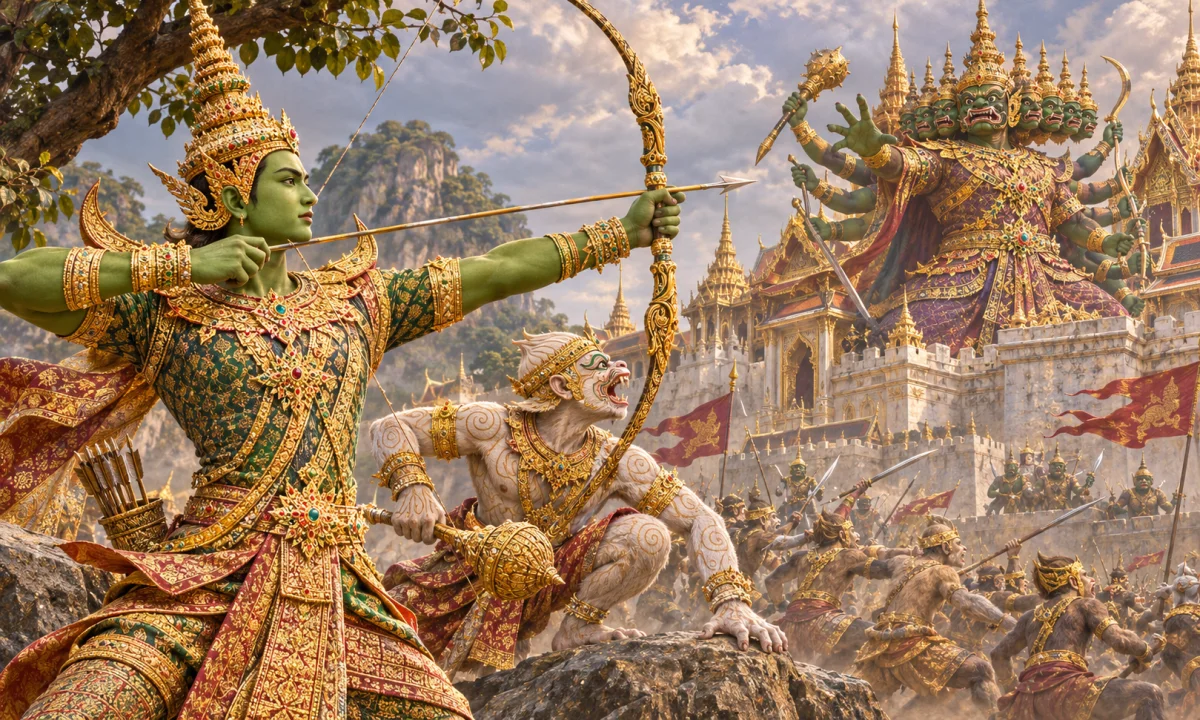
Ramakien is Thailand’s national epic and the most influential Thai adaptation of the Ramayana, the ancient South Asian story of Rama. It belongs to Thai literary, theatrical, visual and court traditions, but it is not simply a translation of the Sanskrit epic. Thai authors, performers and artists reshaped the narrative through local language, Buddhist ideas, older spirit traditions, royal ideology and the conventions of Thai dance-drama. Its central conflict remains the struggle between the righteous prince Phra Ram and the powerful demon king Thotsakan, who abducts Phra Ram’s wife, Nang Sida.
The name Ramakien is commonly understood as meaning “the glory of Rama” or “the story of Rama,” although transliteration and translation can vary. In Thai, it is usually written Ramakian or Ramakien in English-language systems. The work is best understood as a family of related Thai versions rather than as one text with a single, unchanged form.
Origins and cultural setting
The deeper source of the Ramakien is the broad Ramayana tradition of South and Southeast Asia. The Sanskrit Ramayana associated with Valmiki became one of the region’s most influential epic narratives, but it was transmitted through many languages, religious communities and performance traditions. Versions exist in India, Cambodia, Laos, Indonesia, Myanmar and elsewhere. Each developed its own characters, episodes, emphases and artistic forms.
Thai culture encountered the Rama story through the wider cultural world of mainland Southeast Asia. The Khmer court and literary tradition were especially important in the transmission of Indic epics into the region, although the precise routes by which particular stories entered Siam are difficult to reconstruct. The Thai Ramakien therefore reflects both an inherited regional narrative and a distinctly Siamese process of adaptation.
Earlier Thai versions probably existed during the Ayutthaya period, but much of the royal literary heritage of Ayutthaya was lost when the capital fell in 1767. The surviving canonical version is associated primarily with the early Rattanakosin period. King Rama I ordered or supervised the restoration and compilation of a Ramakien text in the late eighteenth century, generally dated to 1797. The work was part of a wider effort to rebuild court culture after the destruction of Ayutthaya.
King Rama II later adapted portions of the story for performance, particularly for khon, the highly stylised masked dance-drama traditionally performed by male actors. Other passages and dramatic forms developed under later rulers and court communities. Consequently, references to “the Ramakien” may mean the principal literary text, a particular performance version, the painted narrative at a temple, or the broader Thai tradition surrounding Rama’s story.
Religious and royal context
The Ramakien contains recognisably Hindu and Brahmanical elements, including gods such as Phra Isuan, the Thai form of Shiva, and Phra Narai, the Thai form of Vishnu. Phra Ram corresponds to Rama, who is understood in the Indian tradition as an incarnation of Vishnu. In Thai usage, however, these figures exist within a religious environment shaped strongly by Theravada Buddhism, local spirit beliefs and royal ritual.
Thai tradition does not always present the epic as a straightforward statement of Hindu theology. Phra Ram is a model of righteous kingship, self-control and commitment to duty. His authority can be connected with ideas of merit, moral order and the ideal Buddhist king, even though the narrative itself is not a Buddhist scripture. The gods, demons and monkey warriors belong to a shared mythic and literary universe rather than to a single exclusive doctrinal system.
The story also supported ideas about the sacred or exemplary nature of kingship. The Thai monarchy was historically associated with Rama through royal names adopted by the Chakri kings, beginning with King Rama I. This does not mean that Thai kings were simply treated as identical with the epic hero in every religious context. Rather, the name and narrative provided a powerful vocabulary for discussing legitimate rule, restoration, justice and the ordering of society.
The principal characters
- Phra Ram is the Thai counterpart of Rama. He is an exemplary prince and king, skilled in warfare and committed to honour, duty and rightful rule.
- Nang Sida is the Thai counterpart of Sita. She is Phra Ram’s wife, whose abduction by Thotsakan drives the central conflict. Her loyalty and endurance are major themes of the story.
- Phra Lak corresponds to Lakshmana, Rama’s devoted younger brother. He accompanies Phra Ram during exile and remains one of his most important allies.
- Hanuman is the celebrated monkey warrior and general. Thai performances often give him a more expansive and theatrically energetic role than many readers expect from the Sanskrit epic.
- Thotsakan is the Thai form of Ravana. He is the demon king of Longka, often identified with Lanka, and possesses great power, wealth and magical ability.
- Sukrip and Phali correspond broadly to Sugriva and Vali, rival monkey rulers whose conflict becomes connected with Phra Ram’s campaign.
- Phra Phrot and Phra Satrut are the counterparts of Bharata and Shatrughna, the other princes of Ayodhya.
- Mae Prapton, in traditions connected with the Thai epic’s divine genealogy, is among the figures linked to the birth and identity of the heroic monkey forces, although genealogical details vary between versions and explanations.
Thai names can appear in several English spellings because Thai words are transliterated in different ways. Thotsakan may also be written Tosakan or Totsakan, while Nang Sida may appear as Sida or Sita. These spelling differences do not necessarily indicate different characters.
Appearance and powers
Ramakien characters are often recognised through a highly developed visual language. In murals, manuscripts, costumes and masked theatre, gods, demons, humans and monkeys have distinct bodily forms, colours, crowns and facial features. These conventions are artistic classifications rather than fixed descriptions found in one universally authoritative text.
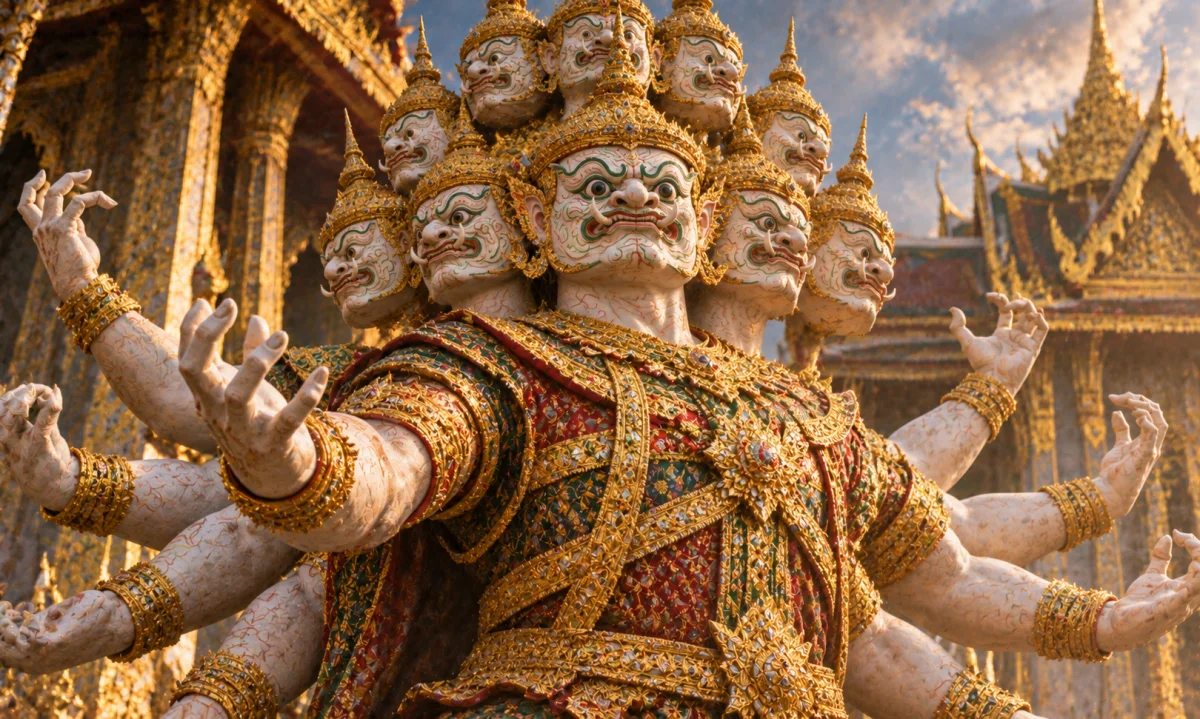
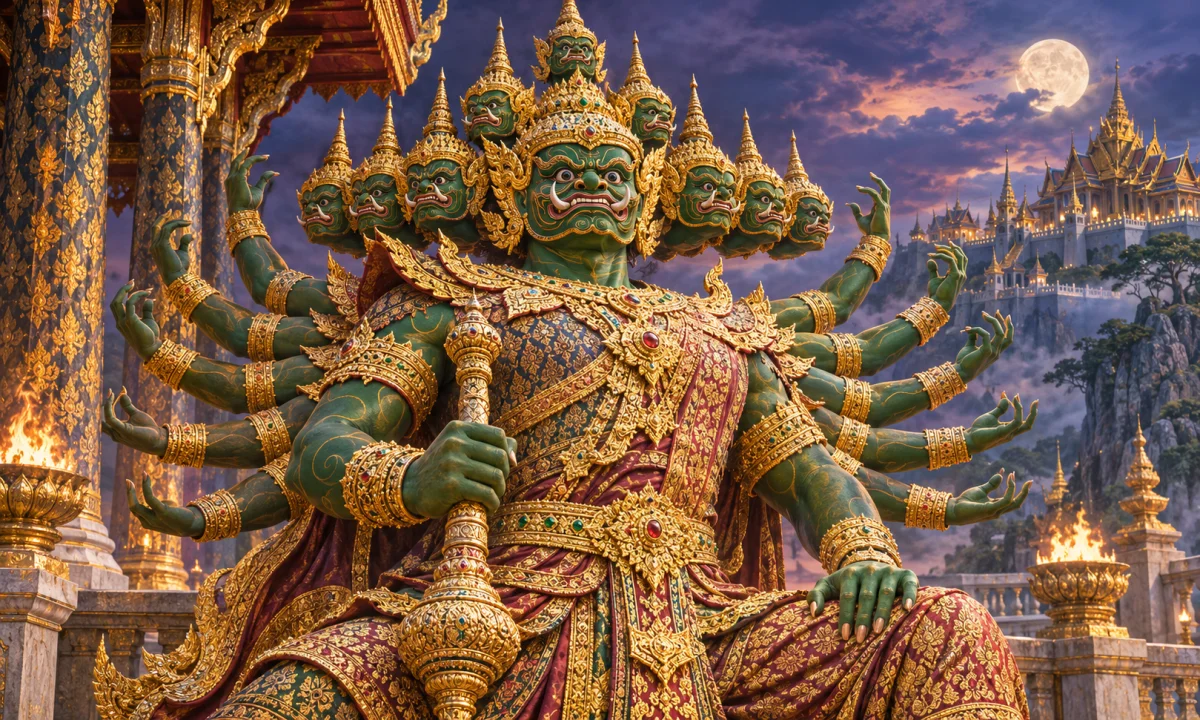
Thotsakan is typically shown with a green body and a complex crown, although the details of his appearance can differ according to the medium. His name is connected with his many faces, and Thai images often represent him with multiple crowned heads or with visual devices indicating supernatural multiplicity. He is not merely a monster without dignity: he is a powerful ruler, learned, wealthy and capable of devotion, but his pride, desire and abuse of power make him an enemy of moral order.
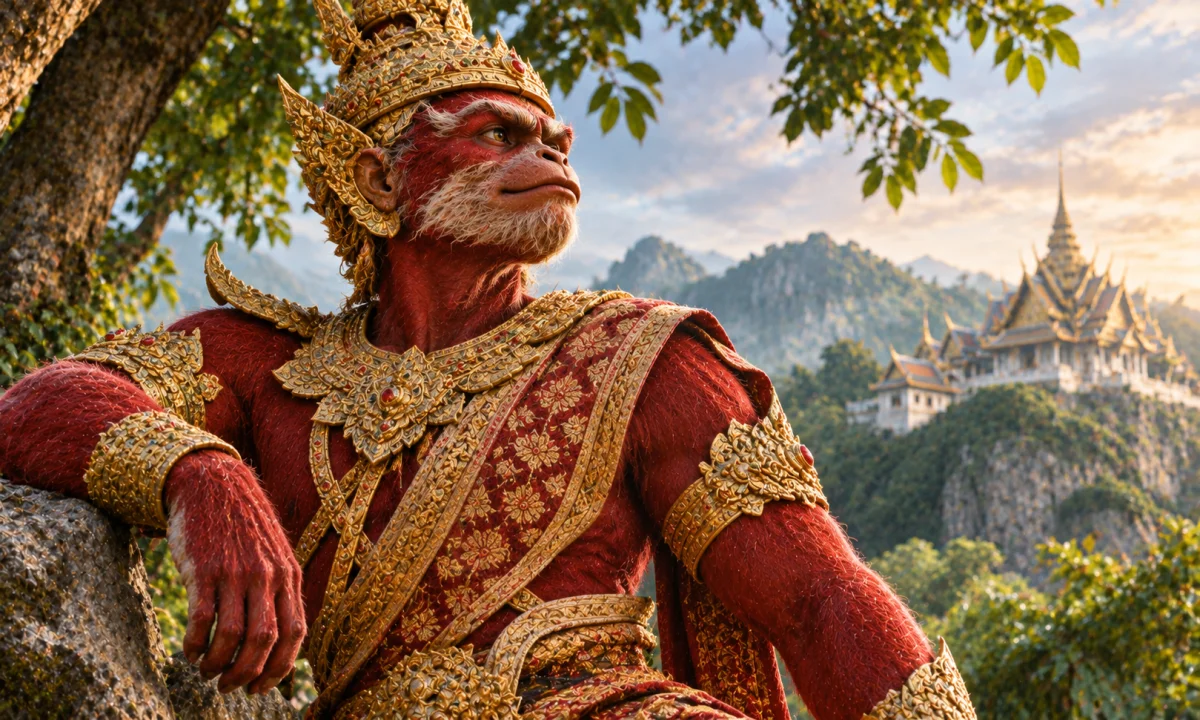
Phra Ram is commonly represented with a green complexion, while Phra Lak is often shown with a different colour scheme. These colours are conventions of Thai artistic representation, not signs that the characters are nonhuman. The monkey warriors have individual colours and forms, allowing audiences to identify them during a crowded battle scene. Hanuman is usually white and is marked by his monkey face, agile body and distinctive crown or headdress in performance.
Magical weapons, aerial travel, transformations, supernatural armies and divine interventions are common features of the epic. Hanuman’s strength, intelligence and ability to change form make him especially important in Thai theatre. He is a warrior, scout, messenger and comic or romantic figure, depending on the episode and performance tradition. These expanded qualities are a notable feature of the Thai adaptation and should not automatically be treated as descriptions of every version of the Indian Ramayana.
The central story
The narrative begins with the birth and destiny of Phra Ram, who is linked to Phra Narai and is born into the royal house of Ayodhya. Court intrigue eventually leads to his exile. Phra Ram leaves the kingdom with Nang Sida and Phra Lak, entering a forest world inhabited by ascetics, spirits, monsters and rival powers. Their departure tests the relationships between family loyalty, royal obligation and personal happiness.
Thotsakan becomes fascinated by Nang Sida and arranges her abduction. In many versions, the episode involves deception and a magical creature used to draw Phra Ram away from the place where Nang Sida is staying. Thotsakan carries her to Longka, where he attempts to persuade her to accept him. Nang Sida refuses him and remains faithful to Phra Ram, while Thotsakan’s court and family respond in different ways to his conduct.
Phra Ram searches for Nang Sida with the help of allies among the monkey armies. The alliance with Sukrip is connected with the succession dispute between Sukrip and Phali. Phra Ram assists Sukrip, and the resulting change in monkey leadership enables the search for Nang Sida to continue. Hanuman then becomes one of the principal agents of the rescue mission.
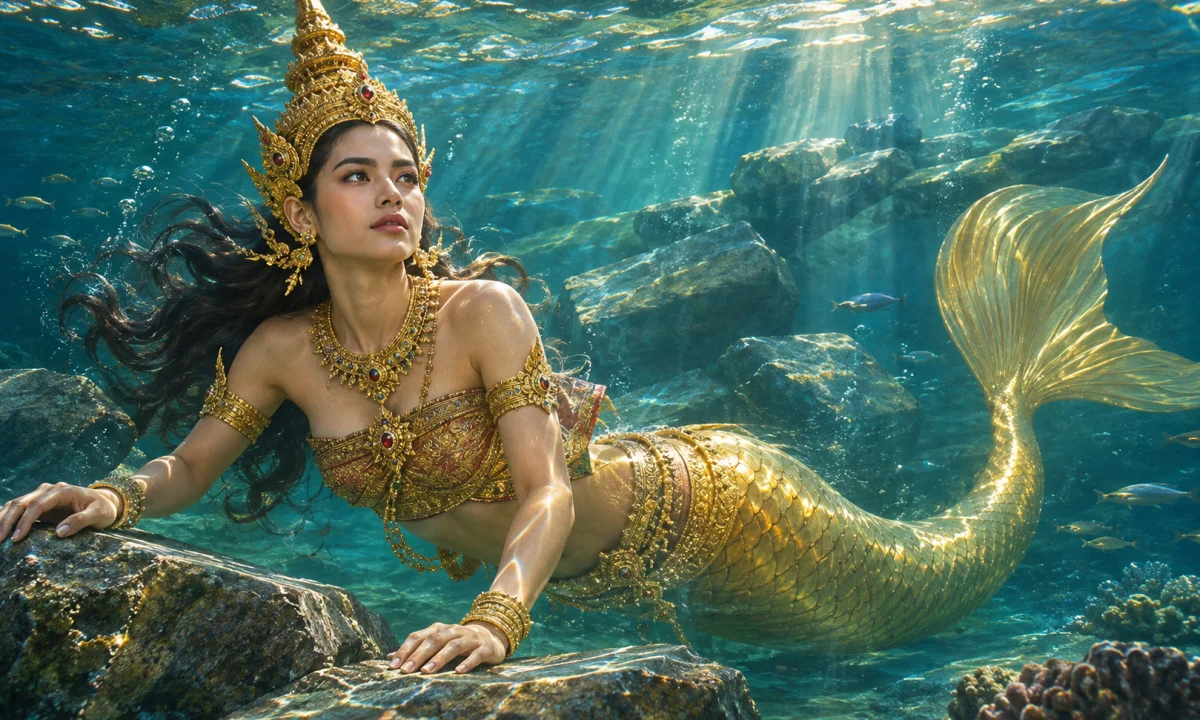
Hanuman’s journey to Longka, his discovery of Nang Sida and his acts of sabotage are among the best-known episodes in Thai performance. He is courageous and loyal, but also playful, inventive and fond of disguises. Thai versions add or elaborate episodes involving his encounters with female supernatural beings and other opponents. The episode of Suvannamaccha, a mermaid associated with Thotsakan’s forces, is particularly famous in Thai art and dance. She and Hanuman become connected through a romantic and adversarial encounter, although details differ among retellings.
After diplomacy and further attempts to recover Nang Sida fail, Phra Ram’s forces wage war against Longka. The battles involve giant warriors, magical weapons, flying chariots, enchanted landscapes and transformations. Thotsakan’s relatives and generals fight with distinct powers and personalities. Some, such as Phra Ram’s or Nang Sida’s sympathetic allies within Longka, complicate the division between the two sides.
The final conflict between Phra Ram and Thotsakan represents more than a contest between two individuals. It is a struggle between rightful conduct and destructive attachment, between a ruler who accepts obligation and one who uses authority to satisfy desire. Thotsakan’s defeat restores Nang Sida and removes a threat to the wider moral and political order. Yet the story does not always end in uncomplicated domestic happiness. Episodes concerning suspicion, separation and the testing of Nang Sida’s purity appear in different forms across the Ramayana family, and Thai versions vary in how they handle them.
Hanuman in the Thai tradition
Hanuman deserves special attention because his Ramakien identity is especially distinctive. In the Sanskrit epic, Hanuman is a devoted servant of Rama, a powerful warrior and a central hero. The Thai tradition preserves these qualities but often makes him more flamboyant, humorous and independent in tone.
Thai Hanuman can be a brilliant strategist and a fearless fighter, yet he is also associated with trickery, disguise, erotic adventures and comic energy. His encounters with Suvannamaccha and other women are widely represented in Thai dance and mural painting. These episodes do not replace his loyalty to Phra Ram, but they create a character who is more exuberant and theatrically versatile than the solemn devotional image familiar from some modern retellings.
His popularity reflects the flexibility of the Ramakien as performance literature. Masked theatre depends on recognisable movement, costume and character types, and Hanuman provides opportunities for acrobatics, combat, humour and dramatic surprise. The exact number and identity of his offspring, companions or romantic partners should not be assumed to be identical in every Thai text or performance.
Art, performance and public memory
The Ramakien is inseparable from Thai visual culture. The walls of Wat Phra Kaew, the Temple of the Emerald Buddha in Bangkok, are covered with an extensive mural cycle depicting scenes from the epic. These paintings are among Thailand’s most famous artistic representations of the story. They show battles, journeys, cities, armies and supernatural beings in a distinctly Thai pictorial style.
The mural cycle is not a neutral illustration of every line of the literary text. Artists arranged and interpreted episodes according to religious, courtly and visual purposes. Characters may be identified through costume, colour and emblematic features, while the composition places the epic within the ceremonial environment of Bangkok’s royal temple.
Khon is another major form through which the Ramakien survives. Performers wear elaborate masks representing demons and monkeys, while the principal human characters may perform without masks in accordance with established theatrical conventions. Dancers communicate through controlled gestures and stylised movement, accompanied by an ensemble and sung narration. A khon performance may present only selected episodes rather than the entire epic.
Other forms include literary recitation, school education, illustrations, puppetry and modern stage productions. The epic’s continued presence does not imply that every Thai audience treats it as literal sacred history. It functions simultaneously as classical literature, royal heritage, artistic repertoire, moral narrative and a familiar part of national cultural identity.
Interpretation and cultural significance
The Ramakien explores the obligations of rulers, spouses, siblings, allies and military leaders. Phra Ram’s conduct is often read through the idea of dharma, or righteous duty, though the term carries different meanings across Indian and Southeast Asian contexts. His willingness to accept exile demonstrates obedience to a moral and political order, while his campaign against Thotsakan presents kingship as a responsibility to protect the vulnerable and punish destructive wrongdoing.
At the same time, the epic does not offer simple moral categories in every episode. Thotsakan can be brave, cultured and devoted to members of his family even while acting unjustly. Some of his allies recognise the wrongness of his actions and advise him to return Nang Sida. The monkey heroes may be loyal and noble but also quarrelsome, impulsive or mischievous. Such contrasts give the narrative dramatic depth and allow performances to move between solemnity, violence, comedy and wonder.
Nang Sida’s role is often discussed in relation to idealised fidelity and feminine virtue, but she is not merely a passive prize. Her refusal of Thotsakan, her endurance in captivity and her moral firmness drive the emotional force of the story. Interpretations of her trials can reflect changing views about gender, authority and the demands placed upon exemplary women. Modern readers may also question the unequal burdens imposed on her by the heroic and royal order represented by Phra Ram.
The epic’s cultural importance is also visible in place names, royal symbolism, temple art and national performance traditions. Bangkok’s association with the royal name Rama has helped keep the connection between the epic hero and Thai kingship visible in public life. Nevertheless, the Ramakien should not be reduced to royal propaganda. Its survival depends equally on performers, artists, teachers, religious communities and audiences who have continually reinterpreted its characters.
Ramakien and related traditions
The Ramakien is closely related to, but distinct from, the Indian Ramayana. It shares the basic plot and many characters, yet its language, names, episodes, artistic conventions and emphases are Thai. It is also distinct from Cambodia’s Reamker, Laos’s Phra Lak Phra Lam and the many Indonesian versions of the Rama story. These traditions belong to a broad cultural family, but none should be treated as a mere regional translation of another.
The Thai epic should also not be confused with the historical King Rama I, Rama II or later Thai kings who used the name Rama. The royal title invokes the cultural prestige of the epic hero, but historical monarchs and the mythological Phra Ram are different figures. Likewise, Hanuman in the Ramakien is not identical to every Hindu, Buddhist or Southeast Asian representation of Hanuman, even though they share a common mythic ancestry.
Modern reception
Modern Thai education, theatre, television, illustration and tourism continue to draw on the Ramakien. Characters such as Hanuman and Thotsakan appear in contemporary visual design and popular entertainment, sometimes separated from the full narrative. Such uses may emphasise adventure, comedy, national heritage or spectacle rather than the epic’s religious and royal context.
International adaptations often simplify the story or combine details from the Sanskrit Ramayana with Thai imagery. A modern depiction of a masked demon, monkey warrior or green-skinned hero may be inspired by the Ramakien without reproducing a traditional Thai performance. The distinction matters because the epic’s meaning lies not only in its plot, but also in the artistic conventions, historical memory and cultural setting through which Thai communities have preserved it.