WORLD
WORLD
Paha
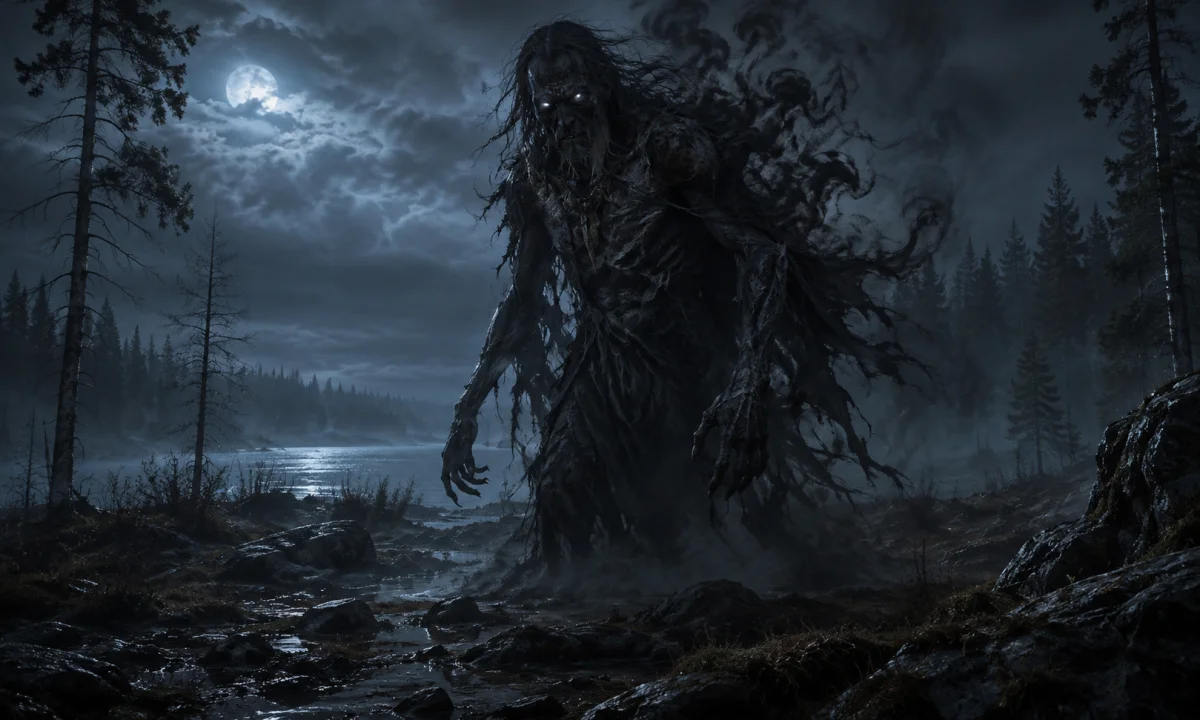
Paha is a Finnish word meaning “evil,” “bad” or “the evil one.” In discussions of Finnish mythology and folklore, it may be presented as a named supernatural being, but its status requires care. Paha is not securely documented as a single, independent pre-Christian Finnish god with a fixed biography, appearance or cult. More often, the word functions as a general designation for an evil force, a harmful spirit, the Devil or an unnamed supernatural enemy.
Origins and cultural setting
Finnish traditional religion developed through a combination of ancient Finnic beliefs, local spirit traditions and later Christian teaching. Before the Christianisation of Finland, people recognised many kinds of supernatural beings associated with nature, places, ancestors, illness, luck and human activity. These traditions did not form one uniform pantheon. Beliefs varied between regions and changed over time.
Christianity entered Finnish areas gradually, beginning during the medieval period and becoming institutionally established under Swedish rule. Older beliefs did not simply disappear. Instead, they often continued alongside Christian ideas or were reinterpreted through them. Spirits once associated with particular places could be described as demons, while older words for powerful or dangerous beings could acquire associations with the Christian Devil.
Within this changing religious environment, paha became a useful term for the forces opposed to God, Christian morality, health, social order and human well-being. It could refer to a specific hostile being in one account and to evil in a more abstract sense in another. The word therefore belongs to Finnish folklore and religious vocabulary more clearly than it belongs to a fixed mythological genealogy.
Much of what is known about Finnish traditional belief comes from oral poetry, incantations, charms, legends, Christian records and folklore collections made mainly in the eighteenth, nineteenth and twentieth centuries. The Kalevala, compiled by Elias Lönnrot and first published in the nineteenth century, is important for the history of Finnish cultural identity, but it is not a direct transcript of an ancient Finnish scripture. Its poems were selected, edited and arranged from oral materials. References to evil in the Kalevala and related poetry should therefore not automatically be treated as evidence for a single deity named Paha.
The name Paha
In Finnish, paha is an ordinary word. Depending on context, it can mean bad, wicked, harmful, difficult or evil. As a noun, it may denote evil itself or an evil thing. Finnish folklore also uses related forms such as paholainen, usually translated as “the Devil” or “the evil one.” These words are connected linguistically, but they are not interchangeable in every traditional context.
The spelling Paha, with a capital letter, is often used in modern mythological catalogues and popular reference works to turn the general concept of evil into a personified figure. Traditional Finnish texts do not always support that treatment. Capitalisation may be an editorial choice rather than evidence that Finnish storytellers consistently regarded Paha as the proper name of one particular being.
This distinction is especially important because Finnish folklore frequently personifies abstract powers. “Evil” may speak, act, attack or be driven away in a charm without possessing the stable identity of a god or demon in the theological sense. A hostile force might also be identified through a more specific term, such as a devil, a harmful spirit, an illness-being or an enemy of Christian power.
Identity and classification
Paha is best classified as a personification or designation of evil in Finnish folk belief, rather than as a clearly defined member of a pre-Christian pantheon. In some descriptions, Paha is treated as an evil spirit or demonic power. In others, it is effectively a Finnish equivalent of the Christian Devil. Still other uses are purely descriptive: a dangerous creature, a malicious person or an unfortunate influence may be called paha without reference to a named supernatural character.
There is no widely agreed traditional account giving Paha a particular parentage, spouse, dwelling place or set of adventures. Nor is there strong evidence for a separate Finnish cult devoted to Paha. The figure’s meaning comes from opposition: Paha represents what harms, corrupts, deceives or violates the desired order of life.
Finnish folk religion often understood the world as vulnerable to forces that could cause disease, accidents, crop failure, infertility, fear or social conflict. These forces were not always neatly separated into “gods,” “demons” and “natural causes.” A spoken charm, an offering, a Christian prayer or a practical remedy could all form part of an attempt to restore protection and balance.
Attributes and appearance
Paha has no consistent traditional appearance. When represented as an abstract evil, Paha may have no body at all. When treated as a supernatural adversary, the figure can take whatever form is appropriate to the story or belief: a threatening stranger, a tempter, a devilish creature or an unseen influence.
Images of a horned, cloven-hoofed or red-skinned devil belong primarily to wider European Christian demonology and later artistic convention. Such imagery may be used to illustrate Finnish references to Paha or paholainen, but it should not be presented as a uniquely Finnish attribute. Finnish folklore itself does not provide one universally recognised physical portrait of Paha.
Some accounts of evil powers associate them with darkness, wilderness, fire, disease, pollution or dangerous boundaries. These associations are common across folklore and do not necessarily identify one being. The forest, for example, was not simply an evil place in Finnish tradition: it could be a source of game, materials and spiritual power, while also containing beings and dangers beyond ordinary human control.
Roles in Finnish folklore
Source of harm and misfortune
The most general role of Paha is to explain or personify harm. Evil could be imagined as entering a household, body or community and producing sickness, quarrels, bad luck or moral disorder. In an incantation, the problem might be addressed as though it were an opponent that could be named, commanded or expelled.
Traditional healing in Finland included charms that drew on several religious layers. A charm might invoke Christian figures such as God, Jesus or the Virgin Mary, while also using older poetic ideas about origins, names and the proper order of things. The harmful force could be told to leave, return to its source or lose its power. References to “evil” in such material do not always indicate a demon with an individual personality; they may describe the condition being removed.
Opponent of protection and order
Paha can also be understood as the opposite of protective power. In Christian-influenced folklore, God, Christ, angels, saints and the Church stood on one side, while the Devil and other demonic forces stood on the other. In older or mixed traditions, protection might come from a knowledgeable healer, a powerful word, a sacred object, a household custom or a respected local spirit.
This opposition was not merely theological. It expressed practical concerns about how people should behave toward one another, how illness and danger should be managed and how vulnerable members of a community could be protected. Calling an action or influence paha could therefore carry moral, social and ritual meanings at the same time.
Temptation and deception
Where Paha is understood through the Christian Devil, the figure may tempt people, deceive them or lead them away from proper belief. These themes are common in Christian storytelling throughout Europe and should not be mistaken for uniquely Finnish mythology. Finnish versions were shaped by local language, storytelling habits and rural experience, but the underlying idea of the Devil as an adversary of God came from Christian tradition.
Relationships with other Finnish figures
Paha should not automatically be merged with every Finnish being later described as evil. Several names in Finnish mythology have complicated histories because Christian writers, folklore collectors and modern interpreters often classified older beings as demons.
Paholainen is more specifically associated with the Devil or an evil spirit. It derives from the same linguistic root as paha, but it is normally a more person-like designation. Depending on the source, Paholainen may be an ordinary word for the Devil rather than the name of a distinct character with an independent mythology.
Perkele is another important example. In modern Finnish, it is a strong swear word, but its history is connected with older Baltic and Finnic religious terminology and with Christian reinterpretation. It should not be treated simply as an alternative spelling or guaranteed synonym for Paha. Its meaning has changed across historical and linguistic contexts.
Hiisi originally referred in Finnic tradition to a sacred place, grove or locality and may also have been associated with a local spirit or supernatural power. In Christianised usage, hiisi could become a term for a demon or heathen being. This later demonic meaning does not erase its older religious context, and Hiisi is not merely Paha under another name.
Lempo likewise has a complex history. In some contexts the name is connected with a powerful or dangerous being, while later Christian interpretation associates it with demonic forces. Lempo has particular traditions and uses that should be considered separately rather than absorbed into a general category of evil.
Louhi, the powerful mistress of Pohjola in the Kalevala, is sometimes portrayed as a villainous witch or antagonist in modern retellings. She is not the same as Paha. Her role in the epic concerns the realm of Pohjola, magic, conflict and opposition to Väinämöinen and other heroes. Treating every hostile female or supernatural figure as Paha obscures the differences between Finnish stories.
Paha in epic poetry and folklore collections
Finnish oral poetry often uses repeated formulas, contrasting forces and broad descriptive terms. Words for evil may appear in scenes involving illness, magic, warfare, curses or supernatural enemies. A poetic reference to “the evil one” does not necessarily provide a character biography. The meaning may depend on the particular performance, region and surrounding verses.
The publication of the Kalevala encouraged readers to look for a Finnish mythology comparable to the pantheons of Greece or Scandinavia. This encouraged useful preservation and study, but it also led some later interpretations to organise fluid oral traditions into a more systematic cast of named gods and demons than the original material warrants. Paha is especially vulnerable to this process because an abstract word can easily be mistaken for the proper name of a single mythological person.
Folklore records also reflect the perspectives of the people who collected them. Collectors often wrote down stories in Christianised communities where older beings had already been reinterpreted. A narrator might use “the Devil,” “the evil one” or a local name according to the situation. Consequently, Finnish references to evil must be read within their historical and linguistic setting rather than assembled into one uniform doctrine.
Symbolism and cultural significance
Paha expresses the problem of vulnerability: illness can enter the body, misfortune can strike without warning and human intentions can be corrupted. As a personification, evil makes these threats imaginable and addressable. It can be confronted through words, ritual, prayer, knowledge and communal action.
The concept also marks boundaries. A person, practice or place called paha may be considered dangerous, morally wrong, ritually unsuitable or simply harmful. The word does not always describe an independent supernatural substance. It can be an evaluation of conduct or circumstance, as well as a name for an unseen power.
Finnish traditional culture therefore does not present a simple division between a benevolent native pantheon and one clearly defined evil deity. Religious life was layered. Older ideas about spirits and sacred places interacted with Christian teachings about sin, demons and divine protection. Paha belongs to this interaction and is most accurately understood as a flexible term through which evil could be described, embodied or opposed.
Later reception
Modern books, websites, games and fantasy settings sometimes list Paha as though it were a Finnish demon with a fixed appearance and established mythology. Such presentations can make the name easier to use in fictional world-building, but they often give it a sharper identity than the historical evidence supports. A horned demon named Paha may be a modern adaptation of Finnish vocabulary and Christian imagery rather than a direct survival of an ancient Finnish character.
In contemporary Finnish, the word remains part of ordinary language and religious vocabulary rather than functioning only as the name of a mythological being. Its traditional significance is best preserved by recognising the range of meanings it could carry: badness, moral evil, harmful influence, a demonic adversary or an unnamed force opposed to health and order. Paha is therefore important not because it possesses a long, fixed mythic biography, but because it reveals how Finnish beliefs understood and named the powers that threaten human life.